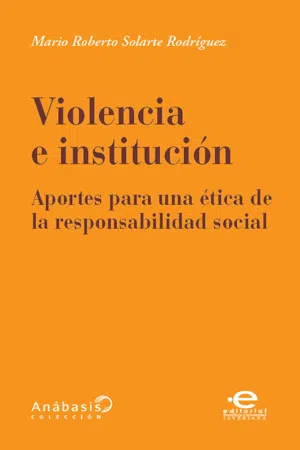
La responsabilidad social de las organizaciones usualmente es debatida desde muchos puntos de vista. Parte de los problemas reside en su fundamentación filosófica, que suele hacerse a partir de las teorías del utilitarismo o de las éticas relativas al contrato social. Cuando se recurre a la mirada teológica, se fundamenta desde la doctrina social de la Iglesia. Violencia e institución. Aportes técnicos para una ética de la responsabilidad social ofrece una perspectiva novedosa y radical sobre el problema de la responsabilidad social de las instituciones. En el libro se ponen en diálogo a los dos mayores pensadores cristianos de los últimos dos siglos: G. W. F. Hegel y René Girard, para discutir sobre el problema que tienen las organizaciones de asumir su propia violencia, la cual muchas veces resulta invisible desde su perspectiva. No solo es novedosa la comprensión de la violencia y su nexo con las formas humanas de organización, sino la posibilidad que representa el reclamo que hacen las víctimas por la acción responsable.
Acevedo, Alma. “Personalist Business Ethics and Humanistic Management: Insights from Jacques Maritain”. Journal of Business Ethics, 105 (2012): 197-219.
Adams, Rebecca. “Loving Mimesis and Girard’s ‘Scapegoat of the Text’: A Creative Reassessment of Mimetic Desire”. En Violence Renounced: René Girard, Biblical Studies and Peacemaking, editado por Willard Swartley, 277-307. Telford: Pandora Press, 2000.
Ahumada, Consuelo. El modelo neoliberal. Bogotá: El Áncora, 1996.
Alberg, Jeremiah. A Reinterpretation of Rousseau: A Religious System. New York: Palgrave Macmillan, 2007.
Alison, James. Conocer a Jesús. Cristología de la no-violencia. Salamanca: Secretariado Trinitario, 1994.
Anspach, Mark. “Violence against Violence: Islam in Comparative Context”. En Violence and Sacred in the Modern World, editado por Mark Juergensmeyer, 9-29. London: Frank Cass & Co., 1992.
Argandoña, Antonio y Ricardo Isea, “iso 26000, una guía para la responsabilidad social de las organizaciones”. En Cuadernos de la Cátedra “la Caixa" de Responsabilidad Social de la Empresa y Gobierno Corporativo, n.° 11 (2011).
Arias, Gonzalo. “Pacifismo y militarismo”. En Conceptos fundamentales de ética teológica, editado por Marciano Vidal. Madrid: Trotta, 1992.
Aristóteles. Metafísica. Edición de Valentín García Yebra. Madrid: Gredos, 1982.
_________.Ética a Nicómaco. Edición bilingüe y traducción de María Araujo y Julián Marías. Madrid: Instituto de Estudios Políticos, 1970.
_________.Física. Traducido por Ute Schmidt Osmanczik. México: Universidad Nacional Autónoma de México, 2001.
_________. Posterior Analytics. Traducido por Jonathan Barnes. Oxford: Clarendon Press, 1993.
Arizkuren Eleta, Amaia. “Una aproximación al ambiguo concepto de responsabilidad social de la empresa”. Revista Estudios Empresariales, n.° 89 (1995): 10-14.
Arrow, Kenneth. “Rawls’s Principle of Just Saving”. Swedish Journal of Economics 75 n.° 4 (1973): 323-335.
Assman, Hugo, ed. Sobre ídolos y sacrificios. San José de Costa Rica: Departamento Ecuménico de Investigaciones, 1991.
Astell, Ann. “Maternal Compassion in the Thought of René Girard, Emil Fackenheim and Emanuel Lévinas”. Contagion: Journal of Violence, Mimesis and Culture, n.° 11 (primavera 2004): 15-23.
Bandera, Cesáreo. The Sacred Game: The Role of the Sacred in the Genesis of Modern Literary Fiction. Pennsylvania: The Pennsylvania State University Press, 1994.
Barberi, Maria Stella. La spirale mimétique. Dix-huit legons sur René Girard. Paris: Desclée de Brouwer, 2001.
Barnes, Jonathan, ed. The Cambridge Companion to Aristotle. Cambridge: Cambridge University Press, 1999.
Bartlett, Robert C., y Susan D. Collins, eds. Action and Contemplation. Studies in the Moral andPolitical Thought of Aristotle. New York: State University of New York Press, 1999.
Bataille, Georges. L’érotisme. Paris: Plon, 1965.
Beiser, Frederick, ed. The Cambridge Companion to Hegel. Cambridge: Cambridge University Press, 1993.
Bentham, Jeremy. An Introduction to the Principles of Morals and Legislation. Oxford: Oxford University Press, 1996.
Bertonneau, Thomas F. “The Logic of the Undecidable: An Interview with René Girard”. Paroles Gelées, n.° 5 (1987): 1-24.
Bjørnar Grande, Per. Mimesis and desire: an analysis of the religious nature of mimesis and desire in the work of René Girard. Koln: Lambert Academic Publishing, 2009.
Blackburn, Simon, ed. The Oxford Dictionary of Philosophy. Oxford: Oxford University Press, 1994.
Blake Tyrrel, William. The sacrifice of Socrates: Athens, Plato, Girard. East Lansing: Michigan State University Press, 2012.
Borradori, Giovanna, ed. La filosofía en una época de terror. Diálogos con Jürgen Habermasy Jacques Derrida. Madrid: Taurus, 2003.
Bouchard, Larry D. “Playing Nothing for Someone: Lear, Bottom, and the Kenotic Integrity”. Literature & Theology 19, n.° 2 (junio 2005): 159-180.
Brennan, Michael. “Incentives, Rationality and Society”. Journal of Applied Corporate Finance 7, n.° 2 (1994): 31-39.
Brenner, S. N. y P. L. Cochran. “A Stakeholder Theory of the Firm: Implications for Business and Society Theory and Research”. En Proceedings of the second annual meeting of the International Association for Business and Society, editado por J. F. Mahon, 449-467. International Association for Business and Society, 1991.
Brophy, Matthew. “Spirituality Incorporated: Including Convergent Spiritual Values in Business”. Journal of Business Ethics, 2014. DOI 10.1007/ s10551-014-2337-y.
Buchholz, Rogene y Sandra Rosenthal. “Social Responsibility and Business Ethics”. En A Companion to Business Ethics, editado por Robert E. Frederick, 303-322. Oxford: Blackwell Publishers, 2002.
Butler, Judith. Subjects of Desire. Hegelian reflections in Twentieth-Century France. New York: Columbia University Press, 1999.
Byrne, Edmund. “Business Ethics: A Helpful Hybrid in Search of Integrity”.
Journal of Business Ethics, n.° 37 (2002): 121-133.
Castiñeira, Ángel y Josep M. Lozano. “¿Qué puede aportar el debate ético contemporáneo a los científicos?”. Cuadernos de Bioética 3, n.° 2 (1998): 37-53.
Catecismo de La Iglesia Católica. Ciudad del Vaticano: Librería Editrice Vaticana, 1992.
Ciulla, Joanne B., Clancy Martin y Robert C. Solomon. Honest Work: A Business Ethics Reader. New York: Oxford University Press, 2007.
Clarke, Paul y Andrew Linzey. Dictionary of Ethics, Theology and Society. New York: Routledge, 1996.
Cohen, Richard A. y James I. Marsh, eds. Ricoeur as Another. The Ethics of Subjectivity. Albany: State University of New York Press, 2002.
Concilio Vaticano II. Bogotá: Paulinas, 1965.
Condren, Mary. “Sacrifice and Political Legislation: The Production of a Gendered Social Order”. Journal of Women’s History 7, n.° 1 (1995): 160-190.
Cooper, Stuart. Corporate Social Performance: A Stakeholder Approach. Burlington, Vermont: Ashgate, 2004.
Cortina, Adela. Ética de la em...
Índice
PORTADA
PORTADILLA
CRÉDITOS
NOTA PRELIMINAR
INTRODUCCIÓN
I SISTEMAS SACRIFICIALES
II LINEAMIENTOS PARA UNA ÉTICA DE LA NOVIOLENCIA
III VIDA ÉTICA Y MORALIDAD
IV LA SOCIEDAD CIVIL EN HEGEL
V VIOLENCIA, RECONCILIACIÓN Y RECONOCIMIENTO
VI LA APUESTA CIUDADANA
VII ÉTICA DE LAS ORGANIZACIONES
CONCLUSIONES
BIBLIOGRAFÍA
Cuenta con la confianza de 375,005 estudiantes
Acceso a más de 1,5 millones de títulos por un precio mensual justo.
Estudia de forma más eficiente usando nuestras herramientas de estudio.
Preguntas frecuentes
Sí, puedes cancelar tu suscripción en cualquier momento desde la pestaña Suscripción en los ajustes de tu cuenta en el sitio web de Perlego. La suscripción seguirá activa hasta que finalice el periodo de facturación actual. Descubre cómo cancelar tu suscripción
No, los libros no se pueden descargar como archivos externos, como los PDF, para usarlos fuera de Perlego. Sin embargo, puedes descargarlos en la aplicación de Perlego para leerlos sin conexión en el móvil o en una tableta. Descubre cómo descargar libros para leer sin conexión
Perlego ofrece dos planes: Esencial y Avanzado
El plan Esencial es ideal para estudiantes y profesionales que disfrutan explorando una amplia gama de categorías. Accede a la Biblioteca Esencial con más de 800.000 títulos confiables y superventas en negocios, crecimiento personal y humanidades. Incluye tiempo de lectura ilimitado y voz estándar de Lectura en voz alta.
Avanzado: perfecto para estudiantes avanzados e investigadores que necesitan acceso total y sin restricciones. Desbloquea más de 1,5 millones de libros en cientos de categorías, incluyendo títulos académicos y especializados. El plan Avanzado también incluye características avanzadas como Lectura en voz alta Premium y Asistente de investigación.
Ambos planes están disponibles con ciclos de facturación mensual, semestral o anual.
Somos un servicio de suscripción de libros de texto en línea, donde puedes acceder a toda una biblioteca digital por menos del precio de un solo libro al mes. Con más de 1,5 millones de libros en más de 990 categorías, ¡te tenemos cubierto! Conoce nuestra misión
Busca el símbolo de lectura en voz alta en tu próximo libro para ver si puedes escucharlo. La herramienta de lectura en voz alta lee el texto en voz alta por ti, resaltando el texto a medida que se lee. Puedes pausarla, acelerarla y ralentizarla. Obtén más información sobre la lectura en voz alta
¡Sí! Puedes usar la aplicación de Perlego en dispositivos iOS y Android para leer cuando y donde quieras, incluso sin conexión. Es ideal para cuando vas de un lado a otro o quieres acceder al contenido sobre la marcha. Ten en cuenta que no será compatible con los dispositivos que se ejecuten en iOS 13 y Android 7 o en versiones anteriores. Obtén más información sobre cómo usar la aplicación
Sí, puedes acceder a Violencia e institución de Mario Roberto Solarte Rodríguez en formato PDF o ePub, así como a otros libros populares en Philosophy y Business Ethics. Tenemos más de 1,5 millones de libros disponibles en nuestro catálogo para que explores.