eBook - ePub
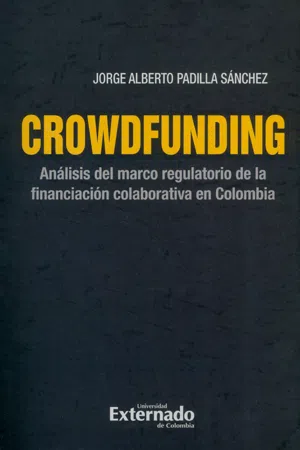
Crowdfunding : análisis del marco regulatorio de la financiación colaborativa en Colombia
- 318 páginas
- Spanish
- ePUB (apto para móviles)
- Disponible en iOS y Android
eBook - ePub
Crowdfunding : análisis del marco regulatorio de la financiación colaborativa en Colombia
Descripción del libro
El Crowdfunding es un nuevo instrumento para recaudar fondos que, de la mano con la evolución de la tecnología y como parte de la corriente FinTech, permite la prestación de servicios financieros de manera más eficiente y menos costosa, sirve como mecanismo de inclusión financiera. Hoy se encuentra en la mira de los reguladores alrededor del mundo, principalmente debido a su distanciamiento de los mecanismos tradicionales y las problemáticas asociadas a su desarrollo.
El trabajo realiza un análisis detallado del fenómeno y la manera como los aportantes, receptores y plataformas electrónicas fueron regulados en Colombia por el Decreto 1357 de 2018. El lector encontrará un estudio crítico del valor del Crowdfunding Act de Estados Unidos como un modelo para la regulación en Colombia.
Información
Categoría
Negocios y empresaCategoría
Negocios en generalNOTAS AL PIE
INTRODUCCIÓN
1 “Since historically few other people (to say nothing of reluctant Banks after the 2008 financial crisis) have been willing to risk their hard-earned money on speculative start-ups, most entrepreneurs and company founders, having exhausted their credit cards and personal savings, have been forced to borrow money or seek investment from their friends, college roommates, family members, teachers, mentors, and anyone else who would listen to their pitch. The near-universal popularity of friends-and-family offerings can be explained by two basic facts of human nature:
1. Friends and family members will frequently offer you money out of love and affection (or, less charitably, to get you out of their hair), not necessarily for the purely economic motive of seeking a return on their investment.
2. Friends and family members are less likely than other people to sue you and force you into bankruptcy if the you-know-what hits the fan and the start-up fails to achieve liftoff” (CLIFF ENNICO, The Crowdfunding Handbook: Raise Money for your Small Business or Start-Up with Equity Funding Portals, 2016, p. 3).
2 “What made such friends-and-family offerings difficult, of course, was that most people’s networks were relatively small and tightly confined. Also, you had to approach each person one on one and establish a personal rapport with each of them. To network successfully in the pre-Internet world, you had to take time to get to know someone before you asked him for a favor or for money. If your network was ricj and well connected, life was good. If it wasn’t, well…”. (CLIFF ENNICO, op. cit., 2016, p. 13).
3 URF. Alternativas de regulación del crowdfunding, 2016, p. 4.
4 Véase IOSCO, Crowd-funding: An Infant Industry Growing Fast. Staff Working Paper 3, 2014.
5 Véase BLAIR BOWMAN, A Comparative Analysis of Crowdfunding Regulation in the United States and Italy, 2015, pp. 321-324.
6 JOAN M. HEMINWAY & SHELDEN R. HOFFMAN, Proceed at your Peril: Crowdfunding and the Securities Act of 1933, 2011, pp. 931-932.
7 IOSCO, op. cit., 2014, p. 11.
8 “‘Financial technology’ or ‘FinTech’ refers to the use of technology to deliver financial solutions. The term’s origin can be traced to the early 1990s and referred to the ‘Financial Services Technology Consortium’, a project initiated by Citigroup to facilitate technological cooperation efforts. However, it is only since 2014 that the sector has attracted the focused attention of regulators, industry participants and consumers alike. The term now refers to a large and rapidly growing industry representing between US$12 billion and US$197 billion in investment as of 2014, depending on whether one considers start-ups (FinTech 3.0) only or the full spectrum of applications, including traditional financial institutions (FinTech 2.0). This rapid growth has attracted greater regulatory scrutiny, which is certainly warranted given the fundamental role FinTech plays in the functioning of finance and its infrastructure” (DOUGLAS ARNER et al., The Evolution of Fintech…, 2015, p. 3).
9 “The key differentiating factors of FinTech 3.0 are the rapid rate of technology development and the changing identity of the providers of financial services. Startups and technology firms have challenged established financial institutions by offering specific, niche services to consumers, businesses, and incumbent financial institutions” (DOUGLAS ARNER et al., Fintech and Regtech in a Nutshell, and the Future in a Sandbox, 2017, p. 7).
10 Véase JAMIE HOPKINS & KATIE HOPKINS, Not all that Glitters is Gold – Limitations of Equity Crowdfunding Regulations, 2014, p. 3.
11 “En muy poco tiempo, Blockchain ha pasado de recibir la etiqueta de disruptiva, a pasar a considerarse la semilla fundamental para una nueva Internet segura, a ser capaz de crear el mayor superordenador jamás construido en la historia, o directamente, a cambiar el mundo tal y como lo conocemos. En un futuro no muy lejano, utilizaremos bases de datos descentralizadas y basadas en Blockchain para cuestiones que irán desde decidir la hora a la que nos levantamos de la cama, pagar por el agua caliente que consumimos en la ducha, garantizar la seguridad de todos los aparatos conectados en nuestro hogar a la Internet de las cosas, negociar con el robot que nos corta el césped del jardín, identificarnos en un vehículo autónomo que nos lleve a trabajar, hacer transacciones económicas de todo tipo con total seguridad y trazabilidad, enviar dinero a un amigo… la centralidad de Blockchain en el mundo transaccional va a ser absoluta, hasta el punto de que no seremos capaces de plantearnos cómo de imperfecta, insegura e incómoda era nuestra vida antes de que esta tecnología viese la luz” (DON TAPSCOTT & ALEX TAPSCOTT, La revolución Blockchain, 2016, p. 16). “A Blockchain is a decentralized collection of data that is verified by members of a peer-to-peer network. The concept most famously arose in the context of Bitcoin, where the data collection is a ledger of time-stamped financial transactions. The Bitcoin Blockchain, like all others, is a solution to the double-spend problem, a variation of the above problem of human interpretation and the possibility of judging one’s own case” (MAX RASKIN, The Law and Legality of Smart Contracts, 2017, p. 317).
12 ASOBANCARIA, Blockchain: mirando más allá del Bitcoin, 2017.
13 “A Smart Contract is an agreement whose execution is automated. This automatic execution is often effected through a computer running code that has translated legal prose into an executable program. This program has control over the physical or digital objects needed to effect execution. Examples are a car that has a program installed to prevent ignition if the terms of a debt contract are not met or banking software that automatically transfers money if certain conditions are met. A Smart Contract does not rely on the state for enforcement, but is a way for contracting parties to ensure performance.
[…] Numerous alternative definitions of Smart Contracts have been proposed. In a paper outlining a template for creating standard Smart Contracts, Clack et al. proposed a broader definition of smart contracts that bifurcates into what they call traditional and non-traditional methods of enforcement. Clack et al. define traditional means of enforcement as those through institutions like arbitration or courts of law – these are weak Smart Contracts in our classification scheme, because the costs to change or revoke the contract are not high enough to proscribe courts or arbitrators from doing so. They define non-traditional means of enforcement as those through ‘tamper-proof’ technology ‘with the assumption that in a perfect implementation of the system wrong-performance or non-performance become impossible.’ This narrower set of Smart Contracts is what I deem the strong variety. The reason is that the execution of the contract can be ‘tampered’ with by the courts in the sense that the court can alter the original intentions of the parties” (MAX RASKIN, op. cit., 2017, p. 309).
14 “Ellos, como su propia nominación lo indica, aluden a las expensas en que habrá de incurrirse con el propósito de celebrar contratos y realizar operaciones de negocios para el desarrollo de actividades empresariales. Mientras más altos sean estos costos, menor será el número de negocios que se realicen, con la consecuente pérdida de valor para el empresario” (FRANCISCO REYES VILLAMIZAR, Análisis económico del derecho societario, 2012, p. 33).
15 A lo largo del texto haremos referencia al término Act, el cual resulta ser equiparable al concepto formal de Ley.
16 “The JOBS Act piggybacks on the concept of groups of individuals pooling their money informally to provide a new, less regulated method for companies to raise capital. The c...
Índice
- CUBIERTA
- PORTADILLA
- PORTADA
- CRÉDITOS
- CONTENIDO
- INTRODUCCIÓN
- CAPÍTULO PRIMERO CROWDFUNDING: LA REVOLUCIÓN DE LAS MASAS EN EL ACCESO A LA FINANCIACIÓN
- CAPÍTULO SEGUNDO EXPERIENCIA INTERNACIONAL EN LA REGULACIÓN DEL CROWDFUNDING: ESPECIAL MENCIÓN AL MODELO NORTEAMERICANO
- CAPÍTULO TERCERO LA REGULACIÓN DEL CROWDFUNDING EN COLOMBIA
- CONCLUSIONES
- REFERENCIAS
- NOTAS AL PIE
- CONTRACUBIERTA
Cuenta con la confianza de 375,005 estudiantes
Acceso a más de 1,5 millones de títulos por un precio mensual justo.
Estudia de forma más eficiente usando nuestras herramientas de estudio.
Preguntas frecuentes
Sí, puedes cancelar tu suscripción en cualquier momento desde la pestaña Suscripción en los ajustes de tu cuenta en el sitio web de Perlego. La suscripción seguirá activa hasta que finalice el periodo de facturación actual. Descubre cómo cancelar tu suscripción
No, los libros no se pueden descargar como archivos externos, como los PDF, para usarlos fuera de Perlego. Sin embargo, puedes descargarlos en la aplicación de Perlego para leerlos sin conexión en el móvil o en una tableta. Descubre cómo descargar libros para leer sin conexión
Perlego ofrece dos planes: Esencial y Avanzado
- El plan Esencial es ideal para estudiantes y profesionales que disfrutan explorando una amplia gama de categorías. Accede a la Biblioteca Esencial con más de 800.000 títulos confiables y superventas en negocios, crecimiento personal y humanidades. Incluye tiempo de lectura ilimitado y voz estándar de Lectura en voz alta.
- Avanzado: perfecto para estudiantes avanzados e investigadores que necesitan acceso total y sin restricciones. Desbloquea más de 1,5 millones de libros en cientos de categorías, incluyendo títulos académicos y especializados. El plan Avanzado también incluye características avanzadas como Lectura en voz alta Premium y Asistente de investigación.
Somos un servicio de suscripción de libros de texto en línea, donde puedes acceder a toda una biblioteca digital por menos del precio de un solo libro al mes. Con más de 1,5 millones de libros en más de 990 categorías, ¡te tenemos cubierto! Conoce nuestra misión
Busca el símbolo de lectura en voz alta en tu próximo libro para ver si puedes escucharlo. La herramienta de lectura en voz alta lee el texto en voz alta por ti, resaltando el texto a medida que se lee. Puedes pausarla, acelerarla y ralentizarla. Obtén más información sobre la lectura en voz alta
¡Sí! Puedes usar la aplicación de Perlego en dispositivos iOS y Android para leer cuando y donde quieras, incluso sin conexión. Es ideal para cuando vas de un lado a otro o quieres acceder al contenido sobre la marcha.
Ten en cuenta que no será compatible con los dispositivos que se ejecuten en iOS 13 y Android 7 o en versiones anteriores. Obtén más información sobre cómo usar la aplicación
Ten en cuenta que no será compatible con los dispositivos que se ejecuten en iOS 13 y Android 7 o en versiones anteriores. Obtén más información sobre cómo usar la aplicación
Sí, puedes acceder a Crowdfunding : análisis del marco regulatorio de la financiación colaborativa en Colombia de Jorge Alberto Padilla Sánchez en formato PDF o ePub, así como a otros libros populares en Negocios y empresa y Negocios en general. Tenemos más de 1,5 millones de libros disponibles en nuestro catálogo para que explores.