The narrative regarding criminal violence in Mexico tends to highlight the negative, while minimizing success stories: this book is different. It explains the reasons why the region of La Laguna succeeded in reducing the statistics of homicides and missing persons and how it started to attend to the families of victims. There were two key factors: 1)federal, state, and local government pushing aside party differences in order to coordinate efforts, and 2) dialogue and response to the petitions of social actors. The result is the best security model in Mexico.
eBook - ePub
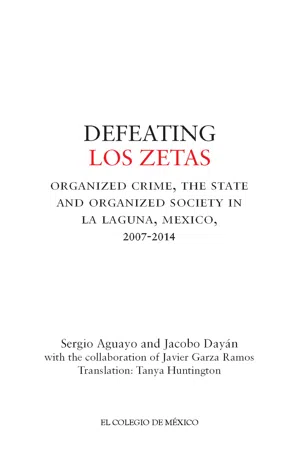
Defeating Los Zetas
Organized Crime, the State and organized society in La Laguna, Mexico, 2007-2014
- Spanish
- ePUB (apto para móviles)
- Disponible en iOS y Android
eBook - ePub
Defeating Los Zetas
Organized Crime, the State and organized society in La Laguna, Mexico, 2007-2014
Descripción del libro
Información
Categoría
Terrorismo 1. Research goals (and several caveats)
One of our missions at the Seminar on Violence and Peace includes contrasting the pessimistic tone of nearly all stories regarding criminal violence with success stories. Such is the case of La Laguna, where government institutions and civic organizations coincided in their diagnostics and concrete public policies; the result has been a sustained decrease in the number of homicides and disappearances. There are issues still pending, of course, but in this text, we explain the underlying causes of their accomplishment.
In 2016, we began to research how organized crime, State institutions and society had interacted in Coahuila. First, we studied the Allende massacre, then the Piedras Negras penitentiary, and in 2020, we completed the present report regarding events in places like La Laguna, a territory where a fierce war was waged between Los Zetas, El Cartel de Sinaloa, and their respective allies. Above all, we were interested in understanding the following:
a) The logic behind the systemic brutality employed by Los Zetas—the most violent cartel—and how the organization was beheaded and fragmented;
b) The reasons why the number of homicides and disappearances were reduced substantially and a dialogue established between victims’ organizations and the State government, which has been fruitful in terms of legislation and public policies that are beneficial, but could be improved, given that levels of impunity continue to be elevated; and,
c) c) The essence of the "Coahuila model" as something to be salvaged as a model so that other cities may implement a replicable formula; one that corrects its deficiencies and improves on its harmonization in the fight against organized crime through integral victim welfare services.
It is worthwhile to point out that when we say success, we refer solely to figures of violence and the willingness of government and civil actors to dialogue. Issues that are still pending include: truth, justice, reparations, the search for the missing, and dismantling of the economic and political protection networks of organized crime. Apropos the success attained in Coahuila, we also lend a great deal of importance to a fairly misunderstood change of direction in federal strategy. In 2010, the presidential administration of Felipe Calderón threw itself into beheading, fragmenting, and financially strangling Los Zetas. The reason for this about face was the systemic brutality employed by the cartel as part of its business model.
The following presidential administration stayed the course under Enrique Peña Nieto, as did the state governments of Coahuila and Durango, the municipal authorities, and much of organized society. The government of the United States also contributed. Finally, in La Laguna, El Cartel de Sinaloa played an active role, something that poses analytical and ethical dilemmas to be discussed later in this study. The outcome was the beheading and fragmentation of Los Zetas, even though they left behind a legacy of systemic brutality.
In the final stages of this investigation, the United States government arrested Genaro García Luna, accusing him of having been in the service of El Cartel de Sinaloa and Joaquín "El Chapo" Guzmán. We feel we must mention this because, if confirmed, these criminal charges will lead to the reinterpretation of some aspects of the drug wars. At present, it is premature to assume that the accusations are valid and moreover, impossible to ascertain the role performed by the then Secretary of Seguridad Pública in the alteration of a strategy that evidently favored El Cartel de Sinaloa.
§
On September 24, 2019, Alfonso Durazo, Secretary of Seguridad y Protección Ciudadana, participated in the Seminar on Violence and Peace held by El Colegio de México. He commented there that La Laguna is "the best model there is in terms of nationwide security of inter-municipal or urban collaboration," and he added, "It is a model that we invariably promote on our cross-country tours."1 The data confirm these statements.
Figure 1
Homicides in the La Laguna metropolitan area
(2000-2018)

Figure 2
Homicide rate in the La Laguna metropolitan area
(2000-2018)

Figure 3
Missing persons in the La Laguna metropolitan area
(2000-2018)

What caused this drop in violence? How has it been sustained for so many years? What factors and figures intervened? And most importantly, can this feat be replicated?
Durazo attributed the success to the Mando Especial, a novel command structure that oversees both the Policía Metropolitana and the Unidad Metropolitana Antisecuestros, permitting coordination between federal authorities and the state and municipal governments of both states, Coahuila and Durango. Doubtless this should be accredited to public officials and politicians. It is not our intention to minimize the importance of the actions taken by Mexican State institutions. Indeed, these institutions are irreplaceable because they hold a legal monopoly on the legitimate use of force, as well as the capacity to shore up the use of public force through other public policies.
Durazo neglected to highlight the role performed by certain figures in organized society. According to other texts, and based on our understanding of how Durazo thinks, this was an involuntary omission, and a fairly common one at that. In the present text, we propose to give these social actors the credit they deserve, because citizen participation in the fight against crime is a constant in every success story. We have documented such involvement in Chicago during the 1920s, New York in the 1930s, Sicily in the 1990s, and Ciudad Juárez and Monterrey in the 21st century.2 In all of these cases, six types of civic organizations took part: the business community, independent media outlets, victims' organizations, civil society associations, and religious and academic groups. Obviously, the form of participation and relative importance of each group varies in each case.
Our investigation is based on a wide variety of sources, although given its original focus and the difficulty we experienced in gaining access to various judicial archives, we relied mostly on interviews of public officials, businesspeople, victims, journalists, and activists. We also found certain judicial files very useful, although we were unable to consult materials requested from the Fiscalía General de la República and the Fiscalía del Estado de Durango, resulting in gaps in our research that will be discussed later on. Our text will be complemented with a documentary film (or perhaps a series of films) in order to share some of the imagery associated with this written record.
The present text is structured as follows: parting from an explanation of the ways in which Los Zetas and El Cartel de Sinaloa resorted to violence, we present the reactions and actions of the Mexican State and of social actors who belong to organized society in La Laguna and the United States. In the final section, these major figures will be contextualized within a broader scenario. We will conclude with a series of recommendations derived from what took place in La Laguna.
§
There are several gaps in our research. One rather important gap was our inability to obtain information regarding Durango, one of two states that form part of La Laguna. We encountered walls of silence attributable, perhaps, to the strength El Cartel de Sinaloa continues to possess in that state.
A second deficiency is our ...
Índice
- Table of Contents
- Acknowledgements
- 1. Research goals (and several caveats)
- 2. Cartel Violence
- 3. The Official Strategy
- 4. Mass Media
- 5. The business community
- 6. The victims and their organizations
- 7. Clandestine cremation sites and extermination zones
- 8. The downfall of Los Zetas
- 9. Lessons and challenges of the "reconquering"
- ANNEXES
- Annex 1Principal events of violence and social resistance in La Laguna
- Annex 2Tables of homicide and disappearances in La Laguna
- Annex 3Sites testing positive for bone shards located by Grupo Vida
- Annex 4Files Reviewed
- Annex 5Major findings at clandestine cremation sites and extermination zones
- Annex 6Rifts in Los Zetas
- Annex 7Requested files that were not made available
- GLOSSARY OF CARTELS, ORGANIZATIONS, INSTITUTIONS AND AGENCIES
Cuenta con la confianza de 375,005 estudiantes
Acceso a más de 1,5 millones de títulos por un precio mensual justo.
Estudia de forma más eficiente usando nuestras herramientas de estudio.
Preguntas frecuentes
Sí, puedes cancelar tu suscripción en cualquier momento desde la pestaña Suscripción en los ajustes de tu cuenta en el sitio web de Perlego. La suscripción seguirá activa hasta que finalice el periodo de facturación actual. Descubre cómo cancelar tu suscripción
No, los libros no se pueden descargar como archivos externos, como los PDF, para usarlos fuera de Perlego. Sin embargo, puedes descargarlos en la aplicación de Perlego para leerlos sin conexión en el móvil o en una tableta. Descubre cómo descargar libros para leer sin conexión
Perlego ofrece dos planes: Esencial y Avanzado
- El plan Esencial es ideal para estudiantes y profesionales que disfrutan explorando una amplia gama de categorías. Accede a la Biblioteca Esencial con más de 800.000 títulos confiables y superventas en negocios, crecimiento personal y humanidades. Incluye tiempo de lectura ilimitado y voz estándar de Lectura en voz alta.
- Avanzado: perfecto para estudiantes avanzados e investigadores que necesitan acceso total y sin restricciones. Desbloquea más de 1,5 millones de libros en cientos de categorías, incluyendo títulos académicos y especializados. El plan Avanzado también incluye características avanzadas como Lectura en voz alta Premium y Asistente de investigación.
Somos un servicio de suscripción de libros de texto en línea, donde puedes acceder a toda una biblioteca digital por menos del precio de un solo libro al mes. Con más de 1,5 millones de libros en más de 990 categorías, ¡te tenemos cubierto! Conoce nuestra misión
Busca el símbolo de lectura en voz alta en tu próximo libro para ver si puedes escucharlo. La herramienta de lectura en voz alta lee el texto en voz alta por ti, resaltando el texto a medida que se lee. Puedes pausarla, acelerarla y ralentizarla. Obtén más información sobre la lectura en voz alta
¡Sí! Puedes usar la aplicación de Perlego en dispositivos iOS y Android para leer cuando y donde quieras, incluso sin conexión. Es ideal para cuando vas de un lado a otro o quieres acceder al contenido sobre la marcha.
Ten en cuenta que no será compatible con los dispositivos que se ejecuten en iOS 13 y Android 7 o en versiones anteriores. Obtén más información sobre cómo usar la aplicación
Ten en cuenta que no será compatible con los dispositivos que se ejecuten en iOS 13 y Android 7 o en versiones anteriores. Obtén más información sobre cómo usar la aplicación
Sí, puedes acceder a Defeating Los Zetas de Sergio Aguayo; Jacobo Dayán en formato PDF o ePub, así como a otros libros populares en Política y relaciones internacionales y Terrorismo. Tenemos más de 1,5 millones de libros disponibles en nuestro catálogo para que explores.