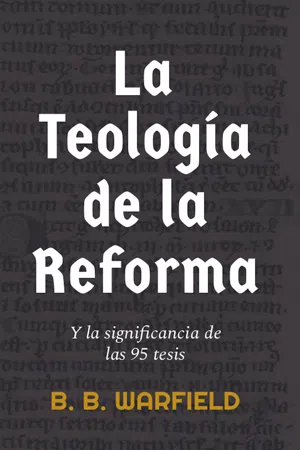
En 1917, por el aniversario 400 de la Reforma, Benjamin B. Warfield escribió este destacado artículo que apareció en The Biblical Review que fue publicado por The Biblical Seminary en Nueva York. Aquí Warfield expuso, como solo él podría, el verdadero corazón de la Reforma. A diferencia de muchos de su tiempo que intentaban encontrar la genialidad y la génesis de la Reforma en algo más que la teología, Warfield escribió: "La Reforma consistió —e insistimos en ello— precisamente en la substitución de un grupo de doctrinas teológicas por otras. En eso consistió para Lutero; y eso es lo que, mediante Lutero, ha significado para el mundo cristiano. Para Lutero significó —debido a calmar su turbada consciencia, y debido al alivio de su profunda convicción de pecado— el redescubrir la gran verdad, la más grande de las verdades que un hombre pecador puede escuchar, es decir, que la salvación es solamente por la pura gracia de Dios.
- 146 páginas
- Spanish
- ePUB (apto para móviles)
- Disponible en iOS y Android
eBook - ePub
La teología de la Reforma y la significancia de las 95 tesis
Descripción del libro
Información
Categoría
Teología y religiónCategoría
Teología cristianaLAS 95 TESIS
1. Our Lord and Master Jesus Christ, when He said “do penance”, willed that the whole life of believers should be repentance.
Nuestro Señor y Maestro Jesucristo, cuando dijo «haced penitencia», quería que toda la vida de los creyentes fuera arrepentimiento.
2. This word cannot be understood to mean sacramental penance, i.e., confession and satisfaction, which is administered by the priests.
Esta palabra no puede ser entendida como la penitencia sacramental, es decir, la confesión y la satisfacción, que es administrada por los sacerdotes.
3. Yet it means not inward repentance only; nay, there is no inward repentance which does not outwardly work divers mortifications of the flesh.
Sin embargo, no sólo se refiere al arrepentimiento interno. No, no hay arrepentimiento interno sino operan exteriormente diversas mortificaciones de la carne.
4. The penalty [of sin], therefore, continues so long as hatred of self continues; for this is the true inward repentance, and continues until our entrance into the kingdom of heaven.
Por lo tanto, la culpabilidad (del pecado) continúa mientras perdure el odio a uno mismo. Porque éste es el verdadero arrepentimiento interno, y continúa hasta nuestra entrada en el reino de los cielos.
5. The pope does not intend to remit, and cannot remit any penalties other than those which he has imposed either by his own authority or by that of the Canons.
El papa no tiene la intención de remitir, y no puede remitir ninguna culpa que no sea la que él ha impuesto, ya sea por su propia autoridad, o por la de los Cánones.
6. The pope cannot remit any guilt, except by declaring that it has been remitted by God and by assenting to God’s remission; though, to be sure, he may grant remission in cases reserved to his judgment. If his right to grant remission in such cases were despised, the guilt would remain entirely unforgiven.
El papa no puede remitir ninguna culpa, sino declarar que ha sido remitida por Dios y asentir a la remisión de Dios. Aunque, ciertamente, puede conceder la remisión en los casos reservados a su juicio. Si se desprecia su derecho a conceder la remisión en tales casos, la culpa permanecerá totalmente imperdonable.
7. God remits guilt to no one whom He does not, at the same time, humble in all things and bring into subjection to His vicar, the priest.
Dios no remite la culpa a nadie a quien no humille antes, y someta lo al sacerdote, Su vicario.
8. The penitential canons are imposed only on the living, and, according to them, nothing should be imposed on the dying.
Los cánones penitenciales se imponen sólo a los vivos y, consecuentemente, nada debe imponerse a los moribundos.
9. Therefore the Holy Spirit in the pope is kind to us, because in his decrees he always makes exception of the article of death and of necessity.
Por lo tanto, el Espíritu Santo en el papa es amable con nosotros, porque en sus decretos siempre hace excepción y nos beneficia en caso de muerte y necesidad.
10. Ignorant and wicked are the doings of those priests who, in the case of the dying, reserve canonical penances for purgatory.
Ignorantes y perversos son los hechos de aquellos sacerdotes que, en el caso de los moribundos, reservan penitencias canónicas para el purgatorio.
11. This changing of the canonical penalty to the penalty of purgatory is quite evidently one of the tares that were sown while the bishops slept.
Este cambio de la pena canónica a la pena del purgatorio es evidentemente una de las cizañas que fueron sembradas mientras los obispos dormían.
12. In former times the canonical penalties were imposed not after, but before absolution, as tests of true contrition.
En épocas anteriores las penas canónicas se impusieron, antes de la absolución (no después), como pruebas de la verdadera contrición.
13. The dying are freed by death from all penalties; they are already dead to canonical rules, and have a right to be released from them.
Los moribundos son liberados por la muerte de todas las penas; Ya están muertos a las reglas canónicas, y tienen derecho a ser liberados de éstas.
14. The imperfect health [of soul], that is to say, the imperfect love, of the dying brings with it, of necessity, great fear; and the smaller the love, the greater is the fear.
La salud imperfecta (del alma), es decir, el amor imperfecto de los moribundos trae consigo, por necesidad, gran temor; Y cuanto menor es el amor, mayor es el temor.
15. This fear and horror is sufficient of itself alone (to say nothing of other things) to constitute the penalty of purgatory, since it is very near to the horror of despair.
Este temor y horror es suficiente por sí solo (por no mencionar otras cosas) para constituir la pena del purgatorio, ya que está muy cerca del horror de la desesperación.
16. Hell, purgatory, and heaven seem to differ as do despair, almost-despair, and the assurance of safety.
El infierno, el purgatorio y el cielo parecen diferir de la misma manera que la desesperación, la casi desesperación, y la seguridad de la salvación.
17. With souls in purgatory it seems necessary that horror should grow less and love increase.
Respecto a las almas en el purgatorio parece necesario que a medida que el horror mengüe, el amor crezca.
18. It seems unproved, either by reason or Scripture, that they are outside the state of merit, that is to say, of increasing love.
No parece que tengamos pruebas, ya sea por razón o por la Escritura, de que estas almas estén fuera del estado de mérito, es decir, de amor creciente.
19. Again, it seems unproved that they, or at least that all of them, are certain or assured of their own blessedness, though we may be quite certain of it.
Además, tampoco tenemos pruebas de que las almas en el purgatorio, al menos en su totalidad, tengan completa certeza de su propia bienaventuranza, aunque nosotros podamos estar bastante seguros de ello.
20. Therefore by “full remission of all penalties” the pope means not actually “of all,” but only of those imposed by himself.
Por tanto, cuando el papa habla de «remisión plenaria de todas las penas», no quiere decir «todas ellas», sino solamente aquellas que él mismo impuso.
21. Therefore those preachers of indulgences are in error, who say that by the pope’s indulgences a man is freed from every penalty, and saved.
En consecuencia, están equivocados los predicadores de las indulgencias, quienes dicen que por las indulgencias del papa un hombre es liberado de todo castigo, y salvado.
22. Whereas he remits to souls in purgatory no penalty which, according to the canons, they would have had to pay in this life.
De modo que el papa no remite ninguna pena a las almas en el purgatorio que, según los cánones, debían haber pagado en esta vida.
23. If it is at all possible to grant to any one the remission of all penalties whatsoever, it is certain that this remission can be granted only to the most perfect, that is, to the very fewest.
Si es posible el conceder a cualquiera la remisión de todas las penas, esta remisión sólo puede concederse a los más perfectos, es decir, a los pocos.
24. It must needs be, therefore, that the greater part of the people are deceived by that indiscriminate and high-sounding promise of release from penalty.
Por esta razón la mayor parte de la gente está engañada por esa promesa indiscriminada y jactanciosa de la liberación de la pena.
25. The power which the pope has, in a general way, over purgatory, is just like the power which any bishop or curate has, in a special way, within his own diocese or parish.
El poder que el papa tiene, en general, sobre el purgatorio, es igual que el poder que cualquier obispo o cura tiene, de una manera especial, dentro de su propia diócesis o parroquia.
26. The pope does well when he grants remission to souls [in purgatory], not by the power of the keys (which he does not possess), but by way of intercession.
El papa hace bien cuando concede la remisión a las almas (en el purgatorio), no por el poder de las llaves (que él no posee), sino por vía de la intercesión.
27. They preach man who say that so soon as the penny jingles into the money-box, the soul flies out [of purgatory].
Es doctrina de hombre la que dice que tan pronto como una moneda en la caja suena, un alma se libra de la pena (del purgatorio).
28. It is certain that when the penny jingles into the money-box, gain and avarice can be increased, but the result of the intercession of the Church is in the power of God alone.
Es cierto que cuando la moneda en la caja suena, la ganancia y la avaricia aumentar pueden, pero el resultado de la intercesión de la Iglesia está solamente en el poder de Dios.
29. Who knows whether all the souls in purgatory wish to be bought out of it, as in the legend of Sts. Severinus and Paschal.
¿Quién sabe, acaso, si todas las almas del purgatorio desean ser redimidas? Hay que recordar lo que, según la leyenda, aconteció con San Severino y San Pascual.
30. No one is sure that his own contrition is sincere; much less that he has attained full remission.
Nadie está seguro de que su propia contrición es sincera; Mucho menos él haya alcanzado la remisión completa.
31. Rare as is the man that is truly penitent, so rare is also the man who truly buys indulgences, i.e., such men are most rare.
Tan raro como es el hombre que es verdaderamente penitente, es también el hombre que verdaderamente compra indulgencias, es decir, tales hombres son los más raros.
32. They will be condemned eternally, together with their teachers, who believe themselves sure of their salvation because they have letters of pardon.
Serán condenados eternamente, junto con sus maestros, los que se creen seguros de su salvación porque tienen cartas de indulgencia.
33. Men must be on their guard against those who say that the pope’s pardons are that inestimable gift of God by which man is reconciled to Him.
Los hombres deben estar en guardia contra los que d...
Índice
- LA TEOLOGÍA DE LA REFORMA
- LA IMPORTANCIA TEOLÓGICA DE LAS NOVENTA Y CINCO TESIS
- SÍNTESIS CONCISA DE LA TEOLOGÍA REFORMADA
- LAS 95 TESIS
- Otros títulos de Publicaciones Faro de Gracia
Cuenta con la confianza de 375,005 estudiantes
Acceso a más de 1,5 millones de títulos por un precio mensual justo.
Estudia de forma más eficiente usando nuestras herramientas de estudio.
Preguntas frecuentes
Sí, puedes cancelar tu suscripción en cualquier momento desde la pestaña Suscripción en los ajustes de tu cuenta en el sitio web de Perlego. La suscripción seguirá activa hasta que finalice el periodo de facturación actual. Descubre cómo cancelar tu suscripción
No, los libros no se pueden descargar como archivos externos, como los PDF, para usarlos fuera de Perlego. Sin embargo, puedes descargarlos en la aplicación de Perlego para leerlos sin conexión en el móvil o en una tableta. Descubre cómo descargar libros para leer sin conexión
Somos un servicio de suscripción de libros de texto en línea, donde puedes acceder a toda una biblioteca digital por menos del precio de un solo libro al mes. Con más de 1,5 millones de libros en más de 990 categorías, ¡te tenemos cubierto! Conoce nuestra misión
Busca el símbolo de lectura en voz alta en tu próximo libro para ver si puedes escucharlo. La herramienta de lectura en voz alta lee el texto en voz alta por ti, resaltando el texto a medida que se lee. Puedes pausarla, acelerarla y ralentizarla. Obtén más información sobre la lectura en voz alta
¡Sí! Puedes usar la aplicación de Perlego en dispositivos iOS y Android para leer cuando y donde quieras, incluso sin conexión. Es ideal para cuando vas de un lado a otro o quieres acceder al contenido sobre la marcha.
Ten en cuenta que no será compatible con los dispositivos que se ejecuten en iOS 13 y Android 7 o en versiones anteriores. Obtén más información sobre cómo usar la aplicación
Ten en cuenta que no será compatible con los dispositivos que se ejecuten en iOS 13 y Android 7 o en versiones anteriores. Obtén más información sobre cómo usar la aplicación
Sí, puedes acceder a La teología de la Reforma y la significancia de las 95 tesis de B. B. Warfield en formato PDF o ePub, así como a otros libros populares en Teología y religión y Teología cristiana. Tenemos más de 1,5 millones de libros disponibles en nuestro catálogo para que explores.