Biological Sciences

Morphological Homology
Morphological homology refers to the similarity in structure or form between different species, indicating a common evolutionary origin. It is used to infer evolutionary relationships and shared ancestry among organisms. By comparing anatomical features such as bones, organs, or body parts, scientists can identify homologous structures and trace the evolutionary history of different species.
Written by Perlego with AI-assistance
Related key terms
1 of 5
6 Key excerpts on "Morphological Homology"
 eBook - PDF
- Adolf Seilacher, Alan D. Gishlick(Authors)
- 2014(Publication Date)
- CRC Press(Publisher)
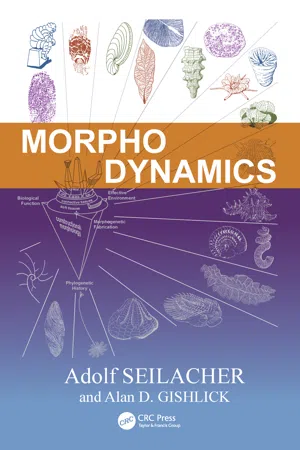
1 Morphology attempts to describe and order natural forms in terms of their differential similarity, i.e., it is an inherently comparative approach. Still, description is only the first step. According to the constructional morphology triangle (Pl. 1.1) there are three major reasons why two organisms should be similar. (1) Shared ancestry is the chief measuring stick for our standard classification. With regard to species and higher taxa, cladistics provides an elaborate terminology comparable to terms in human genealogy. With regard to organs, we talk about homology . (2) Shared function may cause similarity in originally different structures. Since it is secondary, we call this kind of similarity functional convergence . (3) Shared fabrication in a morphogenetic sense causes similarities of still another kind. They are particularly common in skeletal structures and could be called fabricational analogies . This triple interpretation may be applied to whole organisms as well as their functional units (organs), such as eyes, beaks, scales, limbs, etc. While constructional morphology provides the framework for the analysis of a given form, their transformation in ontogenetic and phylogenetic time is the subject of morphodynamics (Pl. 1.1). By inclusion of the specific environment (environmental factors in the order of their importance for the particular organism) the triangle transforms into the tetrahedron of morphodynamics. I. The Historical Aspect of Form The concept of genealogical similarity is so obvious that it appears trivial. Everybody can distinguish a bird, a fish, or a crustacean in spite of the many modifications that the common design, or “ bauplan,” has undergone in different species. Things become more difficult, however, if we deal with a hard-shelled barnacle encrusting a rock, or a parasitic rhizocephalian that has become transformed into a delicate system of root-like haustoria. eBook - PDF
- Gregory R. Bock, Gail Cardew, Gregory R. Bock, Gail Cardew(Authors)
- 2008(Publication Date)
- Wiley(Publisher)
I view homology as something that follows from the fact of evolution. There is a continuity, as 28 WAKE Darwin perceived, and branching and extinction have produced genealogical entities whose phylogenetic relationships are inferred largely on perceived degree of overall homology, especially that portion of overall homology that is uniquely shared. Depending on our outlook we may posit that organs are homologous on some biological grounds and be happy when the proposition passes a phylogenetic test (as with the transition from bones forming a lower jaw articulation in some amniotes to forming inner ear ossicles in others), but all that we have done really is identified a pathway of phylogenetic continuity. All proximal attempts to explain homology in terms of structure, connectivity, topography or morphogenesis, for example, can fail. Is homology any more than phylogenetic continuity? Maybe we need to turn Van Valen’s (1982) definition (‘correspondence caused by continuity of information’) around: the continuity of information necessitates correspondence. Some real questions ,Stasis That which Darwin termed unity of type and what Eldredge & Gould (1972) revived as a modern problem remains unexplained. At one level it is simple enough-inheritance mechanisms assure that descendant taxa continue to resemble ancestors, often in nearly every detail of structure. But natural selection theory tells us that local adaptation should be taking place, and so there must be some mechanistic explanation for the resistance of organisms to evolve (Wake et a1 1983). Do any of the many suggested causes offer a general explanation for morphostatic mechanisms (those which maintain structure in evolution, contrasted to morphogenetic mechanisms which generate structure, Wagner 1994)? Moddario This leads to what has been termed iterative or serial homology. Some truly exciting research is taking place dealing with this large topic (see Raff 1996 for a general review). eBook - PDF
Cladistics: Perspectives on the Reconstruction of Evolutionary History
Papers Presented at a Workshop on the Theory and Application of Cladistic Methodology, March · 22–28, 1981, University of California, Berkeley
- Thomas Duncan, Tod F. Stuessy, Thomas Duncan, Tod F. Stuessy(Authors)
- 2019(Publication Date)
- Columbia University Press(Publisher)
But they are equally significant in the coding of character states for cladistic analysis. In the examples that follow I will show how detailed morphological and developmental inves-tigations utilize the concept of homology in reaching their conclusions and how such detailed investigations can provide new insights into problems of organismic affinity. 52 D. R. KAPLAN Because there is some suggestion that determination of the anatomical (cell to tissue) level of higher plant organization may occur independently of the organographic level (examples abound of plant taxa with convergent external morphologies but diagnostic histologies), I shall confine my dis-cussion largely to the organ level of plant organization. But before turning to specific examples, I would like to deal briefly with the concepts of ho-mology and analogy and the criteria used in the determination of homol-ogy-The Concepts of Homology and Analogy No concept in biology seems to have engendered so much debate for so little actual gain as the concept of homology. Over the past few decades hardly an issue of Systematic Zoology has rolled off the press that did not subject this much maligned and basically misunderstood concept to addi-tional scrutiny and dissection. The disagreement generally concerns not how homologies are determined but what they mean. As summarized by Inglis (1966) and by Sneath and Sokal (1973), the de-bate boils down to whether the concept is defined operationally, i.e., on the basis of morphological correspondence, or whether it includes the as-sumption of commonality of ancestry. As Sneath and Sokal (1973) have ar-gued, the weakness of the phylogenetic definitions of Simpson (1961) and others (Eldredge and Cracraft 1980; Wiley 1981) is that they define ho-mology in terms of the conclusions they wish to reach instead of using an independently derived concept that is applied secondarily to problems of phylogeny. eBook - PDF
Coherence in the Midst of Complexity
Advances in Social Complexity Theory
- H. Letiche, M. Lissack, Ron Schultz(Authors)
- 2011(Publication Date)
- Palgrave Macmillan(Publisher)
Social and cognitive homology draws upon a broader and deeper biological meaning than analogy—that of a fundamental structural level where differing surface phenomena are linked and grounded in similar principles, causes, or structures. (Gould, 2002, devotes considerable 174 C o h e r e n c e i n t h e M i d s t o f C o m p l e x i t y space to expounding on this definition of homology, rather than the Darwinian one.) Naturalists made the distinction we wish to urge you, but they did it almost two hundred years ago: “Biologists came to realize that affinities (later homologies) between species represent a good clue for classifica- tion, whereas analogies—which rather unveil functional agreement, are not useful for classificatory purposes.” Richard Owen was the first to differentiate between homology and analogy. In his terminology, an analog is “a part or organ in one animal which has the same function as another part or organ in different animal,” thus it is purely functionally defined. Homology is structural/functional in definition; it embraces a complex mixture of structure and function, it is the interaction between both factors that counts for Owen. Homology can be described as a resemblance in a state of difference. To speak of homology between the political and the literary field is to assert the existence of structurally equivalent traits—not identical, however—in different ensembles. [“L’homologie peut être décrite comme une ressem- blance dans la différence. Parler d’homologie entre le champ politique et le champ littéraire, c’est affirmer l’existence de traits structuralement équivalents—ce qui ne veut pas dire identiques—dans des ensembles dif- férents.”] (Bourdieu’s (1987) Choses dites Paris: Minuit; p. 167–168). We have suggested that emergent and experienced coherence can be found when there is a narrative constructed around two or more situa- tions, such that the possibilities for next action resonate. eBook - PDF
Homology
The Hierarchial Basis of Comparative Biology
- Brian K. Hall(Author)
- 2012(Publication Date)
- Academic Press(Publisher)
My second reason for introducing de Beer's reader was a heuristic one. Homology is a subject of endless 56 Alec L. Panchen fascination to biologists, but there is something about the apparently endless stream of papers and articles on the subject that suggests that the concept itself is intractable and unsatisfactory and/or that there is a lot of muddled thinking going on. I believe it would help if, as in the pre-vious section, definitions of homology, criteria for testing proposals of homology, and explanations of the phenomenon of homology, were clearly separated. In a stimulating dis-cussion of homology from a cladistic point of view that has become something of a classic, Patterson (1982) records four categories of definitions — classical, evolutionary, phenetic, and cladistic, together with more informal utilitarian ones. But the evolutionary definitions and two of the four cladistic ones conflate definition and explanation. Evolution, or rather phylogeny, is the explanation of homol-ogy, as it is of the phenomenon of natural classification, itself reconstructed from the hierarchy of homologies. It should not be part of the definition. However unsatisfying, homology should be defined simply as structural [and positional] similarity rather than as any structural simi-larity due to common ancestry (Boyden, 1973, p. 82). Or in Owen's words, HOMOLOGUE. The same organ in different animals under every variety of form and function. ACKNOWLEDGMENTS The substance of this chapter was delivered as a lecture at a meeting organized in April 1992 by the Society for the History of Natural History to mark the centenary of Richard Owen's death. But I must also acknowledge a special debt of gratitude to Dr. Nicolaas Rupke for sending me a manuscript copy of his paper on the archetype long before its publica-tion, and for the interest he has shown in this work. eBook - PDF
- Stephen Jay Gould(Author)
- 2002(Publication Date)
- Belknap Press(Publisher)
These independently evolved, but historically constrained, similarities—we would now call them parallel-isms—define Lankester’s original concept of homoplasy. Lankester does ac-knowledge that homoplastic similarities must be evoked by similar environ-Historical Constraints and the Evolution of Development 1073 mental pressures (the pool cue of natural selection, in Darwinian terms), but he stresses the internal basis of inherited common building patterns and ma-terials (1870, p. 42): “Under the term ‘homology,’ belonging to another phi-losophy, evolutionists have described and do describe two kinds of agree-ment—the one, now proposed to be called ‘homogeny,’ depending simply on the inheritance of a common part, the other, proposed to be called ‘homo-plasy,’ depending on a common action of evoking causes or moulding envi-ronment on such homogenous parts, or on parts which for other reasons of-fer a likeness of material to begin with.” The foregoing exegesis raises an obvious question: if Lankester restricted homoplasy to independent origin of similar features based on common and phyletically distinctive internal constraints (though not common ancestral structures) in two or more lineages—thus drawing the phenomenon close enough to the essential and defining theme of homology (the “hold of his-tory”) to rank, in Lankester’s system, as a subcategory of homology (broadly defined)—then how did the term migrate to the opposite meaning now uni-versally and unambiguously understood today? In other words, how did homoplasy move from a subcategory of homology to become the diametric opposite of homology, with the domain of homology then shrinking to en-compass only Lankester’s narrower category of homogeny, and the domain of homoplasy expanding to include all similarities evolved independently and not directly inherited from a common ancestral structure? What looks like an enormous difference—the expulsion of homoplasy as a subcategory of homology (sensu lato), and its establishment as a phe-nomenon directly contrary to homology (sensu stricto) —actually rests upon a small point: the migration of convergence into the category of homoplasy as now defined.
Index pages curate the most relevant extracts from our library of academic textbooks. They’ve been created using an in-house natural language model (NLM), each adding context and meaning to key research topics.

