Biological Sciences

Transport Across Cell Membrane
Transport across the cell membrane refers to the movement of substances in and out of cells. This process is essential for maintaining cellular homeostasis and facilitating various cellular functions. It can occur through passive processes such as diffusion and osmosis, or through active processes such as active transport and endocytosis/exocytosis.
Written by Perlego with AI-assistance
Related key terms
1 of 5
12 Key excerpts on "Transport Across Cell Membrane"
 eBook - PDF
The Living Barrier
A Primer on Transfer across Biological Membranes
- Roy J. Levin(Author)
- 2013(Publication Date)
- Butterworth-Heinemann(Publisher)
CHAPTER 5 The Movement of Molecules Across Cell Membranes The previous chapters developed the idea that the outer plasma membrane acts as a diffusion barrier between the external environ-ment and the internal world of the cell. The advantages of such a barrier are clear. The delicate molecular structures of life are not only protected from a changing and possibly harmful external environment but they are also maintained at conditions optimal for their biological function. The other side of the coin, however, is that the cell membrane barrier will delay or prevent not only the inward passage of nutrients essential to the welfare of the cell but also the outward passage of waste products from metabolism. Furthermore, in cells that manufacture substances for export, such as hormones or enzymes, mechanisms must be present to allow passage of these without damaging the protective barrier function. Numerous cellular mechanisms have in fact developed to overcome these problems of transfer. It will be useful at this point to make a general survey of the transfer systems that occur across biological membranes. We can then examine each in greater detail and discuss its importance to cellular physiology. Rather than list the many cellular transfer systems, an attempt has been made to classify them under various headings in Fig. 22. This has been done to avoid the devastatingly barbed comment of the French novelist, Albert Camus that The absurd man multiplies what he cannot unify! There is, however, the danger of absurdity in making a classification of transfer systems at our present state of knowledge, for some systems can be made to overlap into different categories. This is not a real problem as long as we remember that the classification is only for convenience. It can and should be altered as soon as further work makes such changes advisable. eBook - PDF
Ion Transport Across Membranes
Incorporating Papers Presented at a Symposium Held at the College of Physicians & Surgeons, Columbia University, October, 1953
- Hans T. Clarke(Author)
- 2013(Publication Date)
- Academic Press(Publisher)
Commenting on the proper use of the word membrane he said: Active transport of a substance is brought about by some kind of dynamic machinery working within the cells, which may in turn be bounded by membranes allowing certain sub-stances to pass and holding others back. I maintain that such mem-branes are, in the present state of our knowledge, definitely unsuitable for the study of membrane properties, because it is too difficult to distinguish the membrane from the cell of which it is an integral and perhaps variable part. At that time the importance of active transport as distinct from simple diffusion was not so generally accepted as it is now, and I have heard the comment that Krogh tried to revive the old vitalistic views ION TRANSPORT ACROSS BIOLOGICAL MEMBRANES 7 concerning the processes of life. But the difficulties of studying simple permeation in the presence of simultaneous active transport processes have proved real enough. If we want to study the passage of ions through cell membranes, then what we need first of all is means to decide which ions are actively transported and which are not. Apparently the easiest case to deal with is that of a cell in equilibrium or steady state with its surroundings. Under these conditions any ion which is not subject to active transport must obey the simple condition Mo = Mi where jJ 0 is its electrochemical potential in the cell interior and Mi that of the ion in the bathing solution. If we had at our disposal reversible electrodes for all ions concerned which could be inserted in the cells, the problem would be easily answered. Unfortunately this is not the case. We therefore have no better choice than to calculate the electrochemical potentials from the concentrations and the electric potential difference across the membrane, as determined with internal microelectrodes, usually making the more or less well justified assumption that the activity coefficients are the same in both phases. eBook - PDF
- William V Dashek, Marcia Harrison(Authors)
- 2010(Publication Date)
- CRC Press(Publisher)
CHAPTER 7 Movement of Molecules Across Membranes Susanna Malmstrom INTRODUCTION In the plant cell, molecules and ions are constantly moved in and out and between compartments across membranes in order to sustain regular physiological functions and to respond to environmental stress. These movements are called transport and are usually accomplished by specific trans- port proteins embedded in the membrane. In this chapter, we examine the basic concepts of plant membrane transport and learn about the different transport proteins, how they work and where they are located in the cell. We also look at some of the common research methods for the study of transport proteins and processes. BASIC CONCEPTS OF MEMBRANES, PERMEABILITY, AND TRANSPORT Ion Concentrations and Homeostasis in the Plant Cell For normal growth and development, plants are dependent on the light energy of the sun, and on water and mineral nutrients taken up from the soil by their roots. With these three essential elements present, plants are able to synthesize all other molecules they need in order to grow and to reproduce themselves. An essential element is defined as one that has a clear physiologi- cal role and whose absence prevents a plant from completing a life cycle. Hydrogen, carbon, and oxygen are obtained from water and carbon dioxide (Fig. 7.1). The mineral nutrients obtained from the soil which plants require are traditionally listed as macro- or micronutrients, depend- ing on their relative concentration in plant tissue (Table 7.1). As the name infers, macronutrients are needed in higher amounts than micronutrients. The reason is that macro- and micronutrients have differ- ent functions in the plant. In general, macronutrients are constituents of organic compounds (proteins, nucleic acids) or are important in the regulation of cellular osmosis (e.g. K + ). eBook - PDF
Handbook of Property Estimation Methods for Chemicals
Environmental Health Sciences
- Donald Mackay, Robert S. Boethling, Donald Mackay, Robert S. Boethling(Authors)
- 2000(Publication Date)
- CRC Press(Publisher)
11.2.2.2 Passive Transport through Membrane Channels or Pores Transport through membrane channels or pores requires the substance to be water soluble and to have a cross-sectional diameter less than the diameter of the pore or channel. This FIGURE 11.2 A Chemical Substance Entering a Cell via Passive Diffusion. Note: dissolution of the substance into a state of complete molecular disaggregation is a prerequisite step for crossing a cellular membrane by any means of transport. dQ dt DA C C x = ( ) 1 2 – 266 Handbook of Property Estimation Methods for Chemicals transport process is passive; transport occurs with the concentration gradient, and the rate and direction of movement of the substance depends on its extracellular and intracellular concentrations. Transport through pores is generally possible only for water and small, water-soluble organic molecules that have molecular weights less than about 200 daltons (e.g., ethanol and urea). Theoretically, an elongated molecule such as alkane could enter a cell via a pore; however, the probability that such a molecule would be oriented properly is low. While it would seem that most inorganic ions are sufficiently small to pass through membrane channels, their hydrated ionic radi are too large to permit their passage by this mechanism. Important cellular ions such as sodium, potassium, calcium, chloride, and oth-ers cross cellular membranes by active transport processes. 11.2.2.3 Active Transport Active transport is a process by which membrane-bound proteins carry ions or other sub-stances across the membrane and into (or out of) the cell (Rozman and Klaassen, 1996; Wright, 1995). These carrier proteins serve as “pumps” that move important ions such as sodium, potassium, calcium, chloride, and others against their electrochemical gradients (i.e., from a region of lower to one of higher electrochemical activity).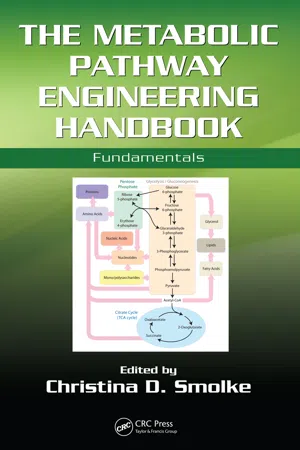 eBook - PDF
The Metabolic Pathway Engineering Handbook
Fundamentals
- Christina Smolke(Author)
- 2009(Publication Date)
- CRC Press(Publisher)
1 -1 1.1 Introduction ....................................................................................... 1 -1 1.2 Structure and Function of the Bacterial Membrane .................... 1 -2 Structure of the Cellular Membrane • Functions • Kinetics of Transport Processes 1.3 The Transporter Classification (TC) System ................................. 1 -8 Channels and Pores • Electrochemical Potential-Driven Transporters • Primary Active Transporters • Group Translocators • Transmembrane Electron Flow Systems References .................................................................................................... 1 -19 1.1 Introduction The cell membrane constitutes a hydrophobic barrier that isolates the cytoplasm from the external medium. The entry and exit of most of the nutrients required for cell growth and the byproducts gener-ated by metabolism are highly restricted by this cellular structure. However, to sustain high growth rates, microbes require a high rate of nutrient import. The presence of specialized transport proteins in the mem-brane allows the cell to circumvent the permeability restrictions imposed by this barrier. Analyses of micro-bial genomes have revealed that approximately 10% of the genes encode proteins involved in transport [1]. These transport systems participate in the import and export of different classes of molecules and also in other important cellular functions. They allow the entry of nutrients to sustain metabolism and ion species to maintain concentration gradients leading to membrane potential and energy generation. Transporters allow the excretion of metabolite by-products and other toxic substances, like drugs or certain metal ions. Transport systems also participate in the secretion of lipids, carbohydrates, and proteins into membrane(s) or the external medium. They enable the transfer of nucleic acids between organisms, contributing to microbial diversity. eBook - PDF
- Stefan Silbernagl, Agamemnon Despopoulos(Authors)
- 2011(Publication Date)
- Thieme(Publisher)
Anionic macromolecules like albumin, which must remain in the bloodstream because of its colloid osmotic action ( p. 210), are held back by the wall charges at the intercellular spaces and, in some cases, at the fenestra. Long-distance transport between the various organs of the body and between the body and the outside world is also necessary. Convection is the most important transport mechanism involved in long-distance trans-port ( p. 24). Transport In, Through and Between Cells (continued) Inflammation and irritation of skin and mucosa, meningitis 19 1 Fundamentals and Cell Physiology Plate 1.9 Transport In, Through and Between Cells II 20 1 Fundamentals and Cell Physiology Diffusion is movement of a substance owing to the random thermal motion (brownian move-ment) of its molecules or ions ( A1 ) in all directions throughout a solvent. Net diffusion or selective transport can occur only when the solute concentration at the starting point is higher than at the target site. ( Note: uni-directional fluxes also occur in absence of a concentration gradient—i.e., at equilibrium— but net diffusion is zero because there is equal flux in both directions.) The driving force, “force” not to be taken in a physical sense, of diffusion is, therefore, a concentration gra-dient . Hence, diffusion equalizes concentra-tion differences and requires a driving force: passive transport (= downhill transport). Example: When a layer of O 2 gas is placed on water, the O 2 quickly diffuses into the water along the initially high gas pressure gradient ( A2 ). As a result, the partial pressure of O 2 ( P o 2 ) rises, and O 2 can diffuse further downward into the next O 2 -poor layer of water ( A1 ).
- B C Currell, R C E Dam-Mieras(Authors)
- 2017(Publication Date)
- Butterworth-Heinemann(Publisher)
Uptake of Nutrients Introduction 12 2.1 The nutritional requirements of cells 12 2.2 Membranes as permeability barriers 15 2.3 The distinction between passive diffusion and carrier-mediated transport 18 2.4 Passive diffusion through protein channels. 21 2.5 Carrier-mediated transport 23 2.6 Passive transport systems. 25 2.7 Active transport systems 26 2.8 Group translocation across membranes 28 2.9 Binding proteins 30 2.10 The utilisation of substrates that cannot pass through the membrane 33 2.11 Experimental approaches to studying transport systems 35 Summary and objectives 40 11 12 Chapter 2 Uptake of Nutrients Introduction The interior of the cell consists of an aqueous solution of salts, amino acids, vitamins, coenzymes, and a wide variety of other soluble materials; this is the cell pool. The cell pool is retained by the plasma membrane and when this is destroyed most of these materials are able to leak out, only substances too large to pass through the cell wall (if present) are retained. Components enter the pool either as nutrients taken up from the environment or as material synthesised from other constituents in the cell. Most nutrients enter the cell by specific transport systems which require their binding to membrane proteins. In this chapter we will examine the processes by which cells take up nutrients from their environment. Firstly, the nutritional requirements of cells and the role of the plasma membrane as a permeability barrier will be examined. Much of the chapter is then devoted to describing the characteristics of the various classes of uptake processes associated with biological membranes. The chapter is not intended to be a comprehensive catalogue of specific uptake processes, since they are extraordinarily diverse with regards to the individual components involved. You will find that much of our knowledge of uptake processes comes from studying bacteria and this has potential biotechnological applications.
- Wilfred Stein(Author)
- 2012(Publication Date)
- Academic Press(Publisher)
How the phospholipids act as barrier and passage will be the subject of Chapter 2 of this volume. How some transmembrane proteins can act as channels will be the content of Chapter 3, while the more complicated, highly specific transport proteins will be dealt with in Chapters 4-6. 1.2. THERMODYNAMICS AND KINETICS OF THE DIFFUSION PROCESS In this section I develop some physical concepts about diffusion in general—how molecules and ions move from place to place within a system composed of a single phase or of a number of phases. The con- 36 1. Physical Basis of Movement across Cell Membranes cepts to be developed here will be needed for a full understanding of the processes of movement across biological membranes. An excellent ac-count of the physical basis of such processes is given in Nobel (1974), and another fine treatment that carries the discussion beyond that needed for our present study is that by Finkelstein and Mauro (1959). Readers who have a firm grounding in such physical principles might care to move directly on to Section 1.3. 1.2.1. Diffusion as a Random Walk Figure 1.12 is an attempt to convey visually the concept of diffusion as a random walk process. The horizontal line is a planar barrier and separates two regions containing different concentrations of a diffusing molecule (the small circles). There are many more of these molecules above the line than below it. In both regions molecules will, in their ceaseless motions, be jumping from place to place, each jump being at random. During the course of such wanderings, the diffusing molecules will jump across the line dividing the two regions. Simply because more molecules are present in the upper region than in the lower region, more molecules will cross from above to below than from below to above. In other words, there will be a net diffusive movement of molecules from above to below, in the direction of diminishing concentration gradient.
- S. C. Skoryna, D. Waldron-Edward, S. C. Skoryna, D. Waldron-Edward(Authors)
- 2013(Publication Date)
- Pergamon(Publisher)
It is evident that in any animal cell which subserves the function of translocation, the occurrence of some form of cytoplasmic streaming will transport and stir intracellular substrate. Although the occurrence of any orderly movement of the intracellular contents will require the expen-diture of energy and must ultimately add to the metabolic cost of translocation, Ewart has calculated that the energy expended in sustaining protoplasmic streaming must be relatively small. (48) The occurrence of such a process in absorbing cells would serve as yet another example of the wide and fascinating variety of phenomena which challenge workers in the fields of biological transport and intestinal absorption. The response of the investigator to this challenge is to direct his thoughts, ingenuity and efforts towards devising experimental procedures to test his views of the phenomenon. At least one outcome of such experiments can be predicted; many more problems will arise, each yet another challenge to the inves-tigator. Summary 1. A description is given of the properties of some model systems for the transcellular active transport ('translocation') of material across a single layer of epithelial cells. 2. The functioning of the models depends upon the occurrence of solute ('substrate') pumping across the bordering membranes of a unit cell, the membranes being also leaky to the substrate. Two types of system are specified. In one sort the limiting membranes of the unit cell are furnished with 'pumps' which move substrate into the cell so that the intra-cellular electrochemical potential of the substrate is maintained at a value greater than that outside and translocation is achieved by the movement of substrate passively out of the cell down leaks. eBook - PDF
- M Volkenstein(Author)
- 2012(Publication Date)
- Academic Press(Publisher)
Thus, nonequilibrium thermodynamics provides a physically substan-tiated description of passive transport. The theory determines the kinetic characteristics of the membrane (for example, κ and ω), which can be measured experimentally. The basic idea of the theory is that the interpre-tation of the membranes' permeability requires a study of the nonequilibrium flows of a substance. This makes it possible to tie the dynamics of transport to the properties of the membrane. The linear dependence of currents on generalized forces (gradients of chemical and electrochemical potentials) for a number of passive artificial and biological membranes has been established experimentally, and this signifies the proximity of the coupled processes in question to equilibrium. 3.3. The Thermodynamics of Active Membrane Transport All membranes, both biological and artificial, are characterized by passive transport, though biological membranes are much more selective. Active transport, however, which takes place in the direction opposite to that of the drop in chemical or electrochemical potential, is an essential feature of specifically biological processes. The maintenance of spatial heterogeneity, 3.3. THE THERMODYNAMICS OF ACTIVE MEMBRANE TRANSPORT 107 inherent in the cell and the organism, actually signifies the existence of active transport. Active transport resolves one of the major contradictions of living matter: the contradiction between the preservation of spatial heterogeneity and metabolism (the exchange of substance and energy with the environment). Active transport is realized as a result of the coupling of diffusional flows with chemical reactions. In other words, the transfer of substances across the membrane occurs at the expense of the free energy released in the course of chemical reactions. eBook - PDF
- Bryan H. Derrickson(Author)
- 2019(Publication Date)
- Wiley(Publisher)
Active transport of solutes is mediated by carrier proteins. Like carrier-mediated facilitated diffusion, active transport exhibits specificity, affinity, saturation, and competition. For a carrier protein that medi- ates active transport, the binding site has a high affinity for sol- ute when the binding site faces the low-concentration side of the membrane and has a low affinity for solute when the bind- ing site faces the high-concentration side of the membrane. This is in contrast to a carrier protein that mediates facilitated diffusion, in which the affinity of the binding site for solute is the same on either side of the membrane. Solutes actively transported across the plasma membrane include several ions, such as Na + , K + , H + , Ca 2+ , I − (iodide), and Cl − ; amino acids; and monosaccharides. (Note that some of these substances also cross the membrane via facilitated diffusion when the proper channel proteins or carriers are present.) Primary Active Transport Uses Energy from ATP to Move a Solute Against Its Gradient In primary active transport, energy derived from hydrolysis of ATP changes the shape of a carrier protein, which pumps a sol- ute across a plasma membrane against its concentration or electrochemical gradient. Indeed, carrier proteins that mediate primary active transport are often called pumps. A typical body cell expends about 40% of the ATP it generates on primary active transport. Chemicals that turn off ATP production—for example, the poison cyanide—are lethal because they shut down active transport in cells throughout the body. The most prevalent primary active transport mechanism expels sodium ions (Na + ) from cells and brings potassium ions 146 CHAPTER 5 Transport Across the Plasma Membrane Na + electrochemical gradient to move a solute against its concentration gradient from extracellular fluid to the cytosol (Figure 5.17): 1 A Na + ion binds to a Na + binding site on the extracellular side of the carrier protein. eBook - PDF
- Arthur B. Ritter, Vikki Hazelwood, Antonio Valdevit, Alfred N. Ascione(Authors)
- 2011(Publication Date)
- CRC Press(Publisher)
of.the.protein.plus.an.additional.amount.due.to.the.presence.of.the.coun-terions.associated.with.the.protein . .The.additional.osmotic.contribution.of. the.counterions.is.called.the. Donnan effect . .In.cells,.the.osmotic.effect.of.the. impermeable.ions.inside.the.cell.is.balanced.by.the.effective.impermeability. of.the.cell.to.extracellular.Na.ions . .The.Na–K–ATPase.active.transport.sys-tem.“pumps”.Na.out.of.the.cell.and,.among.other.functions,.maintains.the. osmotic.stability.of.mammalian.cells . 3.4.1 Cellular Volume Regulation The.red.cell.is.rather.unique . .A.mature.red.cell.has.no.nucleus.and.thus.can. do. little. to. regulate. its. internal. environment . . It. is. primarily. a. membrane,. which.contains.a.solution.of.hemoglobin . .Most.other.cells.respond.to.osmoti-cally. induced. changes. in. cell. volume. by. changing. the. osmotic. content. of. their.cytosol.to.restore.the.original.cell.volume . .They.do.this.by.opening.and. closing.K.and.Cl.channels.to.provide.a.regulatory.volume.decrease.(RVD).in. response.to.a.hypotonic.environment . .They.will.activate.a.Na–K–2Cl.active. transporter.to.obtain.a.regulatory.volume.increase.(RVI).in.response.to.the. effects.of.a.hypertonic.environment . 3.5 Carrier-Mediated Transport Most.of.the.cells.have.a.number.of. electrogenic pumps ,. carrier-mediated .trans-port.systems,.and. ion channels .embedded.in.their.membranes,.which.allow. them. to. transport. ions. and. molecules. into. and. out. of. the. cell. interior. in. response. to. an. appropriate. signal . . The. signal. may. be. electrical. in. nature,. such.as.the.action.potential,.but.most.often.it.involves.the. binding .of.a. regula-tory molecule .to.a.specific. receptor .on.the.surface.of.a.cell.membrane . .Figure. 3.2 .is.a.schematic.diagram.of.the.most.important.electrogenic.pumps.and. ion.channels.that.form.an.integral.part.of.just.about.every.mammalian.cell. membrane. .In.addition.to.the.transporters.shown.in.Figure.3 .2, .cells.in.the.
Index pages curate the most relevant extracts from our library of academic textbooks. They’ve been created using an in-house natural language model (NLM), each adding context and meaning to key research topics.

