Business

Inventory
Inventory refers to the goods and materials a business holds for the purpose of resale or production. It includes raw materials, work-in-progress, and finished goods. Effective inventory management is crucial for ensuring a balance between meeting customer demand and minimizing holding costs.
Written by Perlego with AI-assistance
Related key terms
1 of 5
10 Key excerpts on "Inventory"
- Mbanje S, Lunga J (Editors)(Authors)
- 2016(Publication Date)
- Van Schaik Publishers(Publisher)
Besides, excessive Inventory adversely affects financial performance. Inventory compensates for inefficient management, including poor forecasting, haphazard scheduling and inadequate attention to set-up and ordering processes. The need for better Inventory management systems continues to challenge operations managers. Inventory can be one of the most expensive assets of an organisation. It may account for more than 10 per cent of total revenue or 20 per cent of total assets for some organisations (Wisner et al., 2009: 217). The availability of the right item at the right time and in the right place supports the organisa-tional objectives of customer service, productivity, profit and return on investment. 10.1.1 Inventory defined • Inventory refers to material resources that are stored for use at a later stage through trans-formation from a raw to a finished state, or for use in the current state. Inventory can be put into different categories , such as raw materials Inventory, work-in-process Inventory and finished goods Inventory (Pienaar & Vogt, 2009: 182) • Inventory is a supply of items held by a firm to meet demand. The demand may come from an external customer or it may come from internal operations (Swink et al., 2014: 236). • Inventory is defined as all the goods and materials held by an organisation for sale or use (Institute of Logistics and Transport). • Inventory represents the materials and finished products in the firm and supply chain. These include raw materials purchased but not processed, work in process, maintenance/ repair, operating supplies (MRO), goods completed and awaiting shipment, and goods in transit to warehouses and customers (Paton, Clegg, Hsuan and Pilkington, 2011: 276). DISTRIBUTION PROHIBITED TRACKED BY CUSTOS MEDIA TECHNOLOGIES 147 Inventory ISSUES IN SUPPLY CHAIN MANAGEMENT 10 10.2 THE ROLE OF Inventory IN A SUPPLY CHAIN The most obvious role of Inventory is being able to satisfy customer demand immediately. eBook - PDF
- John Mangan, Chandra Lalwani, Agustina Calatayud(Authors)
- 2020(Publication Date)
- Wiley(Publisher)
Part Three Managing Operations 10 INTRODUCTION Inventory is another name for materials and is any material that a firm holds in order to satisfy customer demand (and these customers may be internal and/or external to the firm). Inventory can thus be found at multiple locations along the supply chain – at the supplier, in the factory and at the customer’s premises. The purpose of Inventory management then is to strike a balance between the levels of Inventory a firm holds to be able to satisfy customer demand in supply chains and the associated costs. Companies hold Inventory for a number of reasons including the following: ● ● To cope with fluctuations in demand and to provide choice for customers. ● ● On the supply side to cope with fluctuations in availability and the risk of upward price changes. ● ● Quantity discounts are often available for buying in bulk, but this can result in excess Inventory being carried. ● ● We saw the importance of JIT in Chapter 3. Not every system, however, can operate on a fully JIT basis – invariably some Inventory may need to build up before a production run can start or there is enough to comprise a full transport load. Inventory Management, Planning and Control ● ● Explain the significance of Inventory in LSCM. ● ● Describe the various costs associated with Inventory management. ● ● Introduce common Inventory control systems and strategies used to reduce Inventory-related costs. ● ● Illustrate techniques used for supply chain planning and control and outline how performance metrics are established. LEARNING OBJECTIVES 152 PART THREE MANAGING OPERATIONS Inventory is generally categorised into the following types: ● ● Raw material Inventory is material purchased and waiting to be processed. ● ● Work in progress (WIP) Inventory comprises material that is being processed along the production line. ● ● Finished goods Inventory are the products awaiting shipment. eBook - PDF
- Donald Waters(Author)
- 2004(Publication Date)
- Wiley(Publisher)
Whenever an organization has materials that it does not use immediately, it puts them into stock. ž Stock consists of all the goods and materials that are stored by an organization. It is a store of items that is kept for future use. ž An Inventory is a list of the items held in stock. An immediate problem is that people use these terms in different ways. In recent years it has become more common to use ‘Inventory’ for both the list of items and the stock itself, and the two terms then become interchangeable. At the same time, organizations refer to their stock as stores, provisions, stockpiles, holdings, reserves, accumulated materials, banks, or a host of other names. To add to the confusion some groups put slightly different interpretations on the terms. Accountants, for example, view ‘Inventory’ as the amount of money tied up in stocks, rather than the stocks themselves, or it might be the total value of an organization’s assets. To finance people, ‘stocks’ are a way of raising cap- ital – in the sense of ‘stocks and shares’ – and have nothing to do with stores of materials. Usually, these differences are fairly obvious and cause few prob- lems, but sometimes you have to be a bit more careful. In this book we will stick to the standard definitions, where an Inventory is a list of the items held in stock. Each entry in the Inventory is a distinct item that is held in stock. A supermarket, for example, has ‘one-litre bottles of Diet Coke’ as a distinct item. Other items in its Inventory might be ‘two-litre bottles of Diet Coke’, ‘half-litre bottles of Diet Coke’, ‘one-litre bottles of Diet Pepsi’, and every other distinct product that it sells. A typical supermarket stocks about 30,000 items. Again, some people use different terms, with the most common alternative being stock keeping unit or SKU. Each item is sold in standard quantities, or units. With our one-litre bottles of Diet Coke, the unit is clearly a bottle.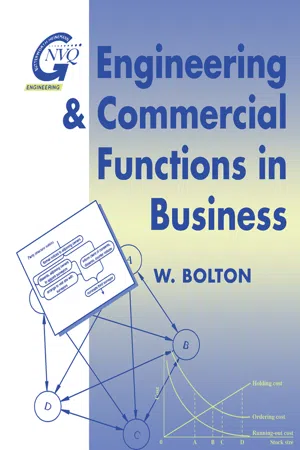
- William Bolton(Author)
- 2014(Publication Date)
- Newnes(Publisher)
Inventory control is concerned with the determination of appropriate Inventory levels and the maintenance of these levels. Thus, the production department will be concerned that production is not hampered by a lack of required materials or components. When production needs, say, a particular quantity of a particular size of mild steel bar, then that material needs to be available. If it is not available at the required time then production might grind to a halt. There would also be concern that there was not a surplus of materials and components beyond that required by production, since the holding of stocks incurs costs as well as the money tied up in the stock. A business which sells items from stock will also be concerned with Inventory levels of finished goods so that customers do not have to wait too long when they order goods. Finished goods stocks present problems. If the stock is too low then the time delay for customers might be too long, if the stock level is too high then too much cash is tied up in the stock and 127 128 Engineering and Commercial Functions in Business holding costs. The aim of Inventory control is to obtain the necessary inventories at the minimum cost to the organization. 7.1.1 Inventory costs Inventories incur costs. Consider the situation with respect to the stocks of raw materials, say mild steel bar. The costs can be considered to be the cost of the item itself, the costs associated with the replenishment of stocks (e.g. the cost of paperwork, transportation, etc.), and holding costs. eBook - PDF
Back to Basics
Your Guide to Manufacturing Excellence
- Steven A. Melnyk, R. T. Chris Christensen(Authors)
- 2000(Publication Date)
- CRC Press(Publisher)
Because of this fact, we have decided to provide a thorough exploration of Inventory. We think that you will find the resulting discussion both interesting and insightful. What Is Inventory? What is Inventory? Let us start with addressing this very basic but important concept. Accountants will tell us that Inventory is an asset. It is something that Back to Basics 126 the firm owns. On the balance sheet, Inventory is treated as part of the liquid assets of the firm. What this means is that Inventory can be converted into money relatively easily and quickly, but this is not always the case. We know, for example, that obsolete Inventory is not as liquid. Often, its real value is very different from its book or accounting value. The Just-in-Time (JIT) experts will tell us that Inventory is an evil. Inventory consumes resources and hides problems. As a result, Inventory should be avoided. This is a blanket statement and not always true. There are times when Inventory has real value. For example, if we are preparing to go on vacation and the car’s distributor shorts out, then we are very pleased when the dealer has a replacement distributor in stock. Inventory is simply the positive difference between supply and demand. It occurs when over a period of time we make more than we consume. Inventory may also be an asset for which we have title (ownership) but not possession. For example, the software package coming to us from a mail-order house in Cali-fornia is Inventory. We own it but we do not have it in our hands. This positive balance occurs for either unintentional (we forecasted more than was actually sold) or intentional reasons. Our focus here is on the inten-tional reasons. Inventory occurs when the costs associated with not having Inventory exceed the costs of having Inventory. Still, why do we really need Inventory? Because of the functions that it provides. Functions of Inventory We do not have Inventory simply because we like Inventory per se . eBook - PDF
Freight Logistics NQF3 SB
TVET FIRST
- TIDASA(Author)
- 2013(Publication Date)
- Macmillan(Publisher)
Page | 68 6 Inventory control activities After you have worked through this section, you should be able to: x List and describe various types of Inventory x List and describe various methods and documentation used in Inventory control x Explain the consequences of improper Inventory control x Define the concept ‘demand forecasting’ -------------------------------------------------------------------------------------- There is a well-known saying that states: Inventories and stock make or break business. In this section, we will look at the role of inventories and Inventory management in the freight logistics industry. It is a fact that too much Inventory can be detrimental to a business. In the same way too little Inventory may also prevent a business from delivering on time and thus damage its reputation. A customer might want to purchase something that is not in stock at that time. Then instead of waiting for new stock, the customer chooses a different supplier. Proper demand forecasting is important to ensure the delicate balance between too much and too little Inventory. 6.1 Inventory types Inventory can be defined as all the items in a store that belong to the company, while stock only refer to those items in the store that you will sell to customers. Many companies do not distinguish between stock and Inventory and some use the term interchangeably. There is also not absolute agreement amongst industries about the different types of inventories/stocks and they may be titled differently in businesses. The following classification of inventories is widely accepted: x Working stock Working stock refers to the stock in the business that reflects the actual demand for the products. x Cycle stock Cycle stock is that portion of a business enterprise’s Inventory that gets depleted through normal sales or through the usage of these stocks in the production process. Cycle stock is replenished through the routine ordering process (Vogt, Pienaar, & Combink De Witt, 2006). eBook - PDF
Operations Management
An Integrated Approach
- R. Dan Reid, Nada R. Sanders(Authors)
- 2023(Publication Date)
- Wiley(Publisher)
Chapter Highlights 1. Raw materials, purchased components and materials, work-in- process (WIP), finished goods, distribution, and maintenance, repair, and operating (MRO) supplies are types of Inventory. Manufacturers use anticipation Inventory to satisfy future demand. Fluctuation stock provides a cushion against uncertain demand. Lot-size Inventory results from the company’s ordering quantity. Transportation inven- tory includes items in transit. Speculative Inventory is a buildup to protect against a future event. MRO Inventory supports daily oper- ations. Many service organizations use tangible Inventory. Many of these items are desirable and subject to theft by employees and cus- tomers. Magnetic strips, security devices, and surveillance systems can reduce Inventory loss. 2. Proper Inventory control and management is often the difference between a profit and a loss. Inventory management objectives include achieving the desired level of customer service, allowing cost-efficient operations, and minimizing Inventory investment. Customer service can be measured as a percentage of orders shipped on schedule, a percentage of line items shipped on schedule, a percentage of dol- lar value shipped on schedule, or idle time due to material shortages. Cost-efficient operations are achieved by using Inventory as buffer stocks, allowing a stable year-round workforce, and spreading the setup cost over a larger number of units. Inventory investment is mea- sured as Inventory turnover and/or amount of supply (weeks, days, and/or hours). 3. Relevant Inventory costs include item costs, holding costs, capi- tal costs, storage costs, risk costs, ordering costs, and shortage costs. Holding cost is the combination of capital costs, storage costs, and risk costs. Capital costs are the higher of either the actual cost of cap- ital or the opportunity cost. Storage costs include out-of-pocket costs associated with storing the Inventory. eBook - PDF
Supply Chain Management
A Global Perspective
- Nada R. Sanders(Author)
- 2020(Publication Date)
- Wiley(Publisher)
Both manufacturing and service organizations carry Inventory. A great deal of Inventory must be carried to support basic processes of product creation. In manufacturing Inventory can take a variety of forms, such as raw◾ materials and component◾ parts, which are delivered from suppliers. Once these items enter the production process they become work-in-process◾(WIP) Inventory. Finally, when the production process is completed, Inventory becomes classified as finished◾goods. Inventory also includes supplies and equipment. As Inventory moves through the supply chain it takes on different classifications. Consider the packaging supplier for Tide laundry detergent for Procter & Gamble. The supplier takes plastic material and creates the packaging. Their finished product then becomes a component part for the production of Tide at the P&G facility. In services, Inventory includes the tangible goods that support delivery of the service, such as medical tools in an operating room or soaps in a hotel chain. It also includes items that are sold as part of the service, such as hair products sold at a beauty salon. In addition, service personnel can be considered part of the Inventory, as their skills define the type of services that can be offered. An example might be physicians on staff and their specialties—such as internal medicine or neurology, or attorneys on staff—such as specialty in tort law versus family law. Services produce an intangible product, and finished services cannot be placed in Inventory. However, this does not mean that some steps in the delivery process cannot be performed before olives, then they’re sure as heck going to make sure it’s the most fabulous jar of Greek olives they can find for the price.” Management has sought to minimize the number of hands that touch a product throughout the supply chain. Whenever possible, Trader Joe’s buys directly from the manufacturer, which then ships the items straight to Trader Joe’s distribution centers. eBook - PDF
- Ed C. Mercado(Author)
- 2007(Publication Date)
- Auerbach Publications(Publisher)
This chapter covers various ways of classifying Inventory into various categories. There are many reasons for classifying Inventory. The most common reasons are for accounting purposes, such as to determine how much finished goods Inventory we have. Or, for manufacturing plants, it could be to determine how much material are “in process”—meaning that some work has already been done on them but the final finished product is not yet complete. There are special classifications of Inventory that are made on an “as needed” basis. For example, you may want to determine the amount of old Inventory. So you would have to first develop a meaning for “old.” One way is to define old Inventory as those with no issues, for example, for the past 12 months. These are the common ways of classifying Inventory: Classification of Inventory Classification by Stage in the Production Process Raw material: Material that will be processed or repackaged or assem-bled into final product. A bakery uses flour and sugar as raw materials, whereas an electronic manufacturing plant uses boards and chips. • Chapter three: Types of Inventory 17 Under inspection: Material currently undergoing some type of inspec-tion. Another term used is MRB, which stands for material review board. Some companies have elaborate systems for performing incoming inspection of material. Work-in-process (WIP): Material that is currently at some incomplete stage of processing. For some companies, WIP can be substantial. With effective planning, it is possible to reduce WIP to reduce space require-ments and eliminate chaos on the shop floor. Partially completed parts: These are subcomponents produced within the company from raw materials. These are stocked temporarily and issued out at a later time for use in completing an end item or a sales order. Finished goods: Final products ready to be shipped out to customer. eBook - PDF
Operations Management
An Integrated Approach
- R. Dan Reid, Nada R. Sanders(Authors)
- 2020(Publication Date)
- Wiley(Publisher)
Magnetic strips, security devices, and surveillance systems can reduce Inventory loss. 2. Proper Inventory control and management is often the difference between a profit and a loss. Inventory management objectives include achieving the desired level of customer service, allow- ing cost-efficient operations, and minimizing Inventory invest- ment. Customer service can be measured as a percentage of orders shipped on schedule, a percentage of line items shipped on schedule, a percentage of dollar value shipped on schedule, or idle time due to material shortages. Cost-efficient operations are achieved by using Inventory as buffer stocks, allowing a stable year-round workforce, and spreading the setup cost over a larger number of units. Inventory investment is measured as Inventory turnover and/or amount of supply (weeks, days, and/or hours). 3. Relevant Inventory costs include item costs, holding costs, capital costs, storage costs, risk costs, ordering costs, and shortage costs. Holding cost is the combination of capital costs, storage costs, and risk costs. Capital costs are the higher of either the actual cost of capital or the opportunity cost. Storage costs include out-of-pocket costs associated with storing the Inventory. Risk costs include theft, damage, deterioration, and obsolescence. Ordering costs are fixed costs associated with either placing a purchase order or a setup cost for a manufacturing order. Shortage costs occur when the customer does not receive an item on time. 4. The ABC classification system allows a company to assign the appropriate level of control and frequency of review of an item based on its annual dollar volume. The system is based on Pareto’s law. Typically items are classified as A items when they have great value, B items when they have moderate value, and C items when they have little value.
Index pages curate the most relevant extracts from our library of academic textbooks. They’ve been created using an in-house natural language model (NLM), each adding context and meaning to key research topics.

