Business

Loan Covenants
Loan covenants are conditions or restrictions imposed by a lender on a borrower as part of a loan agreement. These covenants are designed to protect the lender's interests by ensuring that the borrower meets certain financial and operational requirements. Common types of loan covenants include restrictions on additional borrowing, minimum financial ratios, and limitations on asset sales.
Written by Perlego with AI-assistance
Related key terms
1 of 5

7 Key excerpts on "Loan Covenants"
 eBook - ePub
Private Capital Markets
Valuation, Capitalization, and Transfer of Private Business Interests
- Robert T. Slee(Author)
- 2011(Publication Date)
- Wiley(Publisher)
Loan Covenants are used by lending institutions to influence borrowers to comply with the terms in the loan agreement. If the borrower does not act in accordance with the covenants, the loan may be considered in default and the lender may have the right to demand payment in full. Loan agreements between banks and customers generally contain several types of covenants: Affirmative covenants require the borrower do certain things; negative covenants restrict the borrower in some way; and financial covenants require the borrower to maintain certain financial characteristics during the term of the loan agreement.Affirmative covenants generally require the borrower to comply with basic rules. Examples of affirmative covenants include:- Maintain legal existence.
- Stay current with all taxes.
- Maintain appropriate insurances.
- Keep an accurate financial reporting system.
- Provide the bank with reports as required.
- Possibly maintain compensating balances with the bank.
- Limits to level of indebtedness.
- Limits to distributions, dividends, or management fees.
- Do not merge with or acquire another company.
- Do not allow other liens on company assets.
- No changes in ownership.
- Restrict corporate guarantees.
- Maintain a current ratio (current assets divided by current liabilities) of not less than 1.5 to 1.
- Maintain tangible net worth in excess of $1 million.
- Maintain a ratio of total liabilities to tangible net worth of no greater than 3 to 1.
Covenant requirements can be extensive, depending on the amount and term of the loan and the credit standing of the borrower. Most banks monitor compliance with Loan Covenants on a quarterly basis with the receipt of quarterly and annual financial statements. Sometimes the bank requires a periodic certification by a corporate officer or independent accountant that no covenant violation has occurred, called a compliance certificate. eBook - ePub
Contents of Commercial Contracts
Terms Affecting Freedoms
- Paul S Davies, Magda Raczynska, Paul S Davies, Magda Raczynska(Authors)
- 2020(Publication Date)
- Hart Publishing(Publisher)
This perception of risk, however, includes the protection afforded to the lender by the terms of the agreement. In theory, at least, the more protection is given by the terms, the less risk the lender has and therefore the lower the reward. In practice, however, the correlation is unlikely to be exact. This is partly because of the difficulties of assessing risk, and partly because of the way in which the protection given by the terms will work in practice. As already indicated, it is also typical in the loan market for the risk/reward and associated contractual protections to be fixed for the tenor of the loan at the commencement of its availability, even in the case of a medium- or long-term facility. The restrictions included cannot operate purely to prevent the borrower from doing anything risky or from changing anything in relation to its business. This would have the effect of stopping the borrower from operating in the ordinary course of business, in which case the borrower would not be able to pay the interest or repay the capital. Instead, the terms have to achieve a balance between preventing behaviour that is truly harmful to the lender, and permitting the borrower to operate its business without undue constraint. This is achieved in various ways, an important ingredient of which is a dialogue between the lender and borrower opened by various trigger points.III. Terms of a Typical Loan AgreementIn order to assess the part played by negative covenants in this ‘risk-controlling’ exercise, it is necessary to map the typical terms of a loan agreement. While there is, of course, ample scope for negotiation between the parties, and market variations, the existence of standard-form contracts, such as those produced by the Loan Market Association, by professional support organisations and by law firms, means that there is considerable commonality in the kinds of terms included in such agreements. These agreements are long and complicated, and it is not the purpose of this section to describe all the terms in detail. Instead, it will draw a conceptual map of the main terms, with a view to positioning the negative covenants within this framework.A. Commercial TermsThe first type of terms are commercial terms of the agreement, and are likely to have been negotiated in advance. They create positive obligations. They will, of course, depend on the type of loan made, for example whether it is a term loan or a revolving facility, and on market conditions. The lender is, typically, obliged to make the loan by advancing money on an agreed date or on demand, either in agreed amounts or up to a cap. The lender’s obligation to lend is typically conditional upon the borrower’s satisfying certain conditions at the time of drawdown, which include satisfaction of the covenants (typically by means of a ‘no default’ confirmation, which is linked to ongoing compliance with the covenants). The borrower is obliged to pay interest at the agreed rate,6 and to repay the loan at the time and in the manner agreed. The borrower may also be obliged to pay fees and indemnify expenses.B. Terms Relating to the Provision of InformationA lender can only assess risk if it has the necessary information. It will perform due diligence before taking the final decision to lend, and at that stage it can ask for what information it wants, on the basis that it will not lend unless the information is provided.7 The decision to lend is made, and the ‘price’8 of the loan is set, on the basis of this information, which is then ‘fixed’ by the use of conditions precedent to the drawdown of the loan. If a document evidencing the information has not been provided, or a representation made by the borrower at the time the loan agreement was entered into becomes untrue, the lender is not obliged to advance funds.9 Available until 27 Jan |Learn more
A Pragmatist’s Guide to Leveraged Finance
Credit Analysis for Below-Investment-Grade Bonds and Loans
- Robert S. Kricheff(Author)
- 2021(Publication Date)
- Harriman House(Publisher)
o investors. Other CovenantsOther covenants may include the following:- Business lines : A covenant might restrict a company’s lines of business. For example, an oil and gas exploration company may be limited by this type of covenant to staying in the energy business.
- Related parties transactions : Restrictions are often placed on transactions with related parties and include a description of how they need to be handled. For example, if the chairman of the company also owns a consulting business that the issuer of the bonds wants to hire, this may have to be approved by all outside board members. Or the covenant might limit the fees that can be paid.
- Drop away : This covenant appears in some bonds and typically states that if one, or a combination, of the major ratings agencies upgrade the bonds to investment grade, a number of the covenants may no longer become operative. These drop-away covenants are carefully defined and usually include the most restrictive ones. One item to look for when reading this type of covenant concerns the reinstatement of covenants if the company is later downgraded.
Typically, bank agreements have negative covenants that are slightly tighter than those found in bonds.Words to Watch ForThere are a few words to always be careful of when reading covenants:- And/or: When a covenant lists criteria that have to be met, it can be very important if the word and or the word or appears between the last two items on the list. In a change-of-control covenant, it can make a big difference if the change-of-control offer to repurchase does not go into effect because 1) there is a ratings upgrade ___, 2) the leverage ratio is no higher than pro forma for the event. The meaning is quite different depending on whether and or or is inserted in the blank.
- Leonard D. DuBoff, Amanda Bryan(Authors)
- 2019(Publication Date)
- Allworth(Publisher)
While this sounds reasonable, you should recognize that such restrictions may seriously hamper your ability to borrow additional funds should the need arise. For example, where inventory is used as collateral, you must find out exactly how much of your inventory is involved. A bank may ask for only a percentage of the total inventory to secure the loan. More likely, the bank’s security interest will extend to the company’s entire inventory on hand at any given time, as well as any later-acquired inventory. Here lies the potential problem. The inventory’s value may well exceed the amount of the loan that it secures. Nonetheless, you may find yourself in the position of not being able to use any of the inventory as collateral for additional loans. In cases where this situation is likely to arise, you are well advised to consider alternative sources of collateral.Periodic ReportingTo protect itself, a lender may require you to supply it with certain financial statements on a regular basis—perhaps quarterly or even monthly. From these, the lender can see if the business is performing up to the expectations projected in the loan application. This type of oversight serves not only to reassure the lender that the loan will be repaid but also to identify and help solve problems early on before they become insurmountable and threaten the business viability.DETAILS OF THE AGREEMENTThe loan agreement itself is a tailor-made document—a contract between the lender and borrower—that spells out in detail all the terms and conditions of the loan. The actual restrictions placed on the borrower will be found in the agreement under a section entitled “Covenants.” Negative covenants are things that you may not do without the lender’s prior approval, such as incurring additional debt or pledging the loan’s collateral or other business assets to another lender as collateral for a second loan. On the other hand, positive covenants spell out those things that you must do, such as carry adequate insurance, provide specified financial reports, and repay the loan according to the terms of the loan agreement.Note that, with the lender’s prior consent, the terms and conditions contained in the loan agreement may be amended, adjusted, or even waived. Remember that you can negotiate the loan terms with the lender before signing. True, the bank is in the superior position, but legitimate lenders are happy to cooperate with qualified borrowers.COMMUNICATION WHEN PROBLEMS ARISEOnce a loan is approved and disbursed, the borrower must address a new set of obligations and liabilities. Of course, if all goes according to plan, the loan proceeds are invested, the business prospers, the loan is repaid on schedule, and all parties live happily ever after. However, the business world is fraught with uncertainty. If the business falters and revenues tumble, the borrower may not be able to meet the debt obligations. In this unfortunate event, it becomes imperative that the borrower acts responsibly. View the lender as a potential ally in solving problems, rather than as an adversary.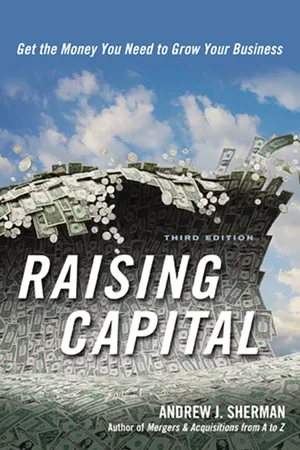 eBook - ePub
Raising Capital
Get the Money You Need to Grow Your Business
- Andrew Sherman(Author)
- 2012(Publication Date)
- AMACOM(Publisher)
Hidden costs and fees . These might include closing costs, processing fees, filing fees, late charges, attorneys’ fees, out-of-pocket-expense reimbursement (couriers, travel, photocopying, and so on), court costs, and auditing or inspection fees in connection with the loan. Another way that commercial lenders earn extra money on a loan is to impose depository restrictions on you, such as a restrictive covenant requiring you to maintain a certain balance in your company’s operating account or to use the bank as a depository as a condition to closing on the loan.Searching for a Business Loan OnlineAs financial services available on the Internet continue to expand, the areas of small-business and commercial lending have also developed into an active industry. There are a wide variety of lenders, loan aggregators, and related resources available online, including:• www.smallbusinessloans.com • www.lendingtree.com • www.businessfinance.com • www.wellsfargo.com • www.sba.gov • www.eloan.com • www.paramountmerchantfunding.com • www.prudential.com • www.ioucentral.com • www.rapidadvance.com • www.merchantloans.comUnderstanding the Legal Documents
Anytime you borrow money, you’ll have to sign documents delineating the terms of the loan—how much is being borrowed, what collateral you’ll be using, what the lender’s interest is, and your promise to repay the debt, including guarantees.The Loan Agreement
The loan agreement sets forth all the terms and conditions of the transaction between you and the lender. The key provisions include the amount, the term, repayment schedules and procedures, special fees, insurance requirements, special conditions to closing, restrictive covenants, the company’s representations and warranties (with respect to its status, capacity, ability to repay, title to properties, litigation, and so on), events of default, and remedies available to the lender in the event of default. Your attorney and accountant should review the provisions of the loan agreement and the implications of the covenants carefully. They should also analyze the long-term legal and financial impact of the restrictive covenants. You should negotiate to establish a timetable under which certain covenants will be removed or modified as your ability to repay is clearly demonstrated. eBook - ePub
- Leonard D. DuBoff, Christy A. King(Authors)
- 2021(Publication Date)
- Allworth(Publisher)
While this sounds reasonable, these restrictions can seriously hamper your ability to borrow additional funds if the need arises. For instance, when inventory is used as collateral, you must find out exactly how much of your inventory is involved. A lender may ask for only a percentage of the total inventory to secure the loan. More likely, the security interest will extend to the company’s entire inventory on hand at any given time, as well as any later-acquired inventory. The problem is that even if your inventory’s value far exceeds the amount of the loan that it secures, you might find yourself unable to use any of the inventory as collateral for additional loans. In situations where this problem is likely to arise, you should consider alternative types of collateral.Periodic ReportingTo protect itself, a lender might require you to supply it with financial statements on a regular basis—perhaps quarterly or even monthly. From these, the lender can see if your business is performing up to the expectations described in the loan application. This type of oversight serves not only to reassure the lender that the loan will be repaid, but also to identify and help solve problems early on before they become insurmountable and threaten your business’s viability.DETAILS OF THE AGREEMENTA loan agreement is a contract between the lender and the borrower that spells out in detail all the terms and conditions of the loan. The restrictions are often in a section entitled “Covenants.” Negative covenants are things that you can’t do without the lender’s prior approval, like incurring additional debt or pledging the loan’s collateral or other business assets to another lender as collateral for a second loan. On the other hand, positive covenants are things that you must do, like carry adequate insurance, provide specified financial reports, and repay the loan according to the terms of the loan agreement. Remember that you can negotiate the loan terms with the lender before signing. True, the lender is in the superior position, but legitimate lenders are usually happy to cooperate with qualified borrowers making reasonable requests.COMMUNICATION WHEN PROBLEMS ARISEOnce your loan is approved and disbursed, you have to address a new set of obligations and liabilities. Of course, if all goes according to plan, your business prospers, you repay the loan on schedule, and everyone lives happily ever after. However, the business world is fraught with uncertainty, and your business may flounder through no fault of your own. Think, for example, of all the events canceled and businesses temporarily closed due to the COVID-19 pandemic. If your business falters and revenues tumble, you might not be able to meet your financial obligations. In this unfortunate event, view the lender as a potential ally in solving problems rather than as your adversary. eBook - PDF
Project Finance in Theory and Practice
Designing, Structuring, and Financing Private and Public Projects
- Stefano Gatti(Author)
- 2007(Publication Date)
- Academic Press(Publisher)
In fact, nothing can change the fact that this is and always will be the primary obligation of every borrower. In a project W nance context, however, it is completely normal, and indeed necessary, for the borrower to take on a complex, detailed set of obligations toward lenders that are ancillary to both the obligation to repay and to the W nancing in general. These obligations may be either correlated to loan repayment (if the project company does not take certain actions, by de W nition it will not be able to repay the loan at the schedule maturity dates) or required by lenders in order to monitor their credit investment and verify that it is being managed properly. Here too we will look at a typical set of covenants for a project W nance transaction, keeping in mind that, as with conditions precedent and representations, speci W c circum-stances can result in speci W c covenants beyond the standard ones usually seen on the market. Normally, the credit agreement di V erentiates between positive covenants and negative covenants, which refer to things that must and must not be done. Covenants are designed as supplemental obligations of the borrower, in addition to the basic obligation to repay to the lenders the amount due on the scheduled maturity dates. Positive Covenants: . Obligations relating to building and operating the plant and the project according to sound industrial and business criteria. Therefore, beyond going to build the project plant and make it operational, the W nancing in question 254 C H A P T E R u 7 Legal Aspects of Project Finance involves a speci W c obligation to build and operate the project. Clearly, the wording of relative clauses varies greatly, depending on the project in question, and may be quite detailed as regards criteria and objectives that in fact constitute this obligation. . Obligations to use the funds made available through the credit agreement solely for the purposes set out in that document.
Index pages curate the most relevant extracts from our library of academic textbooks. They’ve been created using an in-house natural language model (NLM), each adding context and meaning to key research topics.

