Business

Privatization
Privatization refers to the transfer of ownership and control of a business or industry from the public sector to the private sector. This often involves selling state-owned enterprises to private investors or allowing private companies to take over the management and operation of public services. The goal is to improve efficiency, reduce government involvement, and stimulate economic growth.
Written by Perlego with AI-assistance
Related key terms
1 of 5

10 Key excerpts on "Privatization"
 eBook - PDF
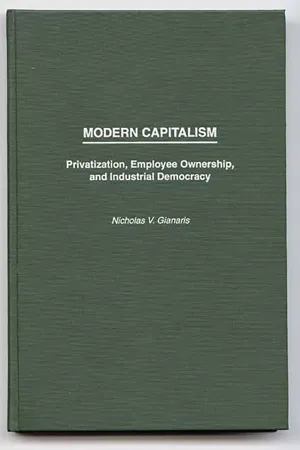
Modern Capitalism
Privatization, Employee Ownership, and Industrial Democracy
- Nicholas V. Gianaris(Author)
- 1995(Publication Date)
- Praeger(Publisher)
Privatization is the process of transferring economic activities from the public sector to the private sector. It may include transfer of ownership or controls in favor of private institutions, employers, and other individuals. Specific norms of Privatization may include: divestment, by selling an enterprise or shares, by free transfer to employees and the public at large 58 Modern Capitalism or by liquidation of inefficient state enterprises and selling their assets; delegation, by contracting services to the private sector, by providing grants or vouchers to producers or consumers for certain services (housing, food, education, health) and by mandating or requiring private agencies to provide services such as unemployment insurance; displacement, by withering away inadequate state activities and replacing them by the private sector as a better alternative and as a result of default, withdrawal, or deregulation and reduction in state monopolization and bureaucratic controls. 1 Con- tracting and franchising of municipal services, including waste collection, street repair, street lights, and vehicle towing are widespread. Privatization and democratization or property ownership, through divestment, employee ownership, and contracting for services take place in almost all countries, regardless of the economic system they follow (capitalist, mixed economy, socialist and particularly former socialist econ- omies) or the stage of development (developed, semideveloping). Close to 100 countries had completed more than 600 Privatization trans- actions and more than 700 additional ones were planned by 1988. Some $39.2 billion were the proceeds from major Privatization in 1988 and $24.8 in 1989. The Japanese sale of 9.6 percent of Nippon Telegraph and Telephone gave $22.8 billion and the British sale of the water industry $8.4 billion. eBook - PDF
- Sheila B. Kamerman, Alfred J. Kahn, Sheila B. Kamerman, Alfred J. Kahn, Sheila Kamerman, Alfred Kahn(Authors)
- 2014(Publication Date)
- Princeton University Press(Publisher)
Privatization describes a direction of change, but it does not denote a specific origin or destination. Its meaning depends on the point of departure—the public/private balance previously struck in a particular domain. And it is a critical question whether moving from public to private in the sense of state to nonstate entails a movement in the other senses: from open to closed (in access to information) or from the whole to the part (particularly in the distribution of benefits). THE POLITICAL MEANING OF Privatization The term Privatization did not gain wide circulation in politics until the late 1970s and early 1980s. With the rise of conservative governments in Great Britain and the United States, Privatization came primarily to mean two things: (1) any shift of activities or functions from the state to the private sector; and (2) more specifically, any shift from public to private of the production of goods and services. 2 Besides directly producing ser- vices, governments establish the legal framework of societies and regulate 2 On the ambiguities of classifying public and private organizations, see Musolf and Seid- man (1980); on the ambiguous character of public authorities in the United States, see Walsh (1980). 22 Paul Starr social and economic life, and they finance services that are privately pro- duced and consumed. The first, broader definition of Privatization in- cludes all reductions in the regulatory and spending activity of the state. The second, more specific definition of Privatization excludes deregula- tion and spending cuts except when they result in a shift from public to private in the production of goods and services. This more focused defi- nition is the one that I shall use here. It leaves open the possibility that Privatization may not actually result in less government spending and reg- ulation—indeed, may unexpectedly increase them. Several further points about this definition need clarification. eBook - PDF
Privatisation in Ireland
Lessons from a European Economy
- D. Palcic, E. Reeves(Authors)
- 2011(Publication Date)
- Palgrave Macmillan(Publisher)
Starr (1988) provides a useful working definition of privatisation as any shift in the production of goods and services from public to pri- vate. According to Starr (1988: 16–17), this more focused definition of privatisation includes the following sub-categories: 1) The cessation of public programmes and disengagement of gov- ernment from specific kinds of responsibilities. At a less drastic level, this may involve the restriction of publicly produced services in volume, availability, or quality which may lead to a shift by consumers toward privately produced and purchased substitutes (called ‘privatisation by attrition’ when a government lets public services run down); 2) The transfer of public assets to private ownership, through the sale or lease of public land, infrastructure and SOEs; 3) The withdrawal of government from the production, but not the financing, of services, for example, through contracting-out or vouchers; and Privatisation in Europe 9 4) The deregulation of entry into activities previously treated as public monopolies. This book concentrates on one single variant of Starr’s (1988) typology, namely the transfer of SOEs to the private sector (see 2 above), and the use of the term ‘privatisation’ hereafter refers only to their sale. In this context, it is also relevant to acknowledge that there is no standard definition of SOEs. Here, they are understood to be commercial public enterprises that earn the majority of their income from the sale of goods and services. 1.2 Development of state-owned enterprises In order to place privatisation policies in perspective, it is first necess- ary to understand the original rationale for the creation of public enter- prises in Europe. Megginson and Netter (2001) describe how, throughout history, ownership of the means of production and trade moved back and forth from the public to the private sector.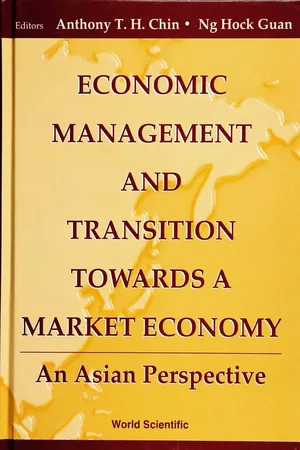 eBook - PDF
Economic Management and Transition Towards a Market Economy
An Asian Perspective
- Anthony T H Chin, Ng Hock Guan;;;(Authors)
- 1996(Publication Date)
- WSPC(Publisher)
Where this is not possible, Privatization per se can be expected to contribute little to increasing economic efficiency or even io reducing the fiscal burden. It is inappropriate to regard the public and private spheres as coherent packages of functional, philosophical and symbolic attributes. There is no necessity that change in ownership status may accompany competition or may necessarily lessen incentive problems arising from imperfect information and delegation of authority. This suggests the possibility of improving efficiency without any change in the ownership status. Predictably empirical studies do not provide unambiguous results as to whether a public or a private Firm is more efficient * It is also worth noting that many firms are neither public nor private but are mixed, i.e., in the joint sector. It appears that economic theory has paid insufficient attention to these types of firms. However, the existence of mixed enterprises dilutes the importance of ownership as a criterion for inferring economic performance. 4. Privatization: Methods and Implementation While the term Privatization is widely used, it is a highly elastic term in the sense that a wide variety of market-oriented initialives affecting ownership, performance, finance, organisation, and business environment are lumped under it. It is therefore not surprising that the term Privatization is usually not defined, and when an attempt is made, the definition ranges from extreme specificity to extreme generality. A scheme of methods or techniques of Privatization, divided by area of operation involved is provided in Figure 10.1. Ownership The first area of operation to be examined is Privatization of ownership. The main method to transfer ownership is divestment, which is crudely, the sale of assets or shares of the enterprises to the private sector. While the concept is apparently simple, among the critical considerations are the extent of divestment and Ihe determination of buyers.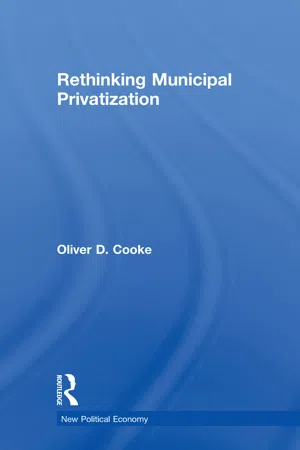 eBook - ePub
- Oliver D. Cooke(Author)
- 2007(Publication Date)
- Routledge(Publisher)
A system of state (rather than private) ownership and operation of industrial enterprises and state planning (rather than markets) amounted to a shift from a private to a state form of capitalism.” 22 In the context of the Privatization of state-owned enterprises, the argument here can be interpreted as reversing the words private and state in the italicized portion of the just-quoted passage, viz., the Privatization movement that has so forcefully emerged over the course of the past quarter-century has generally involved transforming state-owned capitalist enterprises into privately-owned capitalist enterprises. To be clear, from a class perspective, any Privatization involving the transfer of state-owned enterprises to the private sector is understood to involve a host of changes in a number of economic, political, cultural, and natural processes. Moreover, such changes undoubtedly cascade across the social environment (within which the Privatization takes place) in complex and contradictory ways. At the same time, the Privatization programs that have been carried out around the world over the course of the past quarter century have, in general, not involved any change in the class structures of the state-owned enterprises that have been privatized. Whereas prior to Privatization, state administrators or bureaucrats (or, boards of individuals appointed and/or closely connected to them) appropriated and then distributed the surpluses produced by the productive wage laborers employed (by the government) in state-owned enterprises, following Privatization, this appropriation and distribution has been carried out by a different group of private individuals—generally, the board of directors of the private capitalist enterprises that have often become responsible for the operation of newly-privatized enterprises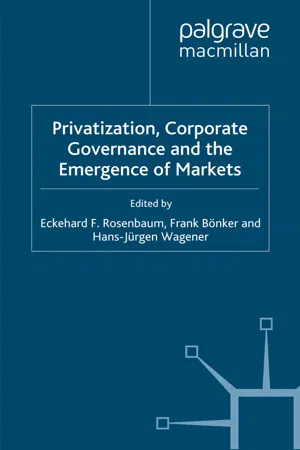
- E. Rosenbaum, F. Bönker, H. Wagener, E. Rosenbaum, F. Bönker, H. Wagener(Authors)
- 2000(Publication Date)
- Palgrave Macmillan(Publisher)
1 Privatization in Context: an Introduction Eckehard F . Rosenbaum, Frank Bönker and Hans-Jürgen Wagener Privatization is a major building block of transformation. At the same time, there are no precedents in Western countries for a Privatization programme of the size and scope currently under way in Central and Eastern Europe. These peculiarities of Privatization in Central and Eastern European countries and its long-term character have sparked and sustained the continuing interest of economists and other social scientists in the issue. Moreover the hitherto accumulated empirical evidence provides an unequalled opportunity to address issues, per - taining for instance to corporate governance and to the relationship between Privatization and the emergence of markets, which not only play a central role in transformation countries but which are also rele- vant in established market economies, highlighting as they do ques - tions which are of paramount importance for the understanding of market economies themselves. For obvious reasons, the literature on post-communist Privatization was, at the beginning of transformation, essentially normative. On the basis of first principles and some, rather meagre, experience from privat- ization in Organization for Economic Cooperation and Development (OECD) and developing countries, a flood of papers tried to categorize the available options and discussed the pros and cons of different ways to privatize state-owned enterprises. In the course of transition, however, this picture has changed and an increasing number of studies has begun to develop a modified and in many respects more elaborate perspective on Privatization. To understand this shift of perspective, it needs to be emphasized first that Privatization cannot be seen as a genuine economic objective. Rather, if the ultimate objective of the economic transformation is the improvement of economic welfare through increased competition and 1 eBook - PDF
Public Finance in Small Open Economies
The Caribbean Experience
- Michael Howard(Author)
- 1992(Publication Date)
- Praeger(Publisher)
THE ECONOMICS OF Privatization The major economic issue involved in Privatization is that of efficiency. Property rights theory suggests that public enterprises operating in competi- tive markets should be privatized. The argument applies to manufacturing industries, airlines, and other competitive service industries. Competition pro- vides greater incentive to private managers to increase allocative and produc- tive efficiency. 7 The replacement of a public monopoly by a private monopoly may not necessarily lead to significant efficiency gains. However, it is generally recog- nized that Privatization can reduce political interference and enhance the quality of management. In any case, a private monopoly in the field of public utilities has to be regulated, to guarantee social efficiency by way of equitable pricing arrangements. The above arguments need some modifications. Some governments are not inclined to privatize, by way of divestiture, enterprises which are profitable or socially efficient, where social efficiency is a highly valued objective. It is contended that Privatization should be considered mainly for those com- mercial enterprises which have become a financial burden on the taxpayers. Continued maintenance of such loss-making enterprises also increases their financial inefficiency, because public sector firms have easy access to credit and government subsidies and are protected from competition. There are also political constraints involved in Privatization. The political directorate may regard certain public utilities as employment agencies. Privati- zation reduces such political influence. Trade unions, too, may fear that Privatization would result in increased unemployment, thereby reducing their political influence. One must, therefore, address the political economy of Privatization, rather than confine the analysis mainly to economic efficiency arguments (Poole 1987). eBook - PDF
Privatization
Successes and Failures
- Gérard Roland(Author)
- 2008(Publication Date)
- Columbia University Press(Publisher)
Starting in 2000 , the government transferred management control and sold ma-jority equity stakes to private owners in 14 companies (strategic sales). However, the new government elected in 2004 has ruled out the privatiza-tion of profitable firms and has also stated that efforts will be made to turn around loss-making firms before they are considered for privatiza-tion. Restructuring strategies however have been almost uniformly un-successful in the past (Department of Disinvestment, 2001 ). In the third section, we describe the progress made in Privatization and the two main approaches used to privatize firms in India: partial privati-zation and strategic sales. While partial Privatization is politically less costly because it does not involve the transfer of management control, there is a risk of continued political interference in these firms. Strategic sales, on the other hand, may generate more efficiency improvements but are politically costly to implement. In the fourth section, we discuss evidence suggesting that political competition and patronage play a significant role in the Privatization pro-cess in India. From the evidence, it appears that the government is reluc-tant to privatize firms located in regions where the governing party faces significant competition from opposition parties. Political patronage also Privatization IN SOUTH ASIA 171 appears to influence the process, as the evidence suggests that politicians are unwilling to give up control of certain firms. We discuss evidence that partial Privatization has led to an improve-ment in the operating performance of Indian firms in the fifth section. According to agency theory, state-owned firms have difficulty monitoring managers because there is neither an individual owner with strong incen-tives to monitor managers nor a public share price to provide information on manager actions as judged by stock market participants. eBook - PDF
- A. Knoester, A.H.E.M. Wellink(Authors)
- 2014(Publication Date)
- North Holland(Publisher)
and Institute of Economics, Hungarian Academy of Sciences, Budapest, Hungary. ** Fourth Tinbergen Lecture, delivered on October 19, 1990 in Utrecht for the Royal Netherlands Economic Association. The Hungarian text of the lecture was translated by Brian McLean, to whom I am grateful for his excellent work. I also thank Maria Kovâcs and Carla Krüger for their assistance in gathering the literature on the subject. 1 There is a very extensive literature on the subject. I have selected here just a few of the studies in English which deal with Eastern European Privatization: Fischer and Gelb (1990), Frydman and Rapaczynski (1990), Lipton and Sachs (1990), Levandowski and Szomburg (1989), and Hinds (1990). An excellent survey of the polemic is provided by Stark (1990). This brief list does not in-clude works concerned with Privatization in the capitalist countries. Reprinted from De Economist vol. 140/2 (1992), pp. 153-176 104 J. KORNAI although I do put forward my own views. 2 My main purpose is to help readers to conduct a methodical analysis of the problem. I outline an intellectual struc-ture allowing people to assemble the body of information they possess and con-front the alternative views encountered with each other before formulating a position of their own. The word 'Privatization', which features in the title, is used in two senses. In the narrower sense it means the transfer of assets hitherto owned by the state into private hands. The broader interpretation covers the property relations in the economy as a whole, so that Privatization of the economy must be understood to mean that the share of the private sector grows until it ultimately becomes the dominant economic sector. This study is concerned with the con-cept of Privatization in that broader sense. The title mentions Eastern Europe, and in the main the study deals with the group of small countries embarking on the road of postsocialist transition.
- Gerard Caprio, Jonathan L. Fiechter, Robert E. Litan, Michael Pomerleano, Gerard Caprio, Jonathan L. Fiechter, Robert E. Litan, Michael Pomerleano(Authors)
- 2010(Publication Date)
- Brookings Institution Press(Publisher)
2 It is in these regions of the developing world that the economic effects of Privatization are likely to be most pronounced. Bank Privatization plays a key role in economic development. An analysis of empirical studies on bank Privatization shows that Privatization improves perfor-mance over continued state ownership even in poor regulatory environments. 3 An investigation of bank Privatizations that use public security offerings as the divest-ment mechanism concludes that profitability, operating efficiency, leverage, and noninterest revenue improve after Privatization. 4 The positive efficiency effects of bank Privatization, in turn, are of great importance in the economic development of emerging economies. State ownership negatively affects bank performance and 2. Barth, Caprio, and Levine (2001). 3. Clarke, Cull, and Shirley (2003). 4. Verbrugge, Megginson, and Owens (1999). financial sector development. 5 Greater state ownership in 1970 was found to be associated with less financial development, slower growth, and lower productiv-ity in 1995. 6 However, bank Privatization will deliver significant efficiency gains only if gov-ernment relinquishes control and abstains from interfering in the affairs of the privatized bank. Banks in emerging economies have a strong, perverse incentive to fund former debtors—even though these state-owned enterprises are less effi-cient and more risky than private firms—because by doing so they have the potential to receive payment for previous debts. 7 This inevitably leads to lower productivity of investment and greater concentration of risk. It is worth examin-ing the effectiveness of different methods of Privatization for avoiding this sub-optimal behavior. A related issue is the fact that interest groups often strongly oppose bank pri-vatization. Apart from the employees of state-owned banks, the beneficiaries of the perverse lending practices often try to obstruct bank Privatization.
Index pages curate the most relevant extracts from our library of academic textbooks. They’ve been created using an in-house natural language model (NLM), each adding context and meaning to key research topics.

