Business

Responsible Leaders
Responsible leaders in business are individuals who prioritize ethical decision-making, sustainability, and social responsibility in their leadership approach. They are committed to creating a positive impact on their employees, communities, and the environment, while also ensuring the long-term success and integrity of their organizations.
Written by Perlego with AI-assistance
Related key terms
1 of 5
12 Key excerpts on "Responsible Leaders"
 eBook - ePub
Strategic Corporate Social Responsibility
A Holistic Approach to Responsible and Sustainable Business
- Debbie Haski-Leventhal(Author)
- 2021(Publication Date)
- SAGE Publications(Publisher)
These leadership styles and approaches demonstrate that when the leader of a company is authentically passionate about making a difference and develops a vision that is about higher purpose, people will be more inspired to follow it. It does not really matter which leadership style is adopted. What is important is the focus of the leadership and how it is used to serve. As such, the holistic approach to CSR leadership asks that leaders approach this great challenge by embedding responsibility in everything they do and in every aspect of the company they lead.Key definitions
- A sustainable leader is someone who inspires and supports action towards a better world (Fistis et al., 2014).
- Responsible Leadership is about making business decisions that, alongside the interests of shareholders, also take into account all other stakeholders, such as workers, clients, suppliers, the environment, the community and future generations (Financial Times, 2017a).
- Responsible Leadership is the art of and ability involved in building, cultivating and sustaining trustful relationships to different stakeholders, both inside and outside the organisation, and in co-ordinating responsible action to achieve a meaningful, commonly shared business vision (Maak, 2007).
- Ethical leadership is the demonstration of normatively appropriate conduct through personal actions and interpersonal relationships, and the promotion of such conduct to followers through two-way communication, reinforcement and decision making (Brown et al., 2005).
- Transformational leaders work by tapping into and inspiring the higher motivations of followers as well as by understanding that people are also purpose- and vision-driven. They create a strategic vision, communicate the vision, model the vision and build commitment towards the vision (Bass, 1985; Burns, 1978).
- Servant leadership is defined as leadership that focuses on serving others, mainly employees, due to a sense of calling and higher purpose (Greenleaf and Spears, 2002).
- Authentic leaders display behaviour true to the inherent moral values of the leader. Such leaders know who they are and are true to self (Avolio and Gardner, 2005).

- Sebastian B. Reiche, Günter K. Stahl, Mark E. Mendenhall, Gary R. Oddou, Sebastian B. Reiche, Günter K. Stahl, Mark E. Mendenhall, Gary R. Oddou(Authors)
- 2023(Publication Date)
- Routledge(Publisher)
Today, executives face socially conscious investors, customers, employees, and a public that expect businesses to take a larger and more responsible role in society. Accordingly, they need to understand and calibrate social and environmental issues that affect their firms and devise strategies that respond to challenges as varied as climate change, a COVID-19 pandemic, the rich–poor gap, and increased workforce diversity. They must also be prepared to deal with activist groups, the threat of protest, calls for greater transparency, and the dramatic increase in exposure provided by the internet and social media.Amid all these changes, business leaders still have to do what they have always had to do: produce growth, deliver results, develop relationships with people, and innovate to meet marketplace needs and beat competitors. What does it take for leaders to be successful in the business world today? It requires new forms of individual and collective learning.Leading Responsibly
In nearly every survey and study, leadership stands out as the number one factor driving responsible behavior in companies (Conference Board, 2016 ; PWC, 2016 ). This starts with the CEO, of course, but includes managers at every level and leaders of work councils. In popular imagination, the high-powered, profit-driven, take-charge model of leadership is the prototype for big business, particularly in the US, but in favor by degrees around the world (Khurana, 2002 ). Yet the benefits of that model are increasingly suspect.In a study of over 500 CEOs operating across 17 countries, for instance, researchers compared CEOs who gave primacy to economic factors (profits, cost control, and market share) in their decision-making versus those who stressed stakeholder values (customers, employee relations, environmental concerns, and communities). They found that economic leaders were seen as authoritarian by their direct reports, whereas CEOs with a stakeholder orientation were viewed as more visionary. Stakeholder CEOs were also more likely to lead firms that performed better financially, and their followers were more apt to show extra effort and make sacrifices for the sake of the firm (Waldman, Seigel, & Javidan, 2006 eBook - ePub
- Rune Todnem By, Bernard Burnes, Mark Hughes, Rune Todnem By, Bernard Burnes, Mark Hughes(Authors)
- 2023(Publication Date)
- Routledge(Publisher)
Conscious of the divide, it strives to remain reflexive about its post-positivist, normative roots while exploring the empirical reality of leading responsibly. Responsible Leadership places itself at the interface of leadership studies, ethics, and business ethics. It has embraced the reflective paucity on the new challenges of present leaders and (their) corporations to act ‘responsibly’ in a globalized world under the threat of severe or even existential ramifications in the case of defective behavior (e.g. Maak, 2007 ; Maak & Pless, 2006 ; Voegtlin et al., 2012). Among the different contributions, that of Maak and Pless are most notable, as their work are the most sensitive concerning the three illustrated problems of justification. Their work embeds Responsible Leadership in the stakeholder literature. Hence, leadership has to acknowledge an increasing cultural and moral diversity as well as the new role of the corporation in society. Maak and Pless (2006, p. 99) define Responsible Leadership as ‘a social-relational and ethical phenomenon, which occurs in social processes of interaction. (…) [It] takes place in interaction with a multitude of followers as stakeholders inside and outside the corporations’. It becomes ‘a values-based and through ethical principles driven relationship management between leaders and stakeholders who are connected through a shared sense of meaning and purpose through which they raise another to higher levels of motivation and commitment for achieving sustainable values creation and social change’ (Pless, 2007, p. 438). More recent is the politically extended concept of Responsible Leadership (see esp. Patzer, 2009, as well as Patzer & Scherer, 2010 ; Patzer et al., 2018 ; Voegtlin et al., 2012). Inspired by the discussions on political CSR (Scherer & Palazzo, 2007), it reflects upon the leader's responsibility in the context of the theory of deliberative democracy and discourse ethics (especially Habermas, 1993, 1996) eBook - ePub
- Nicola Pless, Thomas Maak, Nicola Pless, Thomas Maak(Authors)
- 2021(Publication Date)
- Routledge(Publisher)
For example, a responsible leader may have to struggle between (a) including a specific stakeholder with a purely instrumental approach to CSR (e.g., a partner in the supply chain with a poor human rights record in operations conducted abroad) in the multi-stakeholder network, and (b) ensuring that the supply chain, as a whole, contributes to the common good. Another leader whose strong preferences for corporate sustainability are not aligned with an organizational sustainability agenda (Hahn et al., 2015) may need to persuade the board of directors that corporate social responsibility initiatives are based on financial logic rather than personal moral values (Waldman & Bowen, 2016); otherwise, corporate social sustainability initiatives that are crucial for the common good may not be approved. Another responsible leader may avoid publicizing sustainable initiatives to ensure that these responsible initiatives are pursued. Carlos and Lewis (2018) showed that some organizations that obtain prominent certifications may decide not to publicize them. These authors showed that concerns about being perceived as hypocritical may cause those organizations to withhold their certification status strategically. Add to this the ethical requirements of Responsible Leadership and it becomes clearer still how complex paradoxes operate No longer available |Learn more
Leadership
Research Findings, Practice, and Skills
- Andrew DuBrin(Author)
- 2018(Publication Date)
- Cengage Learning EMEA(Publisher)
In the next chapter, we focus on how leaders acquire and maintain power and their use of organizational politics. doing good deeds—toward being socially responsi-ble and creating an ethical organizational culture. Among the many possible socially responsible and ethical acts are (1) providing strategic leadership of social responsibility and ethics, (2) creating a pleas-ant workplace, (3) helping build a sustainable envi-ronment, (4) engaging in social entrepreneurship, (5) engaging in philanthropy, (6) working with sup-pliers to improve working conditions, (7) establishing written codes of conduct, (8) developing formal mech-anisms for dealing with ethical problems, (9) accept-ing whistleblowers, (10) providing training in ethics, and (11) minimizing abusive supervision through the organization. High ethics and social responsibility are some-times related to good financial performance, accord-ing to research evidence and opinion. A meta-analysis revealed that ethical leadership was positively related to job attitudes, job performance, and overall evalua-tion of the leaders. Employees who work in an ethical environment tend to be better motivated. Corporate social responsibility can help in recruiting talented employees, and can lead to higher commitment to the company. Corporate social performance and corpo-rate financial performance often feed and reinforce each other. SUMMARY Principles of ethical and moral leadership all center on the idea that a leader should do the right thing, as per-ceived by a consensus of reasonable people. Key prin-ciples of ethical and moral leadership are as follows: (1) be honest and trustworthy and have integrity in dealing with others, (2) pay attention to all stakehold-ers, (3) build community, and (4) respect the individual. eBook - ePub
Corporate Behavior and Sustainability
Doing Well by Being Good
- Güler Aras, Coral Ingley(Authors)
- 2016(Publication Date)
- Gower(Publisher)
Serving a greater purpose, making a meaningful contribution to a good, just society, using resources thoughtfully, reflecting potential consequences of own actions on others (in a broad sense) Team members, stakeholders (including shareholders), society, the larger social and ecological environment Inviting stakeholders to share concerns, invite team members to contribute to co-creative processes, facilitate spaces for the enactment of purposeAs our models show, leadership tends to become more responsible in itself as the complexity of self development increases, in the sense that it gradually responds to larger groups of interested or concerned individuals, while only the most complex levels conceive of responsibility as a commitment generally going beyond attaining particular(istic) organizational goals and interests. Only they will therefore be capable and prepared to involve broader numbers of extra-organizational stakeholders without perceiving this as a threat to their personal or organizational identity. In other words, there are varying degrees of both responsibility and RL, depending on the extent to which the respective leader is able to transcend and contextualize his/her (organization’s/business’) primary needs and interests and see the latter as part of a larger context, i.e. of the social or even eco-system the respective organization is part of. Karen Litfin therefore suggests to talk about “responsability” due to the “wider expanse of reality (…) and capacity to respond” (Litfin 2003, p. 51).In the second part of this chapter, we will explore this claim in more detail. We will show that as complexity requirements increase, successful RL becomes less and less a matter of “enlightened individuals” possessing the “right“ personal traits and qualities but rather a matter of ongoing collaborative inquiry and effort. In fact, this claim is in line with late Lawrence Kohlberg’s assumption that his 6th order No longer available
Leadership
Research Findings, Practice, and Skills
- Andrew DuBrin(Author)
- 2022(Publication Date)
- Cengage Learning EMEA(Publisher)
Learning Objectives 141 Chapter Outline Leadership Ethics and Social Responsibility 6 C h a p t e r After studying this chapter and doing the exercises, you should be able to 6.1 Pinpoint key principles of ethical and moral leadership. 6.2 Apply a guide to ethical decision making. 6.3 Describe what leaders can do to foster an ethical and socially responsible organization. 6.4 Identify the link between business ethics and organizational performance. Principles and Practices of Ethical and Moral Leadership Five Ethical Leadership Behaviors Factors Contributing to Ethical Differences The Ethical Mind for Leaders Guidelines for Evaluating the Ethics of a Decision A Sampling of Unethical Leadership Behaviors Leadership, Social Responsibility, and Creating an Ethical Organizational Culture Providing Strategic Leadership of Ethics and Social Responsibility Recognizing the Triple Bottom Line of Profit, People, and Planet Creating a Pleasant Workplace Helping Build a Sustainable Environment Engaging in Social Entrepreneurship Engaging in Philanthropy Working with Suppliers to Improve Working Conditions Establishing Written Codes of Ethical Conduct Developing Formal Mechanisms for Dealing with Ethical Problems Accepting Whistleblowers Providing Training in Ethics and Social Responsibility Minimizing Abusive Supervision throughout the Organization Taking a Stand on Social Issues Ethical and Socially Responsible Behavior and Organizational Performance Summary Key Terms Guidelines for Actions and Skill Development Leadership Case Problem A Leadership Case Problem B Notes L eila Janah, a social entrepreneur who devoted her career to creating job opportunities for the world’s poorest com- munities, died at age 37 from a rare soft-tissue cancer. Yet the work of the organizations she founded continues. As the founder and chief executive officer (CEO) of the Sama Group, which includes Samasource, Samaschool, and LXMI, Janah became a well-publicized social entrepreneur. eBook - PDF
- Ronald R. Sims(Author)
- 2017(Publication Date)
- Information Age Publishing(Publisher)
Ethical Leadership in Organizations 275 ◾ to reduce any fear culture; ◾ to get balanced decision making; ◾ to get consistency of culture in a changing environment; ◾ to make the right choices generating sustainability; and ◾ to create transparency and all the benefits it brings. Then the following question was asked, “And how many of these are good for business?” The somewhat surprised answer was “they all are.” Historically, there is a strong default mentality in the business world that at the crux, company needs (success and competitiveness) override ethical concerns. The example above alone gives 14 reasons to disagree with this and believe that in the contemporary, global world of work, good ethics are increasingly important for a successful, sustainable business. An additional reason for this view comes from a recent global study by IBM comparing the demands of different generations which found that Millennials (between 23 and 36 years old in 2016) regard fairness and eth- ics in the workplace as even more important than recognition and oppor- tunity. 170 This is a real shift. Many are both today’s “followers” and young leaders as well as the next generation of senior leaders. Ethical leadership is important to building or fostering and strengthen- ing interpersonal relationships which are key to organizational success. Lead- ers who engage in ethical behavior strengthen interpersonal relationships, which may reinforce the mechanisms that encourage followers to recognize and accept leaders’ personal influence. 171 As noted earlier, it has been rea- soned that, ‘‘because ethical leaders are caring and fair, relationships with ethical leaders are built upon social exchange and norms of reciprocity’’ (p. 967). eBook - ePub
Creating Employee Champions
How to Drive Business Success through Sustainability Engagement Training
- Joanna Sullivan(Author)
- 2017(Publication Date)
- Routledge(Publisher)
- Encourage local capacity building through close co-operation with the local community [. . .]
- Encourage human capital formation, in particular by creating employment opportunities and facilitating training opportunities for employees.
1.3 Leadership in action: What makes a sustainability leader?Today’s business leaders are faced with a myriad of difficult challenges. No longer focused only on profitability, today’s executives have to consider strategies to deal with climate change, resource scarcity, price volatility and radical transparency. All demand intelligent and far-sighted strategies. All require thought.It’s especially important that leaders have focus and clarity in making decisions, creative insight to transform their businesses, compassion for their customers and employees, and the courage to do things their own way. Today’s leaders think before they act, aware of the consequences, mindful about the future.Sustainability leaders think firstT ry – Sustainability leaders reward innovation and respect failure. They give employees the space to encourage creativity. They let people try and fail, without judgment.H uman – Sustainability leaders act and sound like citizens, not executives. They talk with compassion. They show courage. They are socially responsible.I nfluence – Sustainability leaders persuade by the power of argument and not by position alone.Network – Sustainability leaders build and manage networks, even those outside business norms. In a stakeholder society everyone matters.K nowledge – Sustainability leaders have an integrated approach to the challenges based on a broad understanding of all business functions.F acilitate – Sustainability leaders join the dots and create new pathways. They don’t think in silos. They encourage cross-departmental conversations.I nstinct – Sustainability leaders are comfortable acting with speed and taking decisions even when only limited information is available. They trust their gut feeling.R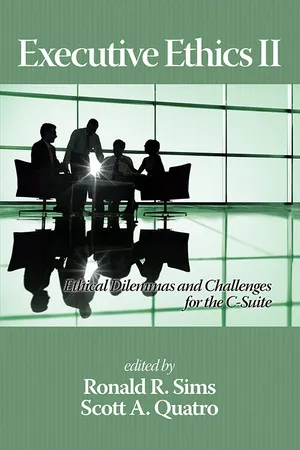 eBook - PDF
Executive Ethics II
Ethical Dilemmas and Challenges for the C Suite
- Ronald R. Sims, Scott A. Quatro, Ronald R. Sims, Scott A. Quatro(Authors)
- 2016(Publication Date)
- Information Age Publishing(Publisher)
Additional behaviors and skills critical for ef- fective leadership are ethics (Neubert, Carlson, Kacmar, Roberts, & Chonko, 2009; Walumba, Mayer, Wang, Wang, Workman, & Christensen, 2011), the ability to build relationships and enhance collaboration (Martin, 2005), and treating individuals as unique (Gilley, Heames, & Gilley, 2012), among others. Ethical Leadership Ethics, a subject discussed for centuries (Toor & Ofori, 2009), has been anecdotally defined as “doing the right thing when no one else is watching” (Leopold, n.d.). In a business context, ethics generally refers to the social and moral obligations of business. Thus, leaders and managers must pay attention to the obligations and expectations society places on business. It has been fairly well established that managers and leaders influence ethi- cal culture (Bass & Steidlmeier, 1999; Ciulla, 1995; Trevino, Brown, & Hartman, 2003; Trevino, Hartman, & Brown, 2000). In terms of ethics, ethical leadership has been defined as the “demonstration of normatively appropriate conduct through personal actions and interpersonal relationships, and the promotion of such conduct to followers through two-way communication, reinforcement, and decision-making” (Brown, Trevino, & Harrison, 2005, p. 120). Establishing a positive ethical culture can lead to improvements in the entire culture of an organization (Brown et al., 2005), such as extra effort, reporting problems, and other employee outcomes. Previous studies have linked ethical leadership to higher job satisfaction and job commitment (Neubert et al., 2009), better performance (Walumba et al., 2011), and lower levels of deviance (Mayer, Kuenzi, Greenbaum, Bardes, & Salvador, 2009). Thus, the characteristics and behaviors of those who would have such an influence over an organization are important ( Jordan, Brown, Tre- vino, & Finkelstein, 2013). Jordan et al. (2013) focused on what made fol- lowers, or employees, perceive that executives were ethical. eBook - ePub
Careers and Talent Management
A Critical Perspective
- Cristina Reis(Author)
- 2015(Publication Date)
- Routledge(Publisher)
Why do some senior executives engage in boundaryless careers while others do not? Is it purely dependent upon a personal choice, or is there something more to it? Put in slightly different terms, under what conditions are senior executives more likely to engage in a boundaryless career? One idea to answer these questions would be to involve the literature on social responsibility, which is concerned with the variations in corporate behavior across different cultures and economic environments. As discussed in the previous section, senior executives’ ethical identity is important and relates to their organizational freedom in ethical decision-making. Most likely, they will choose sustainable organizations where there is an appeal to contribute both to other sustainable organizations, with their skills and knowledge, and also to the well-being of societies and future generations. The focus on corporate social responsibility engages managers in making effective use of their talents (Tymon et al., 2010; Vaiman et al., 2012; Al Ariss et al., 2014).Beginning with the stakeholder theory within a social responsibility perspective, researchers recognize that the way in which corporations treat their stakeholders depends upon the organizations within which they operate (e.g., Fligstein and Freeland, 1995; Hall and Soskice, 2001). In the same way, senior executives will recognize their opportunities as executives across organizations by the way in which these organizations treat their stakeholders. First, it is necessary to define what is meant by stakeholder theory in the context of executives’ boundaryless careers. Following the social responsibility literature, stakeholders are ‘individuals or groups with which the corporation interacts [and] who have a stake or a vested interest in it’ (Carroll and Buchholtz, 2000: 21). Stakeholders usually include employees, consumers, suppliers and local communities, and they will influence the opportunities for senior executives in a second role as executives if they see that they are bringing an improvement to themselves through the work they will do in the organization. Stakeholder theory is important because, according to Campbell (2007), corporations act in socially responsible ways if they do two things. First, they must not perceptively do anything that could harm their stakeholders and, second, if corporations do cause harm to their stakeholders, they must then rectify this as soon as it is discovered and brought to their attention. eBook - PDF
Decision-Making for a Sustainable Environment
A Systemic Approach
- Chris Maser(Author)
- 2012(Publication Date)
- CRC Press(Publisher)
.Such.leader-ship.is.also.pragmatic . .It.has.been.observed.over.and.over,.as.previously.stated,.that. the.only.leader.soldiers.will.reliably.follow.when.risking.their.lives.in.battle.is.one. they.feel.is.competent.and.concerned.with.their.relative.safety . A.leader’s.first.responsibility.is.to.help.followers.examine.their.senses.of.reality . . The.last.responsibility.is.to.give.credit.and.say.“thank.you .” .In.between,.one.must. provide.and.maintain.momentum.and.ensure.effectiveness . Most.people.confuse.effectiveness.with.efficiency . .Effectiveness.is.doing.the.right. thing,.whereas.efficiency.is.doing.the.thing.in.the.most.expedient.manner,.although. at.times.it.may.not.be.the.right.thing.to.do . When.the.difference.between.effectiveness.and.efficiency.is.understood,.it.is.clear. that. efficiency. can. be. delegated,. but. effectiveness. cannot . . In. terms. of. leadership. toward. social-environmental. sustainability,. effectiveness. enables. others. to. reach. toward.their.personal.potential.through.participation.in.the.process.and.leaves.the. world.a.little.more.sustainable.at.the.same.time . .In.so.doing,.a.leader.leaves.behind. a.legacy.of.assets.invested.in.other.people . A.leader.is.also.responsible.for.developing,.expressing,.and.defending.the.follow-ers’. civility. and. values,. even. if. they. do. not. prevail. totally. in. the. ultimate. decision . . Paramount.in.the.process.of.pursuing.social-environmental.sustainability.is.good.man-ners,.mutual.respect.for.one.another,.and.an.appreciation.of.the.way.in.which.we.serve. one.another . .In.this.sense,.civility.focuses.on.identifying.values,.but.without.insisting. that.established.formulas.be.followed.to.coerce.the.people.to.“go.with.the.flow .” 183 The Essence of a Responsible Decision Maker For.participants.to.be.denied.an.opportunity,.not.feel.needed,.and.have.the.beauty. and.novelty.of.ideas.denigrated.is.demoralizing . .It.is.likewise.crushing.to.the.spirit.
Index pages curate the most relevant extracts from our library of academic textbooks. They’ve been created using an in-house natural language model (NLM), each adding context and meaning to key research topics.

