Business

Revenue
Revenue refers to the income generated from the sale of goods or services. It is a crucial metric for businesses, indicating their ability to generate income and sustain operations. Revenue is typically calculated by multiplying the price of goods or services by the quantity sold, and it is a key factor in determining a company's financial performance.
Written by Perlego with AI-assistance
Related key terms
1 of 5


5 Key excerpts on "Revenue"
 eBook - PDF
- Christopher D. Burnley(Author)
- 2018(Publication Date)
- Wiley(Publisher)
In other words, Revenues result in inflows of assets such as cash or accounts receiv- able or decreases in liabilities such as unearned Revenue and are generated by the transac- tions a company normally has with its customers, selling them products and/or providing services. There is a huge range of transactions that can be considered normal operating activities because there are so many different types of businesses. For example, the ordi- nary operating activities for clothing retailers include the sale of clothing and accessories, while the provision of air travel and vacation packages is a normal operating activity for airline companies. Your university or college has a range of activities that are consid- ered normal operating activities. These include providing educational services, selling goods in its bookstore or cafeteria, selling parking passes, and renting rooms in student residences. Revenue is often referred to with other terms, such as sales, fees, interest, dividends, royalties, or rent. As we discussed in Chapter 2, there does not have to be a receipt of cash in order for a company to recognize Revenue. This is why the term economic benefit is used when defining Revenue. While the economic benefit will normally be an inflow of cash at some point, the sale and the receipt of cash do not have to occur at the same time. In this chapter, we will see examples of Revenue transactions for which the cash is received prior to the sale, at the time of sale, or subsequent to the sale. The amount of Revenue (or sales) is one of the most significant amounts reported in the financial statements. For a company to be successful, it must generate Revenues from what it is in the business of doing. A company’s total Revenues must be greater than the expenses incurred to generate them. When total Revenues exceed total expenses, a company reports net income.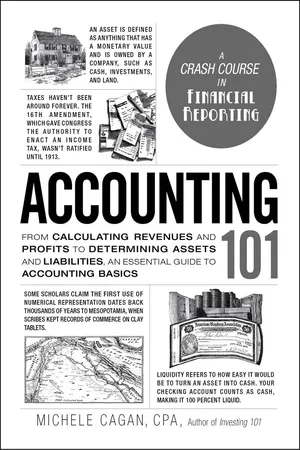 eBook - ePub
Accounting 101
From Calculating Revenues and Profits to Determining Assets and Liabilities, an Essential Guide to Accounting Basics
- Michele Cagan(Author)
- 2017(Publication Date)
- Adams Media(Publisher)
Chapter 5Revenues, Costs, and Expenses
New and small business owners tend to track their profit-related accounts very closely. There’s a good reason for this: Without pretty consistent profits, no business can survive for the long haul. Three numbers go into figuring out profits: Revenues, costs, and expenses. Every business has Revenues (hopefully) and expenses (definitely). Only product-based businesses have costs. In the profit equation, you start with Revenues, then deduct costs and expenses. When the result is positive, you have profits. When it’s negative, your company has sustained a loss for the period.In the profit equation, a product-based company with costs will see an additional and crucial subtotal called gross profit (when expressed as a percentage, it’s called gross margin). That number represents the Revenue left over once you take out the direct costs of the products you are selling. The gross profit tells you how much you have available to cover all the rest of your expenses, ideally leaving some net profit at the end.In this chapter, you’ll learn everything you need to know about Revenues, costs, and expenses, from setting appropriate prices to monitoring and managing product costs to tracking the daily operating expenses. How well a company manages these three income components determines whether they’ll enjoy net profits, or suffer net losses. Passage contains an image
RevenueS
Let’s Make a DealThe goal of every small business is to rack up Revenues (also called sales). After all, Revenues are the first step on the path to profits. When it comes to recording Revenues for accounting purposes, though, it’s not quite as simple as just ringing up a sale. There are different types of sales transactions, and different accounting methods to use. With all the variables surrounding a single sales transaction, the accounting can seem overwhelming, but each transaction really involves just a few basic steps to get the entry recorded and your business another step closer to profitability. eBook - PDF
Financial Accounting Theory and Analysis
Text and Cases
- Richard G. Schroeder, Myrtle W. Clark, Jack M. Cathey(Authors)
- 2022(Publication Date)
- Wiley(Publisher)
As noted earlier, critics of the accounting process favor the economic concept of real income, whereby Revenue is earned continuously over time, but accountants have contended that it is not practical to record Revenues on a continuous basis. Consequently, it is necessary to choose an appropriate point in time to record the occurrence of Revenue. In 1964, the American Accounting Association Committee on Realization addressed this issue and recommended that the concept of realization could be improved if the following criteria were applied: Revenue must be capable of measurement, the measurement must be verified by an external market transaction, and the crucial event must have occurred. 16 The key element in these recommendations is the third criterion. The crucial-event test states that Revenue should be realized on the completion of the most crucial task in the earning process. This test results in the recognition of Revenue at various times for different business organizations. The combined use of the crucial-event test and the transactions approach results in accounting income that measures the difference between sales of the company’s product (Revenue) and costs incurred in the production and sale of that product (expenses). Corporations record Revenues as a result of their ongoing activities. These activities vary from company to company, but they generally consist of the following steps for a manufac- turing company: 1. Ordering raw materials for production 2. Receiving the raw materials 3. Producing the product 4. Marketing the product 5. Receiving customer orders 6. Delivering the product 15 D. Beresford, T. Johnson, and C. Reither, “Is a Second Income Needed?” Journal of Accountancy (April 1996): 69–72. 16 American Accounting Association 1964 Concepts and Standards Research Study Committee, “The Matching Concept,” The Accounting Review 40 (April 1965): 318. 162 INCOME CONCEPTS, Revenue RECOGNITION, AND OTHER METHODS OF REPORTING 7. eBook - PDF
- Harold Bierman, Jr(Authors)
- 2010(Publication Date)
- World Scientific(Publisher)
The income statement compares the Revenues of the period with the expenses that were incurred to gain those Revenues. The difference between the Revenues and expenses is generally defined as the income for the period: Revenues − Expenses = Income . Revenue Recognition The accountant determines income by subtracting expenses from Revenues. As simple as this may seem, there are many complexities that arise when trying to implement this concept. For example, there are many activities and events that must take place to generate Revenues. The accountant adopts the procedure of recognizing Revenues at the time a certain critical event takes place. But which event is important enough to justify the recognition of Revenue? Depending on the situation, there are several acceptable methods of Revenue recognition, but only three will be discussed here. Production basis — recognize Revenue at time of production. Sales ( or accrual ) basis — recognize Revenue at time of sale. Cash receipts basis — recognize Revenue at time cash is received. Production Basis Production is the critical event for companies that produce or construct assets under long-term production or construction contracts. Boeing Aerospace did not build the Boeing 747 and 767 aircrafts to open stock. Instead, these aircrafts are built to customer specifications under production contracts. These contracts specify The Income Statement 91 who the customer is and the amounts and timings of cash flows. As a result, the contracts reduce the uncertainty of the sale and cash receipts events. Companies that produce to order under production or construction contracts often attempt to spread prospective Revenues, related costs, and resulting net income over the life of the contract in proportion to the work accomplished. The method used to accomplish this spreading of Revenues, costs, and income is called the percentage-of-completion or production method. eBook - ePub
UK GAAP 2019
Generally Accepted Accounting Practice under UK and Irish GAAP
- (Author)
- 2019(Publication Date)
- Wiley(Publisher)
An entity is acting as a principal when it has exposure to the significant risks and rewards associated with the sale of goods or the rendering of services. Features that indicate that an entity is acting as a principal include: (a)the entity has the primary responsibility for providing the goods or services to the customer or for fulfilling the order, for example by being responsible for the acceptability of the products or services ordered or purchased by the customer; (b)the entity has inventory risk before or after the customer order, during shipping or on return; (c)the entity has latitude in establishing prices, either directly or indirectly, for example by providing additional goods or services; and (d)the entity bears the customer's credit risk for the amount receivable from the customer. Revenue The gross inflow of economic benefits during the period arising in the course of the ordinary activities of an entity when those inflows result in increases in equity, other than increases relating to contributions from equity participants.This section focuses on the requirements of Section 23 and also refers to the Appendix to Section 23 which provides guidance for applying the requirements in recognising Revenue. The Appendix, however, does not form part of Section 23.3.2Measurement of Revenue
Revenue within the scope of Section 23 shall only be recognised if it meets, at a minimum, the following two criteria: [FRS 102.23.10(c)-(d), 14(a)-(b), 28]- Revenue can be measured reliably; and
- it is probable that the economic benefits associated with the transaction will flow to the entity.
‘Probable’ is defined as ‘more likely than not’. [FRS 102 Appendix I]. The consideration receivable may not be regarded to be probable until the actual consideration is received or when a condition is met that removes any uncertainty.In addition to the above criteria, there are other conditions that need to be met for the recognition of Revenue from the sale of goods and the rendering of services. [FRS 102.23.10, 14]. These are further discussed below at 3.4 and 3.5
Index pages curate the most relevant extracts from our library of academic textbooks. They’ve been created using an in-house natural language model (NLM), each adding context and meaning to key research topics.

