Chemistry

6 + 4 Cycloaddition
The 6 + 4 cycloaddition is a chemical reaction in which a six-membered ring and a four-membered ring combine to form a new six-membered ring. This reaction is a type of cycloaddition, a process in which multiple unsaturated molecules join together to form a cyclic product. The 6 + 4 cycloaddition is an important synthetic tool in organic chemistry for constructing complex ring systems.
Written by Perlego with AI-assistance
Related key terms
1 of 5
7 Key excerpts on "6 + 4 Cycloaddition"
- Ian Fleming(Author)
- 2011(Publication Date)
- Wiley(Publisher)
6.21.Adequately for most purposes, we can state a rule for which cycloadditions can take place and which not: thermal pericyclic cycloadditions are allowed if the total number of electrons involved can be expressed in the form (4n + 2), where n is an integer.This rule needs to be qualified, because it applies to those reactions taking place in the sense shown in Fig 6.2a , in which the orbital overlap that is developing to form the new σ bonds takes place on the same surface of each of the conjugated systems, represented here by a curved line, but implying a continuous set of overlapping p orbitals from one end to the other. The dashed lines represent the two developing σ bonds. Most cycloadditions have this stereochemistry, but an alternative possibility is that one of the two components might develop overlap with one bond forming on the top surface and the other on the bottom surface in the sense shown in the component on the left in Fig. 6.2b . Obviously considerable twisting in the conjugated systems has to take place before this kind of overlap can develop, and reactions showing this feature are exceedingly rare.Fig. 6.2 Suprafacial and antarafacial defined for cycloaddition reactionsWhen both new bonds are formed on the same surface of the conjugated system, that component is described as undergoing suprafacial attack. When one bond forms to one surface and the other bond forms to the other surface, that component is described as undergoing antarafacial attack. The (4n +2) rule applies to the common, indeed almost invariable, cases where both components are attacking suprafacially on each other. It does not apply to the case where one component is suprafacial and the other antarafacial-these are allowed when the total number of electrons is a (4n ) number. They are exceedingly rare, but one example may be the [14 + 2] cycloaddition of tetracyanoethylene 6.22 to heptafulvalene, where the heptafulvalene is attacked in an antarafacial manner 6.23, one of the dashed lines, on the left, showing overlap developing to the bottom surface of the conjugated system, and the other to the top surface, presumably helped by some twisting in the conjugated system. This reaction may not be pericyclic, but it is striking that the two hydrogens at the point of attachment in the product 6.24 are trans eBook - PDF
Organic Reaction Mechanisms 2018
An Annual Survey Covering the Literature Dated January to December 2018
- Mark G. Moloney(Author)
- 2021(Publication Date)
- Wiley(Publisher)
The initial cycloaddition product is a four-membered ring of stannylene, which combines with a further molecule of ethylene to produce a spiro-Sn-heterocyclic ring compound. The reaction is carried out at a temperature of 24.85 ∘ C, and a pressure greater than 1.6 atm. 24 The N -heterocyclic carbene (NHC)-catalyzed formal [2 + 2]-cycloaddition reaction between 𝛾 -substituted allenoates and trifluoromethy ketones furnished substituted oxetanes in a single step in greater than 90% yield. 25 The intermolecular Ni(ClO 4 ) 2 .6H 2 O-calalyzed [2 + 2]-cycloaddion/isomerization between allenyl imides ( 29 ) and N -(2-methoxyphenyl) aldimines ( 30 ) produced trans -1-azadienes ( 33 ) in up to 98% yields. DFT studies at the B3LYP level indicate a catalytic pathway involving an initial stepwise [2 + 2]-cycloaddition to form an azetidine intermediate ( 31 ), a 2-time proton transfer to form a 2-azetine intermediate ( 32 ), and a final conrotatory ring opening to produce the trans -1-azadienes (Scheme 9). 26 The intramolecular [2 + 2]-cycloaddition reaction of unstable acyl ketones ( eg chloro-carbonylphenylketene), derived from metastable mesoionic N -allyl-2-(2-arylvinyl)-1,3-oxazinium-4-olates, yielded 3-allyl-3-azabicyclo[3.1.1]heptane-2,4,6-trione derivatives via a criss-cross cycloaddition reaction through the vinyl double bond. 27 420 Organic Reaction Mechanisms 2018 C O N O Me O ( 29 ) + N PG Ar ( 30 ) Ni(ClO 4 ) 2 . 6H 2 O 5 A MS, r.t. O N O Me O ( 31 ) N PG Ar O N O Me O ( 32 ) N PG Ar O N O Me O ( 33 ) N Ar PG PG = 2-MeOPh Scheme 9 [2 + 3]-Cycloaddition An extensive review of the use of 1,3-dipolar cycloaddition in the synthesis of spiroisoxazoline compounds over the last 40 years has been presented. 28 The dirhodium(II)-catalyzed [3 + 2]-cycloaddition reaction of N -arylaminocyclopropane with alkene and alkynes produced cyclopentanes and cyclopentenes respectively in up to 94% yields. eBook - PDF
- I. Ninomiya, T. Naito(Authors)
- 2012(Publication Date)
- Academic Press(Publisher)
116 6. PREPARATION OF CARBOCYCLIC COMPOUNDS 6.4 SIX-MEMBERED RINGS 6.4.1 Preparation of six-membered rings by electrocyclic reactions The six-membered ring system is the most common among organic compounds. 1,3,5-Hexatriene systems are appropriate conjugated pre-cursors for photocyclization to give 1,3-cyclohexadiene rings. Among many such systems, alkenes conjugated with aromatic rings are good potential starting compounds for the synthesis of cyclohexane derivatives since their photocyclization proceeds very smoothly and in high yield [235,236]. This type of photocyclization is a useful synthetic route to many different polynuclear aromatic systems and occurs with a wide range of substituted and related molecules including various polycyclic and heterocyclic analogues. In addition, certain systems with a single heteroatom (nitrogen, oxygen or sulphur) in place of the central π bond undergo photocyclization, creating new five-membered heterocyclic rings. The discovery and early development of stilbene photocyclization has been surveyed and several general reviews have appeared. For the synthetic chemistry the review [237] by Mallory and Mallory is excellent as many examples are tabulated therein. 6.4.1.1 Synthesis of phenanthrenes and polyaromatics Thermodynamically stable irans-stilbene (279) isomerizes to the cis isomer (280) on irradiation. Further irradiation of the isomerized ds-stilbene (280) at 254 nm leads to the formation of dihydrophenanthrene (281), which is easily oxidized by molecular oxygen or iodine to give phenanthrene (282). Generally, photolysis is carried out in the presence of an oxidant such as molecular oxygen or iodine [236]. eBook - PDF
Organic Reaction Mechanisms 2015
An annual survey covering the literature dated January to December 2015
- A. C. Knipe(Author)
- 2019(Publication Date)
- Wiley(Publisher)
10 520 Organic Reaction Mechanisms 2015 The intermolecular 2 + 2-cycloaddition reactions of coumarin-3-carboxylates (15) and acrylamides (16) produced cyclobutabenzopropancarboxylate esters (17, 18) at room temperature. The reaction is driven by FlrPic iridium complex as a photosensi- tizer and a 3 W blue LED light source (Scheme 5). 11 The novel 2 + 2-cycloaddition reactions of the in situ generated 1,1-bis(trifluoromethylsulfonyl)ethene with a variety of alkynes produced substituted cyclobutenes under mild conditions. 2-(Pyridinium-1- yl)-1,1-bis(triflyl)ethanides were selected as the precursors of the 1,1-bis(trifluoromethyl sulfonyl)ethenes. 12 The initial product of the 2 + 2-cycloaddition of digermyne, BbtGe≡GeBbt (Bbt = 2,6-[CH(SiMe 3 ) 2 ] 2 -4-[C(SiMe 3 ) 3 ]–C 6 H 2 ) with ethylene is the corresponding 1,2-digermacyclobutene, which can react with a further molecule of ethylene. 13 X R 2 O R 1 NR 4 R 5 O R 3 + (15) (16) X R 2 O X R 2 O H R 1 R 4 R 5 NOC R 3 H R 1 CONR 4 R 5 R 3 (17) (18) visible light MeCN, r.t. FlrPic (0.5 mol%) X = O, NH, NMe, NBz + Scheme 5 Aryl-substituted bis(imino)pyridine cobalt dinitrogen compounds behave as precata- lysts in the 2 + 2-cycloaddition reactions of ,-dienes to form bicyclo[3.2.0]heptanes under mild thermal conditions. 14 The 2 + 2-cycloaddition reactions of a dyad connect- ing two styrylquinoline chromophores by an o-xylene bridge (19) produced a single rctt-cyclobutane cycloadduct (20) (Scheme 6). 15 Electrophilic noble metals catalyse the cycloaddition/hydroarylation of 7-aryl-1,6-enynes (21) with e-rich arenes (24) to form 6,6-diarylbicyclo[3.2.0]heptanes (25) in good yields and under mild conditions. The mechanism involves a gold-catalysed 2 + 2-cycloaddition followed by a silver-catalysed hydroarylation of the bicyclo[3.2.0]hept-1(7)-ene intermediate (22) via the silver com- plex (23) (Scheme 7).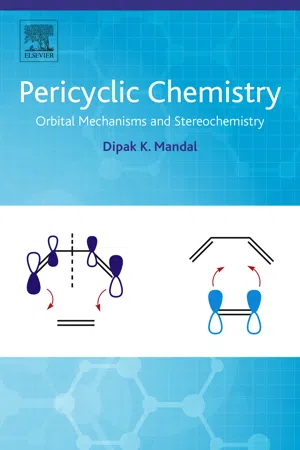 eBook - ePub
Pericyclic Chemistry
Orbital Mechanisms and Stereochemistry
- Dipak Kumar Mandal(Author)
- 2018(Publication Date)
- Elsevier(Publisher)
Fig. 5.112 involving [2 + 2] cycloadditions and retro-cycloadditions.References
1 Woodward R.B., Hoffmann R. Angew. Chem. Int. Ed. Engl. 1969;8:781.2 Evans D.A., Bryan C.A., Sims C.L. J. Am. Chem. Soc. 1972;94:2891.3 Alston P.V., Ottenbrite R.M. J. Org. Chem. 1975;40:1111.4 Caramella P., Quadrelli P., Toma L. J. Am. Chem. Soc. 2002;124:1130.5 Leach A.G., Houk K.N. Chemtracts Org. Chem. 2002;15:611.6 Woodward R.B., Bader F.E., Bickel H., Frey A.J., Kierstead R.W. Tetrahedron. 1958;2:1.7 Sauer J. Angew. Chem. Int. Ed. Engl . 1967;6:16.8 Jung M.E., Davidov P. Angew. Chem. Int. Ed. Engl . 2002;41:4125.9 Alder K., Gunzl W., Wolff K. Chem. Ber . 1960;93:809.10 Millward D.B., Sammis G., Waymouth R.M. J. Org. Chem. 2000;65:3902.11 Garcίa J.I., Mayoral J.A., Salvatella L. Acc. Chem. Res. 2000;33:658.12 Asano T., le Noble W.J. Chem. Rev . 1978;78:407.13 Roush W.R. In: Trost B.M., Fleming I., eds. Comprehensive Organic Synthesis. Oxford: Pergamon Press; 513. 1991;5.14 Winkler J.D. Chem. Rev . 1996;96:167.15 Fallis A.G. Acc. Chem. Res . 1999;32:464.16 Roush W.R., Gillis H.R., Ko A.I. J. Am. Chem. Soc . 1982;104:2269.17 Funk R.L., Vollhardt K.P.C. J. Am. Chem. Soc. 1979;101:215 1980 , 102, 5253.18 Shea K.J., Wise S., Burke L.D., Davis P.D., Gilman J.W., Greeley A.C. J. Am. Chem. Soc. 1982;104:5708.19 Raimondi L., Brown F.K., Gonzalez J., Houk K.N. J. Am. Chem. Soc . 1992;114:4796.20 Bols M., Skrydstrup T. Chem. Rev . 1995;95:1253.21 Oppolzer W. Angew. Chem. Int. Ed. Engl. 1984;23:876.22 Kagan H.B., Riant O. Chem. Rev . 1992;92:1007.23 Corey E.J. Angew. Chem. Int. Ed. Engl . 2002;41:1650.24 Rück-Braun K., Kunz H. Chiral Auxiliaries in Cycloadditions. Weinheim: Wiley-VCH; 1999.30.25 Evans D.A. Aldrichim. Acta. 1982;15:23.26 Evans D.A., Chapman K.T., Bisaha J. J. Am. Chem. Soc. 1984;106:4261 J. Am. Chem. Soc. 1988 , 110, 1238.27 Johnson J.S., Evans D.A. Acc. Chem. Res . 2000;33:325.28 Evans D.A., Miller S.J., Lectka T., von Matt P. J. Am. Chem. Soc. eBook - PDF
Organic Reaction Mechanisms 2016
An annual survey covering the literature dated January to December 2016
- A. C. Knipe(Author)
- 2019(Publication Date)
- Wiley(Publisher)
664 Organic Reaction Mechanisms 2016 2 + 2-Cycloaddition An extensive review of 2 + 2-cycloaddition reactions of allenes, allenenes, allenamides, ketenes, alkynes, siloxy alkynes, phenylthioacetylene, and ynamides promoted by metal- based catalysts has been published. 9 A further review covers all recent aspects of the 2 + 2-photocycloaddition chemistry of synthetically relevant regio- and stereo-selective reactions for the past 20 years (1995–2015). Copper(I) and photoinduced electron trans- fer (PET) catalysis together with direct excitation or sensitization are discussed. 10 de The iminium-ion-catalysed 2 + 2-cycloaddition of , -unsaturated aldehydes with alkenyl phenols produced highly functionalized head-to-tail coupled chiral cyclobutanes with high regiospecificity. 11 The intramolecular 2 + 2-cycloaddition of allenylic esters (10) yielded various trispirocyclic derivatives (11) containing a cyclobutane ring. The process is highly regiospecific under mild reaction conditions (Scheme 3). 12 , 13 O C Ph Ph O (10) O O O O Ph Ph Ph Ph (11) THF, 60 °C, Ar Scheme 3 A key step in the total synthesis of the sesquiterpenes Rumphellaone A and Hushinone is the gold(I)-catalysed 2 + 2-macrocycloaddition of a 1,10-enyne ((R)-6-(2-ethynyl)- benzyloxy-2-methylhept-2-ene) (12) to produce the intermediate ((2aS,5R)-2,2, 5-trimethyl-2,2a,3,4,5,7-hexahydrobenzo[c]cyclobuta[e]oxonine) (13) in a 75% average yield (Scheme 4). 14 The chiral N,N ′ -dioxide-Zn(II)(NTf 2 ) 2 -catalysed 2 + 2- de cycloaddition of alkynones with cyclic enol silyl ethers yielded fully substituted cyclobutenes with high enantioselectivity (up to 97% ee). Both terminal and internal alkynes react in this cycloaddition. 15 ee O (12) O (13) H [Au]-catalysed Scheme 4 eBook - PDF
Organic Reaction Mechanisms 2014
An annual survey covering the literature dated January to December 2014
- A. C. Knipe(Author)
- 2017(Publication Date)
- Wiley(Publisher)
169 O + OR Br Br Br Br OR O Br Br O (138) (139 ( ) 140) Scheme 46 A key step in the three-step synthesis of highly functionalized cyclohepta[b]indoles involves the intermolecular (4 + 3)-cycloaddition reaction of allenamides with furans, indoles, and cyclopentadienes. 170 The dirhodiumtetracarboxylate [Rh 2 (S-BTPCP) 4 ] cat- alyst (144) catalyses the (4 + 3)-cycloaddition reaction between dienes (141) and vinyl carbenes (143), formed from vinyldiazoacetates (142), to produce 1,4-cycloheptadienes (145). The cycloadducts were produced as single diastereomers with high levels of asym- metric induction (Scheme 47). 171 The p-tolylsulfonyl group has been shown to behave as a chiral inductor in the stereoselective (4 + 3)-cycloaddition reactions of 5- and/or 3-substituted (S)-2-(p-tolylsulfonyl)furans with oxyallyl cations, leading to enantiopure polysubstituted 8-oxobicyclo[3.2.1]oct-6-en-2-ones with five stereocentres. 172 ee The intramolecular (4 + 3)-cycloaddition reaction of furanoxonium ion with a 1,3- diene (146) yielded a polycyclic system (147) found in coral secondary metabolites. DFT calculations predict a diastereoselective step-wise cycloaddition between the fura- noxonium ions and the 1,3-dienes (Scheme 48). 173 de The stereoselective formal (5 + 2)-cycloaddition reaction of a dicobalt acetylene complex (148) with an enol silyl ether (149) yielded a 1-acetyl-2-silyloxycycloheptane dicobalt complex derivative (150) with three contiguous substituents arranged cis to each other. Oxidation with CAN produced the substituted maleic anhydride (151) (Scheme 49). 174 de Catalytic amounts of [Cp*RhCl 2 ] 2 with Cu(OAc) 2 promote the intermolecular formal (5 + 2)-cycloaddition reaction of o-vinylphenols with alkynes to yield benzoxepines in high yields (up to 99%). 175
Index pages curate the most relevant extracts from our library of academic textbooks. They’ve been created using an in-house natural language model (NLM), each adding context and meaning to key research topics.

