Computer Science

Decomposition Computer Science
Decomposition in Computer Science refers to the process of breaking down a complex problem into smaller, more manageable sub-problems. This technique is used to simplify the problem-solving process and make it easier to develop and maintain software systems. Decomposition is a fundamental concept in computer science and is used in many different areas of the field.
Written by Perlego with AI-assistance
Related key terms
1 of 5
4 Key excerpts on "Decomposition Computer Science"
 eBook - ePub
Computational Thinking
A beginner's guide to problem-solving and programming
- Karl Beecher(Author)
- 2017(Publication Date)
- BCS, The Chartered Institute for IT(Publisher)
Recursion: a technique used to simplify a problem. It defines the solution to a large, complex problem in terms of smaller, simpler problems of the same form as the original problem. This is a very powerful idea and one that is heavily used in CS.By applying decomposition, you aim to end up with a number of sub-problems that can be understood and solved individually. This may require you to apply the process recursively (see above). That is to say, the problem is re-formed as a series of smaller problems that, while simpler, might be still too complex, in which case they too need breaking down, and so on. Visually this gives the problem definition a tree structure.The conceptual idea of a tree structure is very important to CS and often goes hand in hand with the idea of recursion. A tree represents a collection of entities16 organised into hierarchical relationships. Each ‘parent’ entity may have any number of ‘child’ entities (including none). A tree has a single ‘root’ entity and all childless entities are called ‘leaves’. Visually, it resembles a tree – admittedly an upside-down one, with the ‘root’ at the top and the leaves along the bottom. Trees can represent a huge range of different structures, including something as rigidly defined as a family tree (see Figure 3.1 ).Figure 3.1 Royal family treeOr something put together arbitrarily like arranging Shakespeare’s plays by genre (Figure 3.2 ).Figure 3.2 Shakespeare plays arranged by genre into a tree structureLet’s look at an example. One task that many of us encounter during our education is the production of a dissertation. Writing an academic work some tens of thousands of words in length can inspire fear, panic or even despair. By itself, one monolithic task entitled ‘write dissertation’ is unmanageable, but by decomposing the problem you reduce it into smaller parts, each of which possesses far fewer details. You can then focus your attention on each part and deal with it much more effectively. By solving each sub-problem, you end up solving the overall problem.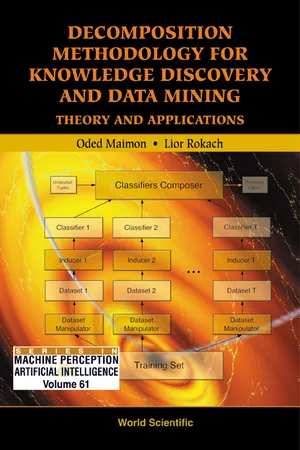 eBook - PDF
Decomposition Methodology for Knowledge Discovery and Data Mining
Theory and Applications
- Oded Maimon, Lior Rokach;;;(Authors)
- 2005(Publication Date)
- WSPC(Publisher)
Chapter 5 Elementary Decomposition Framework 5.1 Decomposition Framework One of the explicit challenges in data mining is to develop methods that will be feasible for complicated real-world problems. In many disciplines, when a problem becomes more complex, there is a general tendency to try to break it down into smaller, distinct, but connected pieces. The con-cept of breaking down a system into smaller pieces is generally referred to as decomposition. The purpose of decomposition methodology is to break down a complex problem into several smaller, less complex and more man-ageable sub-problems that are solvable by using existing tools, then joining them together to solve the initial problem. Decomposition methodology can be considered as an effective strategy for changing the representation of a classification problem. Indeed, [Kusiak (2000)] considers decomposition as the most useful form of transformation of data sets. The decomposition approach is frequently used in statistics, operations research and engineering. For instance, decomposition of time series is considered to be a practical way to improve forecasting. The usual decom-position into trend, cycle, seasonal and irregular components was moti-vated mainly by business analysts, who wanted to get a clearer picture of the state of the economy [Fisher (1995)]. Although the operations resea-rch community has extensively studied decomposition methods to improve computational efficiency and robustness, identification of the partitioned problem model has largely remained an ad hoc task [He et al. (2000)]. In engineering design, problem decomposition has received considerable attention as a means of reducing multidisciplinary design cycle time and of streamlining the design process by adequate arrangement of the tasks [Kusiak et al. (1991)]. Decomposition methods are also used in decision-123 eBook - PDF
- Kyla McMullen, Elizabeth Matthews, June Jamrich Parsons, , Kyla McMullen, Kyla McMullen, Elizabeth Matthews, June Jamrich Parsons(Authors)
- 2021(Publication Date)
- Cengage Learning EMEA(Publisher)
The algorithm for such an extensive app would be difficult to formulate without dividing it into smaller parts, a process called decomposition. When devising an algorithm for a complex problem or task, decomposition can help you deal with smaller, more manageable pieces of the puzzle. Copyright 2022 Cengage Learning. All Rights Reserved. May not be copied, scanned, or duplicated, in whole or in part. Due to electronic rights, some third party content may be suppressed from the eBook and/or eChapter(s). Editorial review has deemed that any suppressed content does not materially affect the overall learning experience. Cengage Learning reserves the right to remove additional content at any time if subsequent rights restrictions require it. Module 1 CoMputational thinking 5 Structural Decomposition (1.2.2, 1.2.3, 1.2.4, 1.2.7) The first step in decomposition is to identify structural units that perform distinct tasks. Figure 1-4 illustrates how you might divide a mobile banking app into structural units, called modules. Figure 1-4 Structural decomposition diagram Mobile banking Two-factor authentication Fingerprint sign-in Passcode/challenge question changes Account management Balances Alerts Direct deposits Payments and transfers Bill pay Mobile check deposits Money transfers Secure login Figure 1-3 A mobile banking app handles many interacting tasks Change user preferences Deposits Withdrawals Transfer money Pay bills Account balance Secure login Fraud alerts iStock.com/vector.S Structural decomposition is a process that identifies a hierarchy of structural units. At the lowest levels of the hierarchy are modules, indicated in yellow in Figure 1-4, that have a manageable scope for creating algorithms. Copyright 2022 Cengage Learning. All Rights Reserved. May not be copied, scanned, or duplicated, in whole or in part. Due to electronic rights, some third party content may be suppressed from the eBook and/or eChapter(s). eBook - PDF
- Carol V. Brown, Heikki Topi(Authors)
- 2003(Publication Date)
- Auerbach Publications(Publisher)
531 0-8493-1595-6/03/$0.00+$1.50 © 2003 by CRC Press LLC Chapter 42 Component-Based IS Architecture Les Waguespack William T. Schiano A component is a building block of computer software systems. Modular construction has been the standard of software architecture for decades. What makes components intriguing now is the integration of technologies to support components, the use of components to compose business applications rather than the underlying system software, and component deployment and distribution over the Internet. These factors converge, leading to the prospect of shortened application development time and increased application software quality. Problem decomposition is a fundamental technique in systems analysis. Through the process of decomposing the whole, one discovers the units of information and function that must come together to define and achieve the behavior of the whole. This guiding principle permeates architecture and civil, electrical, and electronic engineering. It is the same in software engineering employed in the construction of computer-based information systems. Component technology is an outgrowth of the object-oriented paradigm of system modeling, and it mirrors the technique of problem decomposi-tion by encouraging system composition using a collection of interacting, but independently constructed parts. In this context, component takes on the specialized meaning for which we use the term in this chapter. This chapter discusses the definition, supporting technology, use, con-struction, and economics of components. The goal is to explain how build-ing components and building applications using components differ from traditional software development practice. Components have the potential to shorten application development time and reduce overall development costs. To capitalize on this potential, organizations must prepare their pro-cesses and personnel for component-based application building.
Index pages curate the most relevant extracts from our library of academic textbooks. They’ve been created using an in-house natural language model (NLM), each adding context and meaning to key research topics.

