Computer Science

Digital Divide
The digital divide refers to the gap between those who have access to digital technologies and those who do not. This divide can be based on factors such as income, education, geography, and age. It encompasses disparities in internet access, computer ownership, and digital literacy, and has implications for social and economic equality.
Written by Perlego with AI-assistance
Related key terms
1 of 5


12 Key excerpts on "Digital Divide"
 eBook - PDF
- Knud Erik Skouby, Idongesit Williams, Albert Gyamfi(Authors)
- 2017(Publication Date)
- River Publishers(Publisher)
Tsatsou (2011) argues that definitions have lacked sociological meaning. However, a recent study has argued that the Digital Divide presents differences in different contexts, which include: socio-cultural, economic, political, and time (Friemel, 2014). Thus through a third dimension, some scholars note arguments from other studies that have strongly linked the Internet access with a number of socio-demographic dimensions such as income, education, gender and age (Zickuhr & Smith, 2012). In the past, scholars argued that there is no single and universally accepted indicator that can determine the Digital Divide (Vehovar, Sicherl, & Husing T, 2006). As mentioned earlier, this chapter uses the term Digital Divide to refer to the broader meaning where privileged groups are able to access technology better than the less privileged. 5.3 Perspectives on Digital Divide This section provides different brief research perspectives to the concept of Digital Divide. The topics covered include, what is Digital Divide; what is Digital Dividend and Digital Divide; the internet and Digital Divide; why discuss Digital Divide; the nature of Digital Divide; and previous studies on Digital Divide. 5.3.1 What Is Digital Divide? There is a lot of literature about the Digital Divide mostly from the context of developing countries (Heeks, 2006; Mansell, 2008; Miller & Rose, 2008; Skaletsky, Galliers, Haughton, & Soremekun, 2016). The Digital Divide is described as the overall gap that exists between developed and developing countries in the utilization of information and communication technology (Davison, Harris, Vogel, & Jan de Vreed, 1999). Digital Divide is defined as “the huge and widening gap between developed and developing world as regards availability and cost of computer hardware, software and access to telecommunications facilities, including telephones and the Internet” (Miller J., 2002). Table 5.1 provides a summary of other definitions of the term Digital Divide .
- Oscar Alberto Ramirez(Author)
- 2020(Publication Date)
- Society Publishing(Publisher)
The way technologies advance is reversible very rarely. Once the technology has started to get in touch with the people and have an impact on their daily lives, it is next to impossible to reverse the effects they have on the future of those people and the people who may not be in touch with such technologies. Thus, the Digital Divide being discussed aims to encompass the various resources that the internet may be possessing in itself as the technologies that are in use by the people in their daily lives and these and the inability to access them. These inabilities may be due to various factors such as the physical limitations or the factors that concern the control of various mechanisms of communication. Also, even the inability of the people to understand the technologies that come their way. 4.7.1. The Missing Link There are many people around the world who would not hesitate from using web-based services to network with other people across the globe or to use it in their educational endeavors. However, the problem they generally face The Digital Divide in Education 113 is accessibility to the resources. The people tend to face some kind of issue in finding access to the internet and social media even when they are willing to use the services. This happens in a certain class of people and also the people who reside in extremely remote areas from the urban centers. The groups that tend to face the problems may be quite dissimilar to each other in other aspects. But they share a common problem of having access to the internet. Either by due to the unavailability of the networks in those areas or due to the internet service being costly for them. As with the persons with disabilities, the schools across the world, especially in industrialized countries, have made some notable progress in this direction. They have tried to make learning more accessible to them. eBook - PDF
- Martin A. Kesselman, Irwin Weintraub, Martin A. Kesselman, Irwin Weintraub(Authors)
- 2004(Publication Date)
- CRC Press(Publisher)
11 The Digital Divide Linda Ashcroft and Chris Watts Liverpool John Moores University Liverpool, England INTRODUCTION The “Digital Divide,” put simply, is the divide between those people who have access to information and communications technologies (ICTs) and those who do not: the “haves” and the “have nots,” the “information rich” and the “informa-tion poor” (bridges.org, 2002). Norris (2001) identifies a multidimensional Digital Divide, consisting of three distinct divides: global, social, and democratic. The global Digital Divide refers to an international disparity in access to the Internet between industrialized and developing countries, whereas the social Digital Divide is the difference between the information rich and the information poor in any individual nation. The democratic Digital Divide is “the difference between those who do, and do not, use the panoply of digital resources to engage, mobilise, and participate in public life” (Norris, 2001, p. 4). The international, non-profit organization bridges.org (2002) identifies an overall trend of growing disparities both within (social Digital Divide) and between (global Digital Divide) countries. This is despite the fact that all countries are increasing their access to ICTs, because industrialized countries are increas-ing their access at an exponential rate and therefore, in effect, widening the divide. In addition, privileged groups obtain and utilize ICTs more effectively and, gaining advantage from ICTs, become more privileged, therefore accentuating the Digital Divide. 151 This chapter explores the issues and concerns surrounding the Digital Divide from the perspective of both developed and developing countries. GLOBAL PERSPECTIVE Initiatives The international community has become increasingly aware of the Digital Divide and its implications over the last five years and put strategies into place in order to address the problem.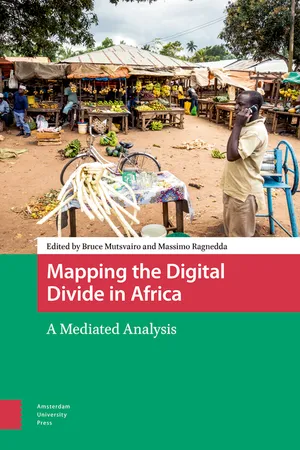 No longer available |Learn more
Mapping the Digital Divide in Africa
A Mediated Analysis
- Bruce Mutsvairo, Massimo Ragnedda, Bruce Mutsvairo, Massimo Ragnedda(Authors)
- 2019(Publication Date)
- Amsterdam University Press(Publisher)
Over the years, the Digital Divide, therefore, has become a social problem rather than a merely technological one (Ragnedda and Muschert, 2013). To appreciate the complexity of Digital Divide fully, scholars and policy-makers must understand its social consequences by looking at society’s inequalities. Although scholars are now taking into consideration the multidimensionality of the Digital Divide (van Dijk, 2005; DiMaggio et al., 2001; Lenhart and Horrigan, 2003; de Haan, 2003), policy-makers have often continued to look at it in terms of lack of access or infrastructure (although some things have changed over the years, specif ically in more advanced societies). In other words, policy-makers have focused mainly on the first level of Digital Divide in the past, not acknowledging the dif ferent skills, abilities, and purpose of use of ICTs in an ef fective way. As already noted, the concept of the Digital Divide does not relate to a single type of ‘divide’, but instead is intertwined with a series of economic, cultural, political, personal, and social issues, and is linked to the growth of computer technology and the Internet. Capacities, motivations, skills, and support in accessing, using, and managing information and knowledge disseminated by such technology may generate signif icant cultural, economic, social, personal, and political advantages. The Digital Divide is, therefore, a multifaceted phenomenon, interwoven with existing processes of social dif ferentiation, as the dif fusion in Africa of such technologies shows. The dif fusion and penetration of ICTs occurs according to the traditional models of technology spread. ICTs reaches more and more citizens that tend to embed them into their daily routine. However, this spread does not ‘neces-sarily’ reduce digital inequalities; rather, it suggests a reconfigurat ion of social stratif icat ion, that in some ways may accentuate existing inequalities. eBook - PDF
- Jason Hughes(Author)
- 2012(Publication Date)
- SAGE Publications Ltd(Publisher)
Source: New Media & Society , 9(4) (2007): 671–696. 20 Gradations in Digital Inclusion: Children, Young People and the Digital Divide Sonia Livingstone and Ellen Helsper Introduction A ‘Digital Divide’ threatens to exacerbate already-wide gaps between rich and poor, within and among countries. The stakes are high indeed. Timely access to news and information can promote trade, education, employment, health and wealth. One of the hallmarks of the information society – openness – is a crucial ingredient of democracy and good gov-ernance. Information and knowledge are also at the heart of efforts to strengthen tolerance, mutual understanding and respect for diversity. (Annan, 2003) C onsiderable academic and policy attention has recently addressed the so-called ‘Digital Divide’, drawing attention to divisions within and across societies according to those that have access to digital tech-nologies (including the internet) and those that do not (Bradbrook and Fisher, 2004; Bromley, 2004; Foley et al., 2002, 2003; Selwyn, 2003, 2004a, 2004b; Warschauer, 2003). Lack of access is associated with disadvantage in financial, educational or cultural resources, and much research has focused on divides by nation (Norris, 2001) and, within developed nations espe-cially, on divides by region (Chen and Wellman, 2003), age (Loges and Jung, 2001), ethnicity (Hoffman et al., 2001) and income (Rice and Haythornthwaite, 2006). However, most research has focused on adult pop-ulations, even though, in recent years, children in Western countries have rapidly gained access to the internet at both school and home, strongly sup-ported by public policy and industry initiatives. Young people’s lives are increasingly mediated by information and com-munication technologies at home, at school and in the community. eBook - PDF
- Paul G. Harwood, Victor Asal(Authors)
- 2007(Publication Date)
- Praeger(Publisher)
Digital Divide 83 With the idea of social inclusion as part of this “evolving concept,” the full complexity of the issue is apparent. Wiring schools, while an excellent start, as we will shortly detail, is simply not enough. Today all Americans, but par- ticularly the digital generation and those who follow them, need the neces- sary usability skills, along with broadband access and the latest computer and operating system, to participate in our digitalized world. As Laurie Lipper, co- founder and co-president of the Children’s Partnership says, We must ensure that children have access not only to the tools but also to high- speed Internet connections. We also need to ensure that teachers have clear goals and the training to help them reach those goals and that there is a wealth of good curricula available. Finally, we need to measure our progress and hold ourselves accountable for our goals. The divide is, as Jim McConnaughey correctly identifies, an “evolving con- cept,” 19 and will “prove an enduring pattern generating a persistent division between info-have and have nots.” 20 So, what started out in 1995 as an effort by NTIA to gauge who was falling through the Net in terms of access, evolved beyond purely an issue of access, to the causality of such access, and the neces- sity of digital social inclusion. WE ARE NOT ALONE The existence of a Digital Divide is not a uniquely American problem. We are not alone. Every nation has a Digital Divide. In this book though, we are just focusing on what Pippa Norris, in Digital Divide: Civic Engagement, Infor- mation Poverty and the Internet Worldwide, terms the social divide, “the gap be- tween information rich and poor in each nation;” however, each social divide dovetails as part of the global divide, examined as “the divergence of Internet access between industrialized and developing societies.” 21 So how bad have we got it in the United States? There is no short answer. eBook - PDF
- OECD(Author)
- 2015(Publication Date)
- OECD(Publisher)
5 STUDENTS, COMPUTERS AND LEARNING: MAKING THE CONNECTION © OECD 2015 123 Digital inequality refers to differences in the material, cultural and cognitive resources required to make good use of information and communication technology (ICT). This chapter examines differences in access to and use of ICT that are related to students’ socio-economic status, gender, geographic location, and the school a child attends. It also investigates whether performance on computer-based tests is related to students’ socio-economic status and their familiarity with computers. Inequalities in Digital Proficiency: Bridging the Divide © OECD 2015 STUDENTS, COMPUTERS AND LEARNING: MAKING THE CONNECTION 124 5 INEQUALITIES IN DIGITAL PROFICIENCY: BRIDGING THE DIVIDE Disparities in access to and proficiency in information and communication technology (ICT), particularly between socio-economically advantaged and disadvantaged children, and between rural and urban residents, have long been a focus of public policy. The expression “Digital Divide” was coined to underline the fact that such disparities may threaten social and national cohesion, as they impede full participation in work and reduce political efficacy for population groups that are left behind on the analogue side of the divide (OECD, 2001). Indeed, given the many opportunities that technology makes available for civic participation, networking or improving one’s productivity at work, the unequal distribution of material, cultural and cognitive resources to tap into these opportunities may perpetuate and even exacerbate existing status differences. What the data tell us • In most countries, differences in computer access between advantaged and disadvantaged students shrank between 2009 and 2012; in no country did the gap increase. eBook - PDF
Bridging the Digital Divide
Technology, Community and Public Policy
- Lisa J. Servon(Author)
- 2008(Publication Date)
- Wiley-Blackwell(Publisher)
Access to information technology is increasing at a rapid rate. Although some groups of people, namely, African-Americans, Latinos, and the disabled, remain persistently and disproportionately on the wrong side of the divide, the gaps between those who have access to IT and those who do not are rapidly closing. Groups that have traditionally been digital have-nots are now making dramatic gains. Gaps between rural and nonrural households and between seniors and younger people have begun to narrow. Some divides, such as that between women and men, have disappeared altogether. And yet the larger problem persists. Deep divides remain between those who possess the resources, education, and skills to reap the ben-efits of the information society and those who do not. Persistent gaps remain between different racial and ethnic groups, people with and without disabilities, single and dual parent families, the old and the young, and people with different levels of income and education. Low-income persons and minorities, particularly when they reside in inner cities, are among the groups being left behind. Table 1.1 illus-trates these changes, and chapter 2 takes up this issue in much deeper detail. Because the technology gap has been defined narrowly, as a problem of access, policies and programs have also been narrowly focused. Proposed solutions to the Digital Divide tend to begin with making sure that schools are wired and that every household has a computer. For example, in March of 2000, Governor Angus King of 4 REDEFINING THE Digital Divide REDEFINING THE Digital Divide 5 Maine announced a plan to give every seventh grade student a laptop computer. King stated that he wanted Maine “to have the most digi-tally literate society on earth.” 6 The governor’s $65 million plan, however, did not allocate any funds for computer training or for 6 New York Times , March 1, 2000. eBook - PDF
Digital Diversity
Youth, Equity, and Information Technology
- E. Dianne Looker, Ted D. Naylor, E. Dianne Looker, Ted D. Naylor(Authors)
- 2010(Publication Date)
- Wilfrid Laurier University Press(Publisher)
If there is one divide that Information and Communication Technology (ICT) is perhaps best designed to overcome it is that of geographic distance. By removing the constraint imposed by synchronous, place-based forms of com-munication, ICT allows linkages across space, facilitating communication with others and access to information. One might expect, then, that priority be given to ensuring access to these technologies for those potentially most dis-advantaged by the barriers created by geographic distance, particularly those in rural and remote areas of Canada. One might also expect that individuals and groups in these remote areas would most actively lobby for and embrace these technologies. I suspect few readers will be surprised to learn that, con-trary to these expectations, one finds instead the quintessential Digital Divide. This chapter examines issues relating to this divide based on social and geographic location. In many ways this chapter is designed to set the stage for some of the other discussions in this book by documenting the effects of both social and physical location on the development of facility with these technologies. The Organisation for Economic Co-operation and Development (OECD 2001a; OECD 2001b, 23) defines the Digital Divide as the gap between individuals and groups “with regard to both their opportunities to access information and communication technology (ICTs) and to their use of 37 Digital distance: Geographic and cultural divides in access and use of computers and the Internet E. Dianne Looker Chapter 2 the Internet for a wide variety of activities” (OECD 2001a, 8). Although pol-icy-makers have focused greatly on creating an advantageous climate for grow-ing the knowledge economy, they have concentrated considerably less on ways to ensure the development of an equitable knowledge society . eBook - PDF
- Jon F. Nussbaum(Author)
- 2016(Publication Date)
The cleavage between Jews and Arabs in Israeli society is a main feature of its structure (Smooha, 1993). Indeed, when comparing computer use by both low income Jews and low income Arab-Israelis, Schejter et al. (2015) found that in 2002 some 30% of low income Jews and less than 10% of low income Arabs used a computer. In 2013, however, 47% of low income Jews used computers in comparison to only 21% of low income Arabs. The divide just got bigger and wider and economics alone cannot explain it. As such, in order to examine the Digital Divide in a given society, it is not only necessary to use longitudinal data but also to understand both economic and other social patterns of exclusion. In the case of Israel, examining the continuity of the divide has proven that the problem is beyond a divide between haves and have-nots of things “digital” as the dominant discourse has as suggested. Policies aimed at alleviating gaps in possession of ICTs focus on “access” and “connectivity.” While THE Digital Divide | 139 these policies had some successes, as demonstrated by the fact that in 2013 more people used the internet and computers than in 2002, the constant gap between different groups in Israeli society demonstrates that the Digital Divide reflects more than access and connectivity gaps; rather it is about the exclusion from partici- pating in the social processes that the digital experience creates the opportunity for (see more in: Van Dijk, 2005). Thus, Schejter et al. (2015) wish to focus the conversation on a social approach to the divide and suggest a shift from discussing the problem as access to digital media and start referring to it as one of ensuring participation in the information and communication society. Indeed, only “very few studies reported on how government intervention can encourage disadvantaged people to adopt more ICTs and their contents” (Srinuan & Bohlin, 2011, p. 19). eBook - PDF
Digital Divides
The New Challenges and Opportunities of e-Inclusion
- Kim Andreasson(Author)
- 2015(Publication Date)
- Routledge(Publisher)
5.4 Social Aspects of the Digital Divide in Russia In October 2013, Rosstat conducted the first federal statistical monitoring of ICT use by individuals. The monitoring was held in all federation subjects based on sampling method of observation, covering the same range of households that was subject to a population survey devoted to employment issues. 19 5.4.1 Digital Divide in Different Types of Populated Areas and Age–Sex Groups Figure 5.17 presents data from the survey that discloses availability of important components of ICT infrastructure in urban and rural households. Based on the data, one can see that the Digital Divide between urban and rural households remains high and is the most explicit in what refers to use of broad-band Internet access. It is explainable. Deployment of broadband Internet access 100 ◾ Digital Divides infrastructure in remote and underpopulated settlements is not always technically feasible and requires high costs that often are not profitable for Internet service providers. Lower levels of education of the rural population is another contribut-ing factor. Figure 5.18 shows data that characterize gender differences in Internet use by urban and rural population. Interesting is the fact that, while men slightly prevail in ICT use when considering the population, in general, or urban population, in rural settlements women are currently more active Internet users than men (according to some indicators by 1–1.5 percentage points). As for Internet shopping, women are more active in both cities and rural areas. It’s worth mentioning that overcoming the gender gap in Internet use and smoothening differences in ICT use between other social demographic groups is a recently observed phenomena. According to results from a survey of Moscow held by IIS in 2005, the Digital Divide between specified groups was much higher, as shown in Figure 5.19. eBook - PDF
The Internet
An Introduction to New Media
- Lelia Green(Author)
- 2010(Publication Date)
- Berg Publishers(Publisher)
Examples would include the newly un-employed, the recently retired on low incomes, some people who are divorced or separated, some migrants, those who relocate to remote or lesser-serviced areas and young people moving away from affluent homes (ibid.: 106–7). These internet-experienced individuals suffer at several levels: not only do they lack access to the internet, they have a clear idea of how the internet could transform their circ-umstances and, finally, they appreciate how the internet could provide a resource through which other people can offer support while they negotiate the realities of their reduced circumstances. Every country includes a number of citizens, like those indicated above, who do not make desirable customers for big ICT companies. Such citizens live in inaccessible places, such as in remote locations with residency numbers too small for a viable service, or they are too poor, elderly or socially and culturally marginalised. Typically, these less serviceable citizens are unable to access the internet except through publicly funded resources such as libraries. In this chapter we examine some aspects of the Digital Divide as it affects people living in wealthy countries. We address digital inequality in the US and we also examine the circumstances of people who care for others in the UK. First, however, we consider the ways that some homeless people in Scotland use ICTs. Reflection: Being a digital native Do you think of yourself as a digital native? How does your communication life compare with that of your parents when they were your age? ICTS IN THE LIVES OF SCOTTISH HOMELESS In the context of three in four of the world’s population being excluded from the internet, the role of the mobile phone as the globe’s major technology for connection and agency should come as no surprise. When we examine the lives of the poorest 70 t h e i n t e r n e t people in the rich minority world, the same pattern is evident.
Index pages curate the most relevant extracts from our library of academic textbooks. They’ve been created using an in-house natural language model (NLM), each adding context and meaning to key research topics.

