Computer Science

Graph Algorithms
Graph algorithms are a set of techniques used to solve problems related to graphs, which are structures consisting of nodes and edges. These algorithms are used to traverse, search, and manipulate graphs to solve various computational problems. They are fundamental in computer science and are applied in diverse areas such as network routing, social network analysis, and recommendation systems.
Written by Perlego with AI-assistance
Related key terms
1 of 5

10 Key excerpts on "Graph Algorithms"
 eBook - ePub
50 Algorithms Every Programmer Should Know
An unbeatable arsenal of algorithmic solutions for real-world problems
- Imran Ahmad(Author)
- 2023(Publication Date)
- Packt Publishing(Publisher)
5
Graph Algorithms
Graphs offer a distinct way to represent data structures, especially when compared to structured or tabular data. While structured data, such as databases, excel at storing and querying static, uniform information, graphs shine in capturing intricate relationships and patterns that exist among entities. Think of Facebook, where every user is a node, and each friendship or interaction becomes a connecting edge; this web of connections can be best represented and analyzed using graph structures.In the computational realm, certain problems, often those involving relationships and connections, are more naturally addressed using Graph Algorithms. At their core, these algorithms aim to understand the structure of the graph. This understanding involves figuring out how data points (or nodes) connect via links (or edges) and how to effectively navigate these connections to retrieve or analyze the desired data.In this chapter, we’ll embark on a journey through the following territories:- Graph representations : Various ways to capture graphs.
- Network theory analysis : The foundational theory behind network structures.
- Graph traversals : Techniques to efficiently navigate through a graph.
- Case study : Delving into fraud analytics using Graph Algorithms.
- Neighborhood techniques : Methods to ascertain and analyze localized regions within larger graphs.
Upon completion, we will have a robust grasp of graphs as data structures. We should be able to formulate complex relationships—both direct and indirect—and will be equipped to tackle complex, real-world problems using Graph Algorithms.Understanding graphs: a brief introduction
In the vast interconnected landscapes of modern data, beyond the confines of tabular models, graph structures emerge as powerful tools to encapsulate intricate relationships. Their rise isn’t merely a trend but a response to challenges posed by the digital world’s interwoven fabric. Historical strides in graph theory, like Leonhard Euler’s pioneering solution to the Seven Bridges of Königsberg problem, laid the foundation for understanding complex relationships. Euler’s method of translating real-world issues into graphical representations revolutionized how we perceive and navigate graphs. eBook - PDF
Binary Digital Image Processing
A Discrete Approach
- Stéphane Marchand-Maillet, Yazid M. Sharaiha(Authors)
- 1999(Publication Date)
- Academic Press(Publisher)
Chapter 3 ALGORITHMIC GRAPH THEORY Graph theory is an important mathematical approach which can be used for mapping complex problems onto simple representations and models. It is based on a robust mathematical background which allows for the definition of optimal solution techniques for such problems. Efficient algorithms can thus be derived which can solve a particular problem based on its graph representation. Graph theory is an area of research by itself and finds applications in many fields such as operational research and theoretical computer science. It also finds applications in image processing, where the discrete nature of image represen- tations makes its use consistent. In fact, it is often the case that graph theory is implicitly used when developing a solution to a particular problem related to image processing. The aim here is to relate image processing concepts to al- gorithmic graph theory in order to take advantage of this approach for further developments. In this chapter, we first present in Section 3.1 terminology and definitions used in graph theory. We summarise well-known algorithms which exist for the solution of problems defined in the context of graph theory. Typically, classes of equivalent problems are defined and solutions are presented for abstract repre- sentations of each class. Section 3.2 presents algorithms for the solution of two classic optimisation problems. More precisely, a number of algorithms are pre- sented for the shortest path problem and the minimum weighted spanning tree problem. Finally, Section 3.3 relates these results to digital image processing concepts presented in Chapters 1 and 2. 3.1 Definitions Major definitions used in algorithmic graph theory are reviewed here. The concept of a graph is introduced via the definition of vertices and arcs. These concepts are then extended to that of paths and trees on a graph. eBook - PDF
- S. R. Kingan(Author)
- 2022(Publication Date)
- Wiley(Publisher)
113 5 Graph Algorithms This chapter introduces Graph Algorithms, the third major topic in the book along with theory and applications. Graph Algorithms is an interdisciplinary area covering both mathematics and computer science. A thorough understanding requires knowing computational complexity (see Appendix C), data structures (see Appendix D), and a programming language in order to implement the algorithms. Nonetheless, it is possible to understand the algorithms and their importance in a more theoretical manner. Generally speaking Graph Algorithms can be divided into two broad classes: existence algorithms and optimization algorithms. An existence algorithm finds the property, invariant, or object of interest. An optimization algorithm finds the best option among a set of options. Section 5.1 presents two algorithms that determine whether or not a graph is connected; if the graph is connected, the algorithms find a spanning tree. They are examples of existence algorithms. Section 5.2 presents two algorithms for finding a minimum weight spanning tree in a weighted graph. Both use a “greedy strategy.” They are examples of optimization algorithms. Section 5.3 presents Dijkstra’s Shortest Path Algorithm for weighted graphs, another optimization algorithm. Richard Karp introduced the concept of NP-complete in his 1972 paper “Reducibility among combinatorial problems” and highlighted several graph invariants as being intractable (Karp, 1972). As such it is worth studying the problems in this chapter since they have nice and efficient algorithms. 5.1 Traversal Algorithms In this section we examine two algorithms to determine if a graph is connected: Depth-First Search (DFS) and Breadth-First Search (BFS). The input for both DFS and BFS is a graph and a starting vertex (call it s). Both algorithms search the graph by traversing edges from vertex to vertex, building a spanning tree as they proceed.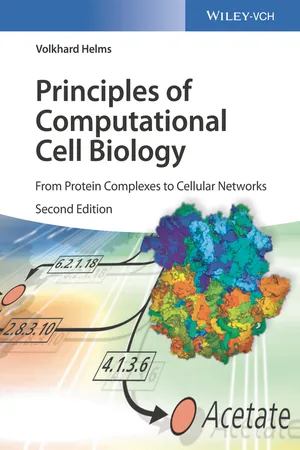 eBook - ePub
Principles of Computational Cell Biology
From Protein Complexes to Cellular Networks
- Volkhard Helms(Author)
- 2018(Publication Date)
- Wiley-VCH(Publisher)
Search and enumeration. Many problems (such as a chess game) can be tackled by constructing a corresponding search problem on a mathematical graph. Algorithms to explore graphs define rules how the graph may be searched.Probabilistic and heuristic algorithms. This class of algorithms is quite diverse.- Probabilistic algorithms make some random choices during the execution.
- Genetic algorithms try to solve a given problem by mimicking biological evolutionary processes. Typically, these are iterative algorithms where random mutations among the current “solutions” generate the next generation of “solutions.” In this manner, genetic algorithms implement the biological concepts of reproduction and “survival of the fittest.” We will see an example of this type in Section 14.5 .
- Heuristic algorithms. The general purpose of such algorithms is not to identify an optimal solution. They are employed when the computing time or memory requirements to find an optimal solution is beyond manageable bounds. Instead, heuristic algorithms construct an approximate solution in a reasonable time.
Figure 4.4 Two popular ways to store connectivity information. (a) The first array contains pointers to the proteins interacting with protein 1, the second array contains the interaction partners of protein 2, etc. (b) An n × n matrix contains values of “1” for interacting proteins and values of “0” for those where no interactions were recorded.4.3 Data Structures for Graphs
As introduced in Section 4.1 , a graph is an abstract data structure. A graph is formed by a set of vertices and a set of edges. The edges represent relationships (connections) between the vertices. In typical implementations of graphs, vertices are implemented as structures or objects. Edges can be realized in several ways. Each of them has its own advantages and disadvantages. One strategy is an adjacency list. This “list” essentially consists of an array of vertices that are associated with incident edges (Figure 4.4 ). If information is only stored in vertices, not in edges (i.e. it is not a weighted graph), a row simply contains the indices of the vertices to which the row vertex is connected to. In this way, edges can be represented in a memory saving fashion. A favorable property of this realization is that it is straightforward to add new vertices to the graph. They can be linked to existing vertices simply by adding elements to the appropriate arrays. On the other hand, it takes O(n) time to find out whether two given vertices are connected by an edge. Here, n eBook - PDF
- Bozzano G Luisa(Author)
- 2014(Publication Date)
- Elsevier Science(Publisher)
CHAPTER 10 Graph Algorithms J. van LEEUWEN Department of Computer Science, University of Utrecht, P.O. Box 80.089, 3508 TB Utrecht, Netherlands Contents Prelude 527 1. Representation of graphs 527 2. Basic structure algorithms 551 3. Combinatorial optimization on graphs 579 References 612 HANDBOOK OF THEORETICAL COMPUTER SCIENCE Edited by J. van Leeuwen © Elsevier Science Publishers B.V., 1990 This page intentionally left blank Prelude Graph Algorithms 527 Graphs are the most common abstract structure encountered in computer science. Any system that consists of discrete states or sites (called nodes or vertices) and connections between it can be modeled by a graph. The connections between nodes of a graph are called edges (in case the connections are between unordered pairs of nodes), directed edges (in case the connections are between ordered pairs of nodes), or hyperedges (in case the connections are arbitrary nonempty sets of nodes). Connections may also carry additional information as labels or weights, related to the interpretation of the graph. Consequently there are many types of graphs and many basic notions that capture aspects of the structure of graphs. Also, many applications require efficient algorithms that essentially operate on graphs. In this chapter we give an overview of the common paradigms and results in Graph Algorithms with an emphasis on the more recent developments in the field. We outline the underlying principles of many essential Graph Algorithms, but usually omit the details of the carefully tuned datastructures that may be needed to achieve the ultimate bounds on time or space complexity for the algorithms. We will only deal with ordinary sequential algorithms, and consider a discussion of parallel and distributed algorithms on graphs as beyond the scope of this chapter. eBook - PDF
Graphs
Theory and Algorithms
- K. Thulasiraman, M. N. S. Swamy(Authors)
- 2011(Publication Date)
- Wiley-Interscience(Publisher)
10.50 C. Greene, A Multiple Exchange Property for Bases, Proc. Am. Math. Soc, Vol. 39, 45-50 (1973). 10.51 J. H. Mason, On a Class of Matroids Arising from Paths in Graphs, Proc. London Math. Soc, Vol. 25, 55-74 (1972). 10.52 R. C. Prim, Shortest Connection Networks and Some Generalizations, Bell Sys. Tech. J., Vol. 36, 1389-1402 (1957). CHAPTER 11 Graph Algorithms Graphs arise in the study of several practical problems. The first step in such studies is to discover graph-theoretic properties of the problem under consideration that would help us in the formulation of a method of solution to the problem. Usually solving a problem involves analysis of a graph or testing a graph for some specified property. Graphs that arise in the study of real-life problems are very large and complicated. Analysis of such graphs in an efficient manner, therefore, involves the design of efficient computer algorithms. In this and the following chapter of the book we discuss several Graph Algorithms. We consider these algorithms to be basic in the sense that they serve as building blocks in the design of more complex algorithms. These algorithms will also help us provide the reader with further insight on some of the topics discussed in the previous chapters as well as introduce new concepts. While our main concern is to develop the theoretical foundation on which the design of the algorithms is based, we also develop results concerning the computational complexity of these algorithms (in particular, in Chapter 12). In certain cases the computational complexity depends crucially on the computational complexity of certain basic operations such as finding union of disjoint sets. In such cases we provide adequate references for the interested reader to pursue further. The computational complexity of an algorithm is a measure of the running time of the algorithm. No longer available |Learn more
Computational Discrete Mathematics
Combinatorics and Graph Theory
- (Author)
- 2014(Publication Date)
- Orange Apple(Publisher)
________________________ WORLD TECHNOLOGIES ________________________ Chapter- 7 Algorithm and Graph Theory Algorithm This is an algorithm that tries to figure out why the lamp doesn't turn on and tries to fix it using the steps. Flowcharts are often used to represent algorithms graphically. In mathematics, computer science, and related subjects, an algorithm (derived from the name of mathematician al-Khwārizmī) is an effective method for solving a problem expressed as a finite sequence of steps. Algorithms are used for calculation, data ________________________ WORLD TECHNOLOGIES ________________________ processing, and many other fields. (In more advanced or abstract settings, the instructions do not necessarily constitute a finite sequence, and even not necessarily a sequence; see, e.g., nondeterministic algorithm.) Each algorithm is a list of well-defined instructions for completing a task. Starting from an initial state, the instructions describe a computation that proceeds through a well-defined series of successive states, eventually terminating in a final ending state. The transition from one state to the next is not necessarily deterministic; some algorithms, known as randomized algorithms, incorporate randomness. A partial formalization of the concept began with attempts to solve the Entscheidungsproblem (the decision problem) posed by David Hilbert in 1928. Subsequent formalizations were framed as attempts to define effective calculability or effective method; those formalizations included the Gödel–Herbrand–Kleene recursive functions of 1930, 1934 and 1935, Alonzo Church's lambda calculus of 1936, Emil Post's Formulation 1 of 1936, and Alan Turing's Turing machines of 1936–7 and 1939. The adjective continuous when applied to the word algorithm can mean: 1. An algorithm operating on data that represents continuous quantities, even though this data is represented by discrete approximations – such algorithms are studied in numerical analysis; or 2. eBook - PDF
- Michael McMillan(Author)
- 2007(Publication Date)
- Cambridge University Press(Publisher)
C HAPTER 16 Graphs and Graph Algorithms T he study of networks has become one of the great scientific hotbeds of this new century, though mathematicians and others have been studying networks for many hundreds of years. Recent developments in computer technology (i.e., the Internet), and in social theory (the social network, popularly con-ceived in the concept of “six degrees of separation”), have put a spotlight on the study of networks. In this chapter, we look at how networks are modeled with graphs. We’re not talking about the graphs such as pie graphs or bar graphs. We define what a graph is, how they’re represented in VB.NET, and how to implement important Graph Algorithms. We also discuss the importance of picking the correct data representation when working with graphs, since the efficiency of Graph Algorithms is dependent on the data structure used. G RAPH D EFINITIONS A graph consists of a set of vertices and a set of edges . Think of a map of your state. Each town is connected with other towns via some type of road. A map is a type of graph. Each town is a vertex and a road that connects two towns is an edge. Edges are specified as a pair , (v1, v2), where v1 and v2 are two vertices in the graph. A vertex can also have a weight , sometimes also called a cost. 283 284 GRAPHS AND Graph Algorithms A B C D E F G H F IGURE 16.1. A Digraph (Directed Graph). A graph whose pairs are ordered is called a directed graph , or just a digraph . An ordered graph is shown in Figure 16.1 . If a graph is not ordered, it is called an unordered graph , or just a graph. An example of an unordered graph is shown in Figure 16.2 . A path is a sequence of vertices in a graph such that all vertices are connected by edges. The length of a path is the number of edges from the first vertex in the path to the last vertex. A path can also consist of a vertex to itself, which is called a loop . eBook - PDF
Algorithms and Theory of Computation Handbook, Volume 1
General Concepts and Techniques
- Mikhail J. Atallah, Marina Blanton(Authors)
- 2009(Publication Date)
- Chapman and Hall/CRC(Publisher)
7 -22 References ................................................................ 7 -23 7.1 Introduction Graphs provide a powerful tool to model objects and relationships between objects. The study of graphs dates back to the eighteenth century, when Euler defined the Königsberg bridge problem, and since then has been pursued by many researchers. Graphs can be used to model problems in many areas such as transportation, scheduling, networks, robotics, VLSI design, compilers, mathematical biology, and software engineering. Many optimization problems from these and other diverse areas can be phrased in graph-theoretic terms, leading to algorithmic questions about graphs. Graphs are defined by a set of vertices and a set of edges, where each edge connects two vertices. Graphs are further classified into directed and undirected graphs, depending on whether their edges are directed or not. An important subclass of directed graphs that arises in many applications, such 7 -1 7 -2 General Concepts and Techniques as precedence constrained scheduling problems, are directed acyclic graphs (DAG). Interesting subclasses of undirected graphs include trees , bipartite graphs , and planar graphs . In this chapter, we focus on a few basic problems and algorithms dealing with graphs. Other chapters in this handbook provide details on specific algorithmic techniques and problem areas deal-ing with graphs, e.g., randomized algorithms (Chapter 12), combinatorial algorithms (Chapter 8), dynamic Graph Algorithms (Chapter 9), graph drawing (Chapter 6 of Algorithms and Theory of Computation Handbook, Second Edition: Special Topics and Techniques ), and approximation algo-rithms (Chapter 34). Pointers into the literature are provided for various algorithmic results about graphs that are not covered in depth in this chapter. 7.2 Preliminaries An undirected graph G = ( V , E ) is defined as a set V of vertices and a set E of edges. An edge e = ( u , v ) is an unordered pair of vertices.
- V V Voevodin(Author)
- 1992(Publication Date)
- World Scientific(Publisher)
Chapter 1 Algorithm and Its Graph Before we s t a r t our study of structure of algorithms, we must spe-c i f y precisely the subject f o r inquiry, the goal of our investigations and the mathematical apparatus to be used i n the process. The accurate problem formulation i s of special importance i n the rather loose re-search area dealing with algorithms. We cannot hope to achieve a sub-s t a n t i a l u t i l i t a r i a n success while studying a r b i t r a r y algorithms. Clearly, we s h a l l have to r e s t r i c t our research to a certain class of algorithms. But what should the nature of that class be, and how do we describe i t ? The answer to t h i s question is not immediately clear. I t is obvi-ous, however, that i t involves some kind of compromise between our de-mands and our capacity to meet them. To a certain, probably large, ex-tent we s h a l l benefit by preferring to analyze only the algorithms that can be implemented on various computers. I t i s t h i s choice that permits us to o u t l i n e the following research plan. To define a class of algorithms we essentially have to specify a number of ways they can be put i n w r i t i n g . This amounts to specifying a class of programs f o r e x i s t i n g or hypothetical computers. We w i l l not characterize classes of algorithms and programs In f u l l d e t a i l . I n -stead, we w i l l t r y to discover some basic structure describing the key kernels of algorithms (or the most important portions of algorithms). Using that basic structure we w i l l devise an abstract computational system which we w i l l c a l l a graph machine. Moreover, we w i l l build a whole set of such machines. Then we w i l l revise our problem: instead of studying the structure of algorithms we w i l l study the functioning of graph machines. Putting t h i s plan into effect w i l l allow us to solve two problems of paramount Importance.
Index pages curate the most relevant extracts from our library of academic textbooks. They’ve been created using an in-house natural language model (NLM), each adding context and meaning to key research topics.

