Economics

Budget Deficit
A budget deficit occurs when a government's spending exceeds its revenue in a given period, typically a fiscal year. This shortfall is often financed through borrowing, which can lead to an increase in national debt. Budget deficits can result from various factors, including economic downturns, increased government spending, or reduced tax revenues.
Written by Perlego with AI-assistance
Related key terms
1 of 5
11 Key excerpts on "Budget Deficit"
 eBook - ePub
Leading Issues in Islamic Economics and Finance
Critical Evaluations
- Zubair Hasan(Author)
- 2020(Publication Date)
- Palgrave Macmillan(Publisher)
At times, the balances of payment deficits accumulate to unmanageable national debt making a country virtually bankrupt. The deficit problem is much bigger than in the above cases. The situation is perilous. The economy must be bailed out. The source of relief is again the IMF But conditions imposed are stringent for ensuring the eventual return of the loan granted.7.1 Introduction
The term ‘deficit financing’ has wide applications even extending to TV shows. In economics, it connotes the amount by which a resource falls short of a given target; indicating most often a difference between cash inflows and outflows or the shortfall by which expenses or costs exceed income or revenues. In the context of developing countries, the term refers to government budgetary deficits. To define:Deficit financing is a practice in which a government spends more money than it receives as revenue the difference being made up by borrowing or minting new funds. (Britannica.com)Having a balanced budget—equating revenues and expenditures of a government—seems an ideal fiscal policy. However, even as socio-economic dynamism may not usually allow a perfect synchronization of the two variables, there are occasions when circumstances may force governments to run into a deficit. There are others when they may find it expedient to run a deficit. This has been true with reference to both developmental effort and crisis management. The concept of deficit is not as simple as it looks. Various indicators of deficit in the budget may be noted, as delineated by Jose (2016 ):- Budget Deficit = total expenditure − total receipts
- Revenue deficit = revenue expenditure − revenue receipts
- Fiscal deficit = total expenditure - total receipts except borrowings
- Primary deficit = Fiscal deficit − interest payments
- Effective revenue deficit = Revenue deficit − grants for the creation of capital assets
- Monetized fiscal deficit = that part of the fiscal deficit which is covered by borrowing from the central bank.
 eBook - PDF
The Reform of Macroeconomic Policy
From Stagflation to Low or Zero Inflation
- J. Perkins(Author)
- 2016(Publication Date)
- Palgrave Macmillan(Publisher)
8 Of Budget Deficits and Macroeconomic Policy (1996) * The amount of attention given to reducing, or at least holding down, the government’s Budget Deficit (on some definition or other) in recent years has been at the expense of a rational approach to macroeconomic policy. This chapter outlines the reasons why that approach may have damaging macroeconomic effects. It draws attention to ways in which the costs and benefits of a reduction or increase in government bor- rowing (‘the Budget Deficit’) should be considered only in the context of the macroeconomic (and other) effects of the particular combina- tions of government outlays and revenue with which any change in the Budget Deficit is brought about. Simulations for a number of countries and areas are drawn upon to illustrate that different combinations of outlays and revenue items can have widely varying effects on the various macroeconomic objectives for the same effect on the Budget Deficit. These illustrate the basic point that it is not helpful to try to couch macroeconomic policy in terms of the effects that it has on the Budget Deficit, on whatever definition a government may be choosing to apply. Moreover, defens- ible definitions are so many that the deficit can be made to show almost any figure by an appropriate choice of definition. (See Perkins, 1995; Robinson, 1996.) The possible benefits and costs of a reduction in government borrow- ing are first considered – as distinct from those resulting from the changes in outlays and revenues with which the change in borrowing 128 * An earlier version of this chapter appeared in D.T. Nguyen (ed.), Queensland, Australia, and the Asia-Pacific Economy, Economic Society (Queensland) (Brisbane, 1996). The ideas in this chapter are considered in greater detail in Perkins (1997).
- INTERNATIONAL MONETARY FUND(Author)
- 1987(Publication Date)
- INTERNATIONAL MONETARY FUND(Publisher)
This means that fiscal policy must constantly seek to synchronize and optimize sometimes an apparently conflicting set of needs and objectives of efficient resource use, growth, and social justice. Issues that must be carefully noted in the treatment of fiscal deficit relate to definition and the relevance of assumptions. Mr. Chelliah has seriously called to question both the Fund and World Bank concept of fiscal deficit defined as “the difference between government’s total expenditures and current revenues; thus it becomes equal to total net borrowing by the government which finances the deficit.” The basic problems are the apparent limitations imposed by the use of Budget Deficit so broadly defined as “an indicator of stimulus to aggregate demand.” Because of the central role of Budget Deficit in Fund/Bank programs, the need to re-examine its definition and composition cannot be overemphasized. Since the source of financing influences the impact of the budget on aggregate demand, any figure that represents Budget Deficit should have taken fully into account only the net effect of that source of finance. For the various reasons and illustrations given by Mr. Chelliah, there appears to be strong evidence in support of his views. The Fund’s model program assumes excessive growth of demand as the basic cause of balance of payments disequilibrium and the reduction of that demand as the basic cure. Evidence abounds to prove that that is not always the case. Mr. R. H. Green notes, “In cases of economies in long-term structural crises (e.g., Ghana and, for different reasons, Uganda) suffering from sustained export purchasing power weakness (e.g., Zambia) or ravaged by international economic depression, the causal factor behind imbalances is clearly not excessive expansion of demand No longer available |Learn more
What We Owe
Truths, Myths, and Lies about Public Debt
- Carlo Cottarelli(Author)
- 2017(Publication Date)
- Brookings Institution Press(Publisher)
The imbalance between the government spending and its revenues (in the above household example, $10,000 in the first year and $10,500 in the second year) is called the government, or fiscal, deficit. The amount the government owes at the end of the year is the public, or sometimes government or national, debt (in the example above, $10,000 after one year and $20,500 after two years). It grows because the government has a deficit. Indeed, broadly speaking, public debt is the cumulative sum of all previous deficits. 1 Debt can go down in terms of dollars, or of whatever national currency, only if, in a given year, government revenues exceed government spending, in which case the government, instead of running a deficit, is running a surplus. So public debt goes up when there is a deficit and comes down when there is a surplus. If revenues and spending are equal, the government is running a balanced budget and the debt goes neither up nor down. One last definition: the primary deficit is the deficit net of interest payments. In the above household example, it is $10,000 in the first year as well as in the second year. It is unchanged because the amount of spending excluding interest payments (what economists call primary spending) does not change. This says that your deficit can go up even if your revenues and primary spending do not change. It goes up because interest payments accumulate and keep rising as long as debt rises, as credit card holders know very well. In modern times, governments, unlike households, do not typically borrow from banks. They borrow by selling securities to investors. The securities with a maturity of up to one year are often called Treasury bills, while other securities are referred to as government bonds, or take fancier names according to their specific features, for example, whether their yield is fixed or indexed to short-term interest rates or inflation eBook - ePub
Country Analysis
Understanding Economic and Political Performance
- David M. Currie(Author)
- 2016(Publication Date)
- Routledge(Publisher)
Budget Deficit ratio measures the size of the government surplus or deficit expressed as a percentage of the country’s GDP. In the US, the ratio for 2000 was:This positive result indicates a budgetary surplus; a budgetary deficit would lead to a negative result.The Budget Deficit ratio reflects the government’s ability to spend within the tax revenues it generates, which global investors interpret as sound fiscal policy. Just like the government spending ratio, the Budget Deficit ratio may be for only the central government or for all levels of government added together. The ratio above was calculated for only the central government. As you see in Table 5.10 , the US experienced an improving ratio throughout the last five years of the Clinton administration, which ended in 2000, but since then the ratio has become increasingly negative under the Bush administration.Similar data are available from the OECD, but for all levels of government – federal, state, and local in the US. Comparing the deficit as percent of GDP in Table 5.11 to deficit as percent of GDP in Table 5.10 reveals that during 1995, 1996, and 1997, when the Federal Government was running budgetary deficits, other levels of Government were running budgetary surpluses so that the ratio for general Government was positive. The same is true in 2003 through 2005: the combined Government deficits as percent of GDP are less negative than the figures for the Federal Government only, indicating that state and local governments ran budgetary surpluses.Because government’s total impact on the economy is measured by the combined taxing and spending of all levels of government, the broader indicator of general government’s surplus or deficit is more appropriate. However, it frequently is difficult to obtain timely information about all levels of government, and it certainly is difficult to evaluate decision making in all states and municipalities. For that reason, more attention is focused on behavior of decision makers at the central government level, so measures of the sort in Table 5.10 eBook - PDF
The Economics of Adjustment and Growth
Second Edition
- Pierre-Richard Agénor, Pierre-Richard Agénor(Authors)
- 2004(Publication Date)
- Harvard University Press(Publisher)
Chapter 3 Fiscal Deficits, Public Debt, and the Current Account It is common to speak as though, when a Government pays its way by way of inflation, the people of the country avoid taxation . . . this is not so. What is raised by printing notes is just as much taken from the public as is a beer-duty or an income tax. What a Government spends the public pays for. There is no such a thing as an uncovered deficit. John Maynard Keynes, A Tract on Monetary Reform , 1923 (p. 62). Key constraints on fiscal policy and macroeconomic management in devel-oping countries are an inadequate tax base, a limited ability to collect taxes, reliance on money financing, and (in some cases) high levels of public debt. Administrative (and sometimes political) constraints on the ability of tax au-thorities to collect revenue have often led to the imposition of high tax rates on a narrow tax base. The consequences have often been endemic tax evasion and unbridled expansion of the informal economy. At times the high degree of re-liance on monetary financing of fiscal deficits in some countries has also resulted in macroeconomic instability, capital flight, and currency crises (see Chapter 8). High and growing levels of public debt exert pressure on real interest rates and have also led to financial volatility and macroeconomic instability. This chapter provides an overview of fiscal policy issues in developing coun-tries. Section 3.1 reviews the structure of public finances in these countries, focusing first on conventional (or explicit) sources of revenue and expenditure and subsequently on seigniorage and the inflation tax, as well as on quasi-fiscal activities. Section 3.2 examines the government budget constraint and the vari-ous ways in which fiscal deficits can be measured. Section 3.3 discusses a simple technique that has proved useful for assessing the medium-term stance of fiscal policy. The role of budget ceilings and fiscal transparency is examined in section 3.4. eBook - PDF
Budget Deficits and Debt
A Global Perspective
- Siamack Shojai(Author)
- 1999(Publication Date)
- Praeger(Publisher)
Hamilton and Flavin (1986) propose a measure of deficits that excludes interest payments but incorporates revenues from monetization and capital gains on gold. Using such a measure, they contend that the apparent 72 The Economic Consequences of Budget Deficits uninterrupted U.S. Budget Deficits from 1960 to 1981 grossly misstated the true fiscal posture of the government in the United States. ASSESSMENT The review of literature sketched above suggests that the deficit debate is still unresolved. Economists have genuine philosophical disagreements on the notion of crowding-out effect. Additionally, there is a mixed body of empirical evi- dence in regard to their philosophical positions. Our review of literature also suggests that there is not a commonly accepted measure of deficits. Finally, we cannot find an unequivocal body of evidence regarding the inflationary effects of deficits. DEFICITS AND INFLATION IN CANADA The Canadian federal (budget) deficits have been growing since the early 1970s when they were less than 1 percent of gross domestic product (GDP). Deficits assumed an upward trend in subsequent years, and the deficit-GDP ratio reached a peak of 7 percent in 1985. Streeter and Lemay (1993) indicate that Canada’s deficits rose by 70 percent between the late 1980s and early 1990s. Much of the increase came about in the early 1990s due to an economic down- turn that slowed revenue growth and generated upward pressure for government spending, particularly in social services. Concomitantly, there was a fundamental shift in the structure of the government deficits as provincial deficits became a more significant component of the overall deficits. Kneebone (1992) examined the effect of changes in the degree of centralization on the public sector’s share of GDP. The impetus for the structural change in Canada’s deficits, according to Kneebone, was citizen mobility. eBook - ePub
The Euro
Why it Failed
- Jesper Jespersen(Author)
- 2016(Publication Date)
- Palgrave Macmillan(Publisher)
Structural (underlying) budget is the current budget corrected for the effect of automatic stabilisers. The outcome of the calculation is often interpreted as a measurement of the discretionary fiscal policy undertaken. A balanced structural budget is seen as a neutral fiscal policy, while a deficit and surplus are considered as an expansionary/contractive fiscal policy.The fiscal compact agreed upon by twenty-six EU member states has limited the size of the deficit to ½ percent of GDP at any time, independent of the size of the output gap. In practice, this means that expansionary fiscal policy is ruled out at any time, even when the output gap is considerable.- 5.
Public sector financial gross debt is the measurement over time of the aggregate public sector borrowing requirements in relation to current GDP. In the Stability Pact and the Fiscal Compact, the upper limit is set to 60 percent of GDP. Under normal conditions, GDP is expected to grow by, for instance, 4 percent each year, which means that the nominal public debt could also grow by 4 percent without any change to the debt/GDP ratio.- 6.
‘Sustainable public finances’ means that a longer-term perspective is taken on the development in public finances under consideration of changes in the demographic structure. In periods when the population grows older due to increased average life expectation, the labour force shrinks as a proportion of the population and public finances come under pressure. The question then to be asked is whether the public debt/GDP ratio will stay constant during a longer-term period, given the present tax rates and the norms and standards of public expenditures related to the welfare state.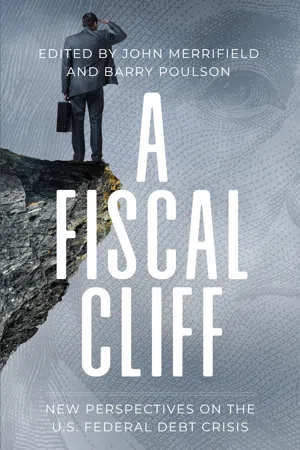 eBook - ePub
A Fiscal Cliff
New Perspectives on the U.S. Federal Debt Crisis
- John Merrifield, Barry Poulson, John Merrifield, Barry Poulson(Authors)
- 2020(Publication Date)
- Cato Institute(Publisher)
WHY DEFICITS?DAVID J. HEBERTThe reality of the U.S. fiscal situation is apparent to even the untrained eye. The problem of persistent government debt plagues not only the federal government but all 50 state governments as well. Pointing this out is nothing new. What is new and perhaps noteworthy, however, is the juxtaposition of the public sector’s indebtedness with the private sector’s profitability. In a time where multiple private companies are now worth over $1 trillion and setting record levels of profit, the U.S. public sector seems to be hemorrhaging money at a faster rate than ever before. This gap between public indebtedness and private profitability is perplexing and worth exploring further.As Richard Wagner has observed on this subject: “While living within a budget can be difficult, most people manage to do it most of the time. Even elected legislators seem to do this with their personal accounts, as we rarely hear of them having persistent financial difficulties.”1 As Wagner points out, the issue with persistent U.S. debts and deficits arises not because the individual legislators are unable to balance a budget—they routinely do so in their own lives. He goes on to note that even groups of people, such as clubs and churches, can operate within a balanced budget, so the current fiscal problems of the United States cannot merely be the result of group decisions or group dynamics per se.Finally, this inability to balance the budget cannot simply be the result of the sheer difficulty of the problem of using astronomical numbers in budgeting. If it were, then we would expect errors to be unbiased, causing governments to run deficits in some years and surpluses in others, with the errors canceling one another over a sufficiently long time. The fact that the real world is characterized by deficits every year—and typically larger-than-predicted deficits—means that something inherent in the public system is biasing the fiscal outcome toward deficits and not doing so in the private sector.
- INTERNATIONAL MONETARY FUND(Author)
- 1989(Publication Date)
- INTERNATIONAL MONETARY FUND(Publisher)
3. Relationship Between Simulated Real Budget Deficit and the Trade Balance
In the simulations considered above, expenditure was adjusted to certain levels and its impact on the trade balance, output, and prices was examined. In the basic model, tax revenue is endogenous to the system, depending on the nominal value of output and imports, so the overall budget balance is also endogenously determined. However, if the resultant trade balances are examined under alternative hypothetical situations, the simulations with a higher Budget Deficit in real terms, under all forms of financing, yield a higher deficit on the trade account in real terms (Table 8 ). When interpreting the results reported in Table 8 , one should note that an increase in the real Budget Deficit over time is not necessarily reflected as a corresponding increase in the external trade deficit, because other developments not explicitly considered in the model may offset the effect of expansionary fiscal policy. If the data for any single year are observed and the impacts on the trade balance of variations in the Budget Deficit under different simulations are compared, a higher Budget Deficit (in real terms) corresponds to a higher deficit in the trade account; this is the only way the simulated Budget Deficit is allowed to change between the scenarios; other factors remain the same for the same year. It may be noted, however, that the effect of an expansionary fiscal policy on the trade balance is generally not as high as may be expected under the fiscal approach to the balance of payments; an increase in the Budget Deficit results in a less-than-equal deterioration in the trade account balance for the Philippines.Table 8 eBook - ePub
- Robert Eisner(Author)
- 2010(Publication Date)
- Free Press(Publisher)
7
Deficits and the Economy:The Theory, Part II
WE HAVE SO FAR CONCENTRATED on a world in which full employment is assured—or assumed. This is a world where all who want to work are working, and are working as much as they want. It is a world where all that we can produce is produced. There is no problem of being able to sell our output. The way to increase production—and income—is therefore to increase our ability to produce, that is, to increase supply. And we have explored potential effects of deficits on supply—finding them somewhat more enigmatic than many chose to believe.But every businessman knows that getting the goods is only half the problem, if that much. What is critical is being able to sell what you can produce. For any single firm that is a problem of the demand for its products. For the economy as a whole it is a problem of total, or aggregate demand.It is here that we will find major effects of federal Budget Deficits and federal debt. They can have a significant impact on aggregate demand. This impact can be good or bad, depending on the situation of our changing, dynamic economy, and depending on just how large the deficits and debt really are. The latter issue brings to the fore some of the critical questions of measurement we have been discussing. But the first essential question is, however large the deficit or debt, what difference does it make? Why should the deficit—the difference between government expenditures and government tax revenues—matter?To answer this, we must build upon a body of theory and analysis well known to most economists, and indeed to a generation or two of survivors of freshman economics courses. We also have to be familiar with some of the recent reservations and objections to this theory and analysis. If we are convinced beforehand that the reservations and objections have been sufficient to negate the analysis, we have in effect decided that deficits do not matter. Those so convinced have perhaps read too far already, and might well pursue a more promising pastime. Those still concerned may want to plunge on with us into the theory.
Index pages curate the most relevant extracts from our library of academic textbooks. They’ve been created using an in-house natural language model (NLM), each adding context and meaning to key research topics.

