Economics

Economic Efficiency
Economic efficiency refers to the optimal allocation of resources to maximize overall welfare. It occurs when goods and services are produced and distributed in a way that maximizes societal benefit while minimizing waste. This concept is a key focus in economic analysis and policy-making, aiming to achieve the most favorable outcomes for society as a whole.
Written by Perlego with AI-assistance
Related key terms
1 of 5

8 Key excerpts on "Economic Efficiency"
 eBook - PDF
Microeconomics
Theory and Applications
- Edgar K. Browning, Mark A. Zupan(Authors)
- 2019(Publication Date)
- Wiley(Publisher)
490 Chapter Nineteen • General Equilibrium Analysis and Economic Efficiency • Economic Efficiency Let’s begin with a formal definition of Economic Efficiency and its corollary, economic ineffi- ciency. An allocation of resources is efficient when it is not possible, through any feasible change in resource allocation, to benefit one person without making any other person worse off. In other words, when the economy is operating efficiently, there is no scope for further improvement in anyone’s well-being unless they are benefited at the expense of other people. An allocation of resources is inefficient when it is possible, through some feasible change in the allocation of resources, to benefit at least one person without making any other person worse off. Inefficiency implies waste, in the sense that the economy is not satisfying the wants of people as well as it could. These abstract definitions become clearer when we employ a diagram. To simplify mat- ters, let’s assume that society consists of only two people, Scrooge and Tiny Tim, although we can easily extend the analysis to larger numbers. In Figure 19.2, Scrooge’s welfare is measured horizontally and Tiny Tim’s welfare vertically. Since no objective way exists to attach units of measurement to a person’s utility or welfare, the welfare measure is entirely ordinal. In other words, a rightward movement in the diagram implies that the resource allo- cation has changed in a way beneficial to Scrooge, but it does not tell us how much better off Scrooge is. All we know from the diagram is that the farther to the right we are, the higher is the indifference curve Scrooge attains. Upward movements similarly imply a change benefi- cial to Tiny Tim. The levels of well-being attained by Scrooge and Tiny Tim depend on their consumption of goods. There are limits, though, to how much they can consume, because limited quan- tities of resources are available to produce those goods. eBook - PDF
- Luther Tweeten(Author)
- 2019(Publication Date)
- CRC Press(Publisher)
CHAPTER TWO Public Welfare and Economic Science Economics can be defined as the science of allocating scarce rcsources among competing ends to satisfy these ends as fully as possible. The definition raises several issues. The term science implies not only a meaningful classification of facts and a systematic body of knowledge but also a logical structure and ability to predict Whether economics can meet these requirements for a science is conjectural. Of great interest is the term ends in the definition. What ends or goals are to be achieved, and for whom? In farm management economics, the dilemma of alternative goals poses no serious philosophic problems. The economist can hold out a profit-maximizing allocation of resources computed by linear programming, and the farm manager can take or leave it depending on his personal goals and financial circumstances. An economist employed by a farm organization with well-defined goals also has no confusion over how and whom to serve. The task is not easy for the policy economist whose salary is paid by taxpayers. Farm policies have a far-reaching impact not only on U.S. farmers and consumers but sometimes on the world. The individual farmer often must accept the policy that the majority of farmers or members of society voted to accept. The goal in broad terms may be defined as well-being, satisfaction, welfare, or utility in society. But there are problems in trying to maximize something as elusive as utility by a policy that affects many individuals, each with unique objectives in life. Welfare economics deals with such issues. It is a part of general economic theory that attempts to answer the question what can the economist in his professional role of a scientist say about public policy? This chapter outlines the origins of welfare economics and criteria for making economic prescriptions. The chapter deals with economic equity and Economic Efficiency and with factors that interfere with Economic Efficiency in society.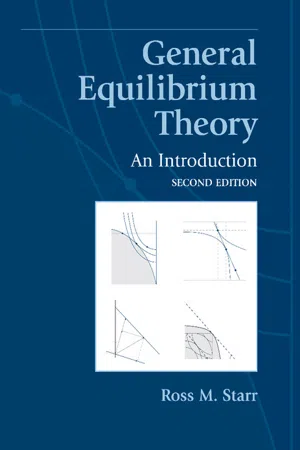 eBook - PDF
General Equilibrium Theory
An Introduction
- Ross M. Starr(Author)
- 2011(Publication Date)
- Cambridge University Press(Publisher)
– G. Debreu (1986) 19 Pareto efficiency and competitive equilibrium 19.1 Pareto efficiency The purpose of economic activity is to allocate scarce resources to promote the welfare of households in their consumption of goods and services. There is a very large number of possible allocations of resources (typically, an uncountable infin-ity), but most of them are wasteful – we can do better. Some wasteful allocations are those that do not make effective use of productive resources (corresponding to points inside the production frontier in the Robinson Crusoe economy). An alternative form of inefficiency occurs in allocations that allocate the mix of out-puts among consumers without equating marginal rates of substitution (subject to boundary conditions), leaving room for improvement in the mix of consump-tion across households (wasteful points corresponding to those off the locus of tangencies in the Edgeworth box). Economic theory does not give us precise guidance as to the desirable distri-bution of income and wealth across households. The theory is agnostic on the distribution of income between Smith and Jones and between Rockefeller and Micawber. We are led then to posit a criterion of nonwastefulness as a standard for the effective utilization of scarce resources, while avoiding the moral question of the desirable distribution of income. The nonwastefulness criterion is Pareto efficiency , and it is fundamentally a simple idea. A (Pareto) improvement in allo-cation is a reallocation that increases some household’s utility (moves higher in the preference quasi-ordering) while reducing no household’s utility. An allocation is Pareto efficient if there is no further room among attainable allocations for (Pareto) improvement. To analyze this concept more fully we start with the definitions needed to formalize these concepts. 205 eBook - PDF
- B Guy Peters, Jon Pierre, B Guy Peters, Jon Pierre(Authors)
- 2006(Publication Date)
- SAGE Publications Ltd(Publisher)
B shows the total benefits accruing to society at each level of output. Allocational efficiency is straightforward: it results when the output level that maximizes the difference between total benefits and total costs, Q te , is selected. Second, consider technical efficiency. C te shows the total cost of producing various quan-tities of a good assuming technical efficiency. Technical efficiency requires that the total cost of the resources employed in producing the good is the lowest feasible amount at every level of output. If output is not produced using the least-cost combination of inputs, then a techni-cally inefficient total cost curve, such as C ti , results. Maximizing the difference between total benefits and total costs with this technical inef-ficiency would result in output level Q ti . This output level is both allocationally and techni-cally inefficient. It is allocationally inefficient because it results in too little output (Q ti rather than Q qe ). It is technically inefficient because the output that is produced costs more than the minimal feasible amount (C i rather than C e ). HANDBOOK OF PUBLIC POLICY 418 Technical inefficiency is straightforward: an alternative way of producing the good at lower cost is available. For example, technical ineffi-ciency results if refuse trucks are manned by three-person crews when the same work could be performed within established shifts with two-person crews. However, technical effi-ciency can be more complicated for two rea-sons. First, there may be trade-offs between various inputs—two-person crews can replace three-person crews, but only if loading equip-ment is added to the refuse trucks. An under-standing of such trade-offs requires knowledge of the “production functions” for public agen-cies. eBook - PDF
Globalization and Economic Ethics
Distributive Justice in the Knowledge Economy
- A. Barrera(Author)
- 2007(Publication Date)
- Palgrave Macmillan(Publisher)
Let us take globalization as an illustration. Free trade across nations induces Ricardian/Smithian efficiency. As nations liberalize their domestic markets and as they move toward their comparative advantage, they put their resources toward their most valued uses (allocative/microEconomic Efficiency). The resulting specialization and competition engender technological change and innovation (Schumpeterian efficiency). Thus, in the ideal market, these three effi- ciencies mutually reinforce each other and converge into a single har- monious dynamic. Finally, a common characteristic of these efficiencies is the central role played by the market. For example, Shipman (1999, 32) lists his five efficiencies in the context of his discourse on the “advantages of markets as a social organising principle.” Kuttner (1997, 24–27) explains his three efficiencies within his exposition on the “virtues and limits of markets.” Dosi et al. (1990, 240, 248–54) consider efficiency in the course of their treatment of technological change in the wake of international trade. Indeed, the market can be viewed as the milieu or the overarching framework within which Economic Efficiency is achieved. In fact, one can make this claim even stronger by noting that the market is a necessary, though not sufficient, condition for eco- nomic efficiency. 10 It is the only social institution, to date, that can best approximate the ideal economic state described by the above- mentioned efficiencies. If economics is indeed about putting scarce resources to their most valued uses, 11 then the market is an incompa- rable social institution that generates such a disposition. The market and Economic Efficiency are inextricably linked to each other. The market is the means to attaining efficiency, even as efficiency, in its own turn, is an end for which the market exists. 12 We examine this linkage in greater depth in the next section.
- (Author)
- 2018(Publication Date)
- Peter Lang International Academic Publishers(Publisher)
7 CHAPTER I The Fundamental Issue: Efficiency in Market Economies This part deals with the terminus technicus 'efficiency' in an extensive sense: Efficiency related to the performance of market according economic theory. The investigation is mainly conducted using the terms 'allocational efficiency' (A-efficiency), and 'informational efficiency' (I-efficiency). Occasionally, the terms 'allocation efficiency' or 'information efficiency' will be used. Because in economic theory these above-cited notions are already widely applied carrying special meanings, the following exposi-tion provides a framework of definitions. A market is considered to be a composite unit of two related sub-systems. These subsystems are referred to as 'allocation system' (A-system) and 'information system' (I-system). Market System /Allocation System ~Info=ation Syst= The A-system comprises the traditional conception of market eco-nomies as based upon autonomous decisions of many legally inde-pendent economic agents. Thus one may think in terms of producers and consumers, of suppliers and demanders of labour and of goods and services. However, we only deal with the relations that are usually assessable in termini of prices. In order to clearly study these market conditions, we put on glasses to 'colour the Hans-Michael Geiger - 978-3-631-75572-3 Downloaded from PubFactory at 01/11/2019 03:27:17AM via free access 8 world' in economic categories thus blocking out all other possib-le interactions 11 • The fact that this type of strategy allows to focus on particular elements by hampering the digression to incidentals is the rational justification for all kinds of 'a priori'-views. This is usually called 'Werturteil im Basis-bereich'. On the other hand, it bears the risk of a narrowed horizon, which suppresses access to better or !!lore appropriate forms of explanation. eBook - ePub
The Market
Equilibrium, Stability, Mythology
- Sydney N. Afriat(Author)
- 2006(Publication Date)
- Routledge(Publisher)
cost-efficient, obtaining the given benefit at minimum cost.The terms efficient and effective have a difference here, which might appear to deny they are synonyms. However, they are employed to distinguish two types of efficiency, or effectiveness, just as in the study of the two social groups to which a reference has been made.Effectivity functions in game theory, introduced by Moulin and Peleg (1982) , show another area where ‘effectiveness’ has made an entry. Such a function describes, for each coalition S, the set of subsets within which S can force an outcome by means of some coordinated action of its members.2 This use seems in line with expressions about a medical treatment, or some agency or institution, or person, being effective or ineffective, as concerns production of intended outcomes.2 For awareness of this subject and information about it, I amindebted to Stefano Vannucci, University of Siena, for personal communications in addition to his papers (1999).Typical Economic Efficiency concepts have to do with production. In a first notion of a production function f, it determines the output q = f(x) obtained with any inputsx ∈ C ..3 Quite usually now, it instead determines the maximum possible output for the given inputs, so q ≤ f (x) for any feasible input-output operationThe efficiency of the operation is then e = q/f(x), that is, actual output as a fraction of the maximum possible. This quotient has also been called the coefficient of resource utilization. Necessarily 0 ≤ e ≤ 1, with e =(∈ C × Ω .x , q) eBook - PDF
Truth or Economics
On the Definition, Prediction, and Relevance of Economic Efficiency
- Richard S. Markovits(Author)
- 2008(Publication Date)
- Yale University Press(Publisher)
Second, in practice, when actually analyzing the allocative efficiency of par-ticular government policies, no economist ever uses ‘‘Economic Efficiency’’ in this Pareto-superior/Pareto-inferior sense. In my experience, all articles that begin by defining Economic Efficiency in the Pareto-superior/Pareto-inferior sense end up implicitly defining the concept in the correct monetized sense Chapter 1 delineated. Third, the Pareto-superior/Pareto-inferior definition of Economic Efficiency is disfavored not only by its inconsistency with popular and professional understanding and usage but also by the fact that the concept it creates would be completely or virtually useless. Since in our actual, highly-Pareto-imperfect world virtually all private choices and (I would submit) all public policies benefit some and harm others, the Economic Efficiency of all or virtually all choices whose Economic Efficiency economists investigate would be indeter-minate if the concept were defined in the Pareto-superior/Pareto-inferior sense. Such a definition would therefore prevent the concept from making the contribution Part III will argue it can make if defined in the monetized sense Chapter 1 articulates to the utilitarian evaluation of choices and policies. Fourth, for two reasons, the Pareto-superior/Pareto-inferior definition of the impact of a choice on Economic Efficiency will not enable economists to achieve the goal that led them to propose it—namely, to increase their social contribution by increasing the moral significance of the economic-efficiency conclusions their expertise enables them to generate. I have already explained the first reason, which is empirically more important: on this definition, the Economic Efficiency of all or virtually all choices will be indeterminate. The sec-ond reason (which is admittedly less empirically important) may be somewhat A Critique of Definitions for Economic Efficiency 49
Index pages curate the most relevant extracts from our library of academic textbooks. They’ve been created using an in-house natural language model (NLM), each adding context and meaning to key research topics.
