Economics

Forex
Forex, short for foreign exchange, refers to the global marketplace for buying and selling currencies. It is a decentralized market where participants, such as banks, corporations, and individual traders, exchange one currency for another. Forex trading is essential for international trade and investment, as it allows businesses and investors to hedge against currency fluctuations and facilitate cross-border transactions.
Written by Perlego with AI-assistance
Related key terms
1 of 5
9 Key excerpts on "Forex"
 No longer available |Learn more
- (Author)
- 2014(Publication Date)
- Research World(Publisher)
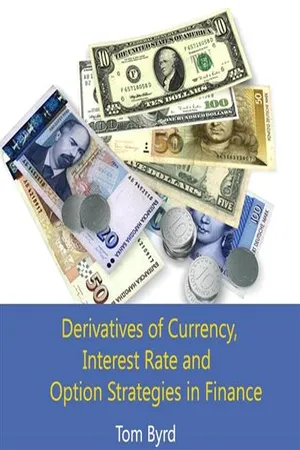
____________________ WORLD TECHNOLOGIES ____________________ Chapter-1 Foreign Exchange Market The foreign exchange market ( Forex , FX , or currency market ) is a worldwide decentralized over-the-counter financial market for the trading of currencies. Financial centers around the world function as anchors of trading between a wide range of different types of buyers and sellers around the clock, with the exception of weekends. The foreign exchange market determines the relative values of different currencies. The primary purpose of the foreign exchange is to assist international trade and investment, by allowing businesses to convert one currency to another currency. For example, it permits a US business to import British goods and pay Pound Sterling, even though the business's income is in US dollars. It also supports speculation, and facilitates the carry trade, in which investors borrow low-yielding currencies and lend (invest in) high-yielding currencies, and which (it has been claimed) may lead to loss of competitiveness in some countries. In a typical foreign exchange transaction, a party purchases a quantity of one currency by paying a quantity of another currency. The modern foreign exchange market began forming during the 1970s when countries gradually switched to floating exchange rates from the previous exchange rate regime, which remained fixed as per the Bretton Woods system. The foreign exchange market is unique because of • its huge trading volume, leading to high liquidity; • its geographical dispersion; • its continuous operation: 24 hours a day except weekends, i.e. trading from 20:15 GMT on Sunday until 22:00 GMT Friday; • the variety of factors that affect exchange rates; • the low margins of relative profit compared with other markets of fixed income; and • the use of leverage to enhance profit margins with respect to account size.
- Homemade Loving's(Author)
- 2021(Publication Date)
- Books on Demand(Publisher)
An average income millionaire usually has between 7 and 10 different sources of income outside of his or her work income. One way of doing this is to build up a passive income in the world's largest market, the currency or Forex market, in the form of Forex.The following explanations in this book serve to present this field and its possibilities in detail and to show how a passive income can be built up in the world's largest market, the currency and foreign exchange market. First of all, it is a matter of explaining some of the terms used in Forex, so that even a beginner can become familiar with this subject.What is Forex and Forex trading?
The term Forex (short for Foreign Exchange Market) is the most common name for the foreign exchange or currency market today. Also the terms FX market, foreign exchange market or currency market are used colloquially. The Forex market is the most liquid and largest market in the world, which includes all the currencies existing in the world. In this market, the demand for foreign exchange meets the supply of foreign exchange and the exchange of foreign exchange takes place at the current exchange rate.There is no central marketplace where this foreign exchange trading is carried out, because the trade is mainly between the market participants.Forex trading is then understood to be the sale and purchase of foreign exchange or currencies. In doing so, investors try to profit from the exchange rate changes and thereby make a profit. In order to maximize the profit amount, very high financial levers are used. However, the use of high financial levers also means the risk of realizing high losses, which can far exceed the original investment.What is the foreign exchange or currency market?
The foreign exchange or currency market is the largest financial market in the world with a daily turnover of more than 5 trillion dollars. In contrast to the floor exchange, trading is possible here 5 days a week, 24 hours a day. Trading is usually possible practically from Sunday night until late Friday evening. Thus, trading is possible from Sunday to Friday non-stop without interruption. eBook - PDF
Speculation And The Dollar
The Political Economy Of Exchange Rates
- Laurence Krause(Author)
- 2019(Publication Date)
- Routledge(Publisher)
For instance, Charles Coombs, the former chief foreign exchange expert at the New York Federal Reserve Bank, has noted that Foreign exchange traders for better or worse, are not a bunch of scholarly Ph.D.s searching reams of statistical evidence for proof that a certain currency rate is becoming over or under valued and thereby triggering their decision to buy or sell. Anyone who has ever spent any time in a foreign exchange trading room knows only too well that traders focus primarily on short run developments. Foreign exchange traders have been taught by harsh experience that betting on the longer term fundamentals is an excellent way of losing your shirt. The name of the game is to anticipate market reactions to each new report coming off the ticker.28 Others have gone even further and have noted that, when traders focus on anticipating market reactions to news, the result tends to produce bubbles: THE FOREIGN EXCHANGE MARKET 73 Many market operators who follow exchange rates on a daily or hourly bases advance the view that exchange rates move in speculative runs, perhaps touched off by a change (or revision of expectations about) fundamental economic conditions, thereafter reflecting a self sustaining speculative mentality: When the train is racing through the station at 90 miles an hour you don't think very long about where it is going to stop; you just try to get on board (anonymous broker).29 Casino-Style Capitalism In order to understand better the relationship between speculation and the foreign exchange market, we need to examine the institutional structure of the market for foreign exchange and its evolution within a broader framework. This will allow us to link larger macroeconomic dynamics with the changing character of the foreign exchange market. While providing such a framework is beyond the confines of this book, such considerations simply cannot be ignored.
- Michael Brandl(Author)
- 2020(Publication Date)
- Cengage Learning EMEA(Publisher)
19 Foreign Exchange Markets 19-1 Foreign Exchange Market Basics 406 19-2 Foreign Exchange Supply and Demand 410 19-3 Foreign Exchange Equilibrium 415 19-4 Foreign Exchange Regimes 422 19-5 Conclusion 425 Copyright 2021 Cengage Learning. All Rights Reserved. May not be copied, scanned, or duplicated, in whole or in part. Due to electronic rights, some third party content may be suppressed from the eBook and/or eChapter(s). Editorial review has deemed that any suppressed content does not materially affect the overall learning experience. Cengage Learning reserves the right to remove additional content at any time if subsequent rights restrictions require it. Foreign Exchange Market Basics You have probably heard it hundreds of times: We live in a globalized world. It’s passé, but it is true. As the 2008 financial crisis demonstrates, our global economy is much more intertwined than it was a generation ago. This is not your parents’ global economy. As economies around the globe become more intertwined, the need to exchange currencies naturally grows. For example, suppose Hans in Stuttgart, Germany, wants to buy an American-made Dell computer. To buy the computer, Hans has to exchange his euros for US dollars. The same holds true for Stan in Milwaukee, Wisconsin, who wants to buy a bond issued by the British mobile phone service provider Vodafone. Stan has exchanged his dollars for British pounds to buy the Vodafone bond. As goods markets and financial markets around the world become more intertwined, the need to buy and sell currencies grows. The Bank for International Settlements reported that the average daily turnover in the foreign exchange market was an eye-popping $5.1 trillion during April 2016. The volume, which is down from $5.3 trillion three years earlier, is still a staggeringly large number. The large role the American economy plays in global markets can be seen in the fact that the US dollar was on one side of the trade in 88% of all FX trades in 2016. eBook - PDF
Money, Markets, and Democracy
Politically Skewed Financial Markets and How to Fix Them
- George Bragues(Author)
- 2016(Publication Date)
- Palgrave Macmillan(Publisher)
This is so that other nations will be willing to hold onto their currency as a reserve asset. Sometimes, governments will act together as a cartel to influence the relative prices of their currencies. Less often, the purposes of numerous states coalesce so strongly that they merge their money- production operations by erecting a single central bank to oversee one currency for all of them. The euro is the result of such a merger and its origins, evolution, and struggles cannot possibly be understood without tracing the political considerations involved. Whenever the matter of politics and currencies is brought up, the dis- cussion invariably turns to the question of fixed versus floating rates. My discussion is no exception to this. Indeed, all the different approaches that governments can adopt in managing their respective currencies can be reduced to variants of those two alternative regimes. Of the two, fixed is the superior, albeit only on the condition—and this is a big condition—it is based on a reserve asset like gold. Here again, this time with currencies, we are confronted with a situation in which the ideal clashes with the prac- tical realities of living in a full-fledged democracy, where the maintenance of a gold standard goes against the deepest tendencies of the regime. WORKINGS AND PLAYERS OF THE FX MARKET For our last financial markets primer, or review as the case may be among readers, a good place to start is with the enormous size of the FX mar- ket. Without question, the buying and selling of currencies is the largest sector of the financial markets, as measured by the value of daily transac- tions. In its latest triennial survey published in September 2013, the BIS estimated the volume of currency trades to be $5.3 trillion on average per day. 4 By contrast, in 2013, the global equity market saw $55 tril- lion of shares traded, but that was over a year. eBook - PDF
- Shad Morris, James Oldroyd(Authors)
- 2020(Publication Date)
- Wiley(Publisher)
95 CHAPTER 6 Introduction Money makes it easier to buy and sell goods around the world. In fact, thanks to electronic banking, paper money and coins no longer need to change hands. However, despite electronic advances in the ways we can transfer currency, the value of money fluctuates across countries, adding a layer of complexity to international business. One country’s currency may be undervalued, which makes buying products from another country more expensive. Or a country may have an overvalued currency, which makes buying products and services from other countries disproportionately cheaper, but makes the home country’s own exports more expensive. Currency exchange is the process by which countries and companies swap one nation’s currency for that of another. The values of different currencies depend on a number of factors, such as the supply of and demand for a particular currency, the level of political stability in the country that issues it, and the economic policies imposed by its government. The disparity between currencies can create arbitrage opportunities (opportunities of taking advantage of price differ- ences in multiple markets) for firms engaging in currency exchange, but it can also expose them to financial loss. Companies planning on doing business internationally need to first understand the opportunities and risks associated with currency exchange and then learn how to effectively respond to these threats and opportunities through various risk-management techniques. LEARNING OBJECTIVES After you explore this chapter you will be able to: 1. Identify the three functions of money 2. Explain why foreign exchange rates fluctuate 3. Discuss the causes and consequences of under- or overvaluation of currency 4. Describe how companies settle international monetary transactions and manage exchange rate risk TUNTI/Creatas Video/Getty Images Currency and Foreign Exchange eBook - PDF
International Trade and Agriculture
Theories and Practices
- Won W. Koo, P. Lynn Kennedy(Authors)
- 2008(Publication Date)
- Wiley-Blackwell(Publisher)
Given a depreci- ation of a currency, foreigners find exports cheaper as residents find imports more expens- ive. Conversely, when a currency appreciates, it gains value relative to other currencies. Given an appreciation of a currency, foreigners find exports more expensive as residents find imports cheaper. There are a variety of participants in the currency exchange market. The major players are commercial banks, corporations, nonbank financial institutions, and central banks. Individuals can participate in this market, but their role is insignificant relative to that of the major players. Central banks use intervention to alter the amount of currency in circulation. Central bank transactions in the private market for foreign currency assets are known as official foreign exchange intervention. u - v u - - - - - - Y 208 -p--- - 10 With the advent of electronic trading via computer network systems, trades can occur in a matter of seconds. Given this, the integration of financial centers combined with the ability to trade electronically implies no major difference in prices around the world. This phenomenon of buying a currency cheap and selling it for profit is known as arbitrage. 11 A vehicle currency is a unit of exchange that is used to facilitate currency transactions between other currencies. The dollar, euro, and yen are widely used as vehicle currencies. 12 Regimes in which exchange rates are permitted to adjust to an equilibrium, market-clearing level are known as floating or flexible exchange rate systems. Fixed exchange rate systems are characterized by central banks determining the currency price and setting it at that level. 13 The spot market involves the trading of currencies for current or immediate delivery. The price of this transaction is called the spot exchange rate. 14 The futures market fills a niche for transactions to be executed at some specified time in the future. eBook - ePub
International Economics
Global Markets and Competition
- Henry Thompson(Author)
- 2017(Publication Date)
- WSPC(Publisher)
Uncertainty about the exchange rate increases the risk of international transactions. A mechanism for avoiding exchange risk is the forward exchange market where a contract is signed to buy or sell foreign currency at some future date at a set rate.A. THE FOREIGN EXCHANGE MARKET
The FX market is based on the supply and demand of foreign exchange. Fundamental relationships involving exchange rates include •The exchange rate link to prices of imports and exports•The response of the BOT to depreciation or appreciationThe FX Market
An importer trades domestic currency for foreign currency on the foreign exchange FX market. Consider a US importer buying Japanese products. The importer can go through a bank to buy the yen to transfer to the bank of the Japanese exporter. Banks and import agencies specialize in currency transactions as well as import restrictions and customs paperwork.Suppose the exchange rate of the yen is $0.008 in the FX market. As with any commodity, price is expressed in home currency. Apples cost $1/pound and Japanese currency $0.008 per yen. One dollar trades for 1/.008 = 125 yen. If the price of M is 625 yen in dollars is $0.008 × 625 = $5. The decision of whether to import is based partly on the FX rate.If the price of the dollar rises to yen/$ = 200 the dollar price of M falls to 625/200 = $3.13. An appreciating currency lower the price of imports and increases the quantity demanded. If imports are elastic, import spending rises as does the quantity of foreign currency demanded.This inverse relationship between $/yen and the quantity of yen demanded is illustrated by the demand for yen in Figure 11.2 . The rise in yen/$ from 125 to 200 equals a fall in $/yen on the vertical axis from 0.008 to 0.005. The quantity of yen demanded rises from 20 to 30 trillion.On the supply side, Japanese importers buying US exports sell yen in the FX market. If the price of business services is $10/S
- Michael Brandl(Author)
- 2016(Publication Date)
- Cengage Learning EMEA(Publisher)
19 Foreign Exchange Markets 19-1 Foreign Exchange Market Basics 382 19-2 Foreign Exchange Supply and Demand 386 19-3 Foreign Exchange Equilibrium 391 19-4 Foreign Exchange Regimes 398 19-5 Conclusion 401 Copyright 2017 Cengage Learning. All Rights Reserved. May not be copied, scanned, or duplicated, in whole or in part. Due to electronic rights, some third party content may be suppressed from the eBook and/or eChapter(s). Editorial review has deemed that any suppressed content does not materially affect the overall learning experience. Cengage Learning reserves the right to remove additional content at any time if subsequent rights restrictions require it. 382 CHAPTER 2 Sample Design About Money Foreign Exchange Market Basics You have probably heard it hundreds of times: We live in a globalized world. It’s passé, but it is true. As the recent financial crisis demonstrates, our global economy is much more intertwined than it was a generation ago. This is not your parents’ global economy. As economies around the globe become more intertwined, the need to exchange currencies naturally grows. For example, suppose Hans in Stuttgart, Germany, wants to buy an American-made Dell computer. To buy the computer, Hans has to exchange his euros for US dollars. The same holds true for Stan in Milwaukee, Wisconsin, who wants to buy a bond issued by the British mobile phone service provider Vodafone. Stan has exchanged his dollars for British pounds to buy the Vodafone bond. As goods markets and financial markets around the world become more intertwined, the need to buy and sell currencies grows. The Bank for International Settlements recently reported that the average daily turnover in the foreign exchange market was an eye-popping $5.3 trillion during April 2013. To put this into perspective, the daily amount of transactions only three years earlier was $4.0 trillion, and it was $3.3 trillion in 2007.
Index pages curate the most relevant extracts from our library of academic textbooks. They’ve been created using an in-house natural language model (NLM), each adding context and meaning to key research topics.

