Economics

Free Trade Zone
A Free Trade Zone is a designated area within a country where goods can be imported, manufactured, and re-exported without being subject to the usual trade barriers and customs duties. This encourages international trade and investment by offering businesses a more favorable environment for conducting trade. Free Trade Zones often have streamlined customs procedures and reduced regulations to facilitate trade activities.
Written by Perlego with AI-assistance
Related key terms
1 of 5
10 Key excerpts on "Free Trade Zone"
 eBook - ePub
101 Things Everyone Needs to Know about the Global Economy
The Guide to Understanding International Finance, World Markets, and How They Can Affect Your Financial Future
- Michael Taillard(Author)
- 2012(Publication Date)
- Adams Media(Publisher)
The most limited forms of trade integration are Free Trade Zones. These are designated areas within an otherwise closed nation in which free trade is allowed. Imports in the form of raw materials come in, are transformed into manufactured goods, and are exported tax-free and without government intervention (except, of course, for things that directly affect national defense, such as weaponry and other sensitive equipment). Goods for consumption can enter the Free Trade Zone but are not allowed to leave.Free Trade Zones can exist in cooperation between any two nations. Sometimes the term “zone” doesn’t refer to a specific geographic location but to a type of business. In Mexico, for instance, businesses called maquiladoras are allowed to operate in a manner similar to Free Trade Zones. They import raw material to produce manufactured exports with lower trade restrictions than other industries.Since these Free Trade Zones are designed for the import of raw materials to be processed into manufactured goods, they naturally attract factories and other manufacturing facilities. This has both benefits and detriments—lax regulations on trade and operations can be effective at attracting investment and employment, but they also attract companies and industries seeking to bend rules.Free Trade Zones are usually set up in two types of locations: underdeveloped regions and port regions.- When established in underdeveloped regions , the investment and production that the new and improved trade policies attract help develop the area. Companies create jobs, increase the nation’s production output, and increase gains from trade and wealth in the area, stimulating development for a higher quality of life. At least that’s the theory. The reason that Free Trade Zones are established near ports is a little bit less complicated: They’re very close to the shipping points through which raw materials will be imported and manufactured products exported.
Since ports and waterways naturally attract trade and industrialization, those organizations that operate there tend to be held to a higher standard for operations and working conditions. These are located in near proximity to other employers; consequently competition for workers is a bit higher since workers have more options and more ability to negotiate for total income. On the other hand, organizations in undeveloped areas, which have few other companies to which workers might apply, have greater negotiating power since the workers have few other choices of employment. This often results in poorer working conditions. eBook - ePub
Freeports and Free Zones
Operations and Regulation in the Global Economy
- Mark Rowbotham(Author)
- 2022(Publication Date)
- Informa Law from Routledge(Publisher)
This would suggest that one can have some of the tax incentives in a Free Zone, but not all of them. The US Foreign-Trade Zones allow for the re-export of goods from a Customs-controlled environment or the release of these goods as well as the manufacture of finished goods from a Customs-controlled environment into US Free Circulation, but they do not allow for Direct Tax incentives. They exist to encourage international trade by Customs-controlled incentives. The same is true of Freeports, although the UK Government is considering allowing the use of direct, as well as indirect, tax incentives to promote the use of the proposed UK Freeports.The outline of the tax incentive approach is as follows:- Freeports – Import Duty and VAT incentives;
- FTZs – Import Duty and Sales Tax incentives;
- EPZs – Import Duty and Sales Tax/VAT incentives plus Direct Tax incentives (Export Oriented);
- SEZs – Direct and Indirect Tax incentives.
The ideal Free Zone facilities should include a combination of both Direct and Indirect Tax incentives, plus the ability to manufacture goods in the zone for re-export or for release into national Free Circulation based on the Tariff Inversion principle as described earlier in the text. This flexibility gives far more incentives for companies to use the Free Zone for either production, storage or general operation purposes, such as international trading of services, thus allowing a wide variety of companies to use the zone while enjoying a wide variety of fiscal incentives.However, it must also be stated that, even within the above set of criteria and categories, there is no absolute demarcation between many of the Free Zone concepts. Each country where such Zones are located is host to different types of Free Zone depending upon national Free Zone policy as determined by national government. In the developing world, Free Zones have a much more varied function given that they are designed as vehicles for a combination of tax incentives in general as well as the encouragement of foreign inward investment. Foreign investment generated income for the country from external sources, and the concept of the EPZ encourages export-led economic growth. Therefore, government policies which engender such activity promote economic growth in their countries and thus seek to encourage greater levels of economic development in line with the policies of the UNCTAD. Indeed, the WEPZA, an organisation which was established by the UNIDO as an umbrella organisation coordinating and promoting the worldwide network of Export Processing Zones, existed as a means of promoting the development of EPZs on a global scale and encouraging their implementation and success. Although the organisation’s secretariat has relocated from its previous base in Arizona, US, to the UK, it is still possible to access many of its publications in its form of the erstwhile Flagstaff Institute, and to determine the extent to which it promoted the whole concept of both Export Processing Zones and Free Zones in general. (The website is www.wepza.org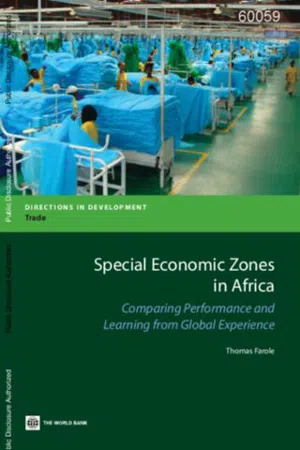 eBook - PDF
Special Economic Zones in Africa
Comparing Performance and Learning from Global Experience
- Thomas Farole(Author)
- 2011(Publication Date)
- World Bank(Publisher)
23 Introduction The term economic zones encompasses a wide variety of related concepts, including Free Trade Zones, free ports, foreign trade zones, export process- ing zones, special economic zones, free export zones, trade and economic cooperation zones, economic processing zones, and free zones. Despite the many variations in name and form, they can all be broadly defined as demarcated geographic areas contained within a country’s national bound- aries where the rules of business are different from those that prevail in the national territory. These differential rules principally deal with investment con- ditions, international trade and customs, taxation, and the regulatory environ- ment; whereby the zone is given a business environment that is intended to be more liberal from a policy perspective and more effective from an administrative perspective than that of the national territory. Even this parsimonious definition 1 does only partial justice to reality, as some countries make no distinction with regard to taxation in their zones, and others have done away with the geographic spatiality of the zone and have instead made it a purely legal space with applicability across the entirety of the national territory or large portions of it. It is therefore not C H A P T E R 2 Brief History of SEZs and Overview of Policy Debates Claude Baissac, lead author surprising that little consistency exists in the denomination and classifica- tion of zones. In this chapter, we first attempt to clarify the definition of zones, taking into account their key structural features and core policy goals. We then explore historic moments in the formation of the modern zone. Finally, we cover the main debates on the meaning and the contribution to growth and development of the modern zone, with a view to summarizing progress in economic and policy analysis, and outlining the outstanding policy questions. eBook - PDF
Economic Management and Transition Towards a Market Economy
An Asian Perspective
- Anthony T H Chin, Ng Hock Guan;;;(Authors)
- 1996(Publication Date)
- WSPC(Publisher)
A survey conducted by the Stanberg Institute, for example, found that as recent as 1970, there were only about 10 countries in the world with some form of FTZ in operation. By 1986, the total number of FTZs had increased to about 175. Moreover, this figure does not include those that were already under construction or in the planning stage, at the time of the survey. It was further estimated lhat, by the early 1990's, about half of all the countries classified as less developed countries would have established at least one FTZ.' In many of these countries, the setting up of FTZ has in fact become the cornerstone of their industrialisation program. What exactly is a Free Trade Zone? Typically, the term FTZ refers to an industrial enclave, that is, an area in a country within which the activities of the firms are treated differently (or rather, preferentially) from those outside. Although domestic firms are not Data taken from [he ILO-UNCTC report. 1988. See [he survey by ILO-UNCTC. op. eft. Free Trade Zones and induslrtai Development 509 prohibited from operating in the enclave, most FTZs have in fact been set up with the express purpose of attracting large multinational corporations (MNCs). The preferential treatments accorded to the MNCs may come in various forms. Many of the MNCs, for example, enjoy fiscal and financial incentives which are not available to those outside the zone. These may include concessionary tax rates, exemptions from import duties or export taxes etc. More importantly, the host government usually undertakes a substantial investment in the infrastructure facilities within the enclave prior to the MNCs' entry, which could help to reduce the setup costs of the MNCs substantially. In recent years, the meaning of FTZ was given an added dimension as some of the socialist countries began to establish the so-called Special Economic Zones. eBook - ePub
Rethinking International Organisation
Deregulation and Global Governance
- Barbara Emadi-Coffin(Author)
- 2003(Publication Date)
- Routledge(Publisher)
5 Free Trade Zone policies in the Republic of Korea, the United Kingdom, and the People’s Republic of ChinaIn Chapter 5 , the national-level regulations required for the establishment of Free Trade Zones will be examined. The assessment of these national regulations which in part structure the development of the export processing zones in the Republic of Korea, the enterprise zones in the United Kingdom, and the special economic zones in the People’s Republic of China demonstrates that Free Trade Zones, as liberalized sectors of the national economy, are in part the result of ambitious policies of re-regulation by national governments. As noted in Chapter 4 , there are many common features shared by export processing zones, enterprise zones, and special economic zones. Each has the general goal of improving economic performance by enhancing growth and integration into global markets. The various types of Free Trade Zone are also similar in the types of goods produced, the investment incentives provided by national governments, the labor conditions found in the zones, and the purposes for which national governments have established them.The common denominator of manufactures produced in Free Trade Zones is their low-value added, labor-intensive character. The usual types of industries are electronic components, clothing, footwear, leather products, sophisticated metal products such as jigs and dies, optical goods, electrical appliances, plastics, toys, sporting goods and car parts (UNCTAD 1984; Wall 1976). A rough worldwide breakdown of industry composition in export processing zones in the mid-1980s showed that 30 percent of all firms produced electronics, while 20 percent of all firms produced garments or textiles (Currie 1985). The focus on these two industries is referred to as the “textile and electronics monoculture” (UN CTC and ILO 1988). These types of firms find it more profitable to transfer parts of their production activities to locations in which there are abundant supplies of low-cost labor.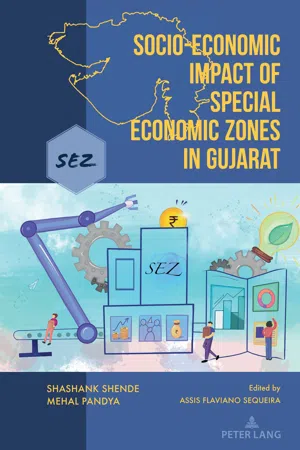
- Shashank Shende, Mehal Pandya, Assis Flaviano Sequeira(Authors)
- 2021(Publication Date)
- Peter Lang Group(Publisher)
This was realised by the governments across the world. One way to address this problem is to provide a level playing field to the local entrepreneur by carving out land parcels and designating such parcels of land as Special Economic Zones (SEZs). These parcels of land are governed by fiscal and legal regulation on par with the foreign competition. Subsequently, SEZs also emerged as a favoured route to attract FDI (Foreign Direct Investment) given the investment crunch in the host country and the attraction of doing business, unencumbered by taxing fiscal reg- ulations and laws, as applicable to the rest of the country. Thus, the main characteristic of a SEZ is that it a geographically delimited area, within which government facilitates industrial activity through fiscal and regulatory incentives and infrastructure support. SEZs go by many names like Free Trade Area (FTA), Free Trade Zone (FTZ), and Economic Zone (EZ) and come in varieties and sizes. Within a defined perimeter, SEZs function under a regulatory regime for business and investors distinct from what normally applies in the broader national or sub-national economy, where they are established. SEZs originated from Free Zones, which are essentially separate customs ter- ritories. Hence, most inputs for SEZs are exempted from custom duties and tar- iffs; the basic premise being that the manufactured goods would be exported to other countries. Governments not only sacrifice revenue by extending customs, fiscal and regulatory concessions, but also invest by providing support measures and physical structure. In return, the governments expect that SEZs create jobs, boost exports, diversify the economy and build productive capacity. The historical trend in SEZs is shown in Figure 1.1. Though the SEZs were established in the 1960s, the widespread use of export-oriented industrial devel- opment strategy especially in Asia led to the mushrooming of SEZs in the 1980s. eBook - ePub
Portals of Globalization
Repositioning Mumbai’s Ports and Zones, 1833–2014
- Megan Maruschke(Author)
- 2019(Publication Date)
- De Gruyter Oldenbourg(Publisher)
265While the proposal for a free port zone was inspired by the US system, Indian planners were willing to expand this system to manufacturing, stating that it was not necessary to strictly follow the American model.266 Manipulation versus manufacturing is not clearly defined, but manipulation might include, for example, dyeing textiles or assembling already manufactured products, while manufacturing involves more extensive activities, such as creating entirely new products from various components. The report suggested that planners rename the policy “Free Trade Zone”, to distinguish it from the American “foreign trade zone.” Indian reports during this period used these two terms interchangeably.Allowing manufacturing in such a zone conformed to the existing practice in India’s system of bonded warehouses at that time. The government’s policy had been to freely permit manufacture in bond, so an FTZ or customs-free zone at certain ports would only be an additional measure to promote exports.267 This scheme included the drawback of duties paid on imported items, which were then reexported. It also allowed manufacturing and reexport in bond.268 The proposal to create a zone overlapped considerably with this system, which the Ministry of Finance highlighted much later in its 1958 report. The Ministry of Commerce largely ignored the bonded warehouse system in the debate on the zone policy. Though the practice of manufacturing in bond was not new, it needed rebranding. In contrast to India, the US FTZ system emerged out of debates on the inadequacy of the bonded warehouse.269 It is not clear how widespread the use of bonded warehouses was in India prior to 1947. By the mid-1960s, these bonded zones were only located at India’s largest ports: Calcutta, Madras, Cochin, and Bombay. By 1965, only Bombay’s custom zone was actively importing and reexporting, although the imported goods vastly exceeded the value of goods exported or reexported. By 1967–1968, as the first FTZ at Kandla opened, the use of Bombay’s bonded zones declined significantly.270 The fact that such a system already existed in India, but was not widely cited by the Ministry of Commerce raises the question whether the American FTZ was more attractive as a marketing label for such a policy rather than an actual policy model. Research suggests that international economic planning consultants in India during the 1950s and 1960s tended to lend legitimacy to plans pursued by Indian bureaucrats and politicians rather than conclusively influencing Indian planning.271 eBook - PDF
World Investment Report 2019
Special Economic Zones
- (Author)
- 2019(Publication Date)
(v) West Asia Turkey, which enacted its Free Zone Law in 1985, operates 18 active free zones and has one more under development. Located on the coast or within easy access to ports, the zones are designed to promote classic export-oriented manufacturing investment. In the 2000s, Turkey created a new type of SEZ – technology development zones – to attract Table IV.6. State-level zones in China Five categories in the official Directory Selected types of wide-area zones • Economic and technological development zone (ETDZ) • High-tech industrial development zone (HIDZ) • Special customs zone (SCZ) • Border/cross-border economic cooperation zone (BECZ) • Other types • Special economic zone • National new area • National innovation demonstration zone • National key experimental zone for development and opening-up • Pilot FTZ • Cross-border e-commerce pilot zone Source: UNCTAD, based on the Directory of Development Zones of China (Announcement No. 4, 2018), the National Development and Reform Commission, the Ministry of Science and Technology, the Ministry of Land and Resources, the Ministry of Housing and Urban-Rural Development, the Ministry of Commerce and the General Administration of Customs. investments in R&D and high-tech industries. These zones offer tax incentives focused on research, software development and other innovative activities. The Gulf Cooperation Council countries use SEZ programmes to support strategic transformation in key industries (e.g. finance). Many are built with public finance and boast state-of-the-art facilities. The most notable examples are SEZs in the United Arab Emirates, where the first free zone was established at the Jebel Ali Port in 1985. The objective was to assist the development of the port, which was located far from populated areas and was struggling to attract business, by drawing in multinational enterprises (MNEs) to establish regional distribution hubs. No longer available |Learn more
Contesting Deregulation
Debates, Practices and Developments in the West since the 1970s
- Knud Andresen, Stefan Müller, Knud Andresen, Stefan Müller(Authors)
- 2017(Publication Date)
- Berghahn Books(Publisher)
24 Patrick Neveling just after the Second World War. 5 Since then, EPZs have come to be a crucial feature of what is often called the neoliberal era. Known under a range of denominations, including Free Trade Zones, foreign trade zones and special economic zones, EPZs have been set up mainly by so-called under-developed countries and regions. Their purpose is to attract manufacturing relocations in sectors such as garments and light consumer electronics, in which cheap labour is paramount for generating profit and where transport costs matter less than for bulkier items. In the early years, such relocations were from industrially advanced countries to underdeveloped countries. EPZs sought to attract investors with exceptional tax and customs holidays, state spending for industrial infrastructure, cheap, docile and non-union-ized labour, and other factors facilitating accumulation that were increas-ingly hard to find in industrially advanced countries with Keynesian and Fordist regimes. In sum, EPZs are emblematic of the high capital mobility and precari-ous working conditions that many social scientists and contemporary histo-rians identify as core criteria for the radical rupture of the early 1970s. To substantiate an alternative reading of world history that sees the 1970s as a period of consolidation, I show how an increasing number of mainly postco-lonial nation states have set up EPZs since 1945. This will reveal that many of the above listed and further features substantiating the notion of radical rupture were actually widespread much earlier. As the number of EPZs has increased over the years, relocations from one zone to another have become common practice, for example. In other words, industrial relocation on a South–South basis was as common in the early 1970s as was South–South economic cooperation. 6 Nevertheless, the 1970s mark a turning point in the global spread of EPZs. eBook - PDF
Industrial Policy and the World Trade Organization
Between Legal Constraints and Flexibilities
- Sherzod Shadikhodjaev(Author)
- 2018(Publication Date)
- Cambridge University Press(Publisher)
In countries, such as the United States and the Dominican Republic, where free zone status is granted to companies rather than territorial areas, 75 the regional specificity test may not work. But for such company- based designations of zones, enterprise or industry specificity could still be pertinent. 4.3.3.3 Prohibited Subsidies Government support for export manufacturing or localization in free zones may conflict with Article 3 of the SCM Agreement that prohibits export subsidies and local content subsidies. Annex I of the SCM Agree- ment delegitimizes any export-related exemption, remission, or deferral of direct taxes or social welfare charges, as well as certain export-related deductions of the taxable base for direct taxes (paragraphs (e) and (f )). In contrast, nonexcess exemptions and remissions of import duties or indirect taxes are allowed for inputs used in making exported products. The SCM Agreement also permits, to a certain extent, substitution drawback systems under which domestic inputs are used as a substitute for imported inputs. 76 In order to avoid possible attacks in the WTO, the most practical approach would be to exclude the export performance or local content conditions from subsidization. Before accession, Kazakhstan, for instance, removed the eligibility criteria of export orientation and import substitution from its legislation on free zones.
Index pages curate the most relevant extracts from our library of academic textbooks. They’ve been created using an in-house natural language model (NLM), each adding context and meaning to key research topics.

