Economics

Full Employment
Full employment refers to a situation where all available labor resources are being utilized in the economy. It does not mean zero unemployment, but rather a level of unemployment where the only people who are unemployed are those who are temporarily between jobs or transitioning to new ones. This level of unemployment is considered the natural rate of unemployment.
Written by Perlego with AI-assistance
Related key terms
1 of 5

10 Key excerpts on "Full Employment"
 eBook - PDF
Economics
Theory and Practice
- Patrick J. Welch, Gerry F. Welch(Authors)
- 2016(Publication Date)
- Wiley(Publisher)
Underemployment occurs when the full capabilities and skills of a resource are not utilized. Many people with valuable skills and good educations will accept unskilled jobs rather than be unemployed. When times are tough due to a pro- longed downturn in the economy, people will often “take what they can get” in order to pay the rent and put food on the table. Sometimes college graduates or those with years of professional employment spend time as food servers because it pays the bills. The Goal of Full Employment As stated earlier, Full Employment is a major macroeconomic goal. However, Full Employment does not mean that 100 percent of the labor force is working. It means that only those who are voluntarily out of work are unemployed. What is the unemployment rate at which Full Employment occurs? What percent- age of the labor force tends to be voluntarily, or frictionally, unemployed? There are no hard‐and‐fast answers to these questions. The rate of unemployment associated with Full Employment has changed over time. Over the past few decades, we have thought Full Employment was anywhere between 4 percent and 6 percent. As changes in the structure of the economy have occurred, we have periodically reevaluated the unemployment rate associated with Full Employment. Changes in the composition of the labor force brought about by the increased participation of women and changes in government unemployment com- pensation payments have contributed to this reevaluation. But, importantly, finding the unemployment rate associated with Full Employment has been complicated by the growth in temporary and part‐time work where there tends to be more work and where people who accept these types of jobs are counted as employed, even though they want to work full‐time. Conceptually, Full Employment means that all resources available for production are fully utilized. Thus, the statistic called “Full Employment” may not perfectly repre- sent the economic concept of Full Employment. eBook - PDF
- William J. Fellner(Author)
- 2023(Publication Date)
- University of California Press(Publisher)
CHAPTER I Underemployment and Equilibrium T H E CONCEPT OF Full Employment T J. HE TASK of defining Full Employment is an ungrateful one. When economists speak of reasonably Full Employment—or more briefly of Full Employment—they usually mean a condition in which job-seeking persons are not unemployed on any significant scale. Such a statement contains but a vague definition of the concept of Full Employment, but it frequently is' true that more importance attaches to a deliberately vague statement of this character than to a pedantic technical definition which hides, rather than makes ex- plicit, the ambiguities inherent in a problem. In this case, as in many others, the attempt at conceptual precision proves to be cumber- some and does not lead to a completely satisfactory result. Full Employment, of course, means the absence of involuntary unemployment: only the honestly job seeking have to be employed in "full" employment. The crux of the conceptual difficulty is that the stock of unemployed persons usually includes individuals who might obtain employment if supply conditions were different on the labor market, that is, if they sought a job on different terms. Whether an individual should be regarded as voluntarily or in- voluntarily unemployed has obviously something to do with the question whether he would remain unemployed even if he were willing to accept a lower reward for his services, that is, even if he changed his attitude as a potential supplier of labor services. The voluntarily unemployed may frequently be interpreted as de- manding for their services a price at which these services are not bought. A wealthy rentier is voluntarily unemployed even if he were willing to work for high multiples of the current salary rates. In spite of this, it is not fruitful to maintain that all persons are volun- tarily unemployed who fail to reduce the supply price of their [3] 4 Monetary Policies and Full Employment services sufficiently to gain employment.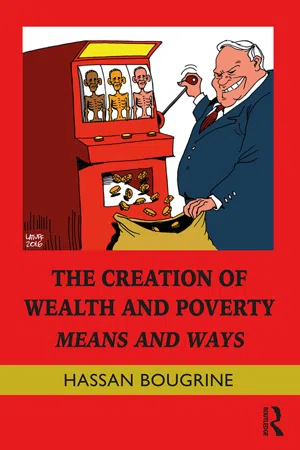 eBook - ePub
The Creation of Wealth and Poverty
Means and Ways
- Hassan Bougrine(Author)
- 2016(Publication Date)
- Routledge(Publisher)
9 who sell the idea that the market does it best (see Bougrine, 2012). Hudson (2015: 180) refers to these ideas as neoliberal ‘junk economics’ that are “crafted to disable society’s defense mechanisms”.Martin Feldstein (2015) thinks that the US economy is already at Full Employment. To justify his claim, Feldstein (2015) wrote:The necessity of Full EmploymentAccelerating wage growth implies that the economy is now at a point at which increases in demand created by easier monetary policy or expansionary fiscal policy would not achieve a sustained rise in output and employment. Instead, this demand would be channeled into higher wages and price . . . [adding that] . . . since the beginning of this year, hourly earnings are up 3.3%, and in May alone rose at a 3.8% rate – a clear sign of Full Employment.So what’s there to worry about?When several of the recipients of the Orwell Award10 complained about the increasing use of doublespeak – words and phrases, which are intentionally designed to obscure the meaning of plain language, they probably were not thinking of “Full Employment”. Yet, the concept of “Full Employment” as used above refers to an economy in which there are officially 15 million persons who are willing to work but cannot find a job plus an additional 6 million people who are working part-time but would like to find a full-time job.11 The use of the concept of “Full Employment” in this sense is so prevalent among economists that in order to accurately describe reality, one is tempted to add another adjective: ‘true’ Full Employment cannot exist when there are so many unemployed people12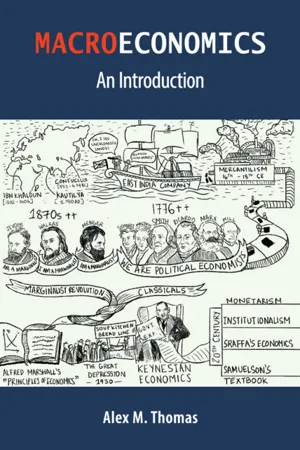 eBook - PDF
Macroeconomics
An Introduction
- Alex M. Thomas(Author)
- 2021(Publication Date)
- Cambridge University Press(Publisher)
MACROECONOMICS 7 The Policy Objective of Full Employment 7.1 Introduction In the previous chapters, we discussed the determinants of output and employment (Chapter 4), the link between economic growth and employment growth (Chapter 5) and, very briefly, the informal nature of employment in India (Chapter 6). As Adam Smith had written, the central objective of political economy is “to provide a plentiful revenue or subsistence for the people”. And the pursuit of Full Employment is one of the ways through which all the people can secure a ‘plentif ulrevenue’. Additionally, as already stated in Section 4.1, the employment ought to be secure (reliable) and well-paying (gainful). Together, this can contribute to a good life for all and, therefore, Full Employment is viewed, in this book, as an extremely desirable policy objective. This chapter summarises the nature of employment in India by measuring its various aspects—drawing upon, primarily, the context. Recollect from the previous chapter that the ‘what to measure?’ question is heavily dependent on concept (used interchangeably with theory) and context. Subsequently, this chapter reiterates relevant aspects of the Keynesian approach to employment and provides broad-based macroeconomic solutions to tackle India’s unemployment problem. The chapter concludes by underscoring the need for a comprehensive employment policy, which meaningfully integrates wages policy, growth policy, agricultural policy and education policy, in order to attain Full Employment as envisioned here. 7.2 The nature of employment in India There are innumerable ways of looking at employment within the macro, meso and micro approaches. Some of the macro questions we hear take the following form. eBook - PDF
Microeconomics, Macroeconomics and Economic Policy
Essays in Honour of Malcolm Sawyer
- P. Arestis(Author)
- 2011(Publication Date)
- Palgrave Macmillan(Publisher)
Unemployment strengthens the ability of employers to resist improve- ments in job quality. It also encourages them to use methods such as increased work intensity and longer work hours to achieve higher profit- ability. The move to Full Employment, by contrast, enables workers to better meet their interests and needs at work. It offers them the scope to resist so-called ‘low routes’ to higher profitability based on sweated labour and to achieve progressive changes in the workplace. While there remain severe institutional barriers to higher job quality, it can be argued that the reduction of unemployment can help the efforts of workers to secure for themselves a better quality of work. Traditionally, the case for Full Employment has been made on the basis of the negative influence of unemployment on economic output and on the well-being of the unemployed. This chapter has suggested that a further argument in support of Full Employment is its positive influence on the ability of those in work to achieve higher well-being. One key conclusion of the chapter is that the goal of Full Employment should be extended to include the encouragement of higher-quality work. The objective should be to create not just any jobs but jobs that meet with the needs of workers. Higher-quality jobs would be those that offer high pay, job security, high levels of discretion, and reasonable hours of work. There should be no sacrifice of job quality for the sake of creating jobs; rather there should be an attempt to achieve more fulfilling work for all. The recent crisis has brought about a return to high unemployment. It has also led to erosions in job quality. If Full Employment and high job quality are to be promoted and restored in future, then this will require a fundamental change of economic theory as well as ideology and policy. For those who are concerned to achieve such a change, the economics of Malcolm Sawyer remain an important source of insight and illumination. eBook - PDF
- B. Sheehan(Author)
- 2009(Publication Date)
- Palgrave Macmillan(Publisher)
If this employment level is less than Full Employment an equilibrium vol- ume of involuntary unemployment is specified. Each unemployment equilibrium position is associated with a determinate level of output, a natural rate of interest, a specific general level of money wages and prices and a particular real wage rate. In conditions of Full Employment the equilibrium level of involuntary unemployment is zero and a neu- tral rate of interest applies. An employment function may be used to specify unemployment equilibria free from reliance on the two classical postulates. Appendix Analysing Unemployment – A Shifting Equilibrium Concept The concept of the unemployment equilibrium raises certain method- ological problems for macroeconomics. Can an economy be in equi- librium with a permanent excess supply of labour? Precisely what do economists mean when they say a market system is in equilib- rium? There are a surprising number of notions of equilibrium that can be gleaned from the literature (Arrow and Debreu, 1954; Minsky, 1982; Chick, 1983; Hansen, 1983; Milgate and Eatwell, 1983; Milgate, 1987, 1988; Amadeo, 1992; Rogers, 1997; Lawlor, 2006). Three of the dominant notions can be summarised in the following way: 1. The Smithian notion of permanent and persistent forces working in the long period to establish natural levels of activity. In equilibrium conditions there must be a uniform rate of profit in different indus- tries which is the way the older classicals, such as Smith and Ricardo, conceive of an equilibrium position. 2. The Marshallian notion where permanent forces operate to establish normal levels of activity in the long run. Normal profits must be evident in each industry. The Marshallian approach seems to be the source of the oral tradition of explaining equilibrium in terms of a market econ- omy finding a resting place where there are no forces for change. The Marshallian concept focuses on what is now called a partial equilib- rium. eBook - ePub
- John Philpott(Author)
- 2005(Publication Date)
- Routledge(Publisher)
We cannot be certain that this need to participate will necessarily be satisfied in a market economy. In the property market buildings can stand empty for years; in the market for consumer goods some of the stock has to be written off. If we treat labour as simply another commodity to be bought and sold, then it is human lives that will sometimes be written off and declared to be redundant. It is appropriate to use emotive language, because the issue here is one of feelings rather than calculation. We want the labour market to be humane in its treatment of individuals, as well as efficient, and we may fear that it is becoming less so. This is in part a matter of the way in which employers and employees choose to behave towards one another, but it is a matter of public policy as well.For many professional economists unemployment is the most important policy issue of all. We see our role as contributing to the solution of a social problem, not just making the economy more productive. We would be most reluctant to abandon the objective of Full Employment, because it points beyond economics to a goal which is not just increasing individual utility but also the cohesion of society as a whole.Setting Full Employment as a policy objective, even in the context of a market economy, makes it clear that society as a whole has an interest in the way that individuals are treated. It does involve the concept of a community and something which Beveridge called ‘public spirit’. We need, in the very different circumstances of today, to find the institutional setting within which that common purpose can be achieved.Clearly there is no way in which society can underwrite the continued existence of particular jobs or even occupations. Neither can there be a right to a job of ones own choosing at a wage one considers fair. A commitment to Full Employment will leave many individual ambitions unsatisfied and hopes disappointed. There will still be closures and redundancies, but perhaps we can find a better way of dealing with the consequences. Perhaps we can prevent people being too dependent on the continuation of a particular job and widen the opportunities they have to recover from misfortune when it hits them.If this is to be achieved then in practice something may well have to be given up in return. The recipe for Full Employment proposed by Keynes was in effect a ‘free lunch’. By making good the deficiency in demand everyone could be better off. If, however, unemployment is now a structural problem then it is unlikely that a painless cure can be found for it. One interpretation of the rise in unemployment is that society has given up the aim of Full Employment because it found the cost in terms of other objectives was too great. Perhaps no such conscious choice was ever actually made. If, however, we are now to make the deliberate choice that Full Employment is to be given priority then we need to know what else is being given up. To make a choice between aims we need to know the means that will be adopted. I turn therefore to the question of how a commitment to Full Employment in a market economy might actually be fulfilled. eBook - PDF
- Steven A. Greenlaw, Timothy Taylor, David Shapiro(Authors)
- 2017(Publication Date)
- Openstax(Publisher)
The human costs of unemployment alone would justify making a low level of unemployment an important public policy priority. However, unemployment also includes economic costs to the broader society. When millions of unemployed but willing workers cannot find jobs, economic resource are unused. An economy with high unemployment is like a company operating with a functional but unused factory. The opportunity cost of unemployment is the output that the unemployed workers could have produced. This chapter will discuss how economists define and compute the unemployment rate. It will examine the patterns of unemployment over time, for the U.S. economy as a whole, for different demographic groups in the U.S. economy, and for other countries. It will then consider an economic explanation for unemployment, and how it explains the patterns of unemployment and suggests public policies for reducing it. 21.1 | How Economists Define and Compute Unemployment Rate By the end of this section, you will be able to: • Calculate the labor force participation rate and the unemployment rate • Explain hidden unemployment and what it means to be in or out of the labor force • Evaluate the collection and interpretation of unemployment data Newspaper or television reports typically describe unemployment as a percentage or a rate. A recent report might have said, for example, from August 2009 to November 2009, the U.S. unemployment rate rose from 9.7% to 10.0%, but by June 2010, it had fallen to 9.5%. At a glance, the changes between the percentages may seem small. However, remember that the U.S. economy has about 160 million adults (as of the beginning of 2017) who either have jobs or are looking for them. A rise or fall of just 0.1% in the unemployment rate of 160 million potential workers translates into 160,000 people, which is roughly the total population of a city like Syracuse, New York, Brownsville, Texas, or Pasadena, California.
- Steven A. Greenlaw, Timothy Taylor, David Shapiro(Authors)
- 2017(Publication Date)
- Openstax(Publisher)
In the past, new technologies have put lower skilled employees out of work, but at the same time they create demand for higher skilled workers to use the new technologies. Education seems to be the key in minimizing the amount of structural unemployment. Individuals who have degrees can be retrained if they become structurally unemployed. For people with no skills and little education, that option is more limited. Chapter 7 | Unemployment 179 Natural Unemployment and Potential Real GDP The natural unemployment rate is related to two other important concepts: Full Employment and potential real GDP. Economists consider the economy to be at Full Employment when the actual unemployment rate is equal to the natural unemployment rate. When the economy is at Full Employment, real GDP is equal to potential real GDP. By contrast, when the economy is below Full Employment, the unemployment rate is greater than the natural unemployment rate and real GDP is less than potential. Finally, when the economy is above Full Employment, then the unemployment rate is less than the natural unemployment rate and real GDP is greater than potential. Operating above potential is only possible for a short while, since it is analogous to all workers working overtime. Productivity Shifts and the Natural Rate of Unemployment Unexpected shifts in productivity can have a powerful effect on the natural rate of unemployment. Over time, workers' productivity determines the level of wages in an economy. After all, if a business paid workers more than could be justified by their productivity, the business will ultimately lose money and go bankrupt. Conversely, if a business tries to pay workers less than their productivity then, in a competitive labor market, other businesses will find it worthwhile to hire away those workers and pay them more. However, adjustments of wages to productivity levels will not happen quickly or smoothly. Employers typically review wages only once or twice a year. eBook - PDF
- Steven A. Greenlaw, David Shapiro, Daniel MacDonald(Authors)
- 2022(Publication Date)
- Openstax(Publisher)
economy is growing strongly, the unemployment rate only rarely dips as low as 4%. Moreover, the discussion earlier in this chapter pointed out that unemployment rates in many European countries like Italy, France, and Germany have often been remarkably high at various times in the last few decades. Why does some level of unemployment persist even when economies are growing strongly? Why are unemployment rates continually higher in certain economies, through good economic years and bad? Economists have a term to describe the remaining level of unemployment that occurs even when the economy is healthy: they call it the natural rate of unemployment. The Long Run: The Natural Rate of Unemployment The natural rate of unemployment is not “natural” in the sense that water freezes at 32 degrees Fahrenheit or boils at 212 degrees Fahrenheit. It is not a physical and unchanging law of nature. Instead, it is only the “natural” rate because it is the unemployment rate that would result from the combination of economic, social, and political factors that exist at a time—assuming the economy was neither booming nor in recession. These forces include the usual pattern of companies expanding and contracting their workforces in a dynamic economy, social and economic forces that affect the labor market, or public policies that affect either the eagerness of people to work or the willingness of businesses to hire. Let’s discuss these factors in more detail. Frictional Unemployment In a market economy, some companies are always going broke for a variety of reasons: old technology; poor management; good management that happened to make bad decisions; shifts in tastes of consumers so that less of the firm’s product is desired; a large customer who went broke; or tough domestic or foreign competitors. Conversely, other companies will be doing very well for just the opposite reasons and looking to hire more employees.
Index pages curate the most relevant extracts from our library of academic textbooks. They’ve been created using an in-house natural language model (NLM), each adding context and meaning to key research topics.

