Economics

International Capital Market
The International Capital Market refers to the global network of financial institutions, investors, and markets where companies and governments can raise funds from investors around the world. It provides a platform for the buying and selling of various financial instruments, such as stocks, bonds, and currencies, across international borders. This market plays a crucial role in facilitating global investment and capital flows.
Written by Perlego with AI-assistance
Related key terms
1 of 5
6 Key excerpts on "International Capital Market"
 No longer available |Learn more
- (Author)
- 2014(Publication Date)
- Orange Apple(Publisher)
____________________ WORLD TECHNOLOGIES ____________________ Chapter- 11 Financial Market In economics, a financial market is a mechanism that allows people to buy and sell (trade) financial securities (such as stocks and bonds), commodities (such as precious metals or agricultural goods), and other fungible items of value at low transaction costs and at prices that reflect the efficient-market hypothesis. Both general markets (where many commodities are traded) and specialized markets (where only one commodity is traded) exist. Markets work by placing many interested buyers and sellers in one place, thus making it easier for them to find each other. An economy which relies primarily on interactions between buyers and sellers to allocate resources is known as a market economy in contrast either to a command economy or to a non-market economy such as a gift economy. In finance, financial markets facilitate: • The raising of capital (in the capital markets) • The transfer of risk (in the derivatives markets) • International trade (in the currency markets) – and are used to match those who want capital to those who have it. Typically a borrower issues a receipt to the lender promising to pay back the capital. These receipts are securities which may be freely bought or sold. In return for lending money to the borrower, the lender will expect some compensation in the form of interest or dividends. In mathematical finance, the concept of a financial market is defined in terms of a continuous-time Brownian motion stochastic process. Definition In economics, typically, the term market means the aggregate of possible buyers and sellers of a certain good or service and the transactions between them. ____________________ WORLD TECHNOLOGIES ____________________ The term market is sometimes used for what are more strictly exchanges , organizations that facilitate the trade in financial securities, e.g., a stock exchange or commodity exchange.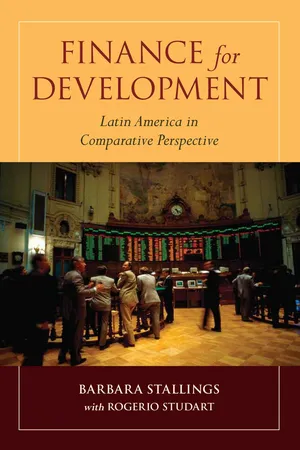 eBook - PDF
Finance for Development
Latin America in Comparative Perspective
- Barbara Stallings, Rogerio Studart(Authors)
- 2006(Publication Date)
- Brookings Institution Press(Publisher)
Firms and households also need access to bond markets to obtain long-term finance for investment and mortgages. Finally, an argument that has become increasingly common combines some of the justifications above: namely, domestic capital markets provide an alterna-tive to borrowing abroad and thus avoid the risks and volatility that the latter entails. The head of the International Monetary Fund (IMF) capital market division recently stated, “The efforts to develop local securities markets have been motivated by a number of considerations, especially the desire to provide an alternative source of funding in order to self-insure against reversals in capital flows.” 8 He went on to quote Alan Greenspan’s well-known comment that smoothly functioning bond markets can act as a “spare tire” to use when other sources of funds dry up. The new interest in capital markets has sparked an increasing amount of analysis aimed at better understanding how they operate. Although most of the studies concern equities, bond markets are also considered. Topics of interest include the relationship of capital markets to economic growth and investment, the circumstances under which they work best, their links to other forms of finance, and differences or similarities across regions. While strong overlaps exist with the literature we have already discussed on the functioning of banking sys-tems, some new topics are also introduced. Theoretical models are ambiguous on whether stock markets are positively or negatively linked to economic growth. For example, the literature contains argu-ments both for and against markets’ capacity to monitor firm behavior; this 114 Changes in Latin America’s Financial System since 1990 7. See Herring and Chatusripitak (2000, especially pp. 14–24). Others make similar argu-ments. 8. Hausler, Mathieson, and Roldós (2003, p. 21). debate is essentially the reflection of the one about banks versus markets.
- L. Armijo(Author)
- 1999(Publication Date)
- Palgrave Macmillan(Publisher)
That is, one can argue that this burden had always been carried to some extent by the creditors. From the capital recipient’s view- point, equity markets are even more subject to booms, panics and crashes than bond markets, as the volatility of stock market investment is likely to be higher. Of course it also is true that large investors such as mutual or pension funds might have an interest in stabilizing a market if they face huge capital losses. It has been argued that the existence of a stock market enhances the allocative efficiency of an economy: recent econometric studies have shown that the size and liquidity of the stock market is positively associated with growth in developed and developing countries (Levine, 1996). However, the causal links underlying this relationship are very controversial and appear to be influenced by the characteristics of each individual country or region (Arestis and Demetriades, 1997). From a purely economic point of view, therefore, it is risky to assert that one form of cross-border capital flow is superior to another, although FDI would seem to have some useful advan- tages for the emerging market country. Stefano Manzocchi 67 External Finance and Long-run Growth Economics textbooks suggest that integration into world capital markets favors economic growth and welfare for several reasons: domestic invest- ment is decoupled from national saving; consumption can be smoothed in the face of country-specific shocks; and world-wide pooling of financial instruments allows more efficient insurance against risk and lower borrowing costs. A widely shared contemporary opinion is that these long-term benefits of capital market integration must be weighed against the short-term difficulties associated with the macroeconomic management of capital move- ments. Our view is different: there is no general, mechanical outcome of capital market integration that is valid for any economy both in the short and in the long run. No longer available |Learn more
- (Author)
- 2014(Publication Date)
- Orange Apple(Publisher)
____________________ WORLD TECHNOLOGIES ____________________ Chapter- 7 Financial Market In economics, a financial market is a mechanism that allows people to buy and sell (trade) financial securities (such as stocks and bonds), commodities (such as precious metals or agricultural goods), and other fungible items of value at low transaction costs and at prices that reflect the efficient-market hypothesis. Both general markets (where many commodities are traded) and specialized markets (where only one commodity is traded) exist. Markets work by placing many interested buyers and sellers in one place, thus making it easier for them to find each other. An economy which relies primarily on interactions between buyers and sellers to allocate resources is known as a market economy in contrast either to a command economy or to a non-market economy such as a gift economy. In finance, financial markets facilitate: • The raising of capital (in the capital markets) • The transfer of risk (in the derivatives markets) • International trade (in the currency markets) – and are used to match those who want capital to those who have it. Typically a borrower issues a receipt to the lender promising to pay back the capital. These receipts are securities which may be freely bought or sold. In return for lending money to the borrower, the lender will expect some compensation in the form of interest or dividends. In mathematical finance, the concept of a financial market is defined in terms of a continuous-time Brownian motion stochastic process. Definition In economics, typically, the term market means the aggregate of possible buyers and sellers of a certain good or service and the transactions between them. ____________________ WORLD TECHNOLOGIES ____________________ The term market is sometimes used for what are more strictly exchanges , organizations that facilitate the trade in financial securities, e.g., a stock exchange or commodity exchange. eBook - PDF
Global Finance at Risk
On Real Stagnation and Instability
- S. Sen(Author)
- 2003(Publication Date)
- Palgrave Macmillan(Publisher)
4 The emergence of non-bank financial institutions with pension funds and similar other agencies operate in the market as powerful institutional investors. As with the newly innovated instruments, operations by these financial institutions are also outside the domain of supervisory banking regulations. Changes, as above, in the pattern of international private capital flows over the last two and a half decades thus seem to have been both qualitative and quantitative. While the magnitude of cross-border financial flows, which cover capital as well as currency markets, has reached unprecedented heights, the relative ease of moving funds International Capital Flows: Some Theoretical Insights 3 across national borders and the uncertainty in the markets both have provided incentives for quick movements of funds. The proportion of capital flows which is locked in long-term real investment projects has, as a consequence, been less attractive, with portfolio invest- ments of short maturity taking precedence over long-term bonds and direct foreign investments. Volatility in the International Capital Market today encompasses, in addition to the magnitude of these flows, similar fluctuations in exchange rates as well as interest rates. With a major part of financial flows geared to the hedge funds, returns on finance today can be sustained by the volatility in finance itself. Thus, calculations of the stock market call/put premiums in the much celebrated formulation of Merton 1 and earlier, of Black and Scholes in the standard models indicate that these premiums move up when stock prices are subject to a wider range of variance. The rising volume, the frequent instabilities, the changing pattern and their dissociation from real activities have increased the importance of analysing private global finance in recent times. In this chapter it is intended to approach the subject from a theoretical angle. eBook - PDF
- Martin Feldstein(Author)
- 2007(Publication Date)
- University of Chicago Press(Publisher)
At the same time, improvements in communications technologies have made investors more aware of opportunities available in foreign markets. International stock exchanges have struggled to meet the growing appetites of domestic investors for foreign equities and the demand for access to capital markets on the part of foreign firms. In the United States, for example, differ- 245 The Role of Equity Markets in International Capital Flows --CMexim 1/31/90 7/31/90 1/31/91 7/31/91 1/31/92 7/31/92 1129/93 7130193 1/31/94 7/29E4 1/31/95 7/31/95 1131196 7/31/96 1/31/97 Fig. 5.2 Value of a one-dollar investment, 199O:Ol-1997:06 ences between accounting and disclosure requirements at home and in foreign countries have made it difficult for foreign firms to register their stock directly on U.S. exchanges. As a consequence, the majority of trading in foreign stocks by U.S. residents occurs either overseas or in over-the-counter, unregistered stocks. In 1994, 1,092 foreign stocks were issued on the combined AMEX, NYSE, and NASDAQ exchanges while 8,097 stocks were traded on Pink Sheets. The majority of American Depository Receipt (ADR) programs are also traded as unregistered securities on the over-the-counter market (Coch- rane, Shapiro, and Tobin 1995).5 It appears that U.S. investors’ demand for for- eign equities is large enough to bear the additional cost and potential risk of trading in stocks not under the regulatory control of the Securities and Ex- change Commission. 5.1.3 Cross-Border Equity Flows The demand for capital in emerging markets, the growing share of equity in the portfolio of savers, and the response of capital markets to facilitate cross- border investment have set the stage for increased capital flows from capital- 5. The Pink Sheets are listings of foreign stocks and their market makers. ADRs are certificates issued by a U.S. bank to represent ownership of foreign corporate shares. 246 Linda L. Tesar rich to capital-poor regions of the world.
Index pages curate the most relevant extracts from our library of academic textbooks. They’ve been created using an in-house natural language model (NLM), each adding context and meaning to key research topics.

