Economics

Laissez Faire Economics
Laissez-faire economics is an economic theory that advocates for minimal government intervention in the economy. It promotes the idea that markets should be allowed to operate freely without government regulation or interference. The term "laissez-faire" is French for "let it be" and reflects the belief that the economy functions best when left to its own devices.
Written by Perlego with AI-assistance
Related key terms
1 of 5

9 Key excerpts on "Laissez Faire Economics"
 No longer available |Learn more
The Making of Modern Economics
The Lives and Ideas of Great Thinkers
- Mark Skousen(Author)
- 2015(Publication Date)
- Taylor & Francis(Publisher)
Pour gouverner mieux, il faudrait gouverner moins (in order to govern better, we ought to govern less).“Laissez faire” has come to represent the hands-off policies advocated by Adam Smith, although he never used the phrase. In the twentieth century, John Maynard Keynes gave laissez faire a bad name; it represented the “do-nothing” policies prevalent during the Depression years. “For good or evil, in present day conditions laissez-faire can no longer be relied upon to furnish economic projects with the capital they need,” he wrote (Skidelsky 1992: 185). According to Keynes, government was needed to rescue laissez-faire capitalism.In fact, laissez faire was never meant to be a heartless “do-nothing” government policy. Adam Smith and the classical laissez-faire economists actually aimed at dismantling the old system of regulations and special privilege, and thus improving the general welfare.The French economists were very much involved in Smith’s magnum opus, starting when he spent time in France preparing his book and discussing ideas with Quesnay, Turgot, and Voltaire. Once The Wealth of Nations was published, the French were highly successful in publicizing Smith’s model of free enterprise and liberalized trade throughout the Western world. They translated Smith’s book into French, published the first encyclopedia of economics and the first history of economic thought, and wrote the first major textbook in economics, Say’s Treatise on Political Economy , which was the principal textbook in the United States and Europe during the first half of the nineteenth century. Many of the Smithian principles were adopted by Alexis de Tocqueville in his profound study of Democracy in America (see box, pages 59 –61 eBook - ePub
- Guy Callender(Author)
- 2008(Publication Date)
- Routledge(Publisher)
At the time that democracy became more egalitarian and diverse in its objectives, laissez-faire became the populist economic doctrine that dominated UK economic policy. Arguably, one consequence was the comparative decline in national certainty of purpose and macro-efficiency. In place of national goals and international dominance, the individual rights of owners to pursue their own paths to their ‘profits on investment’ 97 became a dominating economic force. This chapter has evaluated a diversity of qualitative economic issues that have emerged in Anglo-American economies over the past two centuries. The aim of this historical review has been to underline the comparative speed with which some Anglo-American economies have shifted, at times rapidly, from laissez-faire to centralized models of economic policy on a pragmatic basis. The chapter also raises the question: is the basis of economic theory, and therefore the foundations of its dominant position in the social sciences, objectively scientific or socio-political? The answer to this question may never be entirely clear. Yet the varying influences that have been identified in the historical analysis of the changing economic epochs of the past 120 years, and the overtly loose linkage made by Friedman between the size of government and the size of the tithe (which is a culturally-embedded belief rather than a universal measure), pose fundamental questions about the supposed scientific basis of economics eBook - PDF
America's Free Market Myths
Debunking Market Fundamentalism
- Joseph Shaanan(Author)
- 2017(Publication Date)
- Palgrave Macmillan(Publisher)
1 However, by the 1930s perceptions would change again, and drastically so. The length and severity of the Great Depression contradicted classical economists’ notion of the market as a self-regulating mechanism and with it the appeal of a small nonintervention- ist government declined. Laissez faire ideology came back in vogue in the 1970s. It was given considerable support although not many were aware at the time (or today) of the organized push behind it including from wealthy backers with strong ties to media and academia and research foundations established specifically for 50 J. SHAANAN that purpose. It was not too difficult to persuade the public to accept the message. In good economic times laissez faire was hailed as the cause of prosperity 2 and in bad times, govern- ment, fairly or not, received a large share of the blame. Government was an easy target and was criticized for dama- ging the free market economy with its high taxes and needless interventions. Arguments were made in the 1980s that the US was falling behind Japan and needed to improve its competitiveness. The quick and obvious solution was to reduce corporate and high earners’ taxes. Specifically, reducing marginal tax rates would result in people working harder and reducing corporate taxes would lead to more investment thereby returning the US to economic pre-eminence. Regulation, it was claimed, both economic and social (involving health and safety), had become excessive and was burdensome to the point of stifling innovation. Social programs were criticized for having created a culture of dependency and needed to be dismantled. The self-regulating market would take care of all concerns and if the market is not sufficient the legal system could plug the holes through private lawsuits. Privatization and deregulation became synonymous with economic efficiency. The message driven home was that people had to learn to live with risk and get used to change. eBook - ePub
Modern Understandings of Liberty and Property
Liberty, Property, and the Law
- Richard A. Epstein(Author)
- 2013(Publication Date)
- Routledge(Publisher)
Modern advocates of an approach to laissez faire recognize that whatever rationale it has rests on the assumption that economic society under laissez faire would be, or could be made to be, substantially competitive. Towards the monopolistic aspects of modern society they take various attitudes. Some look upon them as serious obstacles to economic welfare, and would have an otherwise laissez faire state vigorously suppress all important manifestations of monopoly that are not for special reasons to be accepted. Others maintain that government itself is, directly or indirectly, the major support of monopoly and that in a laissez faire economy monopoly, with minor exceptions, would not be able either to establish or to maintain itself in the absence of government support. Others while expressing in principle hostility to monopoly deny its practical importance and contend that in the main moderate elements of monopoly can be tolerated without serious loss, or even with benefit, in a predominantly competitive, laissez faire economy; like the competitive "economic man," the monopolistic firm, without intending it, is, as if guided by an invisible hand, serving the public interest.I would not dispute that even a monopoly-ridden market would be preferable to any economic system trying to operate without any kind of a market. But given the prevalence or the danger of substantial intrusion of monopoly into the market, the logic of the laissez faire defense of the market against state-intervention collapses and there is called for instead, by its very logic, state-suppression or state-regulation of monopoly practices, which one may wish to call, as Henry Simons called it, an instance of "positive laissez faire" or, as I prefer, as an instance of deliberate departure from laissez faire.The free-market phase of the laissez faire doctrine is only one phase of that doctrine and is most relevant to the issues of commutative justice, of just relations in economic transactions between pairs of individuals. There is also the area of distributive justice, of the intervention of state-authority directly or indirectly with the intention of changing an existing pattern of distribution of this world's goods. When economists discuss the workings of a free competitive market, they agree that the existing pattern of distribution of wealth, of income, and of individual knowledge, capacities, and skills, affects the price-structure. They presumably agree also that the price-structure of today affects the income-structure of tomorrow. It is not appropriate, therefore, in a final appraisal from either an ethical or an economic-efficiency point of view of the mode of operation of an economic system, to consider the operations of the market on the assumption that the existing pattern of income distribution is the consequence of a dispensation of Providence. It is not reasonable to treat an existing income distribution, for the purpose of analyzing the market, as if it just "happened," as if it were as independent of influence by the market and as incapable of influence on the market, through the effect of aggregate human exercises of will and economic power, as the Rocky Mountains or storms and earthquakes are free from human control. Even the impact of storms on mankind, moreover, is affected by the pattern of distribution of income.
- Hazel Van Dyke Roberts(Author)
- 2019(Publication Date)
- Columbia University Press(Publisher)
Weulersse, Revue d'histoire de doctrines économtques, 1910, p. 128. 7 See below, p. 324. 8 Adam Smith, as is well known, does not use the French expression. Instead he usually refers to occurrences under conditions of perfect liberty. The only case in which he may be said to use the phrase itself is the English equivalent of laissez faire la nature. See below, pp. 325-327. 9 Gesamtausgabe, Erste Abteilung, Band 3, p. 575. For the best example of Laissez Faire Economics run riot, as it were, and to contrast its spirit with 2 5 2 L A I S S E Z F A I R E With Boisguilbert the expression meant not so much laissez-nous faire, but literally laissez faire la nature. It was nature's plan for the functioning of economic society which must not be interfered with by any ministère étrangère . 10 Just what did he regard as nature's plan for mankind ? It was that all men should be able to gain a livelihood from their labor or that of their ancestors. Immediately, it was anything which served to bring this about and did not tend ultimately to destroy this ability upon the part of others, and thus, in turn, of oneself. It is in this way that the term may be said to have included just tax-ation as well as freedom to trade. The oppression of unjust taxation interfered with the ability to gain a livelihood or to improve one's condition as certainly as restrictions on the abil-ity to trade. Laissez faire meant the mutual aid of man and nature : that products be moved from the place where they were superfluous to the place where products were lacking. It meant freedom to sell under conditions of equality with the buyers. There are two reasons why Boisguilbert stressed freedom to sell. The first is because at the time he was writing France was limit-ing the competition for the purchase of her grains to the home market, and the aides prevented the movement or sale of wine. eBook - PDF
Reviving the Invisible Hand
The Case for Classical Liberalism in the Twenty-first Century
- Deepak Lal(Author)
- 2010(Publication Date)
- Princeton University Press(Publisher)
2 From Laissez Faire to the Dirigiste Dogma The twin pillars of the domestic policy of the British Imperium were the clas- sical liberal policies of “laissez faire” and unilateral free trade. For the classical liberals, Adam Smith and David Hume, these were in the country’s national interest, and though free trade would help in promoting understanding be- tween states, they did not believe (as some of their later acolytes like Richard Cobden) that this would lead to international peace. To maintain interna- tional order, a balance of power through a network of alliances and treaties is needed. 1 We have seen that the new imperial power—the United States— has instead sought to achieve global free trade through reciprocity, and since the New Deal in the Great Depression, it has also eschewed laissez faire. It has however gradually built up its imperium, though only recently has it begun to use its unprecedented economic and military power to maintain international order. In the following three chapters, dealing with the current discontents with globalization under the U.S. imperium, I want to show that, while most of this discontent is based on simple economic fallacies and invalid empirical assumptions, it has been allowed currency in large part because the United States has eschewed the twin economic principles which underpinned the nineteenth-century LIEO. But what are these principles? Classical Liberalism and Laissez Faire Laissez Faire The laissez faire doctrine has been caricatured as “the night watchman state,” as assuming “a harmony of interests,” and as assuming utility-maximizing 48 rational actors. But all these are alien to the thought of the fathers of classical liberalism—Hume and Smith. 2 They do not look upon man as a rational util- ity maximizer with perfect knowledge. eBook - PDF
The Legitimation Crisis of Neoliberalism
The State, Will-Formation, and Resistance
- Alessandro Bonanno(Author)
- 2017(Publication Date)
- Palgrave Macmillan(Publisher)
For the entire ninetieth century and the first three decades of the twentieth century, the laissez-faire doctrine and commensurate policies dominated the economy and society. And while the theory of free func- tioning of the market was criticized throughout the period, it was only after the crisis of 1929 and the onset of the Great Depression in the 1930s that those alternative postures that later constituted the essence of the Fordist regime were implemented. To be sure, laissez-faire is a multifaceted theory that had rarely found applications that truly reflected its orthodoxy. Yet, in the ninetieth century and early twentieth century, the ideas of the free functioning of the market accompanied by state actions that would safe- guard its working were widely accepted at the scientific and political levels. In his classical critique of the laissez-faire doctrine and period, Karl Polanyi (2001 [1944]) illustrated its benefits and, above all, crippling contradictions. The central point of his theory of the double movement refers to the historical tendency to counter the working of the free market with protectionist moves. Accordingly, protectionism was a constant component of the ninetieth-century economy and represented one of its 1 THE STATE IN CLASSICAL LAISSEZ-FAIRE, ITS CRISIS … 15 major dimensions after the 1870s. Polanyi contended that laissez-faire requires pacifist and internationalist outlooks that justify and promote the free circulation of commodities, labor, and capital. Popular in the first portion of the ninetieth century, these sentiments were later replaced by those favoring protectionism and imperialism. As global competition increased and the generation of profit and control of market were increasingly dif ficult, the policies of protecting markets (protectionism) and areas of commercial influence (imperialism) became highly practiced.
- D. Gibson(Author)
- 2011(Publication Date)
- Palgrave Macmillan(Publisher)
60 Laissez Faire at Home 215 Post–World War II policies around the world featured more protectionism and state intervention in economies than has been true since the 1970s. In the United States the huge infrastructure investments of the 1930s and the mobilization of the economy during World War II were followed by a period of investment and prosperity lasting to the beginning of the 1970s. Peschek observed that between 1947 and 1968 there was “a 107 percent increase in the real net value of structures and equipment in manufacturing, a more than doubling of output per worker, and a 70 percent increase in real personal income per capita in the United States.” 61 In spite of the real record at home and abroad, the U.S. Establishment has remained committed to the laissez faire polices of the IMF,World Bank, and WTO.The supporters of free trade, privatization, free flow of investment, and other laissez faire policies do not question or critically examine these policies. The explanations for the fail- ures of the last thirty years are found in the politics or cultures of individual countries, not the polices the Establishment has promoted. 62 In spite of the failures and the growing opposition to laissez faire, the Establishment goes on, apparently seeing no alternative that is acceptable. John Gray predicted in 1998 that when the expected financial crisis came, perhaps triggered by derivatives, change might occur because no country, including the United States, could act to sustain the global economy. 63 As the new century began the Bush II administration was attempting to intensify U.S. and international commitment to laissez faire, demanding, for example, the complete elimina- tion of “all industrial tariffs by 2015.” 64 This reflects the fact that the U.S. Establishment remains thoroughly committed to laissez faire, including the IMF program.These policies still have the backing of the powers that be, but are increasingly resisted and opposed.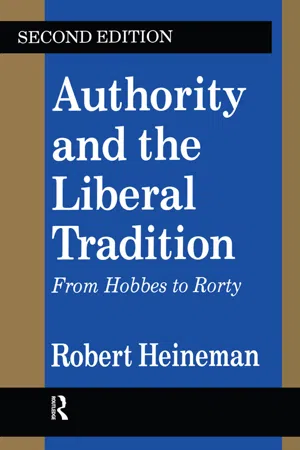 eBook - ePub
Authority and the Liberal Tradition
From Hobbes to Rorty
- Robert Heineman(Author)
- 2020(Publication Date)
- Routledge(Publisher)
Laissez Faire Becomes Public PolicyThe proponents of limited government and economic individualism had widespread public support during much of the latter nineteenth and early twentieth centuries in the United States; and their views soon became part of the supreme law of the land as enunciated by the nation’s highest court. The laissez faire position gained additional credence from the tremendous economic and technological advances that occurred during this period. As a result, many Americans became convinced that governmental power was not necessary for domestic prosperity; and, thus, they saw no need to formulate an articulate theoretical basis for government as a democratically responsive force for social direction.William Graham Sumner and Minimal Government
The foremost academic spokesman for laissez faire ideas in latter nineteenth-century America was, without a doubt, William Graham Sumner. An instructor at Yale University from 1868 until the early twentieth century, Sumner spent the better part of the period from 1870 through the early 1890s popularizing the doctrine of limited government and individual freedom. He was more than a devotee of the ideas of Spencer, however. His thought represents a fairly comprehensive amalgam of the currents comprising the intellectual revolution of the time. Adherence to the ideas of individualism and laissez faire originated from his early acquaintance with the thought of the classical economists.1 Much of his methodology seems to have been derived from his educational years spent abroad in Germany. His acceptance of Spencer’s ideas and their Darwinian parallels originally stemmed not from the Social Statics but from the later The Study of Sociology.2 Richard Hofstadter’s statement that Sumner “brought together three great traditions of western capitalist culture: the Protestant ethic, the doctrines of classical economics, and Darwinian natural selection…”3
Index pages curate the most relevant extracts from our library of academic textbooks. They’ve been created using an in-house natural language model (NLM), each adding context and meaning to key research topics.

