Economics

Macroeconomic Principles
Macroeconomic principles refer to the fundamental concepts that guide the study of the economy at a national or global level. These principles encompass topics such as inflation, unemployment, economic growth, and fiscal and monetary policies. Understanding macroeconomic principles is essential for analyzing and predicting the overall performance of an economy and formulating effective economic policies.
Written by Perlego with AI-assistance
Related key terms
1 of 5

7 Key excerpts on "Macroeconomic Principles"
 eBook - PDF
Basic Economic Principles
A Guide for Students
- David E. O'Connor, Christophe Faille(Authors)
- 2000(Publication Date)
- Greenwood(Publisher)
Page vi Glossary of Economic Terms 223 Selected Bibliography 239 Index 243 Page vii PREFACE Have you ever wondered why some people will spend thousands of dollars for a certain baseball card, but will not pay more than $1 for a gallon of bottled water at the local supermarket? Have you wondered how goods and services that you consume every day are produced, or how they get from the producer to your favorite stores? And why do we use money to purchase these goods? Why do we save and invest some of our money? And why does the government tax us? These are just a few of the questions that are examined in Basic Economic Principles: A Guide for Students. This guide explores how economic concepts and principles relate to our own lives as consumers, savers or investors, workers, and citizens. It outlines and applies a process for making reasoned economic decisions. It encourages critical thinking by investigating controversial issues related to topics as varied as the minimum wage, the decay of our natural environment, poverty, and business ethics of multinational corporations. Basic Economic Principles is a comprehensive reference guide. It is organized around 15 essential questions that deal with economics and economic systems, prices, behavior of consumers and producers, money and credit, saving and investing, taxation and government spending, government stabilization policies, income distribution and poverty, workers and management, and international trade. These focus questions invite students, teachers, and other readers to explore the subject, to locate pertinent information, and to devise additional questions. The guide is also comprehensive in that it introduces and applies the 21 basic economic concepts outlined in A Framework for Teaching Basic Economic Concepts (Economics America, 1995). Basic Economic Principles is a convenient guide to the economy and how it works. The 15 essential questions provide a content focus for each eBook - PDF
- Neva Goodwin, Jonathan M. Harris, Julie A. Nelson, Brian Roach, Mariano Torras, Jonathan Harris, Julie Nelson(Authors)
- 2019(Publication Date)
- Routledge(Publisher)
People generally agree that high unemployment, persistent high inflation, and destruction of the natural environment, for example, are bad things, yet they occur nonetheless. Microeconomics and macroeconomics are terms that are applied rather loosely, covering or empha-sizing different topics as times and circumstances change. Many issues have both macroeconomic and microeconomic aspects. For example, imposition of a sales tax will affect microeconomic behavior — people may consume less or shift their patterns of consumption toward untaxed items — but it also affects government revenues, which, as we will see, are an important element of macroeconomic anal-ysis. There is no single “microeconomy” — rather there are too many subnational economic systems of varied sizes that are studied in the field of microeconomics. However, the term macroeconomy is used to refer to a national economic system. People also speak of the global economy , meaning the system of economic rules, norms, and inter-actions by which economic actors and actions in different parts of the world are connected to one another. Economic actors (or economic agents) — a term you will encounter often in this book — include all individuals, groups, and organizations that engage in or influence economic activity. As the global economy has become an increasingly important part of the experience of more and more people, it has become more essential to include its study in introductory macroeconomics courses. You will find global macroeconomic issues extensively covered in this book. Discussion Questions 1. Which of the following topics would concern macroeconomics, as opposed to microeconomics? Explain the reasoning for your classification. a. Changes in the average price level in the economy b. A business deciding on the prices at which to sell its products c. The value of the total level of production in an economy d. Understanding the impacts of tax policies on government budgets e. eBook - PDF
Economic Environment NQF2 SB
TVET FIRST
- B Serfontein(Author)
- 2013(Publication Date)
- Macmillan(Publisher)
It includes study areas such as economics, geography, history, political science, psychology, social studies and sociology Microeconomics : studies the individual parts of the economy, e.g. households and firms, how prices are determined and how prices determine the production, distribution and use of goods and services Macroeconomics : the study of economics in terms of whole systems, e.g. total production in a country, the general price level, unemployment Words & Terms 8 Topic 1, Module 1 or the overall inflation rate of an economy. Macroeconomics is not concerned about what the units are doing but how the whole system is functioning. In macroeconomics we try to answer questions such as: ● What are the causes of inflation and what can be done about it? ● What are the causes of unemployment and what can be done about it? ● What determines the consumption and savings behaviour of households? In unit 2 we take a closer look at this issue. ● How does monetary policy influence the economy? We deal with this in unit 6. ● How does fiscal policy influence the economy? In unit 7 we take a closer look at this important issue. Think of it like this … Macroeconomics is like an aerial (above ground) photograph of a landscape where the whole picture can be seen, but the small details are invisible. Microeconomics is like a walk through the same landscape – details can be seen up close, but the big picture is hidden. Economics Macroeconomics Microeconomics Macroeconomics Microeconomics Aggregate price level Unemployment Total level of production Total level of exports Individual prices Unemployment in the agricultural sector Production of motor cars Exports of gold Assessment activity 1.1 Look through newspapers and financial magazines and collect examples of microeconomic and macroeconomic issues. State why you would classify them as microeconomic or macroeconomic. Keep this assessment activity in your Portfolio of Evidence. eBook - PDF
- Manzur Rashid, Peter Antonioni(Authors)
- 2015(Publication Date)
- For Dummies(Publisher)
Visit www.dummies.com for free access to great Dummies content online. Part I Getting Started with Macroeconomics In this part . . . ✓ ✓ Discover why macroeconomics is important and get an overview of the many concepts and policies it covers. ✓ ✓ Take a look at the key questions macroeconomists ask about the economy and gain an understanding of why they use models to arrive at answers. ✓ ✓ Understand the four factors that can cause the downfall of an economy. Chapter 1 Discovering Why Macroeconomics Is a Big Deal In This Chapter ▶ ▶ Understanding what macroeconomics is all about ▶ ▶ Glancing at key macroeconomic variables ▶ ▶ Seeing why macroeconomists love modelling ▶ ▶ Introducing macroeconomic policy and financial crises M acroeconomics is the study of the economy as a whole – in contrast to microeconomics, which is the study of individuals and firms. Or as the comedian PJ O’Rourke quipped: ‘Microeconomics concerns things that economists are specifically wrong about, while macroeconomics concerns things economists are wrong about generally!’ Not only does O’Rourke’s quote make even economists laugh, but also it touches on something important: since the global financial crisis of 2007–8, people have become increasingly sceptical of economists and economics. We think that’s a shame (well, we would, wouldn’t we!). But although economists certainly don’t know everything about how the economy works – it’s a hugely complex system that’s difficult to analyse – they do know a lot. This knowledge is important, because macroeconomics affects almost every part of your life. From whether you’re employed or unemployed to how much you earn, how much tax you pay, what services the government pro-vides and how easy or difficult you find borrowing money, macroeconomics really matters. In addition, politicians frequently make promises about the economy and their different policies. eBook - PDF
- Kevin D. Hoover(Author)
- 2011(Publication Date)
- Cambridge University Press(Publisher)
It is not for nothing that the recession of 2007–2009 is already widely known as the “Great Recession.” The first central concern of macroeconomics is to understand MACROECO -NOMIC FLUCTUATIONS – that is, to understand why such calamitous situ-ations arise and, possibly, to provide an intellectual foundation for doing something about them. One should not conclude that macroeconomics is a gloomy field, con-cerned only with the malfunctioning economy. For a quarter of a century 3 4 Macroeconomics and the Real World before the onset of the recession in 2007, the U.S. economy experienced growth punctuated by two mild recessions – one at the beginning of the 1990s and one at the beginning of the new millennium. Over the period from the end of the last big recession in November 1982 to the onset of the Great Recession of 2007, real GDP more than doubled; and, while population increased by 30 percent, total employment increased by more than 50 per-cent. People became richer. GDP per head rose by 75 percent or by nearly $19,000 per year or nearly $76,000 for a family of four (again on the unreal-istic assumption that the gains were spread evenly). Over the course of U.S. history, the forward steps of rising GDP and rising employment have, in the end, overwhelmed the backward steps of recession. The second central con-cern of macroeconomics is to understand long-term ECONOMIC GROWTH – that is, to understand why such happy situations arise and, possibly, to pro-vide guidance on how to foster them in the future. 1.2 What Is Macroeconomics? 1.2.1 Macroeconomics Defined Macroeconomics is sometimes defined as the study of the relationships among aggregate quantities (or aggregates ) such as GDP, employment, unemployment, inflation, interest rates, exchange rates, and the balance of trade. In contrast, microeconomics is sometimes defined as the study of the behavior of individual economic actors – individual people, households, and firms.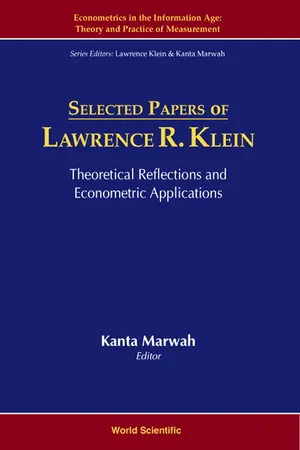 eBook - PDF
- Kanta Marwah(Author)
- 1997(Publication Date)
- World Scientific(Publisher)
32 Theoretical Reflections and Econometric Applications total capital formation, and overall deficit reduction leave much to be desired as outcomes of tax reform. In this case, microeconomic focus without macroeconomic perspective produced a result that did not do as much economic good as could have been achieved. In the case of monetary policy, authorities have several objectives. Some deal with interest rate movements, some with exchange rates and some with credit flows, but a central objective is inflation control. Inflation is defined as the upward move-ment of the general level of prices. That, by itself, is a macroeonomic consideration. The cause sometimes comes from specific prices, such as food and fuel, but at other times many prices move together. As long as they do not all move proportionally, a significant index problem is involved. The general index of prices is, par excel-lence, a macroeconomic magnitude. It does not refer to the prices of any particular good or subset, but to a weighted average of all prices. Money and credit market relations, except for individual portfolios, are genuine macroeconomic relationships. When all sides of the market are brought together, the outcome for final determina-tion of the general price level, exchange rates, and interest rates are macroeconomic phenomena. Money, on the supply side of this market, is not directed at individual agents but to the economy as a whole. Microeconomic principles have been applied to the Central Bank — the Open Market Committee of the Federal Revenue System — using decision theory to de-velop policy reaction functions. If we actually know the individual tastes and desires of the members of the FOMC, it would make sense to develop a policy reaction func-tion along microeconomic lines of optimisation according to decision theory. But the composition of the FOMC changes over the years, and we do not have the means to ascertain their objective preferences. eBook - ePub
- Kenneth M. Eades, Timothy M. Laseter, Ian Skurnik, Peter L. Rodriguez, Lynn A. Isabella, Paul J. Simko(Authors)
- 2010(Publication Date)
- Wiley(Publisher)
The Wealth of Nations, published in 1776. Resource allocation is determined in a market system by reactions to and changes in prices. While the mechanics are rather simple, the implications for society and the belief that firms and markets are valuable social institutions rest in large part on the ideas embodied in supply and demand analysis.A Shift in SupplyExhibit 2.3It is not from the benevolence of the butcher, the brewer or the baker that we expect our dinner, but from their regard to their own self interest…. [Every individual] intends only his own security, only his own gain. And he is in this led by an invisible hand to promote an end which was no part of his original intention. By pursuing his own interest, he frequently promotes that of society more effectually than when he really intends to promote it.—Adam SmithMacroeconomics
Whereas microeconomics focuses on individual and firm-level decisions, macroeconomics focuses on the broad state of the economy. When people ask, “What’s the economy doing?” or “What’s the state of the stock market?” they are asking about the macroeconomy. Macroeconomics employs tools and concepts that help us to think about and predict the level of unemployment, the rate of inflation, rates of economic growth, the level of interest rates, and the policies governments pursue to influence them. Because ultimately the impact of policies depends on the behavior of individuals and firms, macroeconomics does not ignore microeconomic analysis. Models of macroeconomic behavior are rooted in ideas and evidence of how individuals react to changes in their environment. Macroeconomic models range from the simple to the incredibly complex, and all embody some key relationships that we discuss in the remainder of this chapter.To begin with, we can represent what goes on in the economy with a supply and demand graph very similar to those used in the microeconomics section. Exhibit 2.4 is such a graph. Notice that we have appended an A to the D and S to note that we are now dealing with aggregate demand (AD) and aggregate supply (AS). By aggregate, we mean the value of all of the goods and services produced in the economy during a period of time. The more common phrase for this value is the gross domestic product (GDP) of the economy. Since the AD
Index pages curate the most relevant extracts from our library of academic textbooks. They’ve been created using an in-house natural language model (NLM), each adding context and meaning to key research topics.
