Economics

Money Management
Money management refers to the process of budgeting, saving, investing, and spending money in a way that maximizes financial resources and achieves specific financial goals. It involves making informed decisions about income, expenses, and assets to ensure financial stability and growth. Effective money management is essential for individuals, businesses, and governments to maintain financial health and sustainability.
Written by Perlego with AI-assistance
Related key terms
1 of 5

3 Key excerpts on "Money Management"

- Les Dlabay, James Burrow, Brad Kleindl, , Les Dlabay, James Burrow, Brad Kleindl(Authors)
- 2018(Publication Date)
- Cengage Learning EMEA(Publisher)
My advice is to get some lessons in Money Management. I’d be glad to help.” The one thing most people have in common is a desire to use money wisely so that needs, wants, and goals will be satisfied. While no individual, family, or organization is likely to have every desire met, several Money Management techniques can help you use your financial resources wisely. Key Terms Money Management 394 personal assets 395 net worth 396 cash flow statement 396 istockphoto.com/fizkes Do you keep track of how you spend your money? What method do you use? Money Management refers to the day-to-day financial activities associated Copyright 2019 Cengage Learning. All Rights Reserved. May not be copied, scanned, or duplicated, in whole or in part. Due to electronic rights, some third party content may be suppressed from the eBook and/or eChapter(s). Editorial review has deemed that any suppressed content does not materially affect the overall learning experience. Cengage Learning reserves the right to remove additional content at any time if subsequent rights restrictions require it. 16.1 Personal Financial Statements | 395 with using limited income to satisfy your unlimited needs and wants. Money man-agement involves getting the most for your money through careful planning, saving, and spending. It involves making and using a plan for spending. Some people have the wrong idea about Money Management. They think it means never spending, doing without things, and not having any fun. If you learn to manage your money well, you will be able to buy what you really want. Plan-ning ahead and deciding what is import-ant will help you have money for things you enjoy. If you set goals, make wise decisions, buy wisely, and live within your income, you will be a successful money manager. The process of good money manage-ment should start with knowing your current financial status. When watching a baseball or soccer game, most people want to know the score.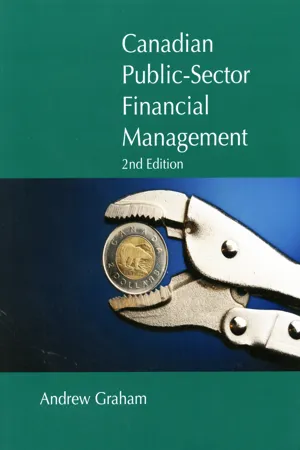 eBook - ePub
Canadian Public-Sector Financial Management
Second Edition
- Andrew Graham(Author)
- 2014(Publication Date)
- McGill-Queen's University Press(Publisher)
This chapter focuses on what is needed to help answer such questions, a process that we call cash management. This term is, admittedly, used somewhat idiosyncratically here by comparison with its use in other accounting and financial-management texts. In some definitions, cash management can refer to the tools to manage money at hand: the treasury or liquidity-management functions. This would encompass banking policies, investment strategies and practice, and policies for safeguarding the funds.In essence, then, cash management as discussed in this text embraces a broad range of control practices associated with the monitoring of financial performance within the current fiscal year (in-year) to ensure that adjustments can be and are made to accommodate changes with respect to the plan and budget. The following definition covers the goal and scope of cash management:Cash management is the formal system which compares actual expenditures against unit spending plans for a given financial year, identifies risks and variances and enables the adjustment of resource allocations to reflect changed circumstances in the that year.The objectives of creating a system for organizational cash management are to: •have funds to pay the bills (i.e., sufficient liquidity) and meet budget targets; •use budgeted resources for their program purposes, and not leave needed funds unspent and program goals unmet; •keep within the appropriated or authorized budget; •have the organizational and resource capacity to react to changes in plans; •reallocate available funds to meet emerging, short-term priorities; and •assess managerial performance, correct errors, adapt to unplanned shifts, and learn from this to adapt future budgets and program parameters.Cash management is not a way to re-open the budget decisions but to adapt to changing circumstances. It encompasses the various elements necessary to effectively manage the assigned budget of a unit within the year over which it is to be implemented. This means that some of the keys to good cash management are: eBook - PDF
- Sudanshu Pandeya(Author)
- 2023(Publication Date)
- Society Publishing(Publisher)
Financial Management as it is conducted by businesses can also be referred to as Company Finance or Business Finance (Hilgert et al., 2003). Fundamentals of Financial Management 5 1.5. SCOPE OF FINANCIAL MANAGEMENT One of the crucial components of general management is financial management, which is tied to many functional divisions like personnel, marketing, and manufacturing. A wide range of topics are covered by financial management using multiple perspectives. The crucial areas of financial management are as follows. 1.5.1. Economics and Financial Management Macro and microeconomic ideas are directly integrated with financial management methodologies. Investment decisions, as well as macro and micro environmental issues, are inextricably linked to the operations of a financial management. Economic equations such as cash value rate of discount, economic order quantity, and so on are also used in financial management. Financial economics is an expanding field that offers numerous potentials in economics and finance (Roll, 1994). 1.5.2. Accounting and Financial Management Accounting records contain a company entity’s financial information. Thus, the association amongst accounting and financial management is readily apparent. In the past, accounting and financial management were considered to be the same subject, but they have since been integrated into Management Accounting since this aspect is so beneficial to finance managers in making judgments. However, modern accounting and financial management are distinct and connected (Chan, 1994). 1.5.3. Mathematics and Financial Management Numerous mathematical and statistical methods and tools are used in current financial management strategies.
Index pages curate the most relevant extracts from our library of academic textbooks. They’ve been created using an in-house natural language model (NLM), each adding context and meaning to key research topics.
