Economics

State and Local Tax
State and local taxes are levied by state and local governments to fund public services and infrastructure. These taxes can include income taxes, sales taxes, property taxes, and various other fees and assessments. They play a crucial role in funding education, public safety, transportation, and other essential services at the state and local levels.
Written by Perlego with AI-assistance
Related key terms
1 of 5
8 Key excerpts on "State and Local Tax"
 eBook - ePub
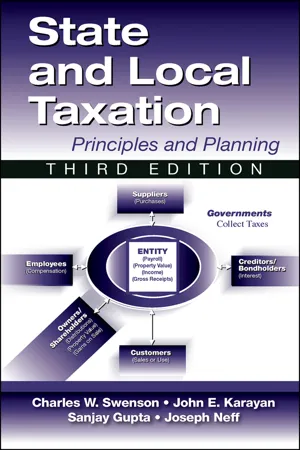
State and Local Taxation
Principles and Practices, 3rd Edition
- Sanjay Gupta, John Karayan, Joseph Neff, Charles Swenson(Authors)
- 2020(Publication Date)
- J. Ross Publishing(Publisher)
The force that is driving the need to understand (and use) State and Local Tax knowledge is largely a function of the dynamism—some would say chaos—that is, in turn, driving state and local public finances in the information age. Simply put, technological advances have made it much easier to sell goods and services from remote locations. Traditionally, businesses without property or employees that are physically present in a jurisdiction cannot be taxed by it. This has meant a possible erosion of state and local bases when brick-and-mortar stores are replaced by e-tailers. At the same time, state and local politicians have clamored for greater tax revenues to finance increased spending for pensions and payroll, not to mention education, safety, and health care. The importance of State and Local Taxes also is a result of massive changes in federal tax laws during the past three decades.There are several reasons for this. Although state and local income tax laws now conform to the federal laws more than ever, stubborn nonconformity coupled with significant increases in State and Local Tax rates have greatly increased the relative burden of State and Local Taxes. Furthermore, quite a bit of the state legislation that is conforming to the federal approach has taken affect after a time lag (even as many states automatically linked their tax law to that of the federal government). In addition, there is the impact of a broader reach for the individual alternate minimum tax (AMT). State and Local Taxes are nondeductible for the individual AMT. This increases their after-tax cost, which has raised the cost of doing business, particularly for owners of businesses operating as flow-through entities such as Subchapter S corporations, limited liability companies, or partnerships.The years of federal tax reform that focused on widening the tax base—for example, 1981 through 1991—created a windfall of state and local income taxes. The reverse occurred when the pendulum swung the other way over the next quarter century. Although headline individual tax rates increased, the federal tax base was eroded for some taxpayers with new deductions. More important, multinational firms, spurred by the U.S. having one of the highest business income tax rates in the developed world until 2018, have been motivated to employ transfer pricing tools to significantly move taxable income outside the U.S. For many jurisdictions, these changes also eroded the state and local income tax base. (Masked by enhanced revenues from employee stock options and stock market profit taking in boom years, the ensuing return to normal patterns has revealed shortfalls in State and Local Taxable income that had been building.) eBook - ePub
Governing Partners
State-local Relations In The United States
- Russell L Hanson(Author)
- 2018(Publication Date)
- Routledge(Publisher)
5The Politics of State-Local Fiscal Relations Jeffrey M. StonecashThe finances of state and local governments are closely connected. The states have legal control of local financial practices and provide much of the revenue of local governments. The states also are responsible for the creation of multiple local governments, which differ greatly in local tax bases that support services. The limited resources of local governments and disparities of tax bases often produce calls for states to do more to help their local governments. These demands have led to a gradual but steady expansion of state involvement in local affairs during the twentieth century. This growth has been accelerated by actions of the national government. However, the rate and timing of expansion varies from state to state, reflecting patterns of party control.The Entanglement of State and Local Finances
State and local finances are fundamentally intertwined. Legally speaking, local governments depend on state government. State governments create counties, municipalities, towns, villages, school districts, and special districts. The state also grants each of these local governments the power to tax and borrow. This power is used in almost all states to regulate what kinds of taxes may be imposed, maximum levels of taxation and debt, and what kinds of borrowing may occur (ACIR 1978; Stonecash 1981b; Kenyon 1989).The states also determine which level of government can use various kinds of taxes. States generally reserve the income tax for state use. The sales tax is also a state tax, though many states allow local governments to impose additional percentages of the sales tax for local use. Property taxes are generally reserved for local governments.States regulate how local property taxes can be applied. There are limits on what properties local governments can tax. Many properties are declared tax exempt because the organization owning land is nonprofit and a political determination has been made that such organizations should not pay taxes. For this reason, state governments grant exemptions to churches, elementary and secondary schools, higher education institutions, neighborhood groups, and a large array of social service groups such as the Red Cross, public television, youth organizations, and religious charities. These exemptions from property taxes limit the ability of local governments to raise money within their boundaries. eBook - ePub
- W.Bartley Hildreth, W. Bartley Hildreth(Authors)
- 2019(Publication Date)
- Routledge(Publisher)
Reform is also a major topic in the election process. Platforms of candidates for major states offices rarely lack discussions of the need to reform State and Local Taxes. The topic is often addressed in governors state-of-the-state speeches and comparable addresses by legislative leaders seeking to set agendas for the coming year.This intense interest by those involved in making decisions in state and local government is mirrored by the attention given to the topic of reform in academic studies and special research reports. Besides appearing in the literature of economics and public finance, the topic spawns research in such fields as educational administration, transportation economics, health economics, business and public policy, law, and political science.B. State and Local Roles in Taxation
The American legal system recognizes state governments as sovereigns, able to make laws using any procedure they choose to adopt on any subject they may choose to address. Historically, the “United” States reflects a compact among states by which they shifted certain designated powers to a new federal government. Powers not so shifted, including taxing powers, remain in the hands of the states.By contrast, local governments are political subdivisions of states. They have no inherent powers except as states may grant powers to them.Typically, local governments are authorized to be organized by local citizens pursuant to extremely detailed state statutes. Those statutes specify how political subdivisions—such as cities, counties, towns, school districts, and special districts—can be created, how their boundaries are adjusted, what officials they shall have and how they will be selected, and what powers they may exercise. In most situations, local governments may only adopt taxes as specifically authorized by state law. In some states, voters have adopted state constitutions that provide for home rule No longer available |Learn more
Public Finance
A Contemporary Application of Theory to Policy
- David Hyman(Author)
- 2013(Publication Date)
- Cengage Learning EMEA(Publisher)
Local taxes are not likely to be an accurate measure of the prices for local gov-ernment services because of the existence of spillover costs and benefits. All these factors result in an equilibrium residential choice pattern that is not efficient. At any point in time, some persons are dissatisfied with their current political jurisdic-tion but for one reason or another are not able to move. Other residents can move either into or out of a community in response to tax rates that do not represent the true marginal costs of local government services. CHAPTER 18 Fiscal Federalism and State and Local Government Finance 643 Copyright 2014 Cengage Learning. All Rights Reserved. May not be copied, scanned, or duplicated, in whole or in part. Due to electronic rights, some third party content may be suppressed from the eBook and/or eChapter(s). Editorial review has deemed that any suppressed content does not materially affect the overall learning experience. Cengage Learning reserves the right to remove additional content at any time if subsequent rights restrictions require it. THE THEORY OF TAXATION WITHIN A DECENTRALIZED SYSTEM Local Tax Base The ability of tax bases to migrate partially from one taxing jurisdiction to another creates problems that constrain the revenue-raising capabilities of local governing units. The possibility of induced locational effects of local taxation is well recog-nized by local governing authorities. 4 Such recognition might account, in part, for local reliance on property taxation in the United States. Real property is relatively immobile compared with the other tax bases. It is impossible to relocate land from one community to another, and shifts in the supply of structures on the land gener-ally occur only in the long run. However, this does not suggest that local property tax policy can have no effect on the value of the property tax base. eBook - ePub
Local Public Finance and Economics
An International Perspective
- Harry Kitchen, Melville McMillan, Anwar Shah(Authors)
- 2019(Publication Date)
- Palgrave Macmillan(Publisher)
The section “Local Sales Taxes” performs the same task for both a general sales tax and a handful of selective sales (or excise) taxes. Both parts include material that is an extension of introductory material on these taxes as provided in Chap. 8. The section “Common Issues” discusses a number of issues that are common in considering their use. In particular, should they be locally administered or “piggybacked”? Should they be set up as local taxes or a form of tax sharing ? Should there be limits on their rates? How might they affect taxpayer behavior? Should they be levied at the local or regional/metropolitan level? Does their use complicate intergovernmental arrangements? What about their revenue yield and volatility? What is their incidence on taxpayers? Environmental taxes or taxes oriented to improving the environment are not yet a major source of revenue for any level of government including local governments but they are emerging. The section “Environmental Taxes” examines local government environmental taxes. The section “Summary” summarizes the chapter. Local Income Taxes Figure 10.1 illustrates 1 the relative importance of income taxes in 34 OECD countries by measuring municipal income tax revenue 2 as a percent of all tax revenue collected in the country. At the high end is Sweden where local income taxes account for 36 percent of all taxes in the country. This is followed by Denmark, Finland, and Iceland where more than 20 percent of all tax revenues are generated by local income taxes. The next highest grouping of countries accounts for slightly more than 12 percent of all tax revenue—this includes Switzerland, Norway, and Japan. At the bottom end are 15 countries where local income taxes are not used. Fig. 10.1 Local income taxes as a percent of all taxes: OECD countries, 2014 No longer available |Learn more
State and Local Government
The Essentials
- Ann O'M. Bowman, Richard C. Kearney(Authors)
- 2014(Publication Date)
- Cengage Learning EMEA(Publisher)
25 So far, TELs have not significantly reduced the size in addition to greater cost of government as advertised. 26 TELs, however, have caused local governments to depend more on the states and led to greater recognition by public officials of the continuing need to consult with the tax-paying public on tax issues. 27 taxation and expenditure limitations (TELs) Restrictions on state and/or local government taxing and spending. Copyright 2014 Cengage Learning. All Rights Reserved. May not be copied, scanned, or duplicated, in whole or in part. Due to electronic rights, some third party content may be suppressed from the eBook and/or eChapter(s). Editorial review has deemed that any suppressed content does not materially affect the overall learning experience. Cengage Learning reserves the right to remove additional content at any time if subsequent rights restrictions require it. Chapter 12 Taxing and Spending 299 Fiscal Stress During national and regional economic downturns, many state and local juris-dictions experience severe fiscal stress : they struggle to pay for programs and provide services that citizens want and need without taxing the citizens at unacceptably high levels. Many factors contribute to fiscal stress. Typically, adverse social and economic conditions, mostly beyond state and local gov-ernment control, establish an environment conducive to financial problems. The unwinding of the national economy in 2008–2011 was due to the deregu-lation of the financial industry, corporate greed, personal irresponsibility, and many other factors beyond state and local government control (though some jurisdictions incurred unrealistic spending obligations even as tax income lessened). Yet it was they—the states and localities—that paid the greatest financial price. Older industrial cities are particularly vulnerable. eBook - ePub
Financing Public Schools
Theory, Policy, and Practice
- Kern Alexander, Richard G. Salmon, F. King Alexander(Authors)
- 2014(Publication Date)
- Routledge(Publisher)
In the process of establishing property tax rates, the usual procedure is that officials of the local governmental body (authorized by state law to establish the rate of taxation) obtain the records giving the aggregate assessed value of properties and the level or amount of expenditures required to meet the anticipated budget for the services needed. The tax rate necessary to meet the budget request is calculated following the aggregation of assessed valuation of property. Unfortunately, this kind of public action gives rise to a very uneven and non-uniform practice of establishing property tax rates from locality to locality and from year to year within the same locality. Although this brief explanation is an oversimplification of the fiscal operations of local units of government, it should serve to indicate how major disparities and inequities creep into property tax administration procedure.Problems also arise in equal application of the property tax to all classifications of property and commensurate classifications of families according to age and income. The fact that taxes on residential property (with the exception of farms) are usually shifted to the consumer or renter creates added burdens. The question arises: Given these and other difficulties, should the local property tax be replaced with other forms of local taxation, or should we turn to policies that seek to cope with the major difficulties in property tax administration and bring about reforms? The answer to this question appears to be overwhelmingly the latter course of action. This is partly due to the fact that the property tax plays such a key role in financing the services of local governments, among which public education is of the greatest order of magnitude by far.Consumption Taxes
Consumption taxes are levies on commodities and transactions, the incidence of which falls upon the consumer through prices paid for goods and services.39 eBook - PDF
Comparative Taxation
Why tax systems differ
- Chris Evans, John Hasseldine, Andy Lymer, Robert Ricketts, Cedric Sandford(Authors)
- 2017(Publication Date)
- Fiscal Publications(Publisher)
This is an important element both of achieving simplicity and compliance as core principles of effective tax system design; and this criterion links closely with our eighth criterion. 17 Tax competition remains a key issue in effective management of fiscal decentralisation seeking to limit similar occurrences in the future: see Blöchliger and Pinero-Campos (2011) and OECD (2013c, pp. 77-96). Comparative Taxation 42 8. A local tax should promote local accountability and therefore responsibility in decision-making by local or state authorities. The relationship between taxes and spending at the local level is often more visible than for national taxes. Taxpayers are therefore often particularly animated about their operation as these taxes are perceived to have a more direct impact on their lives. 3.6 State, regional and local taxes in practice Bearing these criteria in mind, let us look at what taxes are assigned to sub- levels of government, comparing them to overall taxes collected across national governments. For purposes of comparison, we will review a sample of OECD countries as representing the largest developed countries. 18 The OECD statistics which have been drawn upon for Table 3.2 have two major limitations. For unitary countries, they do not show any breakdown which distinguishes regional government taxes where these may exist; regional governments are included under local government (with the exception of Spain where this data is collected given the highly regionally-distributed nature of this country). With recent trends in fiscal decentralisation, this is masking some detail of the growth of regional tax-raising. Second, the table gives no idea of the degree of autonomy over taxes possessed by the sub-central tiers of government. For the majority of countries, the sub-central governments can themselves determine the tax rates of between 90% and 100% of their tax sources.
Index pages curate the most relevant extracts from our library of academic textbooks. They’ve been created using an in-house natural language model (NLM), each adding context and meaning to key research topics.

