Geography

Mineral Reserves
Mineral reserves refer to the economically viable and extractable portion of a mineral deposit. These reserves are estimated based on geological data and economic factors, and they play a crucial role in assessing a country's mineral wealth and potential for mining activities. Understanding mineral reserves is essential for resource management and sustainable development.
Written by Perlego with AI-assistance
Related key terms
1 of 5

10 Key excerpts on "Mineral Reserves"
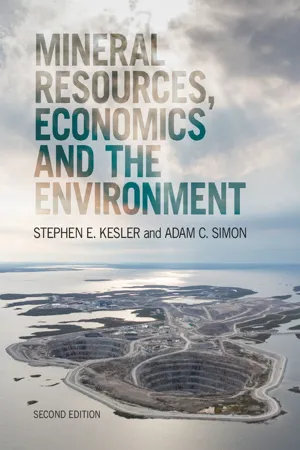
- Stephen E. Kesler, Adam C. Simon(Authors)
- 2015(Publication Date)
- Cambridge University Press(Publisher)
C H A P T E R 14 Global Mineral Reserves and resources If history can be our guide, global mineral supplies will be a major factor in future world relations, as well as the focus of important environmental and economic controversies. At the heart of these disputes will be the fundamental questions of how much is left and how long it will last. Throughout this book, we have quoted reserve and resource fi gures, which are half of this equation. It is time now to review the ways that Mineral Reserves and resources are estimated, and then turn attention to the other side of the equation, mineral consumption. 14.1 Reserve and resource estimation methods Recall from our fi rst chapter that Earth ’ s mineral endowment is referred to as a resource and the part that can be extracted at a pro fi t is known as a reserve ( Figure 1.3 ). Estimates of reserves and resources rely on geology and statistics (Singer and Menzie, 2010 ). Geological approaches range from simple enumeration of known deposits and their probable extensions to more complex assessments based on speci fi c ore deposit types or favorable geological environments. Statistical meth-ods range from those based on assumptions regarding char-acteristics of the population of mineral deposits to others that extrapolate exploration, production, or consumption trends (Wellmer and Becker-Platen, 2002 ; Sinclair and Blackwell, 2006 ; Singer, 2013 ; DeYoung, 2014 ). 14.1.1 Geological estimates Geological estimates are the most traditional and probably the most dependable because they are based on actual observations about rocks. In the simplest method, reserve estimates for individual deposits are collected, evaluated, and compiled to determine the total reserve. Such estimates are useful only for measured and perhaps indicated reserves, and can therefore tell us only how much material has actually been observed and quanti fi ed. Geological estimates of resources are much more complex. eBook - PDF
Earth Science
An Introduction
- Mark Hendrix, Graham Thompson, Mark Hendrix(Authors)
- 2020(Publication Date)
- Cengage Learning EMEA(Publisher)
residual ore deposits A mineral deposit formed from relatively insoluble ions left in the soil near Earth’s surface after most of the soluble ions were dissolved and removed by abundant water. bauxite A gray, yellow, or reddish-brown rock, composed of a mixture of aluminum oxides and hydroxides, that formed as a residual deposit; the principle source of aluminum. Mineral Reserves A term to describe the known supply of ore in the ground; can be used on a local, national, or global scale. Mineral Reserves VS. MINERAL RESOURCES Mineral Reserves are the known amount of ore in the ground that can be mined profitably. Reserves represent a working inventory of an economically extractable mineral commodity in a particular mine or on a national or global scale. Mineral resources, described at the beginning of this chapter, are all occurrences of a mineral commodity, including those only surmised to exist, that have present or anticipated future value. Mining depletes Mineral Reserves by decreasing the amount of ore remaining in the ground, but reserves may also increase in two ways. First, geologists may discover new mineral deposits, thereby adding to the known amount of ore. Second, subeconomic mineral deposits—those in which the metal is not sufficiently concentrated to be mined at a profit—can become profitable if the price of that metal chemical weathering occurs rapidly. Thus, bauxite ores are common in Jamaica, Cuba, Guinea, Australia, and parts of the southeastern United States (●FIGURE 5.10). Copyright 2021 Cengage Learning. All Rights Reserved. May not be copied, scanned, or duplicated, in whole or in part. Due to electronic rights, some third party content may be suppressed from the eBook and/or eChapter(s). Editorial review has deemed that any suppressed content does not materially affect the overall learning experience. Cengage Learning reserves the right to remove additional content at any time if subsequent rights restrictions require it.
- Nigel Woodcock(Author)
- 2017(Publication Date)
- CRC Press(Publisher)
The resources represent the part of the resource base that might conceivably be economic in the future. Within this amount, only the reserves are both economic now and identified with some geological certainty. A final fraction, previously part of the reserves, has been already produced and used by society. The criteria of the McKelvey scheme mean that estimates of reserves and resources vary with changes in economic conditions and geological knowledge (Fig. 5.2a). For instance, reserves appear to increase if the price of a commodity rises, making it attractive to exploit lower-grade and less accessible resources. Conversely, increased costs of extraction and processing will lower the assessed reserves. Estimates of resources are dependent on geological assumptions about their formation and occurrence. Refinement of these geological models can either increase or decrease resource estimates. Estimates are further complicated because changes in the reserves can themselves affect economic and social activity, forming feedback loops that slow the potential changes. So, apparent shortages in reserves raise the price of a commodity and therefore the pace 34 Figure 5.2 Controls on the use of unsustainable and sustainable resources. Geology and environment in Britain and Ireland 52 of geological exploration, both factors that tend to increase the reserves again. Low estimates of reserves also stimulate recycling of some commodities such as metals, slowing the rate of depletion of the natural stock. Finally, the use of some geological resources may be restrained not by the shortage of reserves but by the shortage of safe places to dump the effluents from their production and use (Chs 14, 16). The carbon dioxide derived from burning fossil fuels is the most serious example of this constraint (Ch. 17). Sustainable resources are part of a cycle where the rate of use does not exceed the rate of natural replenishment (Fig. 5.2b). eBook - ePub
- Laurence Robb(Author)
- 2020(Publication Date)
- Wiley-Blackwell(Publisher)
Exploration results can be translated into a mineral resource once it is clear that an occurrence of intrinsic economic interest exists in such form and quantity that there are reasonable prospects for its eventual exploitation. Such a resource can only be referred to as an ore reserve if it is a part of an economically extractable measured or indicated mineral resource. One problem with this terminology is that an economically extractable ore deposit in a developing world artisanal operation may not be viable in a technically developed economy, and vice versa. The term “ore deposit” has no significance in the professional description of a mineral occurrence and is best used simply as a descriptive or generic term. Figure 3 Simplified scheme illustrating the conceptual difference between mineral resources and ore reserves as applied to mineral occurrences. The scheme forms the basis for a more unified description of ore deposits as now required in terms of legislation that has been passed in most major mineral producing jurisdictions. Some Useful Definitions and Compilations General Definitions This section is not intended to provide a comprehensive glossary of terms used in this book. There are, however, several terms that are used throughout the text where a definition is either useful or necessary in order to avoid ambiguity. The following definitions are consistent with those provided in the Glossary of Geology (Bates and Jackson 1987) and The Encyclopedia of the Solid Earth Sciences (Kearey 1993). Ore : any naturally occurring material from which a mineral or aggregate of value can be extracted at a profit. In this book the concept extends to coal (a combustible rock comprising more than 50% by weight carbonaceous material) and petroleum (naturally occurring hydrocarbon in gaseous, liquid, or solid state). Syngenetic : refers to ore deposits that form at the same time as their host rocks
- William A. Hustrulid, Mark Kuchta, Randall K. Martin(Authors)
- 2013(Publication Date)
- CRC Press(Publisher)
It is recognized that it is common practice for a company to comment on and discuss its exploration in terms of target size and type. Any such information relating to exploration targets must be expressed so that it cannot be misrepresented or misconstrued as an estimate of Mineral Resources or Ore reserves. The terms Resource(s) or Reserve(s) must not be used in this context. Any statement referring to potential quantity and grade of the target must be expressed as ranges and must include (1) a detailed explanation of the basis for the statement, and (2) a proximate statement that the potential quantity and grade is conceptual in nature, that there has been insufficient exploration to define a Mineral Resource and that it is uncertain if further exploration will result in the determination of a Mineral Resource. 7.2.9 Reporting of Mineral Resources A ‘Mineral Resource’is a concentration or occurrence of material of intrinsic economic inter-est in or on the Earth’s crust in such form and quantity that there are reasonable prospects for eventual economic extraction. The location, quantity, grade, geological characteristics and continuity of a Mineral Resource are known, estimated or interpreted from specific geo-logical evidence and knowledge. Mineral Resources are sub-divided, in order of increasing geological confidence, into Inferred, Indicated and Measured categories. Portions of a deposit that do not have reasonable prospects for eventual economic extrac-tion must not be included in a Mineral Resource. If the judgment as to ‘eventual economic extraction’ relies on untested practices or assumptions, this is a material matter which must be disclosed in a public report. eBook - PDF
Metal Resources and Energy
Butterworths Monographs in Materials
- P. F. Chapman, F. Roberts, Michael Ashby, J. Charles, A. G. Evans(Authors)
- 2013(Publication Date)
- Butterworth-Heinemann(Publisher)
Chapter 5 Resources, reserves and ore grades The previous chapters have developed arguments which have led to the outline of a framework for assessing the future availability of metals. Now our task is to put some flesh on this skeleton by gathering the information required by the framework. The aim of this chapter is to gather the information we want on resources. We know that we want the information to include data on the quantities of metal available at different ore grades. To gain this, we need to delve into some geochemistry, some economic geology and some geostatistics. Within the confines of this chapter, we cannot do justice to the concepts, methods and evidence used to arrive at the results we wish to use. We outline the main thread of the important arguments and provide a general review of the present state of knowledge. For more detailed discussions of the issues involved, the reader should consult the literature. The first part of the chapter is concerned with establishing a number of basic geological concepts. These include descriptions of the composition of the earth's crust and of the processes of mineral formation. Next we look at the economic and technological factors which determine whether a particular mineral deposit can be profitably mined. This leads directly to a discussion of reserves, resources, probable resources and such terms. Then we look at some of the ways that reserves and resources have been estimated. By this point we will have the basic geological background required to examine the current theories describing the distribution of metal resources as a function of ore grade. We conclude our discussions by pointing out the similarities and differences between these theories. For all practical purposes we are concerned with the extraction of metallic minerals from the continental crust, a thin layer of average depth 15 km and accounting for about 0.3% of the mass of the earth.
- M. Böhmer, M. Kucera(Authors)
- 2013(Publication Date)
- Elsevier Science(Publisher)
A suitable extension of this brief chapter on reserves calculation may be found in the series of articles in the Engineering and Mining Journal, Geostatistics Parts 1—8 (Sine, 1979 and 1980). In these papers a further bibliography is given. Calculation of reserves from the point of view of the enterprise organization may be carried out in different ways. For example, the geologist charged with exploratory operations may perform this task in conjunction with his staff, or it may be carried out by a working team specialized in the estimation of deposits. It is possible to use most varied calculation methods which, however, should always be substantiated for the case in question, as well as diverse computation mechaniza-tions. In any case, the geologist-explorer should be capable of calculating the explored reserves even if applying rather simple methods. 22.8 Reserves calculation report Reflecting its national economic importance, in Czechoslovakia, the reserves calculations for explored deposits are judged by the Federal Commission for Reserves Classification. The report must be submitted in a specified form, an abbreviated example of which is given below. The text contains: 1. general data on the deposit, 2. the geology of the wider environs and of the deposit itself, 3. the qualitative and technological characteris-tics of the raw material, 4. the hydrogeology of the wider environs and the deposit itself, 5. the mining-technical conditions of mining, 6. calculation of the reserves, 7. conclusion, 8. bibliography, list od maps and further sources. Details for the above point (6): Calculation method and its substantiation. The used standards and substantiation of the conditions. The method of ascertaining the parameters of the reserves calculation. Delimitation of the deposit and the principle of its division into blocks. Total calculation results. Collision of interests. Cost of exploration and economic evaluation. eBook - ePub
- Laurence Robb(Author)
- 2013(Publication Date)
- Wiley-Blackwell(Publisher)
Introduction: mineral resourcesTOPICSGENERAL INTRODUCTION AND AIMS OF THE BOOKA SIMPLE CLASSIFICATION SCHEME FOR MINERAL DEPOSITSSOME IMPORTANT DEFINITIONSmetallogeny, syngenetic, epigenetic, mesothermal, epithermal, supergene, hypogene, etc.SOME RELEVANT COMPILATIONSperiodic table of the elements tables of the main ore and gangue minerals geological time scaleFACTORS THAT MAKE A VIABLE MINERAL DEPOSITenrichment factors required to make ore deposits how are mineral resources and ore reserves defined?NATURAL RESOURCES AND THEIR FUTURE EXPLOITATIONsustainability environmental responsibilityINTRODUCTION AND AIMS
Given the unprecedented growth of human population over the past century, as well as the related increase in demand for and production of natural resources, it is evident that understanding the nature, origin and distribution of the world’s mineral deposits remains a strategic topic. The discipline of “economic geology,” which covers all aspects pertaining to the description and understanding of mineral resources, is, therefore, one which traditionally has been, and should remain, a core component of the university earth science curriculum. It is also the discipline that underpins the training of professional earth scientists working in the minerals and related industries of the world. A tendency in the past has been to treat economic geology as a vocational topic and to provide instruction only to those individuals who wished to specialize in the discipline or to follow a career in the minerals industry. In more recent years, changes in earth science curricula have resulted in a trend, at least in a good many parts of the world, in which economic geology has been sidelined.The conceptual development of earth systems science, also a feature of the latter years of the twentieth century, has led to dramatic shifts in the way in which the earth sciences are taught. A more holistic, process-orientated approach has led to a much wider appreciation of the Earth as a complex interrelated system. The understanding of feedback mechanisms has brought an appreciation that the solid Earth, its oceans and atmosphere, and the organic life forms that occupy niches above, at and below its surface, are intimately connected and can only be understood properly in terms of an interplay of processes. Examples include the links between global tectonics and climate patterns, and also between the evolution of unicellular organisms and the formation of certain types of ore deposits. In this context the teaching of many of the traditional geological disciplines assumes new relevance and the challenge to successfully teaching earth system science is how best to integrate the wide range of topics into a curriculum that provides understanding of the entity. Teaching the processes involved in the formation of the enormously diverse ore deposit types found on Earth is necessary, not only because of its practical relevance to the real world, but also because such processes form an integral and informative part of the Earth’s evolution. eBook - PDF
- F.J. Anderson(Author)
- 2013(Publication Date)
- Pergamon(Publisher)
One may therefore define Nash-Pearse's 'technological reserves' with respect to this minimum grade. It must be recognized that to the extent that reserves are measured, with respect to a given minimum cut-off grade, profitability consider-ations are implied. This reflects our view that any attempt to strip technology of economic considerations constitutes a futile and unnecessary exercise. How-ever, by establishing a minimum grade in the near-ideal situations that cannot be easily duplicated, it is possible to remove the variability in this 'reserve base' for a relatively long time, as we have established the limit of profitability, given the best known techniques. In this case, profitability is considered as the opportunity return on investment in the next best alternative use, say in manu-facturing. DEFINITION: A mineral reserve represents a measured quantum of a mineral resource for which the grade is equal to or greater than the minimum grade established by the best available current technology, which yields an opportunity rate of return on investment equal to its next best alternative use. It is crucial that the statement 'opportunity income on investment' be retained in the definition, as it is that rate which determines whether resources flow into or out of the mineral industry. It also removes the variability which would be inherent when different companies in the mineral industry set different levels of expected return, dependent upon private valuations of risk. These rates are known to differ much more markedly in mining compared with manufacturing; hence an average return on investment in manufacturing may be a good guide. It also sets a highly desirable basis for the equivalence of fiscal charge in all indus-tries, thus ensuring the near optimal allocation of all resources, both human and non-human. eBook - PDF
- George Peterson(Author)
- 2019(Publication Date)
- Routledge(Publisher)
Chapter6 Valuation of Mineral Resources William A. Vogely This chapter examines the valuation of mineral resources that may be con-tained in the earth's crust of the wildland. First, the theoretical concept of resource value accruing to the resource in the ground is examined. Second, various characteristics of resources are identified which will determine the methodology that can be used to assign a value. Third, the production func-tion is described for mineral resources as a necessary background for evalua-tion. Last, concepts contained in the literature are reviewed. Theory of Resource Value Mineral deposits in the earth's crust are the result of geologic processes. The entire crust consists of mineral elements plus organic matter. Mineral deposits are concentrations of minerals sufficiently high so that the deposit is distinguishable physically from the surrounding, common rock. Such occur-rences can be classified according to the scheme developed jointly by the U.S. Bureau of Mines and U.S. Geological Survey as indicated in figure 1. This classification scheme for mineral occurrences has both a geologic and an economic axis, based upon the degree of geologic knowledge concerning the occurrence and the economic characteristics of the occurrence in terms of its production potential under prevailing technological and economic con-ditions. Thus, at least theoretically, the earth's crust in any area can be de-scribed in terms of the mineral occurrences classified according to this diagram. Note, however, the only known mineral occurrences are those that have been identified, lying to the leftward portion of the classification figure. And of those identified resources, the economic value of the resource in place increases as the costs of development relative to price of that resource decrease. The value of a resource in place is expressed by the amount of the pure economic rent accruing to that resource in production.
Index pages curate the most relevant extracts from our library of academic textbooks. They’ve been created using an in-house natural language model (NLM), each adding context and meaning to key research topics.

