Geography

New Urbanism
New Urbanism is an urban design movement that promotes walkable neighborhoods, mixed land use, and traditional architecture to create more sustainable and livable communities. It emphasizes compact, pedestrian-friendly development, with a focus on reducing car dependency and promoting public transit. New Urbanism aims to create vibrant, inclusive, and environmentally friendly urban spaces.
Written by Perlego with AI-assistance
Related key terms
1 of 5
12 Key excerpts on "New Urbanism"
 No longer available |Learn more
Roads to Prosperity
Economic Development Lessons from Midsize Canadian Cities
- Gary S. Sands, Laura A. Reese, Gary Sands(Authors)
- 2017(Publication Date)
- Wayne State University Press(Publisher)
8 New UrbanismPart of a broader trend toward the restoration of community and concern for a more sustainable environment, the New Urbanism addresses many of the crucial issues of our time: the decline of America’s cities, the rebuilding of its crumbling infrastructure, housing affordability, crime, and traffic congestion.Katz, 1994C omprehensive master plans include more than just land use and circulation; they also address planning for the local economy. The primary focus of local economic development strategies has typically been on employment centers—industrial estates, office parks, and city centers. More recently, however, there has been increasing recognition that community prosperity is also a function of the quality of life offered to its residents. The suburban model of the last half of the twentieth century, while still dominant, is no longer universally accepted as the only, or the best, development paradigm. Providing alternative forms, such as densification of urban neighborhoods, transit-oriented development, and the New Urbanism, is seen as essential to attracting and retaining the growing segment of the population that rejects low density, single-use, auto-dependent, post–World War II suburban development.There are considerable similarities between New Urbanism and creative class economic development strategies. Both advocate creation of a context in which individuals and communities can flourish, rather than a direct focus on jobs or income. New Urbanism advocates more attention to the quality of urban design and physical forms that encourage interpersonal relations. Such an environment will make communities more desirable and more prosperous. eBook - ePub
Shaping the City
Studies in History, Theory and Urban Design
- Rodolphe El-Khoury, Edwards Robbins, Rodolphe El-Khoury, Edwards Robbins(Authors)
- 2015(Publication Date)
- Routledge(Publisher)
31 New Urbanism provides a voice for those fed up with inner-city decline, the social alienation produced by conventional suburbs, and a world that seems to be increasingly dominated by the automobile. The call for towns and neighborhoods that build community suggest a regional order less dependent on the car and more amenable to pedestrian traffic; it serves as an anodyne to the prevailing planning and development practices responsible for our current plight.For many people, the apparent concern New Urbanists have with community voices and attitudes is a salutary alternative to the often dictatorial and unresponsive design strategies of many urban designers and planners of the modernist and also bureaucratic mode. In an attempt to include local visions and languages, New Urbanists often try to work with the local community in design charrettes to develop a contextual solution grounded in local circumstances and attitudes. Whether this is a marketing strategy or a genuine attempt to include locals in developing the design or a bit of both is open to question. That it is an attractive element of New Urbanist practice and ideology is not.For those developers that support the New Urbanism, it is not only an answer to sprawl and reliance on the automobile, it allows for, indeed encourages, development of sites that, previous to the New Urbanism, would have had fewer units in the same size tract. Real estate developers embrace the New Urbanism in the name of community development but, as Norman Blankman, writing in Real Estate Finance Journal, makes clear,The single most important thing that should be done to bring affordable housing within reach for millions of people is to change zoning laws to permit more compact development. The first steps have been taken by a nationwide movement [i.e. the New Urbanism] to reform US urbanism.32 eBook - ePub
The Ecology of Place
Planning for Environment, Economy, and Community
- Timothy Beatley, Kristy Manning(Authors)
- 2013(Publication Date)
- Island Press(Publisher)
But the New Urbanism movement also presents serious concerns that could have long-term implications for planning in the United States. The first concern is that the New Urbanism is not particularly urban. In fact, the most highly touted New Urbanist developments are located in suburban or exurban areas. While these projects certainly represent improvements over standard development practices, they do not address land use and development patterns within the larger municipalities and regions they inhabit. And while the proponents of New Urbanism espouse regional solutions, their projects and practice are essentially about building new developments in places that frequently work against sustainable regional growth patterns.Second, the New Urbanism is not strongly environmental in orientation. The design features of many New Urbanist developments do have the effect of supporting certain environmental goals. But most New Urbanist projects may involve only one or two supportive aspects—for example, the creation of a more pedestrian-friendly neighborhood (although usually for nonenvironmental reasons, and the benefits achieved may often be canceled out because of an inappropriate location). More fundamentally, with just a few notable exceptions, such projects typically are not designed or conceived in ways that substantially reduce the overall ecological footprint, or impact, of the development and its residents on the environment (e.g., by designing buildings that dramatically reduce energy consumption and use of toxic materials). Environmental sustainability is at best an afterthought and, where incorporated, can be viewed skeptically more as a marketing ploy than anything else.This volume offers a more holistic, comprehensive, compelling approach to repairing and enhancing communities, one that extends well beyond the reach of traditional architecture and urban design, and beyond simply tinkering with the physical layout of a development. This approach recognizes that the seriousness of our environmental and social problems requires reform at a number of levels and in a number of societal spheres. It recognizes that communities must examine the ways in which they educate, produce goods and services in the marketplace, and provide public services. Addressing these concerns requires questioning “business as usual” in many parts of the community and via many avenues for reform and innovation. The agenda of creating sustainable places emphasizes, for instance, fundamentally modifying the ways in which local governments function by reforming the methods by which they purchase and procure, deliver services, manage their building stock, and budget their resources. It means reconceptualizing the local economy so that it is restorative and sustainable. It means understanding in a comprehensive way the resource needs and flows of the community—where its energy, water, and food come from, and how its wastes are dealt with. It emphasizes a host of actions and programs that support and enhance the social life and vitality of the community. eBook - PDF
- David Kolb(Author)
- 2010(Publication Date)
- University of Georgia Press(Publisher)
The New Urbanism offers detailed advice on practical matters ranging from the radius of a corner’s curve to the layout of a metropolitan re-gion. “Many misconceptions are caused by focusing on New Urbanism’s neighborhood-scale prescriptions without seeing them embedded in regional structures . . . . Replacing cul-de-sacs and malls with traditional urban design, although desirable, is not sufficient to solve the problems of modern growth, either practically or ideologically. Without regional form-givers like habitat and agricultural preserves, urban growth bound-aries, transit systems, and designated urban centers, even well-designed neighborhoods can contribute to sprawl. Infill and redevelopment, although a high priority for New Urbanism, cannot accommodate all the growth in many regions. A regional plan is a necessary armature for the placement of new growth” (Calthorpe 2000, 178–80). 6 So the New Urbanism urges metropolitan areas to build toward a denser polycen-tric form made up of many distinct mixed-use neighborhoods or towns rather than a spread of large single-use tracts. Concentrations of com-mercial and civic activity should be embedded in neighborhoods rather than strung out along strips. Compared to familiar suburbs, New Urbanist developments are more concentrated, with smaller lot sizes and houses arranged to address streets whose layout and dimensions are planned to encourage inter-action and neighborliness. Some projects plan for secondary pedes-trian paths from the beginning. The architectural codes may give the impression that the developments spring from the ground full-grown, self-enclosed, and complete, but in fact they are usually slower to “build out” than standard subdivision developments or the nineteenth-century instant towns that sprang up along railroad lines. The New Urbanists would reshape sprawl into a field with many nodes; no single node would be dominant, nor would it be isolated. eBook - ePub
Civitas by Design
Building Better Communities, from the Garden City to the New Urbanism
- Howard Gillette, Jr.(Authors)
- 2011(Publication Date)
- University of Pennsylvania Press(Publisher)
At best, he hoped to promote community by providing magnets for sociability. His vision, even in building the new town of Columbia, did not extend to reforming contemporary culture. That challenge has been taken up more recently by a new generation of architects and critics who, like Rouse, have sought to make more livable places. In addition to being more comprehensive in their intent, they have moved beyond individual enterprises to form a national organization, the Congress for the New Urbanism. 1 Asserting in the introduction to their charter the symptoms of a deteriorating quality of life—“more congestion and air pollution resulting from our increased dependence on automobiles, the loss of precious open space, the need for costly improvements to roads and public services, the inequitable distribution of economic resources, and the loss of a sense of community”—they state their confidence in the social power of design: “We recognize that physical solutions by themselves will not solve social and economic problems, but neither can economic vitality, community stability, and environmental health be sustained without a coherent and supportive physical framework.” 2 These New Urbanists, one reporter noted, “want to induce neighborliness with architecture…they believe social change can be brought about through architecture and planning.” 3 With acknowledged debts to Ebenezer Howard, to the neighborhood planning ideas of Clarence Arthur Perry, and to the regional approach advocated by Lewis Mumford and Patrick Geddes, 4 New Urbanism, as one adherent puts it, stresses “the conviction that the built environment can create a ‘sense of community’…and that a reformulated philosophy about how we build communities will overcome our current civic deficits, build social capital and revive a community spirit which is currently lost.” 5 Echoing the critique that emerged in the 1920s from members of the Regional Planning Association of America, New Urbanists have been critical of eBook - ePub
Planning the Good Community
New Urbanism in Theory and Practice
- Jill Grant(Author)
- 2005(Publication Date)
- Routledge(Publisher)
community independent of the town square or the local pub’ (2000:60). New urbanists suggest that people need a public realm of streets, squares, and parks to meet others who are different from themselves. In this view, community-shaping social interaction occurs primarily in the public realm, rather than in places of work or domestic engagement, and in a context of difference rather than similarity. The designer plays a pivotal role in providing the receptacle spaces the physical containers that allow such integration of difference to develop into community bonds. For New Urbanism, in some sense, social networks are products of space.Our review of new urban approaches in several regions has shown that some principles are commonly held as appropriate to good urban form in the early twentyfirst century. For instance, we find widespread consensus around the significance of mixing uses and integrating housing types and tenures; encouraging compact form and higher densities; and facilitating public transportation and walking options. Specific design questions, like architectural styles and street patterns, generate diverse responses in particular contexts. While traditional architecture is popular in Florida and central Canada, modernist forms drive new urban approaches in Germany and Vancouver. The grid is great in North America, but the cul-de-sac and mews have kerb-side appeal in the UK. Even the principles held in common face challenges in practice, as they prove difficult to implement to the extent that designers might envision.Certainly the North American ‘New Urbanism’ is by no means universal, despite the claims of some of its adherents about its spread world-wide. Even in the United States the movement is not completely unified, but includes competing ideas about how to resolve questions of accessibility (both for cars and for those with mobility impairments). Definitions of the good community seem intrinsically linked to local context, history, and culture, and to the individual interests of community residents. Finding universal principles has not proven easy in a context where issues keep arising, problems prove intractable, and differences will not disappear. eBook - PDF
- Christopher Boone, Ali Modarres(Authors)
- 2009(Publication Date)
- Temple University Press(Publisher)
Many have noted that New Urbanism is a misnomer, since most of its projects have occurred on greenfield sites. This has led some critics to dub it “new suburbanism.” To be fair, DPZ argues that they encourage clients to look first in existing neighborhoods for the quality of life New Urbanism promotes. DPZ has also undertaken some infill projects in cities (Duany et al. 2000). Goldberger suggests, however, that “the New Urbanists may never be fully comfortable with big cities because cities will never be wholly controllable, and control is what Duany and Plater-Zyberk want” (Goldberger 2000, 134). For Dolores Hayden (2003), New Urbanism suffers from two shortcomings—the concentration on new development rather than existing “old-growth” suburbs, and the inabil-ity to address the larger political and economic structures that encour-age sprawl. Clearly, design can play a role in mitigating car use, encour-aging walking and cycling, and creating opportunities for interaction with neighbors. New Urbanism has boldly challenged existing prac-tices, but on its own it will not be enough to change the tide of growth on the fringe of cities. 184 C HAPTER S IX P ATHWAYS TO A S USTAINABLE U RBAN F UTURE What are the pathways to a sustainable urban future? It is difficult to predict what lies ahead, but experience and knowledge can be the basis for guidelines or prescriptions. A precautionary approach, many would argue, is better than blind faith that all will be better, especially since the status quo cannot be sustained. Cities are immensely dynamic places, and they will change. After sixty years of cheap energy and sub-sidized suburbanization, the present generation is left with cities that may prohibit a healthy, high quality of life over the long term (Hayden 2003). As the world becomes urban, we have reached a defining moment. Now is the time to plan as wisely as possible for the future. The first and most important prescription for a sustainable future is to be smart . eBook - PDF
- Barney Warf(Author)
- 2006(Publication Date)
- SAGE Publications, Inc(Publisher)
outcomes. Although many commonalities between countries, and among regions within countries, can be seen, there is a clear geography of planning with sig-nificant variation in legal and jurisdictional systems. In the era of globalization, planning will continue to get the attention of human geographers interested in the processes of community change. —Richard Kujawa See also Central Business District; Gentrification; Infrastructure; New Urbanism; NIMBY; State; Suburbs and Suburbanization; Urban Entrepreneurialism; Urban Fringe; Urban Geography; Urban Managerialism; Urban Social Movements; Urban Sprawl; Zoning Suggested Reading American Institute for Certified Planners. (2005). Ethics for the certified planner [Online]. Available: www.planning .org/ethics/ Cullingworth, J. (1993). The political culture of planning: American land use planning in comparative perspective. New York: Routledge. Dalton, L., Hoch, C., & So, F. (Eds.). (2000). The practice of local government planning (3rd ed.). Washington, DC: International City/County Management Association. Fainstein, S. (1991). Promoting economic development: Urban planning in the United States and Great Britain. Journal of the American Planning Association, 57, 22–33. Florida, R., & Jonas, A. (1991). U.S. urban policy: The post-war state and capitalist regulation. Antipode, 23, 349–384. Gaffikin, F., & Warf, B. (1993). Urban policy and the post-Keynesian state in the United Kingdom and the United States. International Journal of Urban and Regional Research, 17, 67–84. Leitner, H. (1990). Cities in pursuit of economic growth: The local state as entrepreneur. Political Geography Quarterly, 9, 146–170. Sanderock, L. (Ed.). (1998). Making the invisible visible: A multicultural planning history. Berkeley: University of California Press. URBAN ECOLOGY Ecology is a branch of biology that studies relation-ships between and among organisms and their envi-ronment. eBook - PDF
- Camilla Perrone, Gabriele Manella, Lorenzo Tripodi, Ray Hutchison(Authors)
- 2011(Publication Date)
- Emerald Group Publishing Limited(Publisher)
Richard Burdett stresses that every urban neighborhood could be a combination of home, work, culture, and entertainment (2007) ; all of that is requested to reach a sustainable city, and urban planning could also include a lot of attention to a decreasing use of cars. So, once more, densification could combine with neighborhood regeneration to pursue a sustainable urban way of life. The repopulation and reutilization of central areas 3 are essential; however, giving them a character is also important in order to allow people to go to live there and use those spaces. In other words, we think that a sustainable city urgently needs a promotion of ‘urban mood,’ that mood which has been so severely threatened by sprawl. We have some important examples of that as well. In other words, it is important in order to give them an opportunity of being ‘place attached’ without forgetting or renouncing to their everyday mobility. From Urban Sprawl to Sustainable Cities 37 The city is not conceivable without density and heterogeneity, and all these elements are fundamental to reach that ‘urban mood’ that is an added value for a sustainable city. A new understanding of urbanism is required, and this urbanism should pass through a rethinking of the concept of neighborhood and recognition of the contributions of neighborhood studies. NOTES 1. ‘Spurts in the 1960s and 1970s followed by a decline, the mid 1990s to the year 2000 saw more than a doubling of neighborhood studies to the level of about 100 papers per year’ ( Sampson et al., 2002, p. 444 ). 2. ‘Architects would be wise to focus on designing spaces that provide these kinds of opportunities. Simple things, like the design of parks where people can interact in a way that’s safe. It seems like a trivial example, but the town of Brookline has dog parks where in the evening I see lots of people with their dogs ( y ) These are public spaces. eBook - PDF
Sustainable Urban Planning
Tipping the Balance
- Robert Riddell(Author)
- 2008(Publication Date)
- Wiley-Blackwell(Publisher)
Although these precepts, in and of themselves, cannot produce urban functionality as an instant mix, they are the proven basic ingredi-ents. It takes time, as much as or more than a lifetime, to achieve demographic variety, a mixture of occupational and income classes, and racial heterogeneity for middle Anglo settler society. This identifies the importance of fashioning worthy places of residence, and aiding individuals and encouraging families grappling with job insecurity and adverse personal misfortunes to build and maintain their community scaffold. Urban Reforms: Options and Actions The eight sections which follow examine operational urban situations, the inten-tion being to fashion recommendations for improving upon the general economic substance, the social wellbeing and the urban environments which comprise com-munity living places. Urban Growth Management 203 Seaside, Florida. The best known of the new-urbanism projects, used as the outside set for filming The Truman Story. 204 Practice The recommendations start with a contextual scene-setting passage on overall urban social arrangement and style. They then track inward from the quasi-urban periphery to the centre, closing with shopping as entertainment. Urban social arrangement and style (p. 204) Ex-urban sprawl control (p. 211) Small town conservation with development (p. 217) Water’s edge urbanization (p. 221) Eco-village ideals (p. 223) Raw land suburbanization (p. 227) Urban retrofit compaction and clustering (p. 238) Shopping as a leisure activity (p. 251) Public housing policy and transportation provisioning, specialized accessory topics, do not form a significant part of these recommendations. 18 Urban social arrangement and style Recommendations which address the overall urban design problematic are col-lated in box 5.1 as Urban social arrangement and style , rea-soning which owes much to Lynch’s Image of the City (1960), the Bentley et al.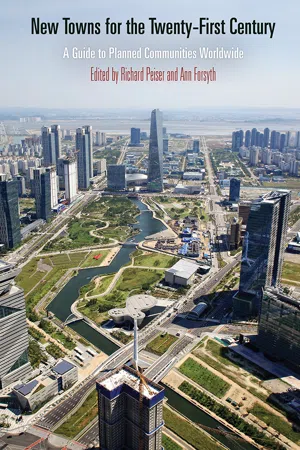 eBook - PDF
New Towns for the Twenty-First Century
A Guide to Planned Communities Worldwide
- Richard Peiser, Ann Forsyth, Richard Peiser, Ann Forsyth(Authors)
- 2021(Publication Date)
- University of Pennsylvania Press(Publisher)
Urban territo-ries today are a challenging mix of spaces, forms, and functionalities. Within that context they are but one constituent element. It is little wonder that even the main advocacy groups without exception have widened their ambit, for example the In-ternational New Towns Association, known as the International Urban Develop-ment Association since the early 1990s. Also, while new towns have not completely ceded claims to be innovative urban milieus, in that category they are joined and frankly overwhelmed by many different kinds of urban environments: witness the “grand tour” of European hot spots reported by Hall and Falk (2014, 4). New towns have been no match for old cities. In aggregate, the results are modest; they have not attained the numbers and significance envisioned by their proponents. But three final observations about their continuing value in conceptual, devel-opmental, and historical terms are proffered. First, and a step back from actual development, is a reaffirmation of the notion of tabula rasa towns and settlement systems as an invaluable heuristic device for conceptualizing, tracking, and evalu-ating urban futures (Reiner 1963; Wakeman 2016; Weller and Bolleter 2013). Vi-sioning is a fundamental planning technique in establishing desired directions and scenarios (Freestone 2012; Hopkins and Zapata 2007). This value spills into plan-ning advocacy, community deliberations, and planning education through design studios. Developmentally, even with seemingly little prospect of a grand new town re-naissance, new towns remain an urban artifact that cannot be ignored. They are not frozen in time and, throughout their lifetimes, have had to respond to new national priorities, technologies, consumer sentiments, design technologies, and financial mechanisms. They face urban renewal challenges comparable to conven-tional city and suburban zones (Gaborit 2010). They are major urban investments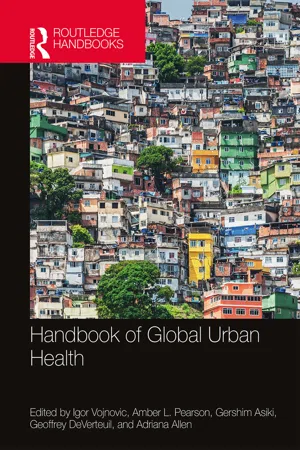 eBook - ePub
- Igor Vojnovic, Amber Pearson, Gershim Asiki, Geoff DeVerteuil, Adriana Allen, Igor Vojnovic, Amber Pearson, Gershim Asiki, Geoff DeVerteuil, Adriana Allen, Amber L. Pearson, Igor Vojnovic, Amber L. Pearson, Gershim Asiki, Geoff DeVerteuil, Adriana Allen(Authors)
- 2019(Publication Date)
- Routledge(Publisher)
Additionally there has been a widespread retreat from the city, to the greater Christchurch region. Nearby districts Selwyn and Waimakariri have experienced considerable population growth (33% and 17% respectively by 2013), leading to increased commuting into the city and greater pressure on transport networks (Statistics New Zealand 2015). This population sprawl also challenges attempts to rebuild a city and community that are healthy, sustainable and resilient. Despite best intentions and the central role of health and wellbeing in the discourse of the redevelopment of the city, beyond the apparent success of the cycleway network, 2 the role that transport will play in facilitating sustainable and healthy development remains unclear. Neighbourhood Regeneration: A Holistic Approach in Glasgow, Scotland The patterning of poor health and deprivation at neighbourhood level occurs for many reasons: as a product of housing markets, loss of employment opportunities, disinvestment and stigma, amongst others. Neighbourhoods, as the smallest unit of social territory, can be seen as the ‘blocks upon which the economic, social, political, and cultural elements of the city are built’ (Flint, J. 2009, p. 354), and the contrasting fortunes of sometimes adjacent neighbourhoods throws the spatial dimension of health inequalities into relief. Area-based interventions, designed to transform disadvantaged neighbourhoods into thriving communities, are a well-established policy approach intended to alleviate poor conditions and compensate for market failures with government support (Adair et al. 2000; DCLG 2009). Europe and the USA have a history of area-based interventions in the form of neighbourhood-level regeneration (Couch et al. 2011). Many of these initiatives have attempted to address public health concerns in relation to overcrowding and insanitary conditions through slum clearance and the creation of peripheral estates (Flint, J. 2009; Couch et al. 2011)
Index pages curate the most relevant extracts from our library of academic textbooks. They’ve been created using an in-house natural language model (NLM), each adding context and meaning to key research topics.

