Geography

Statistically Significant Data
Statistically significant data in geography refers to findings that are unlikely to have occurred by chance. It indicates that the observed patterns or relationships in the data are likely to be real and not due to random variation. This helps geographers make more confident conclusions about the relationships between geographic phenomena.
Written by Perlego with AI-assistance
Related key terms
1 of 5

6 Key excerpts on "Statistically Significant Data"
 eBook - ePub
- Nicholas Clifford, Meghan Cope, Thomas Gillespie, Nicholas Clifford, Meghan Cope, Thomas Gillespie(Authors)
- 2023(Publication Date)
- SAGE Publications Ltd(Publisher)
The development of methods for space and time analysis is a process that is continuously evolving. The increasing availability of spatio-temporal data has led to a pressing need to develop and integrate methods that can be used to reveal useful patterns, and this has been facilitated by the democratization of GIS. GIS can easily integrate geospatial data of different spatial scales and temporal granularity for a wide range of applications. This chapter has reviewed the importance of exploratory spatial data analysis to deepen our ability to detect spatial and temporal trends inherent to the data. Finally, the chapter has discussed the importance of confirmatory statistical approaches to model the role of explanatory variables.SummaryThe past two decades have witnessed two critical changes in the area of spatial data: 1) an increasing availability of spatial and temporal-explicit data and 2) the democratization of Geographic Information Systems (GIS). Georeferenced (or spatial) data are unique and characterized by a set of latitude and longitude coordinates, and come in different formats (point/lines/area or raster). These datasets can be massive, and there is an increasing need for robust statistical and visualization methods that can integrate different dimensions, such as space and time. Traditional statistical methods help explore trends. Spatial point pattern techniques (K-function, Kernel Density Estimation) are well suited to identify the locations of clusters, which are particularly informative in an epidemiological context. Spatial statistical approaches have the potential to identify locally varying patterns when data are aggregated at the areal level, as is the case for several census units. It is particularly important to test for spatial autocorrelation before implementing a regression technique; indeed traditional non-spatial regression approaches do not capture the spatial variation of the phenomenon under study. Caution is recommended when the data exhibit temporal trends (e.g. epidemiological datasets). Suggestions are presented to visualize this information and incorporate it into regression techniques.Note
1 John Edwards had officially suspended his campaign on 30 January 2008, but his name was still on the ballot.Further Reading- Anselin (2011) ‘From SpaceStat to CyberGIS: Twenty years of spatial data analysis software’.
- This provides a historical and critical review of the development of spatial data analysis software. It considers such things as the role of advances in methods, developments in cyberinfrastructure and the growth of open source.
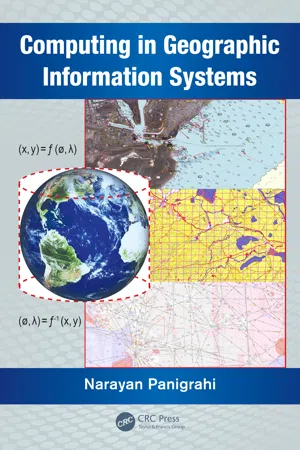 eBook - PDF
- Narayan Panigrahi(Author)
- 2014(Publication Date)
- CRC Press(Publisher)
Statistics deals with aggregates of objects and does not take cognizance of individual items. For example, in finding the statures of a class, a statistician is not very much interested in the height of individual students but in their average height. It is immaterial for him whether a particular student is five feet or seven feet. One wants to have a bird’s-eye view, so to say, of their height perhaps by way of comparing it with the average heights of students in the same class at some other college or in a different class at the same 169 170 Computing in Geographic Information Systems institution. Statistical laws are not exact. The results of statistical enquiry are not expressed in the form of categorical certainty but in terms of probabilities only. A statistical enquiry passes through various stages as given below: • Collection of sample data or field survey. • Organization and preprocessing of survey data and classification or catego-rization of the sample data. • Analysis of the data using statistical operators and methods. • Interpretation of the patterns and trends in the data. 9.2 Spatial Statistics Spatial statistics can be defined as a set of analytical techniques to determine the spatial distribution of a variable, the relationship between the spatial distribution of variables, and the association of the variables of a spatial extent or area. Spatial analysis is often referred to as spatial modeling. It refers to the analysis of phenomena distributed in space and having physical dimensions (the location of, proximity to, or orientation of objects with respect to one another; relating to an area of a map as in spatial information and spatial analysis; referenced or relating to a specific location on the Earth’s surface). eBook - PDF
Spatial Analysis Methods and Practice
Describe – Explore – Explain through GIS
- George Grekousis(Author)
- 2020(Publication Date)
- Cambridge University Press(Publisher)
While observations independence should exist in classical statistics, spatial dependence usually exists in spatial statistics, and classical statis- tics should be modified accordingly. A test of significance is the process of rejecting or not rejecting a hypoth- esis based on sample data. It is used to determine the probability that a given hypothesis is true. A p-value is the probability of finding the observed (or more extreme) results of a sample statistic (test statistic) if we assume that the null hypothesis is true. Rejecting the null hypothesis means that there is a probability (calculated as the difference: 100% α) that alternative hypothesis H 1 is correct (α is the significance level). Not rejecting the null hypothesis means that there is not sufficient evi- dence to reject the null hypothesis, but we cannot accept it either without further analysis. Statistics often deal with normal distribution because many well-defined statistical tests are based on the assumption that the examined distribu- tion is normal. Questions and Answers The answers given here are brief. For more thorough answers, refer back to the relevant sections of this chapter. Q1. Why are spatial statistics used? A1. Spatial statistics employ statistical methods to analyze spatial data, quan- tify a spatial process and discover hidden patterns or unexpected trends in these data in a geographic context. Spatial statistics are built upon statistical concepts, but they incorporate location parameters such as 112 Exploratory Spatial Data Analysis Tools and Statistics coordinates, distance and area. They extend classic statistical measures and procedures and offer advanced insights for data analysis. In geo- graphical analysis, spatial statistics are not used separately from statistics but in complementary ways. Q2. What is the main difference between spatial statistics and descriptive statistics? A2. There is a fundamental difference between classical and spatial statistics. eBook - PDF
- Steven P. Millard, Nagaraj K. Neerchal(Authors)
- 2000(Publication Date)
- CRC Press(Publisher)
693 12 SPATIAL STATISTICS How Are Things Changing over Space? In Chapter 11 we discussed methods for dealing with data collected over time, including testing for trend and how to accommodate serial correlation. Environmental studies often generate data collected over space as well as time. Sometimes we are interested not only in characterizing chemical con- centrations in an area by simple summary statistics, but also by describing the spatial pattern of concentration. Just as we fit models to describe changes in concentration over time, we can also fit models to describe changes in concentration over space. In this chapter we will talk about sta- tistical tools for dealing with spatial data. OVERVIEW: TYPES OF SPATIAL DATA Spatial data can be classified by how the location associated with each observation is defined: by a point (e.g., latitude and longitude of the loca- tion) or by an area or region (e.g., King County, Washington, USA) (Cressie, 1993; Kaluzny et al., 1998). Point spatial data can be further subclassified by whether it is geostatistical or a spatial point pattern. Geostatistical data have point locations associated with them and usually one or more variables are measured at each location. For example, data from an air quality moni- toring network may include observations of ozone, particulate matter, tem- perature, humidity, radiation, wind speed, and time of day for each monitor- ing location. Spatial point pattern data have point locations associated with them and the locations themselves are the variable of interest. Often one of the main hypotheses of interest is whether the locations are random, clus- tered, or regular. eBook - PDF
- Paul A. Longley, Michael F. Goodchild, David J. Maguire, David W. Rhind(Authors)
- 2015(Publication Date)
- Wiley(Publisher)
The day-to-day operational context to our activities is very much determined by where we live and work. The longer-term strategic context may well be provided by where we were born, grew up, or went to college. Our behavior in geographic space often reflects past patterns of behavior. Chapter 2 The Nature of Geographic Data 35 patterns of spatial autocorrelation in one variable will, to a greater or lesser extent, be mirrored in another. However, although this is helpful in building repre- sentations of the real world, we will see in Section 14.5.1 that the property of spatial autocorrelation can frustrate our attempts to build inferential statistical models of the covariation of geographic phenomena. Spatial autocorrelation helps us to build representations but frustrates our efforts to predict. The nature of geographic variation, the scale at which uncontrolled variation occurs, and the way in which different geographic phenomena covary all help us to understand the form and functioning of the real world. These principles are of practical importance and guide us toward answering questions such as: What is an appropriate scale or level of detail at which I should measure the relevant and observable characteristics of the world? How do I design my spatial sample? How do I generalize from my sample measurements? And what formal methods and techniques can I use to relate key spatial events and outcomes to one another? Each of these questions is a facet of the funda- mental problem of the analysis of GI, that is, of select- ing what to measure and record, using the scales of measurement described in Box 2.1. The Tobler Law measuring spatial heterogeneity. This requires us to move beyond thinking of GI as abstracted only from the continuous spatial distributions implied by Tobler’s Law and from sequences of events over continuous time. eBook - PDF
- David O'Sullivan, David Unwin(Authors)
- 2014(Publication Date)
- Wiley(Publisher)
Unless the study area has been very carefully de fi ned, it is unlikely that this re fl ects reality, and the arti fi cially produced asymmetry in the data must be accounted for. In some specialized 40 GEOGRAPHIC INFORMATION ANALYSIS areas of spatial analysis, techniques for dealing with edge effects are well developed, but the problem remains poorly understood in many cases. 2.3. THE GOOD NEWS: THE POTENTIAL OF SPATIAL DATA It should not surprise you to fi nd out that many of the problems outlined in Section 2.2 have not been solved satisfactorily. Indeed, in the early enthu-siasm for the quantitative revolution in geography (in the late 1950s and the 1960s), many of these problems were glossed over. Unfortunately, dealing with these problems is not simple, so that only more mathematically oriented geographers and relatively small numbers of statisticians have paid much attention to the issues. More recently, with the advent of GIS and a much broader awareness of the signi fi cance of spatial data, there has been consid-erable progress, with new techniques appearing all the time. Regardless of the sophistication and complexity of the techniques adopted, the fundamen-tal characteristics of spatial data are critical to unlocking their potential. To give you a sense of this, we continue our overview of what ’ s special about spatial data, not focusing on the problems that consideration of spatial aspects introduces, but instead examining some of the potential for addi-tional insight provided by an examination of the locational attributes of data. The important spatial concepts that appear throughout this book are distance , adjacency , and interaction , together with the closely related notion of neighborhood . These appear in a variety of guises in most applications of statistical methods to spatial data. Here we point to their importance, outline some of their uses, and indicate some of the contexts where they will appear.
Index pages curate the most relevant extracts from our library of academic textbooks. They’ve been created using an in-house natural language model (NLM), each adding context and meaning to key research topics.

