Geography

Water Budgets
Water budgets refer to the balance of water inputs, outputs, and storage within a specific area over a defined period. They account for precipitation, evaporation, runoff, and groundwater recharge to assess the availability and distribution of water resources. By analyzing these components, water budgets help in understanding the hydrological cycle and managing water usage and conservation.
Written by Perlego with AI-assistance
Related key terms
1 of 5


8 Key excerpts on "Water Budgets"
 eBook - PDF
Wetland Plants
Biology and Ecology
- Julie K. Cronk, M. Siobhan Fennessy(Authors)
- 2016(Publication Date)
- CRC Press(Publisher)
A hydrologic, or water, budget is the total of water flows into and out of a site. It is an important tool because it reveals the relative importance of each hydrologic process for a given wetland. Water Budgets, along with information about the local soils and surficial geology, can provide an understanding of the hydrologic processes and water chemistry, help explain the diversity and distribution of species in the plant community, and provide insight into the changes that might result from hydrologic disturbance. Water inflows are generally driven by climate and include precipitation, surface runoff, groundwater inflows, and, in coastal systems, tidal ebb and flow. Mass balance equations are often used to describe the flows of water into and out of a wetland (Huff and Young 1980), and are generally calculated to solve for volume such that: ∆ V/ ∆ t = water inputs – water outputs (3.1) or more specifically: ∆ V/ ∆ t = S i + G i + P n – ET – S o – G o ± T (3.2) where ∆ V/ ∆ t = change in volume of water (storage) per unit time, t S i = surface inflow G i = groundwater inflow P n = direct precipitation ET = evapotranspiration S o = surface outflow G o = groundwater outflow T = tidal inflow (+) or outflow (–); not present in inland wetlands THE PHYSICAL ENVIRONMENT OF WETLAND PLANTS 63 TABLE 3.1 Examples of Water Budgets for a Variety of Wetland Types Wetland Type and Location Inflows Outflows Tides ( ∆ V/ ∆ t) S i G i P n ET S o G o Great Lakes coastal marsh, Ohio 576 131 a 38 67 653 a +25 Mangrove swamp, Florida 121 108 90 28 in = 1228 –54 out = 1177 Prairie pothole, North Dakota 40 37 64 18 –5 Okefenokee Swamp, Georgia 39 b 131 93 73 4 0 Fen, North Wales 38 b 102 49 100 –9 Green Swamp, central Florida 89–180 86–99 5–79 5–6 –10 to 0 Bog, Massachusetts 145 102 24 c +19 Pocosin swamp, North Carolina 117 67 49 1 0 Note: The units are cm yr -1 . eBook - ePub
- Richard Aspinall, Richard John Aspinall(Authors)
- 2013(Publication Date)
- Routledge(Publisher)
Although average global temperatures are on the rise, regional patterns are more complex and variable. As such, attention is shifting from questions of change detection and attribution to investigating more localized patterns and impacts of short- and long-term change (Kintisch 2008). It is at these scales that many of the systemic consequences of climate change will present themselves, often mediated by the availability of water (Bates et al. 2008). Hydrological systems are likely to be altered not only by shifting precipitation patterns in the form of seasonal changes in the timing, intensity, magnitude, and phase state of precipitation but also by changes in surficial energy receipt, evaporation, and transpiration (IPCC 2007). Likewise, terrestrial ecosystems are affected by changes in moisture availability and ensuing disturbance, such as wildfire (Westerling et al. 2006; vanMantgem et al. 2009). Beyond direct health consequences (Patz et al. 2005), societal impacts will stem from modified environmental conditions that affect crop production (Battisti and Naylor 2009) and freshwater resources (Vörösmarty et al. 2000).Climatic water budget analysis has long been used to identify spatial and temporal patterns in water utilization, flows, and storage at the Earth’s surface (Mather 1991; Muller and Grymes 2005). This modeling approach integrates climatic controls with their resultant hydrological conditions (e.g., streamflow, soil moisture content) and therefore provides a useful means of testing how changes in energy, temperature, and precipitation alter the components of the hydrologic system. Since its inception, the water budget has been extensively applied to quantify global and regional hydroclimatic patterns (e.g., Willmott, Rowe, and Mintz 1985; Hay and McCabe 2002; Legates and McCabe 2005; Grundstein 2008) and their biogeographic (e.g., Stephenson 1998), fluvial (e.g., Flerchinger and Cooley 2000), and water resource (e.g., Frei et al. 2002) influences. Researchers have also demonstrated the usefulness of this approach in identifying regional consequences of past and anticipated climatic change (e.g., Mather and Feddema 1986; McCabe et al. 1990; Grundstein 2009).This article seeks to further the goal of clarifying patterns of regional-scale climatic variability through quantification and visualization of change in water budget conditions within the contiguous United States. We use a combination of historical observational climate data and global climate model projections to identify spatial and temporal trends in twentieth-century water budget variables, which are then compared to conditions resulting from anticipated changes in temperature and precipitation by the end of the twenty-first century. Through this analysis we assess the extent to which projected water budget values are within the range of variability seen during the twentieth century and how this varies geographically. eBook - PDF
Fundamentals of Water Security
Quantity, Quality, and Equity in a Changing Climate
- Jim F. Chamberlain, David A. Sabatini(Authors)
- 2022(Publication Date)
- Wiley(Publisher)
It is estimated that about 1.2 billion people live in areas of the world that are water-challenged due to geography alone (Black 2016). Brazil receives the bulk of its water in the Amazonian region, but a fifth of the population is in cities along the northeast coast that receives only 2% of the country’s rainfall. China has 19% of the world’s population but only 5% of water (Black 2016). And this is further exacerbated by the fact that the majority of fresh water exists in the southern part of China while the majority of the population resides in the northern portion of the country, as discussed later in this chapter. 3.3 Human-Impacted Water Budget The water availability for a watershed can be estimated by a simple water budget (Figure 3.5). In a given watershed/basin, the change in storage is equal to the total water entering minus the water leaving the watershed boundaries: Change in storage (ΔS) = Water in − water out ΔS = P + GW in − (ET + Q + GW out ) = P − (ET + Q + ΔGW) (3.1) In Eq. (3.1), P is precipitation, Q is streamflow, ΔGW is change in groundwater seepage (GW out − GW in ), and ΔS is the change in storage. Evapotranspiration (ET) is a combina- tion of evaporation from water surfaces and transpiration through the leaves and stems of plants. Units are given in volume per time period, such as cubic meters per year (m 3 /year). 56 3 The Context of Water Security – The Quantity of Water Figure 3.5 Watershed boundaries show both inputs (precipitation, groundwater inflow) and outputs (evaporation, transpiration, streamflow, groundwater outflow). Source: JFC. Quantification of most of the parameters is relatively straightforward. Precipitation, P, can be measured with a rain gauge and streamflow, Q, can be observed with in-stream flow monitoring. The change in groundwater seepage (ΔGW ) is estimated using observation wells but may be considered relatively insignificant on some time scales of interest.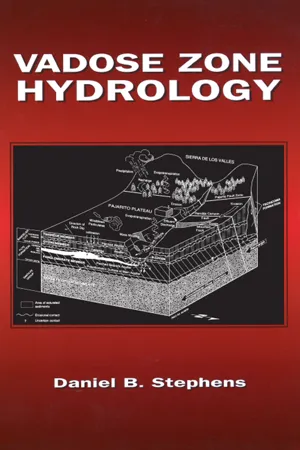 eBook - ePub
- Daniel B. Stephens(Author)
- 2018(Publication Date)
- CRC Press(Publisher)
CHAPTER 2Soil-Water BudgetIn the previous chapter, we discussed the general nature of the vadose zone, as well as fluid flow and storage characteristics. For many problems, it is important to develop an accounting system to track additions, depletions, and changes of water storage in what is referred to as a water balance or water budget. A water budget is an equation of water mass conservation for a particular volume or region. In hydrology, one can derive a water budget for a surface water body, watershed, aquifer system, or vadose zone. These regions are clearly linked together, inasmuch as the output from one becomes the input to another.This chapter presents an overview of the major components of a vadose zone water budget or what soil scientists refer to as a soil-water budget. This overview sets the stage for more detailed discussions in the subsequent two chapters of some of these soil-water budget components that are most important in hydrogeologic investigations.The general equation for the soil-water budget is derived by considering the mechanisms by which water can enter, exit, or be stored in a predefined region of the vadose zone. For many problems, the inflow across the upper boundary of the vadose zone is infiltration, while outflow from the upper boundary is evaporation and transpiration, and outflow from the lower boundary is groundwater recharge. Net inflow (inflow minus outflow) must equal the change in soil water stored in the vadose zone. In the soil-water budget equation, for a discrete time interval, we add flows due to processes that contribute water to the vadose zone, subtract discharges and water losses, and equate this to changes in the water stored in the soil volume:I − E − T − R = Δ S(1)where I is infiltration, E is evaporation, T is transpiration, R is deep percolation or recharge (all four variables in units of L3 T−1 ), and AS represents the change in water storage over the time interval Δt. The horizontal area in Equation 1 is problem dependent, but usually one can deal with a unit cross-sectional area (in plan view). One can divide both sides of the equation by the area, and express the water-budget components on the left-hand side as fluxes, rates, or specific discharges having units of LT−1 eBook - PDF
Water for Agriculture
Irrigation Economics in International Perspective
- Stephen Merrett(Author)
- 2003(Publication Date)
- CRC Press(Publisher)
Chapter 7 Water allocation at the regional scale 7.1 A thought experiment Imagine for a moment that you have the power, given by God or science, to observe over a full year in any region of the world each and every molecule of water appropriated by human society ('input' molecules). Imagine too that in that region in that year you can observe how each such molecule is used within human society or lost to it ('output' molecules). An extraordinary gift! You would then be able to deploy a water resource planning tool that I call the region's 'hydrosocial balance' (Merrett 1999b). The hydrosocial balance is applicable to any defined geographic space; the term 'region' is used advisedly because of its inherent ambiguity. A region could be a continent, a country, a province, a catchment, an irrigation district, a city, a village, a large sports facility, or the site of a manufacturing firm such as a sugar mill. The hydrosocial balance is also always applied to a defined time-period. For convenience of exposition it is assumed here that the time-period is the year 2002. Alternatively it could be for the five years 1998-2002, for example, or for the month of August averaged over the 10 years 1993-2002. The hydrosocial balance for a past or present time-period is referred to as a baseline balance', one for a future time-period is a scenario balance. Table 7.1 sets out the generic form of the hydrosocial balance. Let us first consider the supply-side categories. Rainwater collection, groundwater and surface-water abstraction, desalination plant output and the import of water from other regions are all input molecule flows requiring no further commentary. The annual supply they provide can be measured in megalitres per day or millions of cubic metres per year or litres per head per day (lhd) of the resident population. Internal reuse occurs when a household or a factory or any other organization reuses its own wastewater. eBook - PDF
- Reddy, R N(Authors)
- 2021(Publication Date)
- Genetech(Publisher)
Depending on the purpose, water accounting could be done on a seasonal or yearly basis at the entire scheme level and for submanagement units in order to facilitate management decisions. P HYSICAL U NITS WITHIN THE S ERVICE A REA There are many criteria to consider in defining the physical boundaries for an irrigation water balance. A water balance can be conducted for a field, a farm, a submanagement unit, an entire irrigation service area, and a river basin. Whatever the unit of evaluation, it is necessary to define upper, lower and horizontal boundaries of space. Spatial boundaries for a water balance to assist decisions regarding system management and operation would include: the gross service area of the project: often used as the first approach to examine a global water balance; canal hierarchy: main, secondary, tertiary and quaternary; institutional management: federation of WUAs, WUA, farmers organisation. The above criteria can be included in the definition of the water balance. However, one of the more important aspects is pragmatism. Units for the This ebook is exclusively for this university only. Cannot be resold/distributed. water balance should be based on realistic boundaries for which flows can be either measured or estimated with reasonable accuracy. In an ideal situation, a water balance is conducted for the entire irrigation service area and each management subunit in order to allow the managers and operators to make decisions within their own subunits as well as at the entire project/ system level. However, whatever unit is chosen for the analysis, the boundaries must be clearly set and understood. Setting the spatial as well as the temporal boundaries for a water balance is very important. The failure to set these limits properly is often a main reason for errors made in computing water balances. T EMPORAL B OUNDARIES Temporal boundaries are critical when computing a water balance. eBook - PDF
Atmosphere, Ocean and Climate Dynamics
An Introductory Text
- David H. Miller, John Marshall, R. Alan Plumb, J. Van Mieghem(Authors)
- 2013(Publication Date)
- Academic Press(Publisher)
In these cases, the pipeline analogy or more less equally balanced input and output is inappropriate (Nace, 1969). 420 XV. GROUNDWATER AND ITS OUTFLOWS Indeed the budget is the usual concept applied when man starts to develop or manage a body of groundwater, although difficulties are found in procuring accurate quantities for the inflows and outflows. Some bodies of groundwater also are difficult to delimit. Most ground-water bodies, being constantly in a state of changing equilibrium as inflows and outflows fluctuate, present a complex problem in evaluat-ing how they respond to some change in conditions. Nevertheless, a simplified restatement of the budget is useful. Deep percolation of water, when in excess in the soil, or from wetted stream channels or sites of artificial recharge, usually enters the groundwater body only during certain seasons of the year. Day-to-day changes in its rate are in general unknown. It usually carries freight in the form of solutes dissolved from the soil, salts or fertilizers, or urban wastes. The consequent characteristics of the body of cyclic groundwater fed by percolate are thus its chemical or biological quality, its changing volume, and its temperature. These properties can be monitored more easily than the rates of inflow, and from these records we can deduce the health of the groundwater body. One interest in the state of shallow bodies of groundwater lies in the level of the water table, whether it is too close to cultivated land surfaces or whether it is at the right level for wetland plants and habitat. Our other concern with the health of a groundwater body lies with its outflows: will springs dry up, will trout streams dwindle, is well water safe, will pumps have to be reset deeper in the wells, are we pumping too much fresh water and inviting the invasion of salt water? Some of these characteristics come under the heading of off-site yield of water, and are taken up in Chapter XVII. eBook - ePub
Sustainable Water Management in Smallholder Farming
Theory and Practice
- Sara Finley(Author)
- 2016(Publication Date)
- CAB International(Publisher)
8 Reducing farms’ vulnerability to crop damage during dry spells is therefore crucial to providing good yields within the reality of highly variable rainfall. This goal is especially pertinent on purely rainfed farms that depend on unpredictable precipitation patterns, but promoting resilience is also very important on farms where irrigation is practiced. Resilience is intricately linked to the ecological health of the farm and its soils.Goal #2: Producing Higher Yields from Within a Limited Water Budget
In rainfed farming, the farmer has little control over the absolute quantity of water that will be delivered to the field each season. Even when some form of irrigation is in place, the effort required to move water from place to place, coupled with the scarcity of the resource, should motivate farmers to use each drop wisely. Before seeking to increase the amount of water applied to the field, it is important to ensure that the crop is able to efficiently access and use the water that is stored in the soil. This is commonly referred to as producing ‘more crop per drop’. New water inputs and/or investments in irrigation equipment should only be investigated once efficiency is maximized within the existing water budget.Let’s imagine the plant–soil environment as a closed system, where all water INPUTS are transformed into a corresponding amount of water USES. This is similar to a household spending budget, where a fixed income is used to purchase a corresponding quantity of goods and services. Like in a household budget, water inputs must be ‘spent’ wisely so that maximum benefits can be derived from a limited supply. Water stored in the soil is being ‘saved’ for future use.Fig. 2.1 presents a conceptual representation of the farm water budget.Fig. 2.1.Water inputs (dark arrows) and uses (light arrows) in crop production.9Water INPUTS (dark arrows in Fig. 2.1 ) include rainfall/precipitation – (P) and, in irrigated projects, blue water applied as irrigation (IRR). In areas with shallow aquifers, there will also be some input from the capillary rise of groundwater into the root zone (CAP) (Fig.2.2 ).Fig. 2.2.
Index pages curate the most relevant extracts from our library of academic textbooks. They’ve been created using an in-house natural language model (NLM), each adding context and meaning to key research topics.

