History

Irish Immigration
Irish immigration refers to the movement of people from Ireland to other countries, particularly the United States, Canada, and Australia, due to factors such as poverty, famine, and political unrest. The Irish diaspora has had a significant impact on the culture and demographics of these countries, with Irish immigrants contributing to various aspects of society, including politics, literature, and sports.
Written by Perlego with AI-assistance
Related key terms
1 of 5
11 Key excerpts on "Irish Immigration"
- Eugenio F. Biagini, Mary E. Daly(Authors)
- 2017(Publication Date)
- Cambridge University Press(Publisher)
PART III Emigration, Immigration and the Wider Irish World 24.1. Introduction The scale of Irish emigration is extraordinary. Since 1700 about 10 million men, women and children have emigrated from Ireland. That number is more than twice the current population of the Republic of Ireland (4.6 million), it exceeds the population of the island of Ireland (6.5 million), and it is greater than the population of Ireland at its historical peak on the eve of the Great Famine (8.5 million). An estimated 70 million people worldwide claim some degree of Irish descent, including about 40 million Americans who list ‘Irish’ as their primary ethnicity. In approaching Irish emigration from a comparative perspective, three principal frameworks suggest themselves: com- parisons by period, comparisons with other European countries and comparisons by country of destination. 1 The first approach has the virtue of breaking down a long and complex history into distinct chronological periods, revealing the distinctive charac- teristics of each period and thereby countering a pervasive tendency to approach Irish emigration as an undifferentiated whole. The second approach reveals that, although the Irish famine was unique and the late nineteenth century highly distinctive, earlier and later periods of Irish emigration had much in common with their European coun- terparts. The third approach uncovers the nationally specific conditions that shaped the histories of Irish emigrants in their various countries of settlement abroad, once again serving as a corrective against a tendency to homogenise. This chapter will begin by considering the first two approaches together, examining the origins and processes Irish Emigrations in a Comparative Perspective Kevin Kenny 1 One might also compare the experience of the Irish abroad with that of other immigrant groups in the coun- tries of settlement, but this subject lies beyond the scope of the current chapter. 24
- Niall Whelehan(Author)
- 2014(Publication Date)
- Routledge(Publisher)
11Returnees, Forgotten Foreigners and New Immigrants Tracing Migratory Movement into Ireland Since the Late Nineteenth CenturyIrial GlynnMigration has had an enormous impact on Irish society, yet studies of Irish migration are typically outward-looking and focus on the diaspora abroad. This chapter seeks to challenge this tendency by tracing movement into the country from return migrants in the late nineteenth century to new immigrants in the 2000s. Returned migrants shared extensive details of the world they encountered outside of Ireland when they came home and, as a result, ‘helped bridge the cultural gap between Ireland and the urban world. Their speech, clothing, and manners inevitably infected the home population, producing a droll blend of Ireland, Britain, and America’.1 But historians have devoted little time or space to discussing return migration to Ireland, especially before independence, despite the fact that it involved hundreds of thousands of people coming back with firsthand experiences of life in America or Britain. This is partly due to the lack of data and information available, but also because of an assumption that only a minimal number ever returned from across the Atlantic. Surprisingly little is known about the amount of emigrants who came back from the UK during the twentieth century, either. Ireland also has an infrequently referenced but rich immigration history, as will be demonstrated in the second part of this chapter. Just as return migration grew in the second half of the nineteenth century, so too did immigration. Between 1841 and 1911, the amount of British-born people moving to the island more than quadrupled to almost 140,000. The number of residents born outside Ireland or Britain increased sixfold during the same period to nearly 30,000, with Ireland becoming home to more and more American- and European-born migrants at a time when the island’s population was suffering a serious decline. During the 1960s and 1970s, another notable rise in British and European immigration occurred in the Republic of Ireland. These trends, however, paled in comparison with what occurred from the late-1990s onwards. Over a very short period of time Ireland came to contain a larger proportion of immigrants than many Western European countries that had experienced considerable immigration for fifty years or more. By 2011, an astonishing 17 per cent of the population had been born abroad.2 eBook - PDF
Migration and Immigration
A Global View
- Maura I. Toro-Morn, Marisa Alicea, Maura I. Toro-Morn, Marisa Alicea(Authors)
- 2004(Publication Date)
- Greenwood(Publisher)
The most significant factor in shaping Ire- land's violent history has been its proximity to the larger and more powerful island nation to the east, Great Britain. Ireland has, however, retained a distinct culture and in the more recent past, as immigration gave way to emigration, its people have carried those ideas to many parts of the world, particularly to North America. This, and most other major historical events in Ireland, can be traced to the various migration patterns into and out of Ireland over the years. The use of the word "nation" in the Irish context is fraught with difficulty. On the one hand a sizable number of people living in Northern Ireland, who are indeed Irish people, are intractably opposed to the idea of Irish nationalism and would rather see themselves as British. On the other hand there is a diaspora of over 50 million people around the world—10 times the total population of the island of Ireland itself—who see themselves in various ways as being Irish. This diaspora is the result of centuries of emigration motivated by political strife, the search for religious freedom and, since the middle of the nine- teenth century, harsh economic conditions and even survival itself. Ireland has been much more a sender of emigrants than a receiver of them, although it was the colonization of Ireland by England that brought about the social conditions that caused this enormous exodus. HISTORY OF MIGRATION ISSUES The history of migration into and out of Ireland goes all the way back to the first people who migrated there. About 5,000 years ago people crossed over from what is now Scodand and established themselves in the very northeastern part of Ireland. These first farmers colonized the northern half of the island, as evidenced by the "court-cairns" they built as burial chambers, whose ruins still abound. eBook - ePub
- Bryan Fanning(Author)
- 2021(Publication Date)
- Indiana University Press(Publisher)
SIX EMIGRATIONSFrom the early eighteenth century until the late twentieth century, most of the migration that affected Ireland was emigration. The population of Ireland doubled from 2,000,000 in 1672, to 4,000,000 by 1788, and again to 8,000,000 by 1841, by which time a further million had emigrated to North America. This period of population growth also witnessed ongoing emigration and to a considerable extent emigration patterns were shaped by religiosity with Protestants more likely to be able to afford the passage to North America until ocean travel became significantly cheaper during the nineteenth century. During the eighteenth century between one-fifth and one-quarter of Irish emigrants to the New World were Catholic, while between three quarters and four fifths were Protestant.1 From 1845 to 1855, that is, during and after the Great Famine, Catholics made up 90 per cent of emigrants. During this ten-year period, an estimated 2,100,000 emigrated. Between 1856 and 1921 a further 4,400,000 departed. Of these, 80 per cent were Catholics. In the years between 1815 and 1900 about 7,720,000 in total emigrated from Ireland. The biggest portion, some 4,765,000, migrated to the United States; 1,468,000 went to mainland Britain; 1,057,000 to British North America (what became Canada); 361,000 to Australia and New Zealand; 35,000 to Africa; and about 34,000 to other parts of the world, including South America.2Post-1700 patterns of emigration reflected religious, cultural, political, and economic divisions in Ireland, and reproduced elements of these in some host countries. Donald Akenson, in his introduction to The Irish Diaspora, made the case for seeing past such divisions in trying to define who was Irish:The answer is clear: anyone who lived permanently within the social system that was the island of Ireland. This includes Catholics and Protestants, Kerrymen, Ulstermen, descendants of Norman invaders and of Scottish planters as well of earlier Celtic invaders, speakers of English as well as speakers of Irish Gaelic. That there were during the nineteenth and early twentieth centuries complex political arguments about what was the proper definition of Irish nationality is here irrelevant. It matters not if an individual was (for example) a Catholic whose family during the penal times turned Protestant: he or she was Irish. It does not matter if the person was the descendent of some Norman soldier whose family had Hibernicised and become more Irish than the Irish they conquered: he or she was Irish. It matters not if the individual came by descent from one of the Cromwellians or from the Confederacy soldiers whom Cromwell defeated: she or he was Irish. Ireland was a political and social system and Ireland formed everyone who lived in it. They could hate Ireland, love it, hate each other, it mattered not. They were of Ireland: hence Irish.3 eBook - ePub
Irish Global Migration and Memory
Transatlantic Perspectives of Ireland's Famine Exodus
- Marguerite Corporaal, Jason King(Authors)
- 2018(Publication Date)
- Routledge(Publisher)
8 More broadly, this special issue seeks to explore the global currents of the Irish Famine migration across the Atlantic and Pacific rims, and to comparatively examine the collective experiences of the Famine Irish in terms of their community and institution building; cultural, ethnic, and racial encounters with members of other groups; and especially their patterns of mass migration, integration, and remembrance of their traumatic upheaval by their descendants and host societies. The disruptive impact of their mass-arrival had reverberations around the Atlantic world. As an early refugee movement, migrant community, and ethnic minority, Irish Famine emigrants experienced and were recollected to have faced many of the challenges that confronted later immigrant groups in their destinations of settlement.Thus, the emphasis here is on the Famine Irish because they are both historical agents of traumatic mass migration and iconic “figures of memory.”9 In a speech delivered at the dinner of the St. Patrick’s Society, Toronto, on 17 March 1860, William Halley called the Irish the “Ishmaelites of the earth – wanderers everywhere – discovered ‘quite at home’ under the burning sun of the tropics – happy in the frozen regions of the globe.” Wondering where “the ‘exiles’ have not penetrated,”10 Halley examines the massive outflow of Irish men and women during the Great Hunger and its immediate aftermath. Ireland’s An Gorta Mór (1845–1852) – a period of mass starvation – caused by a wide-scale potato pestilence and resulting in the eviction of numerous impoverished tenants which exacerbated tense relationships between the country and the imperial London Government11 – led to a dramatic exodus of emigrants. These, as novelist Thomas O’Neill Russell suggested in 1860, were “flying away from the beautous isle as though it were the hot-bed, the birth-place of some cursed plague that fastened with deadly gripe upon its victims.”12 eBook - ePub
Women, Gender and Labour Migration
Historical and Cultural Perspectives
- Pamela Sharpe(Author)
- 2002(Publication Date)
- Routledge(Publisher)
11 Lastly, Britain rather than the United States became the principal destination for Irish migrants in the twentieth century. Prior to the onset of the Depression in 1929, the United States was the preferred destination for most Irish migrants with a smaller but substantial flow travelling to Britain. However with the gradual lifting of the Depression in the mid- 1930s, Irish migrants opted to travel to Britain with increasing regularity.Estimates indicate that over 80 per cent of Irish migrants travelled to Britain in the postwar period until 1971: thereafter the choice of destinations became more varied.12Patterns and profile
In 1921–1922 the twenty-six counties of the Irish Free State became an independent state. Whilst annual migration statistics had been published under the British regime, no such data were collected by the Irish authorities and therefore we have to rely on intercensal estimates of net migration.13 Whilst these estimates provide rather static snapshots, they are useful in gauging the scale of migration from twentieth-century Ireland (see Table 11.2 ). In general terms, Irish migration registered peaks in the mid-1930s, in the war years and late 1940s, and throughout the 1950s (see Table 11.2 ).14 In the mid-1930s, Irish emigration increased as opportunities for employment became available in Britain, particularly in the ‘new’ industries located in the south-east of England. The outbreak of war in September 1939 resulted in restrictions being imposed on Irish citizens wishing to travel to Britain, but during the war, the Irish and British authorities concluded an informal labour transfer arrangement whereby Irish citizens were for the first time officially recruited for employment in Britain. Some 150,000 Irish citizens travelled to Britain during the war under these arrangements and this migrant labour played an important role in wartime civilian industries.15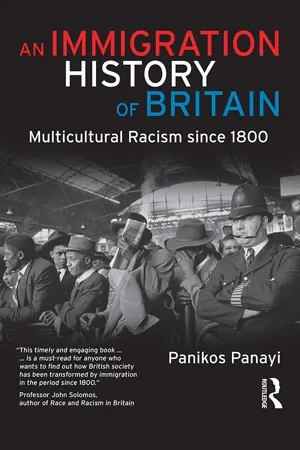 eBook - ePub
An Immigration History of Britain
Multicultural Racism since 1800
- Panikos Panayi(Author)
- 2014(Publication Date)
- Routledge(Publisher)
4In the period between c.1800 and 1945 the overwhelming majority of migrants to Britain therefore originated in Europe. In fact, most of them came from Ireland. While the crisis caused by the Great Irish Famine of the 1840s may have sent over two million people abroad between 1847 and 1855, 300,000 of whom moved to Britain,5 this phase simply represents the tip of the iceberg in terms of both migration out of Ireland and towards Britain. Between 1815 and 1930 around 7.3 million people left Ireland.6 Although the majority ventured to North America, a significant percentage moved to Britain. The global figure probably excludes the seasonal agricultural labourers in Britain throughout the nineteenth century,7 but it would include the regular flows of migrant labour, which moved to and settled in British cities before, during and after the Great Famine. If we use the research of Donald Macraild, Cormac Ó Gráda and Enda Delaney, it would seem that about 1.5 million people made their way from Ireland to Britain in the years 1815–1945.8This meant that throughout the century and a half between 1800 and 1945 Ireland remained the most important source of migrants to Britain in purely numerical terms. Before 1945 a series of other migratory movements from the European continent also occurred, but on a significantly smaller scale. The largest consisted of Jews. For much of the nineteenth century a slow trickle originated predominantly from two areas. First, a maximum of about ten thousand mostly middle class German Jews. In addition, a steady stream of perhaps 15,000 migrants of more humble social origins moved from the Pale of Settlement established by the Russian monarchy in the eighteenth century to ghettoize its Jewish population in the western half of its territories.9 If an equivalent of the Great Irish Famine occurs in Jewish migration history before 1945 then it actually happens twice, as a result of two explosions in antisemitism. The first wave out of the Pale of Settlement takes place between c.1880 and 1914 when 3 million people may have left ‘oppression and poverty in Tsarist Russia’. As many as 2.5 million may have made their way to the USA during these years, with 150,000 settling in Britain.10 Only a few thousand Jews moved to Britain between 1914 and the early 1930s due to the First World War and the introduction of tight immigration controls.11 However, Nazi antisemitism during the 1930s led to a second Jewish refugee crisis which may have caused as many as 300,000 people to emigrate.12 Despite the fact that the British government and public opinion displayed considerable hostility to the idea of an influx of refugees, 78,000 lived in Britain by the time the War broke out.13 Few Jews made it to Britain during the conflict, as the government made no concrete efforts to save Holocaust victims.14 Even at the end of the War, antisemitism, which had always played a large role in determining immigration policy towards foreign Jews, meant that only a few hundred survivors of Nazi polices entered Britain.15 In fact, little Jewish immigration has occurred in the years after 1945 as the Israeli state has attracted the vast majority of Jews leaving the European continent. About 2,000 moved to Britain from the Hungarian Revolution of 1956, together with a similar number fleeing Egypt during the Suez crisis and a few others moving from Aden after 1967. However, as many as 75,000 Israelis may have recently settled in Britain.16 Over thirty thousand Jews have left Britain for Israel since 1948, although some of these have returned.17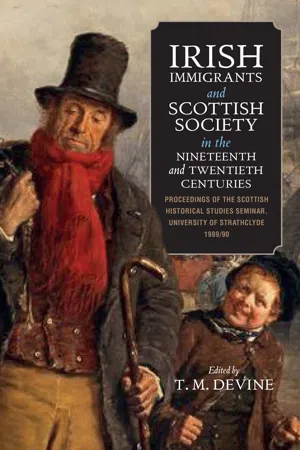 eBook - ePub
Irish Immigrants and Scottish Society in the Nineteenth and Twentieth Centuries
Proceedings of the Scottish Historical Studies Seminar, University of Strathclyde, 1989/90
- Tom M. Devine(Author)
- 2001(Publication Date)
- John Donald(Publisher)
1The Origins of Irish Immigration to Scotland in the Nineteenth and Twentieth CenturiesBrenda Collins IIn this chapter the movement of the Irish to Scotland over the nineteenth and early twentieth centuries is viewed as part of overall Irish emigration. Over 8 million men, women and children emigrated between 1801 and 1921.1 Some members of almost every generation born in Ireland during the nineteenth century left their native land. Emigration became part of the expected cycle of life; growing up in Ireland meant preparing to leave it.What was significant about the movement to Scotland? Throughout most of the 80 years down to 1921 for which even vague counting is possible, approximately 8 per cent of all Irish-born emigrants went to Scotland. However, virtually all English-speaking countries throughout the world experienced some Irish settlement. Within the British Isles, Irish settlement in Scotland showed some tendencies which were different to the overall emigration pattern. Leaving aside differences in areas of origin, the actual level of movement to Scotland remained much more consistent than it did to England and Wales. Whereas in the latter the numbers of Irish-born dropped steadily down to World War I, in Scotland in 1901 there were 205,000 Irish-born, similar to the 207,000 of half a century earlier. This implies that the stream of fresh Irish migrants to Scotland continued for each generation (apart from a slight downturn in the 1880s). The new arrivals fresh from across the Irish Sea added undiluted peasant elements to the partly assimilated groups of descendants of earlier Irish immigrants and together they formed a major force in modern Scottish society.2One aspect about which all theorists on Irish emigration have been agreed has been its connections with Irish population growth. This chapter is therefore divided into three main sections covering patterns of demographic and economic change in Ireland up to the 1840s, from the 1850s to the 1870s, and from the 1880s to the 1920s. Throughout the nineteenth century Ireland remained an agrarian country. During that time the population rose from perhaps 6 million in 1801, to 8 million in 1841, and by 1901 it had fallen to just under 4.5 million. During the twentieth century, the population of the whole of the island continued to decline to under 4.3 million in the 1920s and 1930s. Emigration since the Second World War has declined. In 1981, the population of the whole island was 4.9 million of which approximately one third lived in Northern Ireland. eBook - PDF
- Patrick Fitzgerald, Brian Lambkin(Authors)
- 2008(Publication Date)
- Palgrave Macmillan(Publisher)
It had nothing to recommend it … But I had got away. That was my victory’ (1976, 126–7; for comparison with Brian Moore’s arrival in Liverpool, see Dawe 2007, 99–100; Delaney 2007, 10–11). For how many has the experi- ence of arriving in ‘Celtic Tiger’ Ireland at the end of the twentieth and in the early twenty-first century been similar? A Three-Stage Process 33 3 A Three-Way Process: Immigration, Internal Migration and Emigration The overview of migration in Irish history as a three-stage process given in the previous chapter featured emigration more than immigration because over these 400 years it has been the dominant direction of flow. However, it is important to realise that the leavings, crossings and arrivals of Ireland’s emigrants, from Hugh O’Neill to Edna O’Brien, have been paralleled by those of its immigrants. Migration is not simply a one-directional process of movement between a sending society and a receiving society, but rather a two-directional process: few if any sending societies receive no return migrants or new immigrants – even in the worst year of the Great Famine, as we shall see in chapter 10, Ireland received some; and few receiving societies, such as France, send no emigrants. Addi- tionally, in both predominantly sending societies and predominantly receiving societies, there is internal migration. While it is true that migrating within a country generally involves fewer practical difficulties and much less physical hardship and emotional intensity, internal migration differs from international migration in degree rather than in kind. Not only does it have the same three- stage structure and involve similar practical, physical and emotional challenges, internal migration also affects and is affected by both immigration and emigration. eBook - ePub
The genesis of international mass migration
The British case, 1750-1900
- Eric Richards(Author)
- 2018(Publication Date)
- Manchester University Press(Publisher)
In the British case there is a crucial question about the extent of internal mobility in the home context, studied most influentially by Clark and Souden. At first glance it seems unlikely that a traditionally stable and immobile population would, at one fell swoop or in a series of shifts, lift itself and launch overseas, as though from a standing start. One might expect a society or district to embark on the emigration project only after some psychological and practical preparation – an acclimatising to the process of mobility – a seasoning in the act. Emigrants would already be experienced in mobility, familiar with the idea, habituated to a degree.There is indeed a substantial body of evidence, in several locales, of internal migration accelerating and expanding ahead of, and parallel with, the emergence of large-scale overseas emigration. Moreover the habituating of mobility within the population spurred the process at large – so that after arrival in the receiving communities abroad, the immigrant population struck out further – renewing the momentum of migration in the new world – with further steps of internal mobility. There was an extended continuum of migration, with phases of pre-emigration, emigration and post-emigration. And the process became more complicated by means of chain migration – each successive wave of migrants paving the way for the next, facilitating and financing the inter-generational movements of emigrants – which may have begun by a model of internal migration. This is clearly part of the search for a line of causation in the panorama of emigration.A central question flowing from the enhanced general mobility of the modernising population was their accommodation and their ultimate destination. What provision, if any, was made for extruded labour from agrarian transformation? In parts of mid-eighteenth-century Scotland elaborate efforts were made to establish new ‘improvement’ villages for their reception, with considerable, though mixed, success.27 eBook - PDF
Fathers and Sons
Generations, Families and Migration
- J. Brannen(Author)
- 2016(Publication Date)
- Palgrave Macmillan(Publisher)
4 Contexts and Experiences of Migration Our analysis in this study suggests that the ways in which migration is experienced over time challenges the categorical term of ‘migrant’ (Griffiths et al., 2013) and makes visible migration as a process rather than as only a status of destination. Kofman (2004) argues that migra- tion is rarely about individual decision making but is life course and life event related and is not simply a direct response to economic forces. Migrants travel to join established groups of settlers, while maintaining links with their countries of origin. We have therefore employed the term migration rather than emigration in the book. The former implies ongoing movement, contact and communication while the latter term suggests the notion of break or rupture and no return to country of origin (Fortier, 2000). Migrant groups are typically studied in isolation and at particular moments in time. However, in understanding migration as an expe- rience much is to be gained by a comparative approach that looks at migrants in different historical periods and across the life course. In this chapter, we compare two migrant groups, one from Ireland and one from Poland. The two groups came to Britain in different historical peri- ods, the Irish grandfathers between 1945 and the late 1960s and the Polish fathers in the 2000s. In comparing Irish and Polish groups in this study it has not been our intention to suggest that they are similar. For one thing, the groups of migrants we studied were at different life course phases when they migrated. The Irish came when they were young and single while the Poles were older and in this study already fathers. At interview, the two groups were members of different family generations. The Irish were grandfathers, a critical feature of the study being to demonstrate how being Irish in Britain is a multigeneration phenomenon. 48
Index pages curate the most relevant extracts from our library of academic textbooks. They’ve been created using an in-house natural language model (NLM), each adding context and meaning to key research topics.

