History

Stamp Act
The Stamp Act was a British tax law imposed on the American colonies in 1765, requiring them to pay a tax on all printed materials, including legal documents, newspapers, and playing cards. This act was met with widespread opposition and protests in the colonies, as it was seen as an infringement on their rights and autonomy, ultimately contributing to the tensions that led to the American Revolution.
Written by Perlego with AI-assistance
Related key terms
1 of 5
10 Key excerpts on "Stamp Act"
 eBook - PDF
- John E. Findling, Frank W. Thackeray, John E. Findling, Frank W. Thackeray(Authors)
- 2010(Publication Date)
- ABC-CLIO(Publisher)
Gov. Thomas Hutchinson. Although Hutchinson had written his superiors in London against the Stamp Act, he publicly announced that the colonists must comply with the legislation once it had been passed, thus prompting the attack on his house. Similar riots occurred throughout the colonies, particularly in New York City, as mobs forced stamp commissioners to resign their offices. DOCUMENT: RESOLUTIONS OF THE Stamp Act CONGRESS, 1765 In , the British enacted the Stamp Act, which required the use of stamped paper for newspapers and a variety of other legal and commercial papers. The act also vested enforcement authority in courts of admiralty, which oper- ated without juries. After a number of states protested, representatives from nine of them (Massachusetts, Rhode Island, Connecticut, New York, New Jer- sey, Delaware, Pennsylvania, Maryland, and South Carolina) met in New York at what became known as the Stamp Act Congress. The colonists drew up resolutions that opposed the British actions and called for their repeal. Few British acts aroused as much co- lonial resentment as the Stamp Act of 1765, as revealed in this print showing colonists making a tax collector’s life miserable. (Courtesy of the National Ar- chives and Records Administration.) THE Stamp Act, 1765 111 Although the colonial protests eventually brought about the repeal of the Stamp Act, Parliament reaffirmed its authority in the Declaratory Act and subsequently enacted a wide variety of taxes in the colonies with the Townsh- end Acts (). Ultimately, the colonists’ denial of parliamentary authority and their outrage over the abuses of their rights would lead to the outbreak of the American Revolution. eBook - PDF
The Intellectual Life of Edmund Burke
From the Sublime and Beautiful to American Independence
- David Bromwich(Author)
- 2014(Publication Date)
- Belknap Press(Publisher)
190 • IV • The American War I n 1763, the chancellor of the exchequer and new chief minister of England, George Grenville, looked hard at the Treasury books and saw that the cost of collecting taxes from America was greater than the reve-nue. To bring in more money, he persuaded the House of Commons of the utility of the Stamp Act; and it was passed by Parliament on March 22, 1765, with a strong majority in the House of Commons and unanimity in the House of Lords. The objects of the Stamp Act were to pay for the Canadian war and to reassert British control in the American colonies— neither of them necessarily offensive or controversial ideas. But the condi-tions of supervision and collection were onerous and new. Paper used in legal documents and newspapers had now to be embossed with a revenue stamp, and payment was made through colonial stamp distributors. At-torney licenses took the highest of the enumerated taxes; also taxed were magazines, packs of cards, and dice. This was an “internal” tax and to that extent intrusive, levied for the express purpose of regulating the activities of the colonists. To the radical Americans, who followed British politics closely, these exactions from Grenville might have seemed predictable and to have promised worse to come. Grenville had supported the gov-ernment against Wilkes on the question of general warrants. The colonists struck back with pamphlets and protests, not only against the new tax but against all involuntary taxation. Grenville had tried to soften the blow by choosing established men as stamp distribu-tors, but they were subjected in America to mobbing and intimidation. The house of Thomas Hutchinson, the governor of Massachusetts, was sacked and his library burned. The peace of the colonies was broken by a summer of riots; and the Stamp Act was a dead letter by November. No-body could be found to enforce the law, and nullification spoke louder than any reply. eBook - PDF
Taxes on Knowledge in America
Exactions on the Press from Colonial Times to the Present
- Randall P. Bezanson(Author)
- 2015(Publication Date)
- University of Pennsylvania Press(Publisher)
We will turn first to the English tax, for while it fol-lowed the colonial taxes, it flowed directly from the English Stamp Acts that have just been discussed. Thereafter we will turn to the taxes imposed by 56 Chapter 2 the colonies of Massachusetts and New York to fill out the picture. We will finally conclude with some tentative and general conclusions about the his-tory of stamp taxation through both the English and colonial experiences. THE ENGLISH STAMP TAX In 1765, when the Crown extended the stamp tax to the American colonies, the ultimate demise of the English knowledge taxes was far from obvious, but revenue was by then coming to serve as a more significant (though not exclusive) object of the taxes. With the new taxes imposed on the Colonies, revenue seems clearly to have been the chief object. But an additional element was present as well: a challenge to the legal authority of the mother country. The Seven Years' War, which had extended to the American continent, was not only responsible for increased stamp duties in England, it also provided the occasion for what would become in 1765 an act of Parliament establishing a stamp and advertising tax in the American colonies. 1 The stamp tax was set at one halfpenny on every newspaper and pamphlet of a half sheet or less, and one penny per sheet for each publication up to six sheets in size. Publishers of almanacs and calendars were required to pay a stamp duty of fourpence for every copy. The advertisement tax required that two shillings be paid on every advertisement appearing in a newspaper or pamphlet. 2 Stamp offices were established in each of the American colonies. While the tax lasted less than a year, the history of violent opposi-tion in the Colonies which forced its repeal on May i, 1766, is highly instructive. The stamp tax of 1765 had a very different origin, and served very different purposes, than the Stamp Act of 1712 and its progeny. eBook - PDF
- Dorothy Volo, James M. Volo(Authors)
- 2003(Publication Date)
- Greenwood(Publisher)
Soon even the common people began to denounce taxation without representation, and they spoke openly of supporting the rights of Englishmen, of defending American liberties, and of government by the consent of the governed. The argument over specific regulations and taxes had quickly evolved into an all-out battle concerning constitutional principles. The Stamp Act Congress In October 1765, a Stamp Act Congress met in the city of New York with representatives from nine colonies in attendance. The congress pre- pared a resolution, which it sent to King George III and Parliament, requesting the repeal of the Stamp Act and the revenue acts of 1764. The petition also asserted that the basic rights of the colonials had been vi- olated by Parliament's attempt to tax them without their consent. Many merchants pledged not to import English goods until the laws were re- pealed, and those who did not pledge faced open intimidation by the mob. Nonetheless, one month later, the Stamp Act took effect. In some col- onies business was suspended. In others the law was ignored. Almost everywhere colonists refused to use the stamps. Those Stamp Act agents who had not already resigned, hid in their homes and refused to appear in public. In Massachusetts, many fled to the protection of British troops Taxation Without Representat in Boston. In New York, violence broke out when a mob gathered to burn the royal governor in effigy and harassed the troops with a sur- prising lack of regard for their own safety. Several homes were invaded and looted. Windows were broken and fires were set in the streets. Only the restraint practiced by the regulars and their officers prevented an exchange of gunfire. Sons of Liberty Popular organizations, called Sons of Liberty by British Colonel Isaac Barre in a speech before Parliament, had been formed almost everywhere in the colonies by 1765. eBook - PDF
Roger Sherman
Signer and Statesman
- Roger Sherman Boardman(Author)
- 2017(Publication Date)
67-68 fji. (ed. 1834). Ingersoll finally, in January 1766, after receiving threatening letters, pub-licly renounced the office under oath and forwarded his resignation to the English authorities. Distributors in all the other colonies had acted similarly. THE Stamp Act CONGRESS 89 would make common cause. 17 Christopher Gadsden, delegate from South Carolina, expressed the closer bond in his well-known phrase—no New England man, no New-Yorker, but all of us Americans. 18 Only nine colonies were represented, but Virginia and the other absentees were all known to be in sympathy with the purpose of the gathering. A dignified pro-test was made through petitions to the Crown and both houses of Parliament, and a declaration of the rights and grievances of the colonists was drawn up—four excellent state papers. The rights of levying their own taxes and of trial by jury were asserted; the Stamp Act and the Revenue Act of 1764 were condemned; but no threats were uttered. Though Con-necticut's delegates had been forbidden to sign these papers, they were indorsed by her Assembly in its regular fall session. At this session also a resolution was passed that no business requiring stamped paper should be transacted in the colony during the coming winter. v On November 1 the Stamp Act went into effect—nominally. The preceding day Governor Fitch, in the presence of such members of the Council as would remain to countenance the rite, had most reluctantly taken the oath required of all the governors to enforce the act. It was to cost him dear. On the fateful morning New Haven's bells were all tolling—from church, state house, and college came the doleful music; the churches had proclaimed it a day of fasting. A copy of the Stamp Act was placed in a small coffin and ceremoniously buried. From that date no courts sat except for criminal cases, for civil court proceedings could only be legalized by the use of stamps. eBook - PDF
Revolution Against Empire
Taxes, Politics, and the Origins of American Independence
- Justin du Rivage(Author)
- 2018(Publication Date)
- Yale University Press(Publisher)
(Courtesy of the Lewis Walpole Library, Yale University) t h e r i s e an d fa l l o f t h e s ta m p ac t 139 had a world-class bureaucracy in place to collect revenue at the point of production. 119 If a textile worker in Norwich had more money to buy soap because of the growing colonial market, Britain’s tax receipts would rise, regardless of whether Americans paid stamp taxes or not. Additional imperial trade meant more money for both British manufacturers and for the British state. The Stamp Act meant less for both. In addition to their strong economic and fiscal arguments, radical Whigs in Parliament took a constitutional position that echoed the one being made across the Atlantic. They declared that parliamentary taxation was a violation of colonial rights that had long held the empire together. 120 Pitt insisted that the House of Commons “had no right to lay an internal tax upon America, that country not being represented.” And he drew a distinction between legislation and taxation, arguing that taxes are “a voluntary gift and grant of the Commons alone.” This was exactly the opposite position of authoritarian reformers, and his brother-in-law Grenville would have none of it. Rising in response, the former prime minister countered that the colo-nies had “grown to disturbances, to tumults, and riots.” If Pitt and his radical friends had their way, government would effectively be “dissolved,” and America would tip from near “rebellion” into “revolution.” Pitt responded to these assertions by saying that he “rejoice[d] that America . . . resisted.” The polarized politics of taxation and empire were on full display, as was the increasingly marginal position of establishment Whigs and their principles. eBook - PDF
The Brief American Pageant
A History of the Republic
- David Kennedy, Lizabeth Cohen, Mel Piehl, , David Kennedy, Lizabeth Cohen, Mel Piehl(Authors)
- 2015(Publication Date)
- Cengage Learning EMEA(Publisher)
While flags flapped at half-mast, the law was openly and flagrantly defied—or rather, nullified. Britain was hard hit. Merchants, manufacturers, and shippers suffered from the colo-nial nonimportation agreements, and hundreds of laborers were thrown out of work. Loud demands converged on Parliament for repeal of the Stamp Act. But many of the members could not understand why 7.5 million Britons had to pay heavy taxes to protect the colonies, whereas some 2 million colonists refused to pay for only one-third of the cost of their own defense. After a stormy debate, Parliament, in 1766, grudgingly repealed the Stamp Act. But in virtually the same breath, it provocatively passed the Declaratory Act , reaffirming Par-liament’s right “to bind” the colonies “in all cases whatsoever.” The British government thereby drew its line in the sand. It defined the constitutional principle it would not yield: absolute and unqualified sovereignty over its North American colonies. The colonists had already drawn their own battle line by making it clear that they wanted a measure of sovereignty of their own and they would undertake drastic action to secure it. The stage was set for a continuing confrontation. The Townshend Tea Tax and the Boston “Massacre” Control of the British ministry was now seized by the gifted but erratic Charles (“Cham-pagne Charley”) Townshend, a man who could deliver brilliant speeches in Parliament even while drunk. Rashly promising to pluck feathers from the colonial goose with a minimum of squawking, he persuaded Parliament in 1767 to pass the Townshend Acts . The most important of these new regulations was a light import duty on glass, white lead, paper, paint, and tea. Townshend made this tax, unlike the Stamp Act, an indirect customs duty payable at American ports. Flushed with their recent victory over the stamp tax, the colonists were in a rebellious mood. eBook - ePub
Chatham's Colonial Policy
A Study in the Fiscal and Economic Implications of the Colonial Policy of the Elder Pitt
- Kate Hotblack(Author)
- 2023(Publication Date)
- Routledge(Publisher)
Chapter XVI The Stamp Act“The true cause of the discontent of the Americans has arose from the rigour and hardship of the Stamp Act. It stands upon a principle that it is politic to call upon the plantations to pay a perpetual revenue and tax in aid of the Mother Country.“Now the true connection between the colonies and Great Britain is commercial.”—Lord Camden, in the debate in the House of Lords on the second reading of the Bill for the Repeal of the Stamp Act, March 11, 1766.The Stamp Act is the supreme test of Pitt’s economic theories and colonial policy. In the early months of 1766 he spoke with unrivalled knowledge and mature judgment. His generous behaviour after the events of 1761 had given men confidence in his criticisms. No longer could he be accused of desiring to embarrass the party in power for private ends. His personal ambition was half satisfied and consciously limited. During the last years of the reign of George II, Pitt had ruled a kingdom and won an empire. After 1761 he knew that he could never regain the position he had lost. Sir William Pynsent’s bequest had removed that desire for the emoluments of office which might have influenced Pitt as husband and father. Finally, the disease which often crippled his limbs had not yet impaired the vigour of his intellect. Unshackled by office, party, or faction, Pitt spoke with the scientific detachment of an expert. The dictum of 1766 must not be confused with the rhetoric of 1739.The Stamp Act problem was one which could only be solved by a statesman who possessed an intimate knowledge of American affairs. It was no petty quarrel over colonial liability for the war debt, but a question which concerned the fundamental principles of the complicated commercial and political systems by which England governed her plantations. There is as much history as politics in most of the Stamp Act speeches; they abound in references to charters and appeals to precedents. This line of argument appears at first to obscure the real points at issue ; but though pedantic in form it is scientific in spirit, for the quarrel between Great Britain and her colonies started when the Mayflower sailed from Plymouth. The New Englanders owed both the strength and the weakness of their provincial character to early adversity. Driven from one country by religious bigotry, they suffered bitterly while wresting homes from the hostile inhabitants of another. The descendants of the Pilgrim Fathers were not the sons of good citizens, but of men who had worked out their own political salvation. A sturdy race developed self-reliant but suspicious, narrow with the zeal of conviction. In the eighteenth century, when England began to take a tardy interest in her colonies, she tasted the bitter fruits of ill-treatment and neglect. The suspicions of the colonists made the governor’s work irksome and ineffective ; while the mutual jealousy between the different provinces made any united effort against their common enemies almost impossible. It was the continual sordid struggle over supplies between the colonial assemblies and their governors that induced Sir William Keith to submit a proposal to George II that a revenue should be gained from America by a tax on stamped paper. Sir William Keith had been Deputy-Governor of Pennsylvania for many years, and the “Short Discourse on the present state of the Colonies in America with respect to the Interest of Great Britain,”1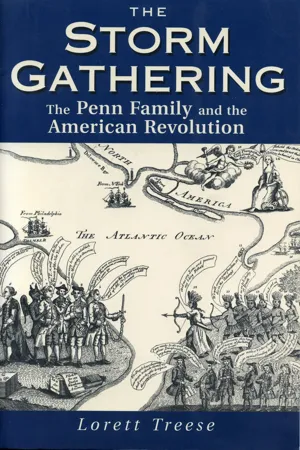 eBook - PDF
The Storm Gathering
The Penn Family and the American Revolution
- Lorett Treese(Author)
- 1992(Publication Date)
- Penn State University Press(Publisher)
Thomas Penn testified that the colonies needed a certain amount of paper money and suggested that the legislation be deferred to let the colonies consider its impact.2 Although Pennsylvania merchants were already complaining about poor trade and scarce hard cash, the Sugar Act and reports of other possible revenue measures failed to arouse much early protest in Pennsylvania. In September 1764 Massachusetts wrote the Pennsylvania assembly to warn of a threat to American rights and suggest that the other coloniesjoin Massachu- setts in remonstrating against this new posture. The Pennsylvania assembly merely instructed Richard Jackson to work with other colonial agents in trying to get the recent legislation repealed.3 During the fall of 1763 and the winter months of 1764, Thomas Penn's "To Prevent a Stamp Duty. .. " 67 letters to his nephew commented on Grenville's latest proposed revenue measure, soon to become the Stamp Act. This legislation would require many legal and public documents to be printed on stamped paper that could be obtained only through distributors or agents when certain taxes had been paid. In principle, Thomas liked the idea of a general, centrally administered tax to fund defense, because it would make it unnecessary for the Pennsylva- nia assembly to raise money and would thus prevent contentions between the governor and the house. He wrote, "This will entirely put an end to disputes about raising Money for the public Services, as an Excise will answer all the purposes of civil Government."4 Although to Thomas Penn the Stamp Act seemed "the most easy of a general tax,"5 he foresaw opposition in America and correctly predicted: "I believe it will be opposed, as an internal Taxation rather to be done by Act of Assembly."6 He stopped analyzing the matter when the issue was postponed for a year while Britain tried to collect the needed money through the Sugar Act.
- John Dickinson(Author)
- 2014(Publication Date)
- Perlego(Publisher)
necessity will subject us, if this act continues in force, to the payment of the duties now imposed.Why was the Stamp-act then so pernicious to freedom? It did not enact, that every man in the colonies should buy a certain quantity of paper—No: It only directed, that no instrument of writing should be valid in law, if not made on stamp paper, &c.The makers of that act knew full well, that the confusions that would arise upon the disuse of writings would COMPEL the colonies to use the stamp paper, and therefore to pay the taxes imposed. For this reason the Stamp-act was said to be a law THAT WOULD EXECUTE ITSELF . For the very same reason, the last act of parliament, if it is granted to have any force here, will execute itself, and will be attended with the very same consequences to American Liberty.Some persons perhaps may say, that this act lays us under no necessity to pay the duties imposed, because we may ourselves manufacture the articles on which they are laid: whereas by the Stamp-act no instrument of writing could be good, unless made on British paper, and that too stampt.Such an objection amounts to no more than this, that the injury resulting to these colonies, from the total disuse of British paper and glass, will not be so afflicting as that which would have resulted from the total disuse of writing among them; for by that means even the stamp-act might have been eluded. Why then was it universally detested by them as slavery itself? Because it presented to these devoted provinces nothing but a choice of calamities, imbittered by indignities, each of which it was unworthy of freemen to bear. But is no injury a violation of right but the greatest injury? If the eluding the payment of the duties imposed by the stamp-act, would have subjected us to a more dreadful inconvenience, than the eluding the payment of those imposed by the late act; does it therefore follow, that the last is no violation of our rights, though it is calculated for the same purpose that the other was, that is, to raise money upon us , WITHOUT OUR CONSENT
Index pages curate the most relevant extracts from our library of academic textbooks. They’ve been created using an in-house natural language model (NLM), each adding context and meaning to key research topics.

