History

The King's Great Matter
The King's Great Matter refers to King Henry VIII's quest to annul his marriage to Catherine of Aragon in order to marry Anne Boleyn. This led to a significant constitutional and religious crisis in England, ultimately resulting in the break from the Catholic Church and the establishment of the Church of England. The King's Great Matter had far-reaching consequences for the monarchy, religion, and the English Reformation.
Written by Perlego with AI-assistance
Related key terms
1 of 5
5 Key excerpts on "The King's Great Matter"
 eBook - ePub
- Michael A. Winkelman(Author)
- 2019(Publication Date)
- Routledge(Publisher)
Super utroque regis coniugioBetter is a poor and wise child, than an old and foolish King, which will no more be admonished. -Ecclesiastes 4.13Chronicle histories reveal that Henry VIII inhabited a play-world. One reports the King repairing to Cardinal Wolsey’s house for recreation, where “the banquets were set forth with masques and mummeries in so gorgeous a sort and costly manner that it was an heaven to behold. There wanted no dames or damsels meet or apt to dance with the maskers or to garnish the place for the time, with other goodly disports.”1 A contemporary expatiated upon the conceit: “Now the Court of England was like a stage, whereon are represented the vicissitudes of ever-various fortune.”2 Whether canoodling a potential consort or stage-managing a reformative putsch, the monarch was performing a role: a sharp distinction between pageantry and policy did not hold in his universe.Even the major crisis of his reign seems overtly theatricalized, veering haphazardly from bedroom farce to passion play to state tragedy. This was his “Great Matter,” the drawn-out divorce proceedings against Queen Catherine of Aragon so he could wed Anne Boleyn. By 1527 the King had decided his marriage of eighteen years’ duration to Catherine was invalid. She had been married to his older brother Arthur, who died in 1502, months after their wedding. Henry had therefore violated a scriptural prohibition: ‘Thou shalt not uncover the nakedness of thy brother’s wife: it is thy brother’s nakedness” (Lev. 18.16, KJV). To him, their lack of surviving male issue signalled divine disfavor (they had one daughter, Princess Mary).3 In a letter to his agents at Rome dated June 23, 1529, Henry wrote that he needed to be able to remarry, “not only for the exoneration of our conscience, but also for the surety of our succession and the weal of this our realm and people.”4 eBook - ePub
- David G Newcombe(Author)
- 2002(Publication Date)
- Routledge(Publisher)
2 The ‘King’s Great Matter’ It was hardly a surprise when, on 23 May 1533 in the archiepiscopal court at Dunstable, Archbishop Thomas Cranmer pronounced the marriage of Catherine of Aragon and Henry VIII null and void. The king had been agitating for such a decision for the past six years and if that decision would not be made in Rome, then it was now possible in Canterbury. This was no ordinary decision by the archbishop, and the events which led up to it were no less than extraordinary. For in the process of seeking an annulment 1 of his first marriage, Henry VIII had done the unthinkable. The king of England, the ‘Defender of the Faith’, had led the Church in England out of obedience to the Church of Rome. No one except Henry VIII ever really knew when he developed his famous scruples about his marriage to Catherine of Aragon for the first time. His confessor, Bishop Longland of Lincoln, remembered that Henry may have mentioned his misgivings as early as 1522 or 1523. If so, it was a well-kept secret until 1527, when the king informed first Cardinal Wolsey and then Catherine of his concern. Prior to that Henry had been, on the whole, a dutiful husband. At first the marriage appeared to have the qualities of a chivalric romance: in 1513, for instance, Henry had raced home in advance of his army to present his queen with the keys to Tournai and Thérouanne, trophies of the desultory campaign of that summer in northern France. Henry also involved Catherine in affairs of state publicly, and he listened to her advice privately. This is not to say that he was not a king of his times. We know that he had extramarital affairs but, as Professor Elton points out, they were, ‘for a king, almost ludicrously few’. 2 Nevertheless, one illegitimate son, Henry Fitzroy (later created duke of Richmond), was recognised by the king, and another child was suspected of being a royal bastard – William Carey, son of Mary Carey, married sister of Anne Boleyn No longer available |Learn more
- (Author)
- 2014(Publication Date)
- White Word Publications(Publisher)
Traditionally it has been believed that this was Margaret (Madge) but recent research has led to the claim that this was actually Mary. King's Great Matter: 1525–1533 Henry became impatient with Catherine's inability to produce the heir he desired. All of Catherine's children died in infancy except their daughter Mary. Henry wanted a male heir to consolidate the power of the Tudor dynasty. In 1525, as Henry grew more impatient, he became enamoured of a charismatic young woman in the Queen's entourage, Anne Boleyn. Anne at first resisted his attempts to seduce her, and refused to become his mistress as her sister Mary Boleyn had. She said I beseech your highness most earnestly to desist, and to this my answer in good part. I would rather lose my life than my honesty. This refusal made Henry even more attracted, and he pursued her relentlessly. Eventually, Anne saw her opportunity in Henry's infatuation and determined she would only yield to his embraces as his acknowledged queen. It soon became the King's absorbing desire to annul his marriage to Catherine. Henry appealed directly to the Holy See, independently from Cardinal Thomas Wolsey, from whom he kept his plans for Anne secret. Instead, Henry's secretary, William Knight, ________________________ WORLD TECHNOLOGIES ________________________ was sent to Pope Clement VII to sue for the annulment. The grounds were that the bull of Pope Julius II was obtained by false pretences, because Catherine's brief marriage to the sickly Arthur had been consummated. Henry petitioned, in the event of annulment, a dispensation to marry again to any woman even in the first degree of affinity, whether the affinity was contracted by lawful or unlawful connection. eBook - ePub
- G.R. Elton(Author)
- 2018(Publication Date)
- Routledge(Publisher)
VThe King’s Great Matter
1. The Origins Of The DivorceWhen Henry VIII, a few months after his accession, married Catherine of Aragon, he married his brother’s widow: in the momentous story of Henry’s first divorce this is almost the only statement one can make without fear of contradiction from some quarter. Catherine’s previous marriage had put her into a prohibited degree of relationship with her second husband, and the contracting parties had therefore obtained a dispensation from Pope Julius II. Since this original dispensation was so badly phrased as to leave room for much doubt, Julius allegedly satisfied further questions from Spain with an additional letter or brief in which he resolved the doubtful points. The dispensation was not nearly so matter of course as is sometimes assumed; it was a difficult point of theology and canon law whether the pope could in fact dispense in this particular case. For the authority of Holy Writ was involved: Henry’s marriage contravened Leviticus xx. 21, which verse declared that a man who marries his brother’s widow shall be childless.1 It is, however, likely that the papal dispensation would never have been questioned but for the events that followed.The marriage seems to have been a happy one in the early years, but a sad blight rested upon its children. One after another they were still-born or died within a few days of birth; the queen had several miscarriages; and by 1525, when all hope of further issue had to be given up (Catherine was by then forty and there had been no pregnancy for seven years), Henry’s sole heir was a girl, Mary, born in 1516. The Tudor stock was always unhealthy and childbed invariably dangerous in the sixteenth century; but it is not surprising that an amateur theologian and fervent formal Christian like Henry VIII should have remembered the curse in Leviticus. Nor did the doubts arise suddenly. Henry had registered a politic protest as early as 1505 when his father wanted to retain a chance of repudiating the marriage; this had never been altogether forgotten. Catherine was the visible sign of the Anglo-Spanish alliance with which her personal fortunes were always bound up. In the later years of Henry VII she had a very miserable time indeed while her father and father-in-law haggled over her second marriage, and in 1514, when Henry VIII fell out with Ferdinand, he vented his anger on his wife, good husband to her though he commonly was. As early as this, rumours began to circulate that the king was thinking of divorcing the queen.2 These rumours came to nothing, but as the years passed two things combined to revive the king’s early doubts about the validity of his marriage. One was the interest of the realm—the danger of a disputed succession; the other Henry’s own concupiscence—his falling in love with Anne Boleyn. Which of the two played the greater part in settling his determination is a fascinating problem, often debated, but really insoluble. Nor, in the last resort, does it greatly matter, except that with the divorce, and the Reformation that ensued upon it, we enter a field where 400 years after the event historians’ passions are still far from spent.3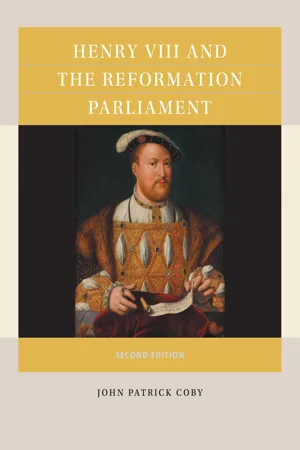 eBook - ePub
- John Patrick Coby(Author)
- 2019(Publication Date)
- The University of North Carolina Press(Publisher)
2 Historical Background THE KING’S “GREAT MATTER”A fateful decision it was when the newly proclaimed boy-monarch, Henry VIII, chose to marry his deceased elder brother’s widow, Catherine. Catherine, or Catherine of Aragon, was the daughter of Ferdinand and Isabella of Spain, the king and queen famous for having sent Columbus in 1492 on his voyage of discovery. In 1501 they sent their daughter Catherine to marry Arthur, Henry VII’s firstborn son and prince of Wales. Arthur was fifteen, Catherine almost sixteen. The marriage was short-lived, however, as the sickly Arthur died of consumption five months later. Seven years later, in 1509, Catherine (who had remained in England) was married to the seventeen-year-old Henry, Henry VII’s second-born son. Henry married Catherine, six years his senior, upon his father’s death, just days before his eighteenth birthday and his coronation as king. It was a magnanimous gesture, but one of dubious religious legality, for it is written in the Book of Leviticus (20:21): “If a man takes his brother’s wife, it is impurity; he has uncovered his brother’s nakedness, they shall be childless.” Henry VII, who first arranged the marriage, later decided against it, fearing that it would put in jeopardy the line of succession and unsettle an already shaky Tudor dynasty. But young Henry, now his own man, was determined to act magnanimously, and the pope in Rome (Julius II) had previously granted him a dispensation.The marriage was not quite childless. Catherine did give birth to a daughter, Mary (1516–58), who would go on to become queen of England (r. 1553–58). But a male issue was what was required, and Catherine, though pregnant many times, never managed to produce a male heir who survived. By the mid-1520s, Catherine’s child-bearing years had passed, as had her youthful good looks. Indeed, she had become quite frumpy, while her husband—tall, strong, handsome, and athletic—was still in the prime of life, the picture-perfect Renaissance prince.
Index pages curate the most relevant extracts from our library of academic textbooks. They’ve been created using an in-house natural language model (NLM), each adding context and meaning to key research topics.

