History

Zora Neale Hurston
Zora Neale Hurston was an influential African American author, anthropologist, and filmmaker during the Harlem Renaissance. She is best known for her novel "Their Eyes Were Watching God," which explores the experiences of African American women in the early 20th century. Hurston's work focused on the culture and traditions of the American South, and she played a significant role in preserving and celebrating African American folklore and storytelling.
Written by Perlego with AI-assistance
Related key terms
1 of 5
11 Key excerpts on "Zora Neale Hurston"
 eBook - PDF
Icons of African American Literature
The Black Literary World
- Yolanda Williams Page(Author)
- 2011(Publication Date)
- Greenwood(Publisher)
Zora Neale Hurston Zora Neale Hurston was an American novelist, folklorist, anthropologist, and prominent member of the circle of writers associated with the Harlem Renaissance of the 1920s. (Library of Congress) 172 Icons of African American Literature Zora Neale Hurston (1891–1960), a leading novelist, dramatist, folklorist, and short-fiction writer during the Harlem Renaissance, was born in Nota- sulga, Alabama, the daughter of John and Lucy Potts Hurston. When she was very young, the family moved to the all-black town of Eatonville, Florida, where Hurston grew up. Eatonville became a fixture in her artistic vision and much of her work is set there. As well, many of her characters are based on Eatonville persons and many of her fictive situations are drawn from real-life occurrences there. As a child, Hurston lived a rather carefree and happy life surrounded by a large family, including her grandmother. Her father was a local minister and mayor of Eatonville; her mother was a schoolteacher and housewife. Hurston received her early education at the Hungerford School in Eatonville, a normal school patterned on the model of Booker T. Washington’s Tuskegee Institute. Her later schooling took place at a boarding school in Jacksonville, Florida, until she left school altogether after the death of her mother and her father’s remarriage. For a time, Hurston lived with relatives, worked a variety of odd jobs, and ultimately obtained work as a lady’s attendant in a traveling show. When the show reached Baltimore, Maryland, Hurston left the show and entered the high school department of the Morgan Academy (now Morgan State Univer- sity). Upon completion of her high school diploma, Hurston entered Howard University in Washington, DC. While a student at Howard, she studied Eng- lish with the noted scholar Lorenzo Dow Turner and took classes with Dr.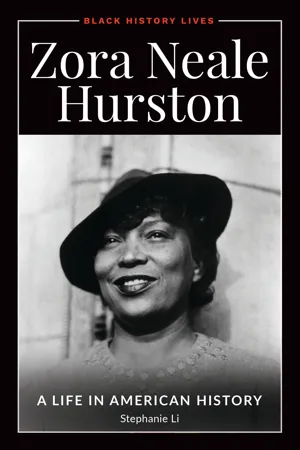 eBook - PDF
Zora Neale Hurston
A Life in American History
- Stephanie Li(Author)
- 2020(Publication Date)
- ABC-CLIO(Publisher)
Nearly a century past Hurston’s first anthropological expeditions, we must be mindful of 190 Zora Neale Hurston how radical and at times dangerous it was for a lone black woman to inhabit such different social worlds. Though a native of Florida, a place she studied and lived in for years, Hurston was always eager to explore new facets of African American and African diasporic life. In this way, she rep- resents both a fierce individuality and a deep commitment to cultural lega- cies. This somewhat paradoxical position led in her later life to politically conservative views, even as her younger self espoused beliefs more consis- tent with the burgeoning civil rights movement. Hurston was a writer who embraced change, allowing individual experiences as well as shifting social mores to influence her perspective on race, identity, art, and the future of the United States. This biography aims to explore how these elements impacted her creatively and produced a powerful series of texts that will continue to inspire readers for many years to come. While most authors are primarily dedicated to a single narrative mode—fiction, poetry, drama, or essays—Hurston worked across a variety of genres. One theme that permeates her life is her refusal to be contained by a single idea, category, or expectation. It is no surprise, then, that although she is best known for her novels, she also wrote plays, a series of provocative essays, and groundbreaking anthropological texts that describe her experiences in the American South, Haiti, and Jamaica. Although we can clearly distinguish between Hurston’s major fictional and academic work, much of her writing straddles these two forms. She penned many stories based on well-known folktales, and some of her most memorable lines are common expressions among black Southerners. eBook - PDF
Black Regions of the Imagination
African American Writers between the Nation and the World
- Eve Dunbar(Author)
- 2012(Publication Date)
- American Literatures Initiative(Publisher)
Zora Neale Hurston serves as the starting point of this larger study for a variety of reasons, primarily because her life of liter-ary production bridges the Harlem Renaissance and the mid-twentieth-century black writers who inhabit this project. She serves to begin the study secondly because as an African Ameri-can female ethnographer during this period, Hurston’s relation-ship to the “realism” expected of ethnography offers an initial insight to understanding why other mid-twentieth-century writ-ers might have similarly taken up the tools offered by ethnogra-phy both to represent and to resist representing to a mainstream public particular aspects of African American culture. In this sense, Hurston’s personal and publishing history offers a model for reading the anxieties and intentions of some of the most crit-ically acclaimed black writers of the mid-twentieth century. Not quite Hurston’s contemporaries, writers such as Wright, Himes, and Baldwin continued to explore, expose, and exile themselves in the hope that distance would bring them clarity on African American life in the United States and the world. Couple with these intentions and anxieties the act of “going into the field,” and one can begin to see how ethnography might offer black writers some amount of distance needed to carry out a variety of critiques, from the personal to the national and international. Focusing on the writings of Zora Neale Hurston, then, this chapter explores how she employs ethnography to orchestrate the difficult task of offering a public articulation of African American identity and artistic production in the midst of twen-tieth-century U.S. global expansion and a growing sense of black modernity, which would eventually help enable the integration of black Americans into a recognized public sphere as equal sub-jects to whites within the United States.
- Michael Nowlin(Author)
- 2019(Publication Date)
- Cambridge University Press(Publisher)
But the Hurston we now know as one of the giants of African American literature emerged after the Renaissance, as though the demise of that movement helped liberate her literary ambition and powers. 2 What in hindsight seems a period of apprenticeship rather than underachievement was no doubt prolonged by Hurston’s years of anthropological field research and her patron and “godmother” Charlotte Osgood Mason’s proprietary interest in that work. But the experience of the “Negro literary renaissance” helped her 125 more fully apprehend the two enabling, seemingly contradictory premises of her own bid for literary distinction. The first of these was that African American intellectuals and writers continued to put far too high a premium on the “literary” as a symptom of cultural legitimacy and greatness, when it was precisely centuries of wide- spread, enforced black illiteracy that gave African American culture its oral and theatrical inventiveness, its musicality, its democratic and communal character, and its power to compel the interest and fascination of whites. The “unlettered Negro has given the Negro’s best contributions to America’s culture,” she said in an interview with the Chicago Daily News in 1934, the year in which she published her first novel (cited in Hemenway, Zora Neale Hurston 205). The problem of giving literary form to this vital cultural material – or better, of drawing on it to reset the parameters of literariness, and thus open the door to a greater black impact on the literary field – remained an enticing if daunting challenge for any black writer. Despite the so-called “jazz age” and vogue for Harlem, Hurston confidently assumed that white readers and audiences were still very much in the dark about “real” African American folk culture, but were ready to recognize and reward the first black artist who could reveal it to them. eBook - PDF
- F. Ndi, Bill F. Ndi, F. Ndi, Bill F. Ndi(Authors)
- 2021(Publication Date)
- Langaa RPCIG(Publisher)
Writing precisely what she heard in her all-black town in northern Florida gave her strength and stated (to other black people) that her experiences were not going to be censored. Zora Neale Hurston’s writings by their very nature are anti-assimilationist and reflect the instincts of one who having or not birthed a child, knows and feels the labor of childbirth. As such, protecting and defending her young from predators becomes her number one preoccupation. Her awareness is a shot in the arm to bolster her narrative technique and thus “alter specific cultural power structures” (Kadish and Massardier-Kenney 5). Her writings lay a foundation stone of socio-political opposition that expresses itself as one against the nauseous historical record that has hitherto been aimed at denying Blacks their humanity though slavery, colonialism, racism, police brutality, and assimilation. Her works thus shed a revolutionary light on Black struggle to make a place in the sun. It is in this regard that Zora Neale Hurston succeeds in expressing the power of Black imagination and resolve. The works restitute the most fundamental proceeds of having a memory, means of memory, 185 identity, and culture of one’s own. Zora Neale Hurston’s training in anthropology and folklore seems to reveal that a figure who jumps through hoops is rewarded with more and progressively narrower hoops. In other words, contrary to the American Dream, life becomes more difficult not less difficult. A careful study of everyday life reveals that people do not have a sense of who they are. This fear, anxiety, and shakiness seeps into the vernacular. The sound, the emotional pain, and the cries that can be heard within a language have more to do with the condition of the individual than with anything that appears in ink on the printed page. eBook - PDF
American Women Writers, 1900-1945
A Bio-Bibliographical Critical Sourcebook
- Laurie Champion(Author)
- 2000(Publication Date)
- Greenwood(Publisher)
Cheryl Wall’s “Mules and Men and Women: Zora Neale Hurston’s Strategies of Narration and Visions of Female Empowerment” views Hurston as an anthropologist and suggests ways Hurston’s women are empowered. Many scholars examine Hurston as a female autobi- ographer: James Krasner, “The Life of Women: Zora Neale Hurston and Female Autobiography”; Elizabeth Fox-Genovese, “My Statue My Self: Autobiograph- Zora Neale Hurston 167 ical Writings of Afro-American Women”; Franc ¸ois Lionnet, “Autoethnography: The An-Archic Style of Dust Tracks on a Road ”; and Nellie Y. McKay, “Race, Gender, and Cultural Context in Zora Neale Hurston’s Dust Tracks on a Road.” Hurston’s contributions to literary movements such as the Harlem Renais- sance and the Southern Renaissance are other areas discussed by scholars. Hur- ston is included in almost every discussion of the Harlem Renaissance, but essays that significantly discuss her contribution to the movement include Mary V. Dearborn’s “Black Women Authors and the Harlem Renaissance,” Sharon Dean and Erlene Stetson’s “Flower-Dust and Springtime: Harlem Renaissance Women,” John Lowe’s “Hurston, Humor, and the Harlem Renaissance,” and Ralph D. Story’s “Gender and Ambition: Zora Neale Hurston in the Harlem Renaissance.” Jan Cooper, in “Zora Neale Hurston Was Always a Southerner Too,” points out that although she should be included in discussions of the Southern Renaissance, Hurston is omitted because of racial bias. Geneva Cobb- Moore’s “Zora Neale Hurston as Local Colorist” establishes Hurston as a re- gionalist and local colorist who delineates a distinctive group of people. Among book-length treatments of Hurston’s works, several stand out. Even though published in the 1970s, Robert E. Hemenway’s Zora Neale Hurston: A Literary Biography remains the most insightful study. Another skillful biography is Lillie P. Howard’s Zora Neale Hurston. A valuable book on Hurston’s humor is John Lowe’s Jump at the Sun: Zora Neale Hurston’s Cosmic Comedy. eBook - PDF
Ethnic Modernisms
Anzia Yezierska, Zora Neale Hurston, Jean Rhys, and the Aesthetics of Dislocation
- D. Konzett(Author)
- 2002(Publication Date)
- Palgrave Macmillan(Publisher)
Hurston’s recent revival in the late 1970s and 1980s emphasized her im- portance as a folk writer and feminist whose stories and novels depict the inassimilable difference of African American culture, generating a sense of ethnic pride. In her well-known foreword to Robert Hemenway’s biography of Hurston, Alice Walker, for instance, cites “racial health” as “the quality [she] feels is most characteristic of Zora’s work . . . , a sense of black people as complete, complex, undiminished human beings, a sense that is lacking in so much black writing and literature.” 6 However, in foregrounding the spe- cific cultural and regional aspects of Hurston’s folklore, critics like Walker have focused on only a small part of her work. Accordingly, Hurston’s no- tions of community and tradition appear to be rooted in premodern forms of a conservative black folk culture that have persisted into the 20th century. Pro-Hurston critics often equate this persistence with a form of strategic sur- vival, casting the author and her work as paradigmatic examples of cultural resistance and antiassimilationism. What is ignored in this revival of black folk culture is Hurston’s aesthet- ics of dislocation that calls into question any primordial belonging to a spe- cific region or people. Reacting to this romantic treatment of Hurston’s folklore and attempting to direct attention to ongoing problems in black communities, some critics have of late begun to question Hurston and her reception. Hazel Carby, for example, locates Hurston’s work of the 1920s and 1930s in “a discourse of nostalgia for a rural community” that displaces the black urban problem 7 and idealizes the folk as a formal aesthetics, and Cornel West asks why Hurston’s reactionary essays and conservative politics are overlooked or dismissed by contemporary feminist thinkers. eBook - PDF
Zora Neale Hurston
An Annotated Bibliography and Reference Guide
- Rose P. Davis(Author)
- 1997(Publication Date)
- Greenwood(Publisher)
Hurston was the only trained African American folklorist in the South, and this study looks at her contributions to the project. (DAI 52–9A:3400) B70. Brantley, William Oliver. Women of Letters, the Southern Renaissance and a Literature of SelfDetermination. Madison: University Page 21 of Wisconsin, 1991. This study provides an “intertextual examination” of women from the Southern Renaissance. Chapter five “considers the nexus of gender, region, nation, and race” in Dust Tracks on a Road. (DAI 52–10A:3599) B71. Cassidy, Thomas John. Desire and Representation in TwentiethCentury American Realism (Hurston, Dreiser, Gather, Morrison). Binghamton: State University of New York, 1991. This study examines relationships based on desire and critiques several novels to explore “male centered forms of marriage and self/other relationships.” Their Eyes Were Watching God one novel used to study the representation of desire and what is real. (DAI 52–3A:914) B72. Connor, Kimberly Rae. Conversions and Visions in the Writings of AfroAmerican Women. Charlottesville: University of Virginia. Rebecca Jackson, Harriet Jacobs, Toni Morrison, Alice Walker, Paule Marshall, and Hurston are authors whose works are examined for a “recurring pattern concerned with identify formation.” Believes Hurston “occupies a pivotal position in the development of AfroAmerican women’s writings.” (DAI 53–2A:497) chapter four where an examination of Their Eyes Were Watching God shows she exploited the “discourse of the romance plot to simultaneously protect herself, the heroine, and black men.” (DAI 53–1A:149) B74. duCille, F.Ann. Coupling and Convention: Marriage, Sex, and Subjectivity in Novels by and About African American Women, 1853–1948. eBook - ePub
In Search of Us
Adventures in Anthropology
- Lucy Moore(Author)
- 2022(Publication Date)
- Atlantic Books(Publisher)
‘When I set my hat at a certain angle and saunter down 7th Avenue [Harlem’s main drag] … the cosmic Zora emerges,’ she wrote. Persuading people to let her measure them would be easy. ‘How can any deny themselves the pleasure of my company? It’s beyond me.’ She had arrived in New York that January with $1.50 in her pocket and a blazing desire ‘to get All ’ from life. At thirty-four years old – though she claimed to be twenty-four – she had come a long way from Notasulga, Alabama. Hurston’s childhood had been mostly spent in Eatonville, Florida, America’s first incorporated black town, where her father had been pastor in one of the Baptist churches and mayor. Hurston was thirteen when her mother died. Her father and stepmother sent her to a segregated boarding school in Jacksonville, where she discovered she was black: her first day there was ‘the very day that I became colored’. In 1917, aged twenty-six, she reinvented herself as a sixteen-year-old to qualify for the free high school education offered by the all-black Morgan College in Baltimore, Maryland, before moving to Washington, DC, where she attended another all-black college, Howard University, co-founding the student newspaper there. She dreamed of being a writer and the short story she wrote in 1921, during her time at Howard, ‘John Redding Goes to Sea’, brought her membership of Alain Locke’s literary club, the Stylus. It was probably this introduction, through Locke, the first African American Rhodes scholar and a writer and philosopher, to what would become known as the Harlem Renaissance, that inspired Hurston to move to New York eBook - PDF
- Rachel Farebrother, Miriam Thaggert(Authors)
- 2021(Publication Date)
- Cambridge University Press(Publisher)
However, by foregrounding the sin- gle-authored ethnographic text over cinematic representation, anthropolo- gists ensured that complex human encounters were framed around a single witness’s literary interpretation, which reinforced hierarchies of power between scientists and their subjects. Alison Griffiths has claimed that, “Ironically, cinema’s ability to represent reality with such compelling verisimilitude may have contributed to anthropologists’ ambivalence about the medium, since the sense of agency afforded native peoples for the duration of a performance also threatened to undermine the specular authority of an idealized scientific observer.” 10 By embracing filmmaking, Hurston granted her subjects a degree of autonomy away from the writer’s pen and unsettled such scientific hierarchies. In so doing, she transformed anthropological investigation into a two-way creative encounter that acknowledged her subjects as artists and individuals. Zora Neale Hurston, Film, and Ethnography 293 Hurston’s footage, which is now nearly a century old, is brief and fragmentary. The fifteen reels, of which only nine survive, represent a handful of silent moving snapshots – lasting from a few seconds to a few minutes – of a two-year recording trip. Yet they still have tremendous historical value as cinematic documents of the interwar African American South. With the exceptions of Eatonville, where she grew up, Africatown and Bogue Chitto, where the two Middle Passage survivors lived, and Eau Gallie, where she rented a cottage to write, her stopping points in the South – Mobile, Loughman, Lakeland, Mulberry, Pierce, Miami, New Orleans, and Bogalusa – were all major centers of industry that attracted jobseekers from across the region in the 1920s, and what is particularly remarkable about Hurston’s research project is the geographical diversity of her interviewees. eBook - ePub
- Christopher Douglas(Author)
- 2011(Publication Date)
- Cornell University Press(Publisher)
As a student of Boas and an anthropologist and literary modernist, Hurston generally (but not always) exemplified this counter-tradition’s rival and differently renovated notion of what “culture” was, and in fact this different version of culture generally dominates Hurston’s 1930s work, as I have shown. Her ethnographies and novels most often demonstrate thoroughly Boasian propositions about culture: first, that culture is descriptive (of what groups of people actually do or believe) and not prescriptive (a culture is not what a group is trying to become); second, that culture is distinct from, and not grounded in, race; and third, that culture is not determined by, and does not confer, an identity. Hurston worked to collect and transcribe—but not evaluate—African American stories and religious practices. She liked African American tales partly because she thought they were as good as other cultures’ stories, and there is not really the sense that she, via a nativist logic, prefers African American tales because they are racially hers. This is why, though she grew up on these stories, she could then go on to “luxuriate” in the “syllables and rhythms” of Paradise Lost even before being told “that Milton was one of the greatest poets of the world” (Dust 98). Hurston’s disdain for adaptations of African American spirituals according to European musical traditions was not a nativist preference for her own, but rather the cultural pluralist declaration that the folk music did not need a European high-culture supplement in order to count as art. So even as Coolidge was calling for “more culture” and for Americans “to be supremely American” (qtd
Index pages curate the most relevant extracts from our library of academic textbooks. They’ve been created using an in-house natural language model (NLM), each adding context and meaning to key research topics.

