Languages & Linguistics

Deduction
Deduction in linguistics refers to the process of drawing specific conclusions from general principles or premises. It involves reasoning from the general to the specific, often used in language analysis to make inferences about grammatical rules, sentence structures, and meaning. Deductive reasoning is fundamental to understanding and formulating linguistic theories and hypotheses.
Written by Perlego with AI-assistance
Related key terms
1 of 5

6 Key excerpts on "Deduction"
 eBook - PDF
- Jose L. Zalabardo(Author)
- 2018(Publication Date)
- Routledge(Publisher)
We shall refer to 118 Deduction a collection of deductive rules as a deductive system, and to the process of establishing a logical consequence claim with a deductive system as deducing (in the system) the conclusion from the premises. Deducing a conclusion c from a set of premises P in a deductive system is supposed to show that, in accepting the logical consequence claims expressed by the rules of the system, we would be committed to accepting also that c is a logical consequence of P. If a deductive system is to serve this pur-pose, its rules will have to be specified in such a way that to deduce c from Pin the system we don't need to make any further assumptions about logical consequence. One of the traditional aspirations of logic was the provision of a deductive system which, for every set of premises P, would allow us to deduce from P all its logical consequences and nothing else, i.e. a system in which we could deduce a proposition c from P if and only if c is a logical consequence of P. Our main goal in this chapter and the next is to show that, with respect to the instances of logi-cal consequence generated by the structure of first-order propositions, this aspiration can be fulfilled. In Chapters 2 and 3 we established several results to the effect that whenever a formula and a set of formulas r satisfy a certain condition, is a logical consequence ofr. Thus, e.g., we established (i) that any set whose elements are a conditional and its antecedent has its consequent as a logical consequence-or, in more familiar terms, that for all formulas , 'Jf, { ~ 'JI, } I= 'V (see Exercise 2. 16 (5)). Notice that this sufficient condition for logical consequence is specified in purely syntactic terms. To determine whether a claim satisfies it we don't need to invoke any semantic assumptions. We also established conditional results to the effect that a logical con-sequence claim follows from other logical consequence claims. eBook - PDF
- C. Martín-Vide(Author)
- 2014(Publication Date)
- North Holland(Publisher)
This plan is then used as input to a linguistic realization module which is itself a (linguistic) knowledge based system. 2. N A T U R A L D E D U C T I O N S Y S T E M Natural Deduction is a formalization of assumption-based mathematical reasoning. We have adopted the ND system developed by Dag Prawitz for Classic First Order Logic (FOL) [2]. In spite of the relevant role of evidential logic calculus for Artificial Intelligence, we are restricted to a reasoning modelling that uses a deductive logic calculus for classic FOL, since we believe that it is a suitable and enough means to investigate the explanation planning problem in logic based environments. 2.1. N D Inference Rules Let's introduce informally some important definitions. Definition 2.1 An inference rule is an argument composed by a set of premises P 1 ? P n (n > 1) which causes a conclusion Q, and is denoted here by (Pi,...,P n ) l· Q. Definition 2.2 A Deduction consists of consecutive inference rules applications. We de-note a Deduction of a formula A from a set of formulae T, by Γ h *A. The folowing rules define the hypothesis discharging mechanism used by assumption-based rules. Consider A, B, C any FOL formulae; Γ any set of formulae; ± the absurdity symbol; a an unbound variable that denotes any domain value; and A x a denotes a substi-tution of bound variable χ by parameter a. Then, 1. Given a Deduction A U Γ h we can infer A —> Β and discharge any number of ocurrences of hypothesis A; 2. Given a Deduction ->A U Γ h * J_ , we can infer A and discharge any number of ocurrences of hypothesis -Ά; 3. Given three Deductions, Γι h •A V Β, A U Γ 2 H *C, and Β U Γ 3 h *C, we can infer C and discharge any number of ocurrences of hypothesis A and Β from second and third Deduction; 4. Given two Deductions Γχ h *3xA and A x a U Γ 2 ~ *B, we can infer Β and discharge hypothesis A*, since a does not occour in 3xA , in B, or in any other hypothesis on which Β depends in the Deduction. eBook - PDF
- Sebastian K. Saumjan(Author)
- 2017(Publication Date)
- De Gruyter Mouton(Publisher)
40 STRUCTURAL LINGUISTICS theoretical empirical science. Therefore, the hypothetico-deductive method should be the logical basis of structural linguistics as well. However, up until now other points of view concerning method in structural linguistics have been widespread. Some consider the deductive method basic in structural linguistics, and thus, without any good reason, assign structural linguistics to the mathematical disciplines. Others, on the contrary, consider that structural linguistics should use the inductive method, and thus lower structural linguistics to the level of the descriptive, classificatory, empirical sciences. If we want structural linguistics to develop as a genuinely theoretical empirical science we must insist that structural linguistics make systematic use of the hypothetico-deductive method. 3 Since the hypothetico-deductive method is of fundamental importance for structural linguistics, it would be useful to consider its essential features in detail, paying special attention to those aspects of the method which are most interesting in connection with the problems studied by structural linguistics. The hypothetico-deductive method consists of constructing and using for cognitive purposes a deductive system of hypotheses, from which assertions about empirical facts may be deduced. A deductive system of hypotheses has a hierarchic structure. In this system are distinguished various levels on which hypotheses are placed. On the highest level are hypotheses which serve only as premises for all the other hypotheses of the deductive system. On the lowest level are hypotheses which serve only as consequences in the deductive system. On the levels in between are hypotheses which serve as the consequences of higher-level hypotheses and as the premises of lower-level hypotheses. As an example let us consider the three-level deductive system of hypotheses given by Braithwaite. eBook - PDF
- Charles S. Peirce, Carolyn Eisele(Authors)
- 2014(Publication Date)
- De Gruyter(Publisher)
S-27 is a set of lecture notes on a subject related to that of tMs lecture. It reads as follows: Ladies and Gentlemen: The first kind of reasoning to be studied is Deduction. Deduction is that kind of inference in which the fact expressed in the conclusion is inferred from the facts expressed in the premisses, regardless of the manner in which these facts have come to the reasoner's notice. Deduction is either necessary or probable. Necessary Deduction is that sort of inference in which the fact concluded is con-ceived to be involved in the facts premised. It is the reasoning of mathematical demonstration. 4 0 6 EXISTEmiAL GRAPHS It has taken two generations to work out the explanation of mathematical reasoning. This delay has been partly due to many writers entirely missing the point and directing their energies to ascertain the sequence of mental phenomena in reasoning instead of the logical sequence of the argument, which need not be closely related to the psychological sequence. The delay has also been due in part to the circumstance that some students attempted to divest thought of its garment of expression and to get at the naked thought itself, an attempt analogous to that to remove the peel from an onion so as to get at the naked onion itself. Reasoning is nothing but the discourse of the mind to itself. Divest thought of signs and it ceases to be thought, and becomes, at best, direct perception. What is requisite is to take really typical mathematical demonstrations, and state each of them in full, with perfect accuracy, so as not to skip any step, and then to state the principle of each step so as perfectly to define it, yet making this principle as general as possible. For routine demonstrations there is no particular difficulty; but for the major theorems there is much. If we attempt to make the statement in ordinary language, success is practically impossible.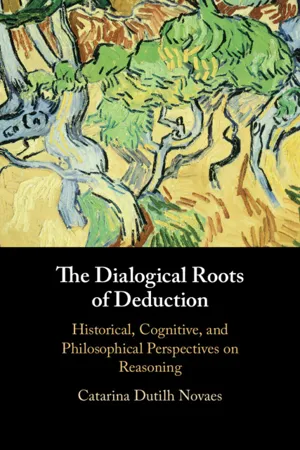 eBook - PDF
The Dialogical Roots of Deduction
Historical, Cognitive, and Philosophical Perspectives on Reasoning
- Catarina Dutilh Novaes(Author)
- 2020(Publication Date)
- Cambridge University Press(Publisher)
However, as I will argue throughout the book, current conceptions of Deduction still maintain much of their (dialogical) origins; thus, to truly comprehend the nature of Deduction, going back to its historical origins is in fact indispensable. But, naturally, the proof will be in the pudding, i.e. in how much mileage we can get out of the (historically inspired) main hypothesis of the book – that Deduction is essentially a dialogical notion – when addressing the puzzles and questions pertaining to Deduction that still loom large. In other words, I do not take the ‘roots’ approach to be automatically suitable in all cases. It is, however, a particularly suitable approach to investigate the concept of Deduction specifically, as I hope will become evident as we proceed. 2.3 Deduction as a Dialogical Notion With these methodological considerations in place, I now introduce the main hypothesis of the present investigation: deductive reasoning is essentially a dialogical phenomenon. It is this hypothesis that will be further investigated in subsequent chapters; it will receive corroboration insofar as it is able to shed new light and explain a number of otherwise puzzling properties of the concept and practices of Deduction, at different levels. The overall argumentative structure of this book can be described as abductive: it is by showing that the dialogical account is able to explain a wide range of apparently unrelated phenomena pertaining to Deduction that an ‘inference to the best explanation’ – Deduction as a dialogical notion – presents itself. The project is an instantiation of the method of synthetic philosophy (Schliesser, 2019), where findings from different areas are brought together by means of a unifying hypothesis. 9 9 The work of Kim Sterelny is a quintessential example of synthetic philosophy in this sense. eBook - PDF
Software Engineering Foundations
A Software Science Perspective
- Yingxu Wang(Author)
- 2007(Publication Date)
- Auerbach Publications(Publisher)
According to Lemma 6.1 ( Syn ) and Definition 6.8 ( Sem ), the relationship between a language and its syntaxes and semantics can be illustrated as shown in Fig. 6.2. Fig. 6.2 explains that linguistic analyses are a deductive process that maps the 1-D language into the 5-D semantics of natural languages via the 2-D syntactical analyses [Wang, 2007h/07j]. O O … O … O O … [L (1-D)] Syn (2-D) Sem (5-D) S J B T O Figure 6.2 The Universal Language Processing (ULP) model Semantic analysis and comprehension are a deductive cognitive process. According to the OAR model as developed in Section 9.4, the semantics of a sentence may be considered having been understood when: a) The logical relations of parts of the sentence are clarified; and b) All parts of sentence are reduced to the terminal entities, which are either a real-world image or a primitive abstract concept. The theoretical foundations of language cognition and comprehension will be further discussed in Chapter 9. 6.2.4 GRAMMARS Syntactic and semantic analyses in linguistics rely on a set of explicitly described rules known as the grammar of a language. Therefore, Chapter 6 Linguistic Foundations of SE 421 contemporary linguistic analyses focus on the study of grammars, which is centered in language acquisition, understanding, and interpretation. Definition 6.9 The grammar of a language is a set of common rules that integrates phonetics, phonology, morphology, syntax, and semantics of a given language. The grammar governs the articulation, perception, and patterning of speech sounds, the formation of words and sentences, and the interpretation of utterance. 6.2.4.1 Properties of Grammars O’Grady and Archibald (2000) identified five basic properties of grammars as follows: • Property 1. Generality: All languages have a grammar. • Property 2. Parity: All grammars are equivalent in terms of their expressive capacity.
Index pages curate the most relevant extracts from our library of academic textbooks. They’ve been created using an in-house natural language model (NLM), each adding context and meaning to key research topics.
