Languages & Linguistics

Indian English
Indian English refers to the variety of English spoken in India, influenced by the country's linguistic diversity and cultural heritage. It incorporates elements from various Indian languages, resulting in unique vocabulary, grammar, and pronunciation. Indian English is widely used in media, literature, and everyday communication, reflecting the rich linguistic tapestry of the country.
Written by Perlego with AI-assistance
Related key terms
1 of 5
10 Key excerpts on "Indian English"
- Esterino Adami(Author)
- 2022(Publication Date)
- Routledge(Publisher)
Nair and deSouza 2020 : 308–301). Although in the following chapters I deal with fictional language, it is undeniable that the authors’ stylistic choices also constitute aspects of the composite linguistic question of India. As a rule, the language that surfaces in the narratives I analyse represents a standard form of Indian English, thus generally aligned with World English, but at times it displays a series of marked diatopic features, suggests creativity at work, and reveals the influence of English in contemporary India. In the next sections, I provide an outline of the main characteristics of Indian English and some references to Indian English literature (and culture).2.2 Indian English(es) and Linguistic/Stylistic Variation
Approaching a diatopic form of language means dealing with variation at three core levels, namely phonetics and phonology, lexis, and syntax, i.e. areas in which Indian English exhibits a broad degree of differentiation from standard English, and I here offer some descriptive generalisations of Indian English, drawing examples from published scholarship, in particular Mukherjee (2010 ), Sailaja (2009 ), and Sridhar (2020 ), bearing in mind of course that “the term ‘Indian English’ is an abstraction as are idealizations such as General Indian English and Standard Indian English” (Sridhar 2020 : 253), given the scope of variability of the language according to a host of parameters, such as social class, education, and provenance of the speakers, as well as the capacity of authors to manipulate rhetorical and narrative strategies.Alterations are particularly relevant in the area of vocabulary, which presents large numbers of borrowings from other languages. The interest of lexicographers in Indian English is also proved by a peculiar publication entitled Hobson-Jobson. The Anglo-Indian Dictionary, originally published in 1886 to collect words and phrases commonly used in the Indian colony. Although this work has some etymological inaccuracies or simplifications, it certainly shows the capacity of the language to incorporate loanwords and receive influences from other languages and cultures during exonormative stabilisation in the colonial time and before the proper nativisation process (Schneider 2007 : 165). Such lexemes typically refer to domains like flora, fauna, and culture (e.g. betel, dhoti, nabob). Sailaja (2009 : 72) proposes the definition of “restricted items”, namely “those items that have not made it into native varieties of English” and that belong to various cultural domains, such as food and religion. These restricted items are not lexicalised Indian words, which are now known in the English-speaking world and commonly recorded by English monolingual dictionaries (e.g. guru). Instead, they are used only in India, or are related to certain states or parts of the country, and this feature also appears in Indian English novels, such as English, August by Upamanyu Chatterjee (1988), for example, which hints at the language divide between the north (the Hindi-speaking belt) and the south of the country, or many of the works by Amitav Ghosh that frequently features Bengali terms. Traditionally, the lexis of Indian English is mainly derived from British English as a result of colonialisation, but due to the effects of globalisation, the spread of social media, and the economic models from the USA, the impact of American English is rapidly growing, specifically affecting the parlance of younger generations. However, still today there seems to be a preference towards the British variety of English, in particular among young female speakers, even if it may still denote traces of the colonial past (Bernaisch and Koch 2016 eBook - PDF
- Alexander Bergs, Laurel J. Brinton, Alexander Bergs, Laurel J. Brinton(Authors)
- 2012(Publication Date)
- De Gruyter Mouton(Publisher)
This terminological debate fundamentally addresses the more important question of how to classify Indian English. The variety is cited in a number of early typologies of language contact and change. Fishman (1967) consid-ered English in India to be a case of diglossia without bilingualism, arguing that access to English is reserved for urban elites. Thomason and Kaufman similarly focused on elite usage: especially where use of the target language is confined to educated people who write it reg-ularly, interference is very slight or nonexistent in the morphosyntax but more extensive in the phonology […] The English spoken by Indians in India is a classic example, with Standard English syntax but phonological features. (Thomason and Kaufman 1988: 129) In fact English use has spread far more broadly than Fishman or Thomason and Kaufman’s descriptions suggest (see D’Souza 2001), and English in some parts of India has moved towards a state of diglossia with bilingualism. Individuals are tied into personal networks based in local languages, but they participate daily in English-based institutional or informal domains composed of other bilingual speakers. In a parallel debate over classification, opinion has been divided on the theoretical question of whether the “divergences” described in Section 5.1 constitute learner errors or dialect innovations. Early studies of Indian English tended to be restricted to pre-scriptive or pedagogical descriptions based on deficiency-or error-oriented approaches. This early work was founded on the exo-normative principle that appropriate norms for use were to be determined by a variety outside the context of use, such as British English (Quirk 1990). More recently, endo-normativity has been argued to distinguish postcolonial varieties from incomplete second language learning (see Kachru’s 1991 132. Second-Language Varieties: English in India 2089 eBook - PDF
Standards of English
Codified Varieties around the World
- Raymond Hickey(Author)
- 2012(Publication Date)
- Cambridge University Press(Publisher)
Finally, I will turn to the norms of spoken and written IndE as they have emerged so far. 13.3.1 English as an Indian language Linguists like Braj Kachru have long fought for the acknowledgement of IndE as a legitimate variety of English in its own right. Nowadays, these issues are long settled – at least for the linguist, if not for the actual speech community in question – and ‘recent realities seem to be rendering the ENL–ESL distinction increasingly obsolete’ (Schneider 2007: 13). If we only considered the available figures for English as a native language in the narrow sense in India, we would be dealing with a very small speech com- munity indeed: 224,449 persons or 0.02 per cent of the Indian population named ‘English’ as their mother tongue in the 2001 census. 1 However, such a figure upholds a rather simplistic distinction ‘native–non-native’ that does not take speakers’ multilingual competence into account. In a recent article, Crystal (2008) reviews some of his earlier predictions about the worldwide number of English speakers and notes with reference to India: Kachru’s figure of 3% [of proficient IndE speakers], referred to in the 1985 article, was evidently history. Although answers varied greatly, depending on the levels of English assumed, most people thought that around a third of the population were these days capable of carrying on a domestic conversation in English. (Crystal 2008: 5) A third of the Indian population amounts to around 350 million people. For those 350 million, English naturally belongs to their linguistic repertoire, while for the remainder of the population, English is a foreign language out of reach for them and their children, and the unequal access to English con- tinues to be a hotly debated topic (see Annamalai 2004). The position of English within the overall Indian communicative space has thus shifted considerably over the last decades, coinciding with the rise of an urban middle class.
- Bernd Kortmann, Kerstin Lunkenheimer(Authors)
- 2013(Publication Date)
- De Gruyter Mouton(Publisher)
521 Part V: South and Southeast Asia 522 Devyani Sharma Indian English 523 Devyani Sharma Indian English 1 Introduction Indian English (IndE) is a superordinate term that encompasses a range of predominantly L2 varieties of Eng-lish spoken across India. The population of India exceeds one billion; an estimate of English speakers in the country is 100 million, reflecting individuals who actively use the language and not those who can simply read English words. Over 80 million individuals reported English as a second language in the last Indian census (2001), and nearly 40 million as their third language. Notably, only approximately 250,000 individuals reported English as a native language and this figure has not changed significantly since independence in 1947. (There may nevertheless be an increase in numbers of native English speakers in urban areas; most of these individ-uals report their native Indian language on the census and so are not captured accurately by census statistics.) IndE occurs in vastly different social contexts and linguistic ecologies. This presents certain challenges for the WAVE survey, discussed later. Bhatt (2004) distinguishes between Standard IndE and Vernacular IndE. The former diverges from Standard British English primarily in phonetics and is a co-L1 for many urban Indians, while the latter shows divergence at all levels, including ideology, and is not standardized or codi-fied. It should be noted that vernacular IndE is not a focused variety as in native vernacular Englishes, but rather represents a range of L1-influenced sub-varieties incorporating learner traits as well as emerging dia-lect features (Sharma 2005a). The term IndE is frequently taken to exclude more marked varieties such as the pidgin-like Butler English (Hosali 2005). Early research in IndE (e.g. Kachru 1965, 1983) established the autonomy of IndE and, thereby, the wider field of World Englishes. eBook - PDF
- Rajend Mesthrie(Author)
- 2008(Publication Date)
- De Gruyter Mouton(Publisher)
As a very brief, yet bold, speculation I suggest that some adaptations of Ferguson’s theory of diglossia – where certain High/Low forms are indexed to certain High/Low functional domains – may account for the observed choices among the competing candidates of linguistic expressions. The syntactic de-scription of English that follows is based on the methodological premise that a descriptively adequate grammar must address the relationship between the forms that a language manifests and its speakers’ perception of reality and the nature of their cultural institutions. This premise yields an interpretation of language use constrained by the grammar of culture. This is particularly true of English in India: the particular form taken by the grammatical systems of IndE is closely related to the social and personal needs that language is required to serve – issues of language identity, and historical and political patterns of its contact, that is, issues of language ideology. Before discussing the syntax of English in India, I briefly present the socio-historical context of the development of English in India to properly situate the discus-sion of its grammatical aspects. 1.1. English in India: a brief socio-historical contextualization English was introduced to India around 1600 via the establishment of the East India Company. Although initially severely limited in the numbers of its speak-ers, English bilingualism increased with various strategies of trade and pros-elytizing, especially from the early 17th century up to the 18th century. The proselytizing strategy was chiefly instrumental in introducing English bilin-gualism to the Indian subcontinent. After 1765, when the East India Company established political control in India, and especially in the early 19th century, the spread of English was aided and abetted by support from prominent Indians 548 Rakesh M. Bhatt who preferred English to Indian languages for academic, scientific and other intellectual inquiry. eBook - PDF
The Multilingual Apple
Languages in New York City
- Ofelia García, Joshua A. Fishman, Ofelia García, Joshua A. Fishman(Authors)
- 2011(Publication Date)
- De Gruyter Mouton(Publisher)
The languages of India in New York* Kama! K. Sridhar L Introduction The Asian Indian immigrants in the U. S. are a group divided along sev-eral identities, e. g., regional (language); social (caste, occupation, in-come, etc.); religion (Hindu, Muslim, Christian, Buddhist, etc.). They come from a traditionally multilingual and pluricultural country. The 1981 census of India reported 107 mother tongues being spoken in India (Krishnamurti 1989). However, this figure is not reliable because in the 1961 census, 1,652 mother tongues were reported (Pattanayak 1971; Sri-vastava 1988). The figures vary for a number of reasons: a given language may be reported under as many as forty-seven different names reflecting the returnee's ethnic, professional, attitudinal and other affiliations; sev-eral varieties of the same language exist, some are mutually unintelligible, others are not. If only languages reported by more than 1,000 persons and excluding foreign mother tongues are counted, there are approxi-mately 400 languages used in India. These belong to four different lan-guage families: Indo-Aryan, Dravidian, Sino-Tibetan, and Austro-Asi-atic. Complicating the linguistic scene is the presence and use of more than 40 scripts, religious and caste dialects, diglossic variation (high and low varieties of the language), and code-mixed varieties (mixing of two languages, Sridhar 1989, ch. 1). Code-mixing is very common all over the country, and is significant for our purposes in discussing language maintenance among the members of this group, to be discussed later on in the chapter. Historical reasons contributed to the linguistic reorganization of India, with 25 major states and other union (federal) territories, most of which are identified by a distinct language being spoken by the majority of the people in the region. Apart from the dominant regional language, every region is inhabited by several types of minority language speakers, e. eBook - PDF
- Rajendra Singh(Author)
- 2008(Publication Date)
- De Gruyter Mouton(Publisher)
There are, I claim, no linguistic reasons for classifying systems such as IE as ‘non-native varieties’. I also argue against the position that sees IE as ‘non-native’ for putative reasons of local lan-guage ecology for it is clear that IE is an integral part of the language ecol-ogy of contemporary India. As for the claim that the linguistic dimensions of IE cannot be separated or isolated from the social and politico-economic context in which it is embedded, I argue that while there is no need to deny the role that political economy and ideology can and do play in encouraging some linguists to treat varieties such as IE as somewhat deviant, these fac-tors have little bearing on who is to count as a (native) speaker of English, and should be discussed and negotiated elsewhere. As the study of Indian English is deeply embedded in the study of what is generally referred to as ‘the non-native phenomena of English’, I must be- 34 Rajendra Singh gin by opening that box. The expression in question invites two related but distinct interpretations: the pedagogical one, according to which Indian Eng-lish is a deviant variety, and the ecological one, according to which English is an outsider in India. Both of them go back at least to Manu (2.21–22), who characterized the growing Aryavrata exactly the way B. Kachru char-acterizes, without any mention of Manu, the expansion of English (cf. Singh 2003). In the recent past, there are, of course, Iranian discussions of the na-ture and quality of the Persian of the upstart Indians. eBook - PDF
- William Bright(Author)
- 2014(Publication Date)
- De Gruyter Mouton(Publisher)
It is relevant to recall that, when I first lived in India, I was surprised to find that my cook, who was illiterate, could nevertheless speak two Indo-Aryan languages and two Dravidian languages fluently, in addition to English. 3.2. Conclusions about language contact The study of India as a linguistic area shows us the following: (a) There is an immense number of borrowed words, including ones of'basic' (supposedly 'non-cultural') meaning; in some languages we find borrowed forms for words as universal as 'man', 'woman', 'sun', 'moon', and 'water'. Here, as in many other cases, there are sociocultural reasons: the concepts referred to by these loanwords are not simply phenomena of the physical ι8 Studies in American Indian Linguistics universe, but rather part of the spiritual universe of Hinduism. To be a 'mart' in India is not simply to be a male adult human, but rather to be the player of a particular divinely ordained role. Here it may also be noted that all the languages of India now take many loanwords from English, especially in the speech of the educated. Bailey (1938: in.) tells us of hearing this sentence in Punjabi: meeraa faadarinlaa meerii vaaif nuu baRaa BaiDlii TariiTkardaa ee, i.e., 'My father-in-law treats my wife very badly'. Here all the principal words are borrowings from English—'father-in-law', 'wife', 'badly', 'treat'; only the particles and the auxiliary verb are native. (b) When a language acquires loanwords, it often acquires new sounds at the same time, which are then 'naturalized' and come to occur in all kinds of vocabulary, even that of native origin. Thus, in India, an entire series of retroflex consonants, pronounced with retracted tongue, constitute a basic part of the Dravidian languages; however, since ancient times they have also been entering the Indo-Aryan languages—initially, as part of loanwords.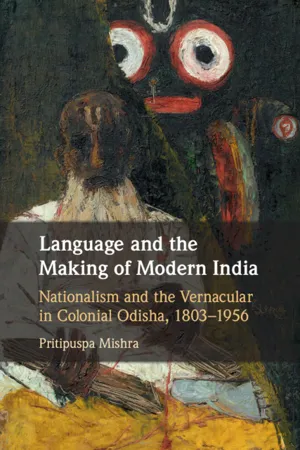 eBook - PDF
Language and the Making of Modern India
Nationalism and the Vernacular in Colonial Odisha, 1803–1956
- Pritipuspa Mishra(Author)
- 2020(Publication Date)
- Cambridge University Press(Publisher)
At issue here is not what is correct philological knowledge, but what the emergent nation-state should see – to borrow James Scott’s phrase – as the primary linguistic categories that constitute India. 40 This explains his reluctance to acknowledge linguistic variety in India. These debatable claims are then occluded by his repeated use of language lists that give the semblance of factuality and precision. Hence even as he appears to be wrong about the nature of linguistic diversity in India, he is emphatic in his claim that there are precisely fifteen languages in India. Not only this, his language lists are often posed within discus- sions about national unity: It is fascinating to find how the Bengalis, the Marathas, the Gujaratis, the Tamils, the Andhras, the Oriyas, the Assamese, the Canarese, the Malayalis, the Sindhis, the Punjabis, the Pathans, the Kasmiris, the Rajputs and the great central block comprising of the Hindustani speaking people, have retained their peculiar char- acteristics for hundreds of years . . . and yet have been throughout these ages distinctively Indian. 41 The pictorial quality of this list is striking. It is not a list but a portrait or map of India – with a Hindustani heart surrounded by monolingual groups. Even though these language groups share an Indian quality, they are marked by their particularity. Despite his explicit liberal aspira- tions, such a list underlines the fact that the people of these language 39 Partha Chatterjee, Nationalist Thought and the Colonial World: A Derivative Discourse (Minneapolis: University of Minnesota Press, 1984). 40 James Scott, Seeing Like a State: How Certain Schemes to Improve the Human Condition Have Failed (New Haven, NJ: Yale University Press, 1998). 41 Nehru, The Discovery of India, p. 63. Incorporating India 215 groups are not mutually interchangeable. The Indian citizen could not possibly be a universal liberal subject.
- Joshua A. Fishman(Author)
- 2014(Publication Date)
- De Gruyter Mouton(Publisher)
Some of the education ministries of different States of India have also started regional institutes of English which function in close cooperation with the Central Institute of English. The approach to the teaching of English is becoming increasingly more realistic and the professors of English and academic adminis-trators are slowly realizing that there is a pressing need: ( l ) t o develop register-oriented teaching materials in English suitable to the Indian educational system; (2) to train teachers of English at all levels in contemporary methods of language teaching and in the different branches of the linguistic sciences; (3) to reorganize gradu-ate and undergraduate programs in English both in literature and language (it is often claimed — and not wrongly — that for the Indian departments of English literature, English literature ends with the 19th century!); (4) to reduce the dichotomy between literature-oriented and language-oriented faculties; (5) to develop a realistic attitude toward teaching English literature in India; and above all, (6) to initiate debate and cooperation among literary scholars and language specialists in Indian universities so the Indian scholars them-selves can give some theoretical foundations to the teaching of English and also make it goal-oriented and significant to Indian linguistic, cultural, and educational settings. The new Indian approach to the teaching of English has to be relevant to the needs of the students at different levels in the Indian educational system (see Mohan, mimeographed). It is also being realized that the training centers for the teaching of English as a foreign (or second) language in the English-speaking countries (America or Britain) are unable and ill-equipped to under-stand the problems of the non-English speaking areas of Asia. Their current programs, therefore, have no serious relevance to these coun-tries.
Index pages curate the most relevant extracts from our library of academic textbooks. They’ve been created using an in-house natural language model (NLM), each adding context and meaning to key research topics.

