Languages & Linguistics

Semiotics
Semiotics is the study of signs and symbols and their interpretation. It explores how meaning is created and communicated through various systems of representation, such as language, images, and gestures. Semiotics examines the relationship between signifiers (the form of the sign) and signifieds (the concept or meaning associated with the sign), providing insights into communication and cultural expression.
Written by Perlego with AI-assistance
Related key terms
1 of 5

11 Key excerpts on "Semiotics"
 eBook - PDF
- Melissa A Hardy, Alan Bryman, Melissa A Hardy, Alan Bryman(Authors)
- 2009(Publication Date)
- SAGE Publications Ltd(Publisher)
Semiotics, the science of signs, is an object language that refers to itself and its workings as well as serving as a metalanguage by which other systems of signs can be analyzed. A sign, we can begin by stating, is something that makes sense in the mind of some person, but may be seen usefully as the connection between an expression and a content (Hjemslev, 1961). Semiotics takes itself as an object as well as a subject. Semiotics can be used to analyze any system of signs, including language, the pre-eminent communicational system. Semiotics is a formal and logical framework that resembles mathematics since it contains the tools to execute logical opera-tions on itself (as a sign system) as well as using these tools to analyze motion, change, or disruption in other systems. However, the term ‘Semiotics’ remains a ‘sponge concept’ (Noth, 1990), soaking up diverse meanings, and precise definitions are avoided. In part because Saussure, who originated the term, had grandiose aims, Semiotics facilitates semantic, syntactical and grammatical analy-ses, as well as serving a subject of semiology (Barthes, 1970). 1 Thomas Sebeok (1994: 4–5), the most important American practi-tioner of Semiotics, argues that Semiotics includes the study of at least five elements: the real world; complimentary or actual models of the real world; semiosis, or ‘sign action’, concerning how matters are commu-nicated; how abstractions from the real world circumscribe what we can know about it; and how the interplay of models, readings of the real world, illuminate experience. The question of this chapter is: how does one undertake this kind of analysis? Semiotics seeks to understand the structure of representation and its functions. eBook - PDF
- Roman Jakobson(Author)
- 2010(Publication Date)
- De Gruyter Mouton(Publisher)
Semiotic, as an inquiry into the communication of all kinds of mes-sages, is the nearest concentric circle that encompasses linguistics, whose research field is confined to the communication of verbal messages, and the next, wider concentric circle is an integrated science of communica-tion which embraces social anthropology, sociology, and economics. Again and again one may quote Sapir's still opportune reminder that every cultural pattern and every single act of social behavior involves communication in either an explicit or implicit sense. It must be re- LANGUAGE IN RELATION TO OTHER COMMUNICATION SYSTEMS 699 membered that whatever level of communication we are treating, each of them implies some exchange of messages and thus cannot be isolated from the semiotic level, which in its turn assigns the prime role to lan-guage. The question of semiotic, and in particular, linguistic ingredients inherent in any pattern of human communication is to serve as a vital guideline for the forthcoming inquiry into all varieties of social commu-nication. In fact, the experience of linguistic science has begun to be noticed and creatively utilized in modern anthropological and economic studies; creatively indeed, because the elaborate and fruitful linguistic model cannot be mechanically applied and is effectual only insofar as it does not violate the autonomous properties of any given domain. The present author's survey of Linguistics in Relation to Other Sciences, to appear in the Unesco volume Main Trends in Social Research (see above, pp. 655-696) has touched upon some questions of the relationship between the study in communication of verbal as well as other messages and the total study in communication. Here attention will be focused upon the need for classification of sign systems and cor-responding types of messages, particularly with regard to language and verbal messages. eBook - PDF
- Wolfgang U. Dressler(Author)
- 2014(Publication Date)
- De Gruyter(Publisher)
The Semiotic Framework of Textlinguistics Winfried Nöth Ruhr-Universität Bochum 1 Semiotics and Textlinguistics Before the semiotic framework of textlinguistics can be analysed, it is necessary to distinguish clearly the province of Semiotics from that of textlinguistics. Textlinguistics is the branch of linguistics in which the methods of linguistic analysis are extended to the level of the text. This might seem a trivial statement, but Semiotics is also concerned with texts, and it is important to realize that textlinguistics and Semiotics use the term text in different ways. While textlinguistics is only concerned with the texts of a natural language, Semiotics considers instances of verbal as well as non-verbal communication as texts. 1.1 The Field of Semiotics Semiotics is concerned with sign systems or codes. Thus, by definition the study of Semiotics includes language, the most elaborated system of signs, as well as other non-linguistic codes. This makes the field of Semiotics appear rather unlimited. A recent bibliography of Semiotics (Eschbach 1974) contains more than 10,000 titles covering the most diverse areas from non-verbal communica-tion to the philosophy of language. A survey of some monographs which explicitly lay claim to a semiotic approach seems to confirm this picture of a rather heterogeneous field: there are semiotic approaches to animal communi-cation (Sebeok 1972), theology (Grabner-Haidner 1973), epistemology (Klaus 1963; Resnikow 1968), basic research in mathematics (Hermes 1938), film analysis (Knilli 1971; Metz 1972), psychiatry (Shands 1970), communication theory (Ruesch 1972), architecture (Eco 1972), aesthetics (Bense 1967), mass communication (Koch 1971), advertisements (Nöth 1975) and literature (Trabant 1970; Wienold 1972; Coquet 1973; Segre 1973). eBook - PDF
- Charles W. Morris(Author)
- 2014(Publication Date)
- De Gruyter Mouton(Publisher)
And any attempt to solve the problem means a recon-struction of linguistics at its foundations. The suggestion here made is that semiotic provides the metalanguage THE SCOPE AND IMPORT OF SEMIOTIC 3 0 5 for linguistics, and that the terminology of linguistics is to be defined by linguists on the basis of the terms of semiotic. In this way one could describe all languages of the world in a uniform terminology which would make possible a scientific comparative linguistics. A number of linguists have moved steadily in this direction, as mention of the names of Edward Sapir, Alan Gardiner, Leonard Bloomfield, and Manuel J. Andrade indicates ^ And from the side of a general theory of signs, such philosophers, logicians, and psychologists as Peirce, Cassirer, Reichenbach, Camap, and Bühler have been increasingly attentive to the material fumished by linguists. The carrying out of this program consistentiy and in detail would mean the emergence of a semiotically grounded science of linguistics. Since this work requires the expert training of the linguist, it does not fall within the province of this study; it is for this reason that we have not employed the current terminology of linguistics nor attempted to define this terminology in our terms nor proposed a new terminology. We must be content to indicate a program the carrying out of which will require the co-operation of the general semiotician and the specialized linguist. A language is completely described in terms of the signification of its simple and compoimd signs, the restrictions which are imposed on sign combinations, and the way the language operates in the behavior of its Interpreters. These distinctions are those of semantics, syntactics, and pragmatics; hence these studies, when limited to languages, would constitute the three main divisions of linguistic science. eBook - PDF
Last Lectures
Collège de France 1968 and 1969
- Émile Benveniste, Irène Fenoglio, Jean Claude Coquet, Jean-Claude Coquet, Irène Fenoglio(Authors)
- 2019(Publication Date)
- Edinburgh University Press(Publisher)
Here already is a possible definition of linguistics: science concerned with linguistic signs. We immediately face a major problem which embraces linguistics and beyond. We here take on the notion of ‘sign’ which begins to emerge as one of the most novel and important of the science’s notions. Not the notion of sign itself, which is ancient (the mediaeval signum, the semeion of Greek philosophy), but the idea that signs can form coherent sets, systems of signs, and that they give birth to a new science: the science of signs, semiology. 3 We live in a universe of signs. We use several sign systems concurrently, at every moment, without being aware of it: to point them out is already an exploration of the domain of semi- ology. First of all, we speak: this is a first system. We read and write: this is a distinct, graphic system. We greet, make ‘signs of politeness’, of recognition, of rallying. We follow arrows, stop at traffic lights. We write music. We attend shows, watch films. We manipulate ‘monetary signs’. We participate in ceremonies, celebrations, religious services, rituals. We vote in various ways. Our manner of dress depends on other systems. We also use partial evaluation systems (new/old house, rich/poor . . .). Let us pause a moment to think about this, since it is a new idea, and neither its birth nor its fortune could necessarily have been foretold. 4 The novelty consists in seeing that: 1. there is in the world, in nature, in human behaviour, in human creations, a quantity of signs of very diverse types (vocal, gestural, natural), of things which signify, which have a meaning; 2. consequently, there is reason to believe that these signs con- stitute sets, are linked in some way; 3. relationships can be established amongst these sets of signs; 4. the study of signs leads to the creation of a specific disci- pline: semiology. eBook - PDF
- Paul Bouissac(Author)
- 2010(Publication Date)
- Continuum(Publisher)
It is formed on Greek words like many other technical terms in medicine and philosophy. This term brings together semeion [sign] and logos [science]. In both French and English, as well as in other modern European languages, “semiology” designated the science of patho-logical symptoms, that is, the various signs of diseases that medical doctors are trained to identify. “Semiology” also applied to the system of maritime signals that were used to communicate informa-tion between ships at a distance through diverse visual cues involving geometric shapes and colors. It was likewise found with reference to sign languages. When Saussure tried to provide a comparison that would illustrate how a sound configuration becomes a linguistic form, he relied on what happens in the case of maritime signals. He evoked the stock of pieces of cloth of various shapes and colors that are stored in a trunk at the bottom of a ship. All together, in no particular order, they are nothing but a meaningless heap of rags. Once some are selectively extracted and hung in full view in a specific order according to some SIGNS, SIGNIFICATION, SEMIOLOGY 103 general conventions among seafarers, they acquire the status of being a signal. Their meaning depends on all the other possible signals that this particular configuration is not. Saussure was impressed by the fact that what seemed to him the essential properties of language—the relationship form/signification, the arbitrariness of the relationship between the two, and their dif-ferential values—also characterized other systems based on social conventions. He mentioned etiquette, the rites of politeness that vary from cultures to cultures, and military signaling as well as the mari-time code in general. Furthermore, as we noted above, he was aware of the neurological research of Broca who had identified a particular region in the brain that was involved in the production of language.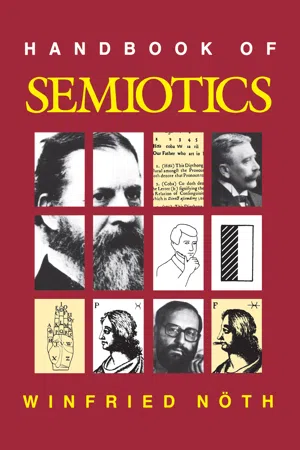 eBook - PDF
- Winfried Noth, Winfried Nöth(Authors)
- 1990(Publication Date)
- Indiana University Press(Publisher)
2.1 Language and Semiotic The heuristic point of departure for Hjelm-slev's Semiotics is language, which in his defi-nition is not only natural language but language in a far broader sense, including any structure that is analogous to a language and satisfies the given definition (194 3: 102, 107). Hjelmslev introduced the term semiotic 2. LANGUAGE, SEMIOTIC(S), AND SEMIOLOGY I 65 for language in this broad sense. The given definition to which Hjelmslev referred is, a semiotic is a hierarchy, any of whose components admits of a further analysis into classes defined by mutual relation (ibid. 106). Thus, a natural language, in this terminology, is a semiotic, but since structures analogous to language be-long to the class oflanguage in the broad sense, the distinction between language and semiotic, and with it the distinction between linguistics and Semiotics, tends to dissolve itself in Hjelm-slev's glossematics ( cf. Moun in 1970c: 96). The German translators of Hjelmslev's Prole-gomena (194 3a) even translate semiotic gener-ally as language (Sprache), justifying this terminology with reference to the text of the Danish original (1943a: lOS). Nevertheless, Hjelmslev attributed a special place to language in relation to other semiotic systems: In practice, a language is a semiotic into which all other Semiotics may be trans-lated-both all other languages, and all other conceivable semiotic structures (194 3: 109). Quoting S. Kierkegaard, Hjelmslev added: In a language, and only in a language, we can 'work over the inexpressible until it is expressed.' 2.2 Semiology and Metasemiotic Hjelmslev placed his semiotic project of estab-lishing a linguistics in the broader sense on an immanent basis in the tradition of the Saussurean project of a general semiology (194 3: 1 08). eBook - PDF
- Thomas A. Sebeok, Jean Umiker-Sebeok, Thomas A. Sebeok, Jean Umiker-Sebeok(Authors)
- 2011(Publication Date)
- De Gruyter Mouton(Publisher)
If linguistics as a whole is to be excluded from this account, what about other massive logocentric endeavors, notably literary Semiotics? For 'many poetic features belong not only to the science of language but to the whole theory of signs, that is, to general Semiotics' (Jakobson 1960: 351). As far back as 1974, Bailey and Chatman had already compiled a bibliography of twenty pages under this specific rubric for this country and Canada alone; and indeed, as Wellek says in his incomparable compendium of American criticism during the first half of this century, many 'in the United States aim at an all-embracing structure of universal poetics and finally at a science of Semiotics...' (1986: 156). Scholes has fearlessly ventured in just this direction, by way of a series of lively practical demonstrations of semiotic technique, with a glossary of semiotic terminology attempting to knit the loose ends of his book together (1982). 6 Since mid-century, until at least the advent of the era of so-called 'post-struc-turalism' (i.e., 'deconstruction* and the unfortunately designated 'pragmatism'), there has appeared a veritable avalanche of explicitly or implicitly semiotic works that bore on textual matters. And, concomitantly with—or perhaps despite—the coming of these novel approaches, whole fresh semiotic subdisciplines have sprung up, with a distinctively American flavor or at least with a strong input from the Western shores of the Atlantic, dealing with many genres of Semiotics of discourse in the narrow sense. Here are just a few samples: 302 Thomas A. Sebeok —Semiotics of the theater, comprehending both the playscript and the spectacle text, with other performance elements (Carlson 1988); Plate 21. eBook - PDF
Wittgenstein in Translation
Exploring Semiotic Signatures
- Dinda L. Gorlée(Author)
- 2012(Publication Date)
- De Gruyter Mouton(Publisher)
The intersemiotic artist searches for the purity of the verbal and nonverbal signs and attempts to trans-pose them into the modernity of different times and spaces. The illogical dis-covery of intersemiosis is a sign of freedom for logical scholarship: the poetic liberty to (self-)question the center of the sign and its accessories. The intro-duction of intermedial and extramedial languages creates a translation from inside to outside the sign itself. The semiotic status of various nonverbal languages and their translational equivalences with verbal languages presents problems. The function of the linearity of speech and script must also be defined in the variety of different arts, because written and oral texts are interpreted as unduly narrowing the field of artistic frames. This narrowing presents a distinction and succession of items which in the finished message of painting, architecture, and sculpting is presented all together in the combined sign, like Peirce’s “emotion of the tout ensemble ” (CP: 1.311). By surfing to the narration in drama, film, and opera, we jump from the whole to details, and have a complex series of close-up, medium, and long shots. The chainlike sequence of dramatis personae in written texts is segmented and transposed into different time-space units and sequences (Merrell 1992). Linguistic features are essentially arbitrary and basi-cally conventional(ized) from one language to another, this linear process is also true for the perception of music, while the outward manifestation of other arts, such as painting and sculpture, is free to be inspected or neglected at will. One common feature shared by musical and poetic language alike is the role of repeated projection of the “higher” paradigmatic (that is, structural) equivalences upon the “lower” syntagmatic (that is, serial) chain of signs. In music, the organic synthesis of synchronism and progression produces mel-ody, harmony, as well as polyphony. eBook - PDF
- Bronwen Martin, Felizitas Ringham(Authors)
- 2006(Publication Date)
- Continuum(Publisher)
Utterances such as 'in other words', 'do you understand?', 'what I mean to say' are illustrative of this function. Dictionaries are a good example of the metalingual function dominating a text. Dominance of the metalingual function in a text does not preclude the other speech functions being present to varying degrees. See also communication model. Metaterm 121 Metaphor The term metaphor designates the procedure by which a given sentential unit is substituted for another, thereby transforming its original semantic charge. In other words, a substitute name or descriptive expression is transferred to some object/person to which it is not literally applicable: 'pilgrimage', for instance, is employed instead of life', 'burning fire' to express the notion 'love', 'lamb' to describe a child, etc. See also metonymy. MetaSemiotics The term metaSemiotics refers to the theory of meaning produced on a second or higher level of signification. Any utterance which can be semiotically investigated may also cause effects that cannot be explained by analysing linguistic data. For instance: Why do we believe someone's words to be true when they themselves offer no guarantee for such trust? What makes us understand the opening passage of a book as fiction or documentary account, if there is no firm verbal indication as to which way it is to be taken? According to Hjelmslev, there are two basic types of metaSemiotics: a scientific one and a non-scientific one. Non-scientific metaSemiotics falls within the domain of philosophy, ontology and even ethics. It concerns, in fact, a fiduciary agreement between an enunciator and an enunciatee which, in everyday life, cannot be analysed in terms of objective science. Scientific metaSemiotics, on the other hand, deals with objects which are themselves already scientific signifying systems, such as mathematics, logic, linguistics. Its main concern, therefore, would seem to be a matter of metalanguage. eBook - PDF
Sign, System and Function
Papers of the First and Second Polish-American Semiotics Colloquia
- Jerzy Pelc, Thomas A. Sebeok, Edward Stankiewicz, Thomas G. Winner, Jerzy Pelc, Thomas A. Sebeok, Edward Stankiewicz, Thomas G. Winner(Authors)
- 2020(Publication Date)
- De Gruyter Mouton(Publisher)
LINDA R. WAUGH Some Remarks on the Nature of the Linguistic Sign What is the multiform relationship and interplay between the two sides of any verbal sign—its sensuous, perceptible aspect, which the Stoics labeled signans (the signifier), and the intelligible or, properly, translatable aspect, which they termed signatum (the signified)? Roman Jakobson 1971a: 631 Given the fact that 'every linguistic entity, from the largest down to the very smallest, is a necessary conjunction of signans and signatum' (Jakobson 1971a: 656), the nature of the linguistic sign, including the types of connections which exist between signans and signatum as well as the intrinsic characteristics of both the signans and the signatum, is important not only for our understanding of language but also for work in general Semiotics. This is especially true since language is multimodally associated with other human semiotic systems (Preziosi 1979a: 96—102)—i.e. a situation of linguistic communication is usually combined with other types of semiotic communication—and is also, directly and indirectly, connected with the full panoply of human semiosis. The exchange of linguistic messages is an extremely powerful factor in our com-munication with one another. The code which those messages imply—and by virtue of that, the linguistic sign as the constitutive element of both the code and the correlated messages—is an extremely powerful instrument by which we build our linguistic, and more generally our semiotic, universe. A G E N E R A L ISSUE: 'CONVENTIONALITY' In his overviews of Semiotics, Roman Jakobson (1971b: 655-710; 1975) has shown that Charles Sinders Peirce's (1867 [i960]) trichotomy of signs—icon, 390 Linda R. Waugh index, and symbol—may be reformulated as the junction of two dichotomies, similarity/contiguity (which also underlies metaphor/metonymy) and factual (existential)/imputed.
Index pages curate the most relevant extracts from our library of academic textbooks. They’ve been created using an in-house natural language model (NLM), each adding context and meaning to key research topics.

