Languages & Linguistics

Text Speak
Text speak refers to the use of abbreviations, acronyms, and other shorthand forms of language commonly used in text messaging and online communication. It is often characterized by its brevity and informality, and has become a widely accepted form of communication in many contexts. However, it is also criticized for its potential to undermine traditional language skills and communication norms.
Written by Perlego with AI-assistance
Related key terms
1 of 5
5 Key excerpts on "Text Speak"
 eBook - PDF
- Larry Samovar, Richard Porter, Edwin McDaniel, Carolyn Roy(Authors)
- 2016(Publication Date)
- Cengage Learning EMEA(Publisher)
Language Variations 275 Copyright 2017 Cengage Learning. All Rights Reserved. May not be copied, scanned, or duplicated, in whole or in part. Due to electronic rights, some third party content may be suppressed from the eBook and/or eChapter(s). Editorial review has deemed that any suppressed content does not materially affect the overall learning experience. Cengage Learning reserves the right to remove additional content at any time if subsequent rights restrictions require it. Texting In the past decade a new form of slang has emerged — texting. Texting involves employing a cell phone or some other electronic device to send a message as text. Because it is a kind of instant messaging and saves the users both time and energy, texting has grown in popularity. By some estimates, the average cell phone user sends eighty to one hundred text messages a day. By using acronyms and abbrevia-tions, messages can be sent much faster than by typing out long passages on the key-board. Those abbreviations now represent a form of slang. The problem is that this new shorthand uses the English alphabet. If someone does not know that alphabet, he or she may not understand the slang. Plus, many of the text abbreviations may contain concepts that are culture specific. Below are a few examples that might be confusing to someone who is not familiar with some of the subtleties of the English language: Idioms As we have stressed throughout the last few pages, in much of the world, English is taught as a second language; therefore, you may face countless situations when you are in a country where you are speaking English to someone who might not be as fluent in the language as you. And in the United States, the Census Bureau, as we noted at the beginning of the chapter, points out that English is the second language for over 60.6 million of the people who now live in the country. eBook - PDF
- Ken Hyland, Meng Huat Chau, Michael Handford(Authors)
- 2012(Publication Date)
- Continuum(Publisher)
The chapter concludes by speculating on future developments in texting practices and the likely direction of linguistic research. A brief note on terminology before we proceed: this chapter uses various terms to describe the medium it explores: text messaging, texting and SMS (Short Message Service). Each communiqué is described as a text message, Texting and Corpora 151 and is not shortened to ‘text’ due to the general meaning of this term in linguistics. The language of texting has been called ‘Txt’ (Thurlow, 2003). Although the term risks perpetuating erroneous notions that text messages are inevitably abbreviated, I use it throughout the chapter for its convenience and clarity and because of the widespread use of the term in the literature. Overview of Text Message Corpora Research into text messaging can be situated within the field of computer-mediated discourse (CMD), to use Herring’s (2007) term. Much early research into CMD was concerned with where it sat on the writing-speech interface (e.g. Baron, 1998). As researchers moved away from the notion of one homogeneous ‘electronic mode’, more sophisticated data analyzes took into account the various social and technological features that define each domain or ‘technological mode’ (Herring, 2007). Text messaging is one such mode, sharing with other modes features such as the abbreviation strategies adopted by CMD users to overcome time and/or space constraints (Hård af Segerstad, 2002) while differing in other respects. Characteristics particular to texting include its use in coordinating activities (Ling and Yttri, 2002) and thus its integration with other forms of interaction such as face-to-face encounters as well as its particularly intimate nature. Text messages tend to be sent from mobile phones (rather than computers) straight into the recipient’s pocket; and, unlike some chat rooms, they are generally sent between people who already know each other well (Ling and Yttri, 2002).
- Susan Herring, Dieter Stein, Tuija Virtanen, Susan Herring, Dieter Stein, Tuija Virtanen(Authors)
- 2013(Publication Date)
- De Gruyter Mouton(Publisher)
and Gurly Schmidt 2002 SMS-Kommunikation: Etnografische Gattungsanalyse am Beispiel einer Kleingruppe. Zeitschrift für Angewandte Linguistik 36: 49–80. Anis, Jacques 2007 Neography: Unconventional spelling in French SMS text messages. In: Brenda Danet and Susan C. Herring (eds.), The Multilingual Internet: Language, Cul-ture, and Communication Online , 87–115. New York: Oxford University Press. Bamba, Fatim and Stuart J. Barnes 2007 SMS advertising, permission and the consumer: A study. Business Process Management Journal 13(6): 815–829. Baron, Naomi S. 1998 Letters by phone or speech by other means: The linguistics of email. Language and Communication 18: 133–170. Bieswanger, Markus 2007 2 abbrevi8 or not 2 abbrevi8: A contrastive analysis of different shortening strategies in English and German text messages. Texas Linguistics Forum 50. http://studentorgs.utexas.edu/salsa/proceedings/2006/Bieswanger.pdf Bosnjak, Michael, Wolfgang Neubarth, Mick P. Couper, Wolfgang Bandilla, and Lars Kaczmirek 2008 Prenotification in web-based access panel surveys: The influence of mobile text messaging versus e-mail on response rates and sample composition. Social Science Computer Review 26(2): 213–223. Buckingham, David 2007 Beyond Technology: Children’s Learning in the Age of Digital Culture . Cam-bridge, UK: Polity. Cameron, Deborah 1995 Verbal Hygiene . London: Routledge. Cheung, Stephen L. 2008 Using mobile phone messaging as a response medium in classroom experi-ments. Journal of Economic Education 39(1): 51–67. Chiluwa, Innocent 2008 Assessing the Nigerianness of SMS text-messages in English. English Today 24(01): 51–56. Coupland, Justine (ed.) 2000 Small Talk . London: Longman. Crystal, David 2008 Txting: the Gr8 Db8 . New York: Oxford University Press. Deumert, Ana and Sibabalwe Oscar Masinyana 2008 Mobile language choices. The use of English and isiXhosa in text messages (SMS): Evidence from a bilingual South African sample.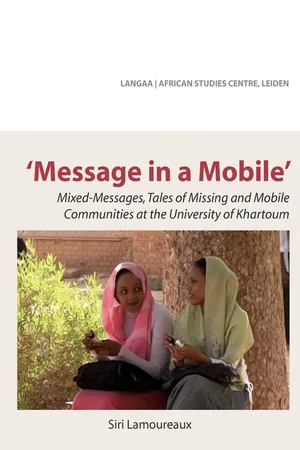 eBook - PDF
Message in a Mobile
Mixed-Messages, Tales of Missing and Mobile Communities at the University of Khartoum
- Siri Lamoureaux(Author)
- 2011(Publication Date)
- Langaa RPCIG(Publisher)
The space of the text message allows for a wide range of expression, some aspects of which deviate from normal written styles by permitting an in-formal, colloquial and oral type of writing, and others which adhere to standard formal writing conventions. Texting as a semi-oral medium As technologies such as reading and writing are adopted, they bring with them notions of how communication should be. Goody (1968) saw Arabic in West Africa as a ‘technology of literacy’, and a symbol of modernity; the cell phone too, as an instrument of modernity according to this line of thought, should be shaping language (although some would see this as negative compared with the positive view of reading and writing “traditional” texts). Nonetheless, literacy, in this view is a fixed, autonomous bundle of skills that is transferred from one knowing group to another group. However, critics of the “Great Divide” theory of “literate” vs. “oral” societies have challenged this dichotomizing view, arguing that a clear-cut distinction cannot be made between written and spoken practices, that text and speech are intertwined in daily use and local contexts shape and determine the processes for coding culturally significant information. Scribner & Cole (1981) replaced “literacy” as a set of imported, de-contextualized, informa-tion-processing skills which people applied with “literacy practices” as socially organized practices in which people engaged. At the local level, these can include such wide-ranging activities as oral memorization and recitation of religious “texts”, various ways of reading aloud, ways of talking that seems text-like. Or, as it concerns the present research, literacy in electronic tools such as computers and phones can yield text that seems talk-like - computer mediated communica-tion literacy (CMC). Indeed, an SMS as a hybrid of written-oral style is an example of the way text and talk interact. No longer available |Learn more
Understanding Language
A Basic Course in Linguistics
- Elizabeth Grace Winkler, Elizabeth Winkler(Authors)
- 2012(Publication Date)
- Continuum(Publisher)
Chapter Overview 1. The myths 244 2. Stylistic abbreviations 247 3. Etiquette 250 4. Computer-mediated language and gender 252 5. Gamer language 253 6. Texting cross-culturally 254 7. Computer-mediated language and literature 255 8. The spread of English 256 9. Conclusion 256 1. The myths There has been a great hue and cry in the popular press, 1 as well as in ‘state of the nation’ conversations, about how email and instant messaging, such as texting, chat and twitter have contributed to a generation of young people ending up completely illiterate and unable to express itself through writing (though this is not supported by research). In fact, the general perception also exists that the type of language used in these technologies is bleeding through to the speech of these same young people. These types of claims about the decline in language are not particularly new; some of the same claims are made about the ‘scourge’ of local dialects. For example, the conclusion that people using dialect will be unable to write prop-erly or express themselves clearly in places that are not in that local context. We know this is not the case. Many people are bidialectal and can shift to more 10 Electronic-Mediated Communication and Its Effects on Language Electronic-Mediated Communication and Its Effects 245 formal varieties of language when they are in job interviews and other con-texts for which more standard varieties of language are needed. Also, dialectal diversity within a single country rarely results in people being unable to make themselves understood across the country. The complaints do not begin or end with electronic communication and dialects; many of the same complaints have been levelled when other public forums like popular magazines, local radio and television, which can feature non-standard language and slang.
Index pages curate the most relevant extracts from our library of academic textbooks. They’ve been created using an in-house natural language model (NLM), each adding context and meaning to key research topics.

