Languages & Linguistics

Visual Description
Visual description refers to the use of language to create a mental image of a person, object, or scene. It involves the use of sensory details such as color, texture, and shape to help the reader or listener visualize what is being described. Visual description is often used in literature, poetry, and other forms of creative writing.
Written by Perlego with AI-assistance
Related key terms
1 of 5
5 Key excerpts on "Visual Description"
 eBook - PDF
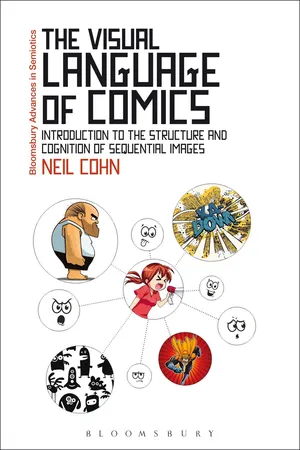
The Visual Language of Comics
Introduction to the Structure and Cognition of Sequential Images.
- Neil Cohn(Author)
- 2013(Publication Date)
- Bloomsbury Academic(Publisher)
Thus, while glossed over as the study of “comics,” really the cognitive study of this visual language aims to illuminate the links between domains that can paint a broader picture of the nature of human expression. What is “visual language”? “Visual language” here has been framed by its relationship to comics, but this notion ultimately extends beyond these contexts. Rather, the idea of a visual language contributes toward filling a gap in the cultural category regarding the channel of graphic expression. While we readily acknowledge that verbal communication uses a system of expression, graphic commu-nication has no equivalent system recognized (i.e. I speak in the verbal language of English, but I draw in _______?). While language is viewed as a rule-governed system acquired through a developmental period, drawing is looked at as a “skill,” conditioned only by the expressive aims of the artist and their abilities, which are assumed to develop through explicit instruction or innate talent. While sentences can be grammatical or ungrammatical, the predominant intuition is that there is no unacceptable way to structure images. Humans use only three modalities to express concepts: creating sounds, moving bodies, and creating graphic representations. 3 I propose further that when any of these modalities takes on a structured sequence governed by rules that constrain the output—i.e. a grammar—it yields a type of language. Thus, structured sequential sounds become spoken languages of the world, structured sequential body motions become sign languages, and structured sequential images literally become visual languages . 4 THE VISUAL LANGUAGE OF COMICS This notion of a “visual language” fills the gap for categorizing the cognitive system at work in graphic expression. When individuals acquire or develop the ability to systematically draw, along with the structures necessary to string them into sequences, they are effectively using a visual language. eBook - PDF
Teaching, Learning, and Visual Literacy
The Dual Role of Visual Representation
- Billie Eilam(Author)
- 2012(Publication Date)
- Cambridge University Press(Publisher)
In a world where visualization and media constitute a constant stream of visual stimuli, controlling what we perceive becomes a core goal of educational sys- tems. And who is more appropriate than teachers to take on the achievement of this goal? In the next chapter, I go on to describe and discuss the symbolic language of the VRs we perceive. 124 9 Symbolic Language Signs and Sign Systems The global shift from writing as the predominant mode of communication to the overriding present-day use of images has brought about many changes, not only in the media but also in knowledge dissemination as expressed in curriculum, instruction, and learning. However, written language and images differ inherently. This calls for the development of new understandings of visual messages and of new effective ways to represent diverse information. The present chapter discusses these issues. “Visual language” is a broad term, defined as an intentional use of symbols acquired within a culture, according to cultural norms and conventions, for the purpose of communication (Debes & Williams, 1978). Visual language used for nonverbal communications can take different forms; the more important ones comprise gestures – use of body movements – and systems of signs and symbols used as language (Avgerinou & Ericson, 1997). An addi- tional form of visual language (added by Ausburn & Ausburn, 1978) consists of the abstract elements of the language, like color, light and shadow, line and flow of movement, juxtaposition of items, perspectives, and relative sizes of items. Eisner (1970) for example, related to abstract representational elements as “qualitative visual symbols,” which are based on universal and/or cultural conventions, and which represent qualitative referents. However, symbols are used not only for communicating ideas to others but also for thinking. eBook - PDF
Structures of Image Collections
From Chauvet-Pont-d'Arc to Flickr
- Howard F. Greisdorf, Brian C. O'Connor(Authors)
- 2007(Publication Date)
- Libraries Unlimited(Publisher)
Part II The Language of Image Structures We are each incarcerated in our separate perspectives. M. Merleau-Ponty As noted in the previous chapters, in the eyes of a beholder, visions are grasped and processed. Processing in the human animal is mostly a conver- sion to linguistic terms that can be understood in some context, whether it is personal thought or interpersonal communication. In this continuing dis- cussion, we will go to some lengths to provide supporting evidence for the duplicity that often equates language to images, including specific examples of how we tend to describe images as though they were parts of speech. In his book Semantic Theory, Kurt Baldinger discusses the relationship of lan- guage to concept. We have taken liberties with the book in synthesizing our own view on how language invokes hegemony over images, as indicated in the diagram below. Applying Language to Visual Experience Conceptualization in Language B Conceptualization in Language A Language conceptualization in common surrounding a visual experience Conceptualization surrounding the visual experience unique in Language B Conceptualization surrounding the visual experience unique in Language A Conceptualization independent of a given language When we speak of images as being worth a thousand words, we tend to lose sight of the fact that often an image can also be a visual event that requires no words at all. We offer as proof the thousands of glances we take during our daily routines to which we give no names, no titles, and no descriptions. The images were there for the seeing, you saw them, and moved on without thinking or saying anything about them. As a further example, we offer in evidence the words of Temple Grandin, an associate professor of animal science at Colorado State University: Because I have autism, I live by concrete rules instead of abstract beliefs. And because I have autism, I think in pictures and sounds.
- Anita Naciscione(Author)
- 2010(Publication Date)
- John Benjamins Publishing Company(Publisher)
Illustrations open up the possibility to make human thought visible, to create a vi-sual efect; they provide food for thought or, as Arnheim puts it, they form visual thinking ([1969] 1997). Te picture (Figure 6.2) from Turber’s book TeBeast inMeandOtherAnimals ([1928] 1973: 269) is an apt drawing about the nature 2. Visualdiscourse is a coherent visual representation of instantial use with the aim of creating a visual narrative. In visual discourse, the phraseological image is evoked pictorially with or without a verbal text, and cohesion of phraseological meaning is retained. 3. Another interesting issue is whether the message of the verbal presentation of the phraseo-logical image is infuenced by quality and type of visual presentation. Tis aspect has received detailed attention in Burger’s article (2008). Whether there exist more or less efective modi-fcations from the point of view of the recipient is of great importance for the applied feld of advertising. However, investigation of the recipient’s viewpoint is not the aim of my research (see Burger 2008). Figure 6.1 Te cat is out of the bag Chapter 6. Visual representation of phraseological image 177 of human beings. Stylistically, it is a visual pun. Te caption, coupled with the vi-sual impact, brings out the literal meaning of the constituents of the PU to throw one’s weight about/around , 4 which is metaphorical in its base form. Metaphori-cal meaning is grounded in bodily experiences. 5 Together with the visual impact of physical perception, the textual message creates a more powerful stylistic efect. In visual representation, the cognitive link between thought, language, and sight provides a signifcant insight as we turn from the sense of sight to abstract phra-seological meaning. Te shif from fgurative to literal or from literal to fgurative results in a pun. Tis pattern demonstrates the function of the sense of sight 6 in mental and visual perception. eBook - PDF
Cognitive Linguistics
Current Applications and Future Perspectives
- Gitte Kristiansen, Michel Achard, René Dirven, Francisco J. Ruiz de Mendoza Ibáñez, Gitte Kristiansen, Michel Achard, René Dirven, Francisco J. Ruiz de Mendoza Ibáñez(Authors)
- 2008(Publication Date)
- De Gruyter Mouton(Publisher)
In light of this, lan-guage that is purely of a visual nature has much to offer our understand-ing of the embodied experience of interactions with each other, our en-vironments, and our linguistic expression of that experience. Visual communication: Signed language and cognition 373 Notes 1. There are many colleagues with whom I have had helpful discussions on cog-nitive linguistics and signed language, but in particular, I am indebted to Sher-man Wilcox and Barbara Shaffer for their insights, without which this chapter could not have been written. Any errors, of course, remain my own. 2. Stokoe et al. (1965) refer to these categories as “aspects” and to “cheremes” as opposed to phonemes. Phonologists since Stokoe, however, have tended to re-tain terminology more widely used in the discipline of phonology. References Armstrong, David F., William C. Stokoe, and Sherman E. Wilcox 1995 Gesture and the Nature of Language . Cambridge: Cambridge Univer-sity Press. Battison, Robbin 1978 Lexical Borrowing in American Sign Language . Silver Spring, MD: Lin-stok Press. Brentari, Diane 1998 A Prosodic Model of Sign Language Phonology . Cambridge, MA: MIT Press. Browman, Catherine P., and Louis Goldstein 1989 Articulatory gestures as phonological units. Phonology 6: 201–251. Boyes Braem, Penny 1981 Features of the handshape in American Sign Language. Ph.D. diss., University of California, Berkeley. Corballis, Michael C. 2002 From Hand to Mouth: The Origins of Language . Princeton/Oxford: Princeton University Press. Dudis, Paul G. 2004a Body partitioning and real-space blends. Cognitive Linguistics 15(2): 223–238. 2004b Depiction of events in ASL: Conceptual integration of temporal com-ponents. Ph.D. diss., University of California, Berkeley. Emmorey, Karen 1999 Do signers gesture? In Gesture, Speech, and Sign, Lynn Messing, and Ruth Campbell (eds.), 133–159. New York: Oxford University Press. 2002 Language, Cognition, and the Brain: Insights from Sign Language Re-search .
Index pages curate the most relevant extracts from our library of academic textbooks. They’ve been created using an in-house natural language model (NLM), each adding context and meaning to key research topics.

