Law

Law and Justice
Law and justice are interconnected concepts that aim to maintain order and fairness in society. While law refers to the system of rules and regulations set by a governing authority, justice pertains to the moral and ethical principles of right and wrong, as well as the fair treatment of individuals within the legal system. The pursuit of justice is a fundamental goal of the law.
Written by Perlego with AI-assistance
Related key terms
1 of 5

8 Key excerpts on "Law and Justice"
 eBook - PDF
Liberal Studies
An Outline Course
- N. C. Dexter, E. G. Rayner, C. V. James, D. Mattam, P. Sanderson(Authors)
- 2014(Publication Date)
- Pergamon(Publisher)
So the question of whether a given individual finds a law just is essentially a question of how far that individual finds himself in agreement with the prin-ciples of the society in which he lives. And if he differs from it, by what standards other than the prevailing standards of society he measures the ultimate worth of that law. A law is condemned as unjust, basically, from the point of view of an ideal, impersonal justice transcending human convenience or expediency. This has been variously described. The Greeks looked upon justice as a balance; a reasonable all-round development of s 120 Liberal Studies personal qualities, and a rational equilibrium of political forces, conducive to social harmony. The Romans regarded it as a spirit of mercy tempering the iron force of law; the humane interpretation that emphasized what is sometimes called the spirit rather than the letter of the law. The mediaeval church stressed the import-ance of God as the only true source of real justice, and judged the efficacy of human laws by comparison with the divinely-inspired standard of which it was the sole guardian. The rationalists of the Enlightenment regarded justice as an attribute of a rationally-inspired nature created by God, looking to the so-called natural law as its source. In the industrialized world of the nineteenth century, many, like Marx, thought of justice as an attribute of economics, and looked for social justice to an adequate and fair distribution of economic power. But not very far below the surface of all these interpretations lay the basic idea of fairness, giving us a clue to what, though their form of words may have been different, lay at the root of the idea of justice. eBook - PDF
Liberal Studies
An Outline Course
- N. C. Dexter, E. G. Rayner, C. V. James, D. Mattam, P. Sanderson(Authors)
- 2013(Publication Date)
- Pergamon(Publisher)
So the question of whether a given individual finds a law just is essentially a question of how far that individual finds himself in agreement with the prin-ciples of the society in which he lives. And if he differs from it, by what standards other than the prevailing standards of society he measures the ultimate worth of that law. A law is condemned as unjust, basically, from the point of view of an ideal, impersonal justice transcending human convenience or expediency. This has been variously described. The Greeks looked upon justice as a balance; a reasonable all-round development of 120 Liberal Studies personal qualities, and a rational equilibrium of political forces, conducive to social harmony. The Romans regarded it as a spirit of mercy tempering the iron force of law; the humane interpretation that emphasized what is sometimes called the spirit rather than the letter of the law. The mediaeval church stressed the import-ance of God as the only true source of real justice, and judged the efficacy of human laws by comparison with the divinely-inspired standard of which it was the sole guardian. The rationalists of the Enlightenment regarded justice as an attribute of a rationally-inspired nature created by God, looking to the so-called natural law as its source. In the industrialized world of the nineteenth century, many, like Marx, thought of justice as an attribute of economics, and looked for social justice to an adequate and fair distribution of economic power. But not very far below the surface of all these interpretations lay the basic idea of fairness, giving us a clue to what, though their form of words may have been different, lay at the root of the idea of justice. eBook - PDF
- Sionaidh Douglas-Scott(Author)
- 2013(Publication Date)
- Hart Publishing(Publisher)
227 A Common Conception of Justice? Justice and the Rule of Law seems less than well adapted to the competing claims of pluralism and to demands of the regulatory state. Formal accounts that do not require such a principled coherence seem better suited to the contemporary legal space. However, rather than looking to the thinnest of theories, I argue that the rule of law incorporates human rights. Raz has argued: A non-democratic legal system, based on the denial of human rights, on exten-sive poverty, on racial segregation, sexual inequalities, and racial persecution may, in principle, conform to the requirements of the rule of law better than any of the legal systems of the more enlightened Western democracies … 45 However, human rights, as I argue below in chapter nine, have (rightly or wrongly) become so much part of our mindset, a first point for any vision of justice, that their recognition and enforcement is now seen as essential for the respect of human beings. Moreover, they have become juridified in a wealth of documents both national and international as essential stan-dards that positive laws must observe. Even if there exists disagreement as to their exact nature and scope, there is broad agreement at a more general level and on the necessity of their legal enforcement, often—even usually—in the form of bills of rights, giving rise to judicial review. Human rights operate both as constraints on power and as preserving shields for individual autonomy and liberty—thus also fulfilling the essential functions of the rule of law. Therefore, I see them as necessary elements of the rule of law. 46 If forced to comply with categories, I would therefore describe the account of the rule of law advanced in this book as ‘thin +’. This brief discussion of the rule of law confirms that there exists no single model for the rule of law, no more than there is one for justice or democracy. eBook - ePub
Giorgio Agamben
Power, Law and the Uses of Criticism
- Thanos Zartaloudis(Author)
- 2010(Publication Date)
- Routledge-Cavendish(Publisher)
Not only law, but also juridical justice requires the inclusive-exclusion of a state of integrity (a bare life), a sacred, unparticipated realm. The theorization of this work aims neither at rendering legal judgment unnecessary, nor at arguing that the positing of legal principles is unnecessary in general. It does, however, at least suggest that the legal and procedural notion of justice does not exhaust the idea of justice in the actuality of case-processing, legislation and legal judgment. Here, definitional care is required: the ideal form of justice and the idea of justice are not posited as synonyms. The ideal form of justice can forever be deferred within a legal system and still be claimed to ‘not be exhausted in the actuality of law’, even if this remains counterfactual. Instead, the idea of justice is not posed, anew, as an ultimate ‘essence’ of the law (as a metalegal principle) or as a mere idealistic guiding principle of its work-in-action. This inquiry poses first the question of the law’s messianic aporia as a question as such (at the root, in fact, of the foundational mythologemes of law’s painful promises); and, second, it poses the question of rethinking the idea of justice philosophically as uncoupled from the law, which does not though indicate a ‘freedom from the law’. As such, justice is not related to foundation of law, its origin, or to the end of law, but to its fulfilment (its return to pure potentiality, which will be explored below in some detail). 12 In this sense, the concept or category of justice may not be best described as a legal concept or even as a counterconcept to the law in the performance of legal critique eBook - PDF
- John Laws(Author)
- 2021(Publication Date)
- Hart Publishing(Publisher)
IX. Conclusions My view of the Rule of Law, then, is that the very process of impartial and independent adjudication (which even the thin theory requires) implies the deployment of objective standards in the interpretation and development of the law. The standards start with loyalty to the law’s language – statute law should be interpreted according to the ordinary meaning of its text. But this is only a starting-point. Lord Mansfield’s argument in Omychund exemplifies the truth that very often the language will not cover every case. No less often, the language may be capable of more than one interpretation. In all these instances the judges will apply standards that constitute norms for the regulation of the conduct of persons and bodies subject to the law in question. The core standards are reason, fairness and the presumption of liberty, whose practical application requires the constitu-tional balance. It may strike the reader as curious that in all this discussion of constitutional principle and the Rule of Law I have not so far mentioned justice. Justice is of course at the centre of every aspect of our legal system – criminal law, private civil law, family law, enforcement process: though, as I said in the Introduction, these are among the many functions of the law which this book is not about. Justice is Conclusions 25 28 Quoted by L Fuller, The Morality of Law (Yale University Press, rev edn 1969) 152. inherent in all of them, and all of them involve the inclusion of constitutional prin-ciples in the territory of statutory interpretation. The same principles – obviously perhaps – infuse judge-made law, that is, the creations of the common law that are independent of statute, and I shall say more about that in chapter 5. The insistence of justice is found in the second of our three core constitutional norms, fairness, and in chapter 5 I shall also return to that. eBook - PDF
Definition in Theory and Practice
Language, Lexicography and the Law
- Roy Harris, Christopher Hutton(Authors)
- 2007(Publication Date)
- Continuum(Publisher)
Much of jurisprudence can indeed be understood as a clash between narrow definitions of law (e.g. law as a set of explicit rules, independent of moral or social rules) and broader definitions which see law as normative moral, social and economic practice. Some defin-itions of law give language a central role: 'The law, then, is a language that lawyers and judges use when they try to prevent or resolve problems -human conflicts -using official rules made by the state as their starting point' (Carter and Burke 2002: 6). Glanville Williams suggests that law is a sub-category of language: For lawyers language has a special interest because it is the greatest instru-ment of social control. Lawyers are perhaps apt to regard law as the sole, or chief, means of social control, forgetting that law is only a special department of language and that, whereas the application of law is limited, language is all-pervasive. (Williams 1945: 71) Following on from this, Williams argues (1945: 72) that jurisprudence is 'in much need of semantic analysis', in particular to avoid 'word fetishism' and the 138 Definition in Theory and Practice taking of Verbal distinctions' for 'real distinctions', problems diagnosed by Ogden and Richards (1923). He evokes the metaphor of core meaning which legal theory shares with semantics: The upshot is that the words we use, though they have a central core of meaning that is relatively fixed, are of doubtful application to a considerable number of marginal cases. In general, we try in our language to sharpen our distinctions beyond what is warranted by the facts of the case. It is a necessary feature of language that we should have to make this effort, and thus it is inevitable that our linguistic distinctions should constantly break down. (Williams 1945:191) Williams' conclusion is that 'the theory here advanced destroys completely and for ever the illusion that the law can be completely certain.
- Shiv R.S. Bedi(Author)
- 2007(Publication Date)
- Hart Publishing(Publisher)
(For Hart’s quotation see HLA Hart, The Concept of Law (Oxford, Clarendon Press, 1961) 188. 92 Weeramantry ibid , p 521. 93 Ibid . 94 Ibid . 95 Shestack cited in M Dixon and R Mccorquodale, Cases and Materials on International Law , 2nd edn, (London, Blackstone Press) p 194. Justice, according to Rawls is the first virtue of social institutions. And he main-tains that human rights are certainly an end of justice. Therefore, his theory of justice based on fairness suggests that the role of justice is crucial to understand-ing human rights. Rawls’ conception of justice rests on his two following cardinal principles: First Principle . Each person is to have an equal right to the most extensive total system of equal basic liberties compatible with a similar system of liberty for all. Second Principle . Social and economic inequalities are to be arranged so that they are both: (a) to the greatest benefit of the least advantaged, consistent with the just saving principle, and (b) attached to offices and positions open to all under conditions of fair equality of opportunity. 96 The general conception behind these principles rests on the principle of fairness . In deriving these principles Rawls has created in his book a hypothetical situation in which a group of people are to choose a set of principles of justice to govern their own conduct. The principles are to be agreed upon under certain conditions bear-ing specifically on knowledge and motivation. The knowledge conditions are to guarantee fairness. The choosers are assumed to know general scientific principles but are shielded by a ‘veil of ignorance’ from their own knowledge, for instance their own conception of the good, own talents, own society, own position, etc. This is how Rawls formulates his normative principles of justice based on fairness, and shielded by ‘veil of ignorance’ . These two principles, however, are not of equal weight.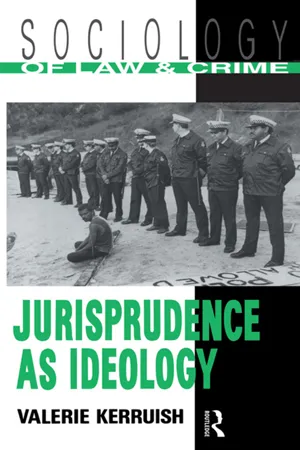 eBook - ePub
- Valerie Kerruish(Author)
- 2005(Publication Date)
- Routledge(Publisher)
Finnis uses an analogy between a builder interpreting and determining an architect’s plans to explain this notion. The legislator/judge fills in the details of rules and regulations and has freedom of choice in so doing so long as he or she stays within the principles of the natural law.Since the natural law (morality) is instantiated in some degree in a human legal system there is a prima facie (moral) obligation to obey the law. But legal systems like other natural organisms can be healthy or corrupted, and human laws, given human fallibility, can be just or unjust. Whereas the discursive specificity of legal obligation (in the sense of obligations prescribed by formally valid laws) is that they are absolute, the moral obligation to obey the law is one of practical (not formal legal) reasonableness. In a particular case it may therefore be outweighed by other requirements of practical reasonableness.It is not too much of an over-simplification to say that just as Hart’s concept of law includes a minimum content of natural law, Finnis’ includes a minimum content of legal positivism. There is a difference of priorities here on just the question with which Finnis begins his text—the evaluation of the significance and importance of relevant data, given that some agreement on what is relevant comes from the character of Jurisprudence as an internalist philosophy of law. Different philosophical frameworks fracture the supposedly singular notion of legal thought. They bring with them differences on fundamental questions about law and society which go to characterisation of the relations between law and morality and law and coercion as internal or external to the concept of law. At the meta-discursive level, these differences emerge in arguments about the proper boundaries of the domain of Jurisprudence. With Dworkin’s text we move to a delimitation of that domain by political principles of United States, New Deal liberalism.Law’s Empire: Law as IntegrityMethod and politics
The courts are the capitals of law’s empire, and the judges are its princes, but not its seers and prophets. It falls to philosophers, if they are willing, to work out law’s ambitions for itself, the purer form of law within and beyond the law we have.
Index pages curate the most relevant extracts from our library of academic textbooks. They’ve been created using an in-house natural language model (NLM), each adding context and meaning to key research topics.

