Law

Legal Causation
Legal causation refers to the link between a defendant's actions and the resulting harm to the plaintiff in a legal case. It involves determining whether the defendant's actions directly caused the harm and if they can be held legally responsible for it. Legal causation is a key element in establishing liability in tort and criminal law cases.
Written by Perlego with AI-assistance
Related key terms
1 of 5

10 Key excerpts on "Legal Causation"
 eBook - ePub
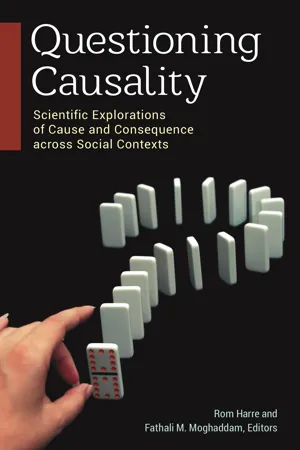
Questioning Causality
Scientific Explorations of Cause and Consequence across Social Contexts
- Rom Harré, Fathali M. Moghaddam, Rom Harré, Fathali M. Moghaddam(Authors)
- 2016(Publication Date)
- Praeger(Publisher)
22 In the United States, the interaction between courts and academics is promoted by the activities of the American Law Institute, an organization of scholars, judges, and private practitioners. The institute publishes Restatements of the Law in various fields that attempt to present comprehensive accounts of what the state of the law is in each field and suggest where changes may be occurring or may be expected.The issue of Legal Causation typically surfaces when a person has been harmed and has asked the courts to make a determination of legal liability for that harm. Of course, in many instances the law imposes liability when no actual harm has occurred. In criminal cases, for example, the law prohibits and punishes particular conduct even if the conduct has caused no harm, as in the case of offenses ranging from attempted murder to speeding. In some civil (i.e., noncriminal) cases as well, the law imposes liability even in the absence of any clear harm, as in cases of trespass onto land and unlawful threats. Most civil cases, however, involve a claim that one party has been harmed, that a second party has caused the harm, and that the second party must compensate the first party for his loss. It is in cases of that type, which can be found in every field of law, that lawyers and judges grapple with issues of causation and the consequences that flow from findings of causation.The way the law addresses the issue of causation has some parallels with the treatment of causation in other fields, but it differs in significant ways as well. In particular, issues of social policy, moral culpability, and the shared community sense of fairness frequently affect the way in which the law views causation and the consequences of finding that one actor’s conduct has “caused” injury to another. That is because in many respects the law endeavors to reflect commonly shared moral sensibilities. If legal doctrine or the results of legal disputes wander too far from what the community regards as just outcomes, the law loses credibility with the persons it is intended to serve. For that reason, regardless of what philosophical or scientific concepts of causation might seem to dictate, the law frequently resists holding an individual liable for harm suffered by a victim if the common sense of fairness would dictate that the individual should not be held responsible for the harm. Such legal decisions that seek to reflect community values regarding rights and responsibilities are sometimes referred to as responding to the “corrective justice” purposes of the law. eBook - PDF
- Matthew Dyson(Author)
- 2014(Publication Date)
- Cambridge University Press(Publisher)
2 There are thus, in John Gardner’s terminology, causal and non-causal wrongs: J. Gardner, ‘Moore on Complicity and causality’ (2008) 156 University of Pennsylvania Law Review PENNumbra 432, 432. 239 rule in Rylands v. Fletcher or the offence of causing death whilst uninsured under section 3ZB of the Road Traffic Act 1988. 3 B. Causation as determining the legal response to a crime or tort Causation may go to establish that the defendant is liable to a particular legal response – be it, for example, liability in damages or punishment as a result of committing a tort or crime. Although this may overlap with the last role causation plays in both areas of law, it is distinct from it. If a person is seeking to claim substantial damages in respect of a trespass committed against his person, he or she must show that the trespass caused him loss. The tort is constituted simply by non-consensual touching. Causation of loss is not here relevant, then, to the constitution of the legal wrong. Rather, causation of loss goes to establishing the defendant’s liability to pay substantial damages. In the criminal law, causation sometimes plays a similar role. It is sometimes the case that causing an (injurious) outcome will result in the commission of a more serious offence which renders a person liable to a more severe sentence than if the outcome had not occurred, or that the causation of harm will be a significant factor in assessing the severity of a sentence for a particular offence. C. Causation as an element of a defence Various defences in both areas of law embed a causal requirement. 4 For example: the defence of contributory negligence in tort requires that the claimant’s carelessness has contributed to its injury; the defence of duress requires that the duress has caused the commission of the offence; the defence of illegality states that one cannot recover damages for the consequences of one’s (seriously) illegal conduct. eBook - PDF
- Marta Infantino, Eleni Zervogianni(Authors)
- 2017(Publication Date)
- Cambridge University Press(Publisher)
part i Causation in Context 1 The Place and Space of Causation marta infantino and eleni zervogianni 1.1 Introduction No matter what the legal system, no matter what the ground for litiga- tion, it is a firm tenet of tort law that there can be no liability without causation. The success of a plaintiff’s claim is always said to be depend- ent upon whether, and to what extent, a causal link is established between the defendant’s activity and the plaintiff’s loss. 1 Despite the apparent simplicity of such an inquiry, questions lying beneath the assessment of causation are manifold. Would the injury have occurred without the defendant’s act? 2 What to do in cases in which an injury would have occurred anyway, but later in time? And in which cases would the injury have occurred even if the defendant had behaved properly? Is chance enough for establishing causation, and, if yes, what degree of chance is required? When the plaintiff’s susceptibility to injury has contributed to the final result, should it be taken into consideration? What other factors should be taken into account? What proof should be given, and by whom? What 1 The possible citations are endless. In the comparative perspective, suffice it to refer to A.M. Honoré, ‘Causation and Remoteness’, in International Encyclopedia of Comparative Law (Tübingen: Mohr Siebeck, 1971), vol. XI, ch. 7, pp. 3, 7, and to M. Bussani and M. Infantino, ‘Tort Law and Legal Cultures’ (2015) 63 American Journal of Comparative Law 77 at 93–8. 2 What triggers the defendant’s liability might be an act, an omission or even a status, condition or activity (such as being the owner of a thing, the guardian of a person or the manager of a business).
- Gemma Turton(Author)
- 2016(Publication Date)
- Hart Publishing(Publisher)
1 Jane Stapleton, ‘Choosing what we Mean by “Causation” in the Law’ (2008) 73 Modern Law Review 433, 438. 2 Richard Wright, ‘Causation in Tort Law’ (1985) 73 California Law Review 1735, 1774–1812. 3 Richard Wright, ‘The NESS Account of Natural Causation: A Response to Criticisms’ in Richard Goldberg (ed), Perspectives on Causation (Hart Publishing, 2011) 290–91. 4 Wright, ‘Causation’ (n 2); Richard Wright, ‘Causation, Responsibility, Risk, Probability, Naked Statistics, and Proof: Pruning the Bramble Bush by Clarifying the Concepts’ (1987) 73 Iowa Law Review 1001; Wright, ‘The NESS Account’ (n 3). Wright builds on the idea of a ‘causally relevant factor’ first developed by Hart and Honoré, Causation in the Law (Clarendon Press, 1959). 2 Identifying the Proper Function of Causation As established in chapter one, causation is central to interpersonal responsibility, but the law relating to causation is currently in a state of confusion. This confusion extends not only to the exceptional approaches to causation, but characterises the standard approaches as well. This chapter will attempt to undo the confusion by adopting a clear approach to understanding the causal problems as well as their solutions. The starting point to developing any test for causation must be an accu-rate understanding of what purpose the doctrine of causation has in negligence. It will be argued here that the concept of causation in law is narrower and more precise than the use made of the term ‘cause’ in everyday language because, as Stapleton has explained, causation can be understood in a wide range of senses, from involvement, to explanation, to blame. 1 Moreover, as Wright, building on the work of Hart and Honoré, argues, philosophy provides the law with a robust account of causation that ought to form the basis of any legal test. eBook - ePub
- Danuta Mendelson, Ian Freckelton, Danuta Mendelson, Ian Freckelton(Authors)
- 2017(Publication Date)
- Routledge(Publisher)
Three topics will be dealt with in the light of this distinction between values that mark everyday life and those specific to law or medicine. These topics are causation, responsibility and legal liability. The concept of cause dominates our inquiries into the processes by which things happen, or have happened. Responsibility for good or bad outcomes of human conduct forms the link between causation and legal liability. It is central to the assessment of people's lives and doings, their successes and failures. But both causation and responsibility, though important in law, are concepts drawn from everyday life. The third topic is specific to law. It concerns the conditions that, in the interests of fairness, limit the extent to which people can be made liable for causing harm.It may help to list at the outset the values that will be mentioned. In my view those that underlie causation concern the external world, which is, within limits, conceived as objective, regular and knowable. The knowledge that we acquire with its help enables us to survive in an uncertain world. That we should be responsible for our conduct and its outcome serves a different set of values. It encourages people to act in a way that will lead to good outcomes and it promotes a sense of personal identity. The restrictions on legal liability for harm caused to others rest on various aspects of fair adjudication, especially fair procedure. Fair adjudication is obviously not a medical value. Though the concept of cause is also not specially medical, its role in providing explanations of disease and recipes for cure is crucial to medical science and practice.Values Underpinning the Concept of Cause
To take Kant as a starting point, causation can be thought of as a category, like space and time, built into our make-up. We cannot help conceiving the external world in terms of it. If Kant is right, it follows that it is an across-the-board notion, applied not only in law but in science, medicine, history, ethics, politics and, if it comes to that, cricket. The concept of cause is the same in every sphere of life. That the moon's shadow caused the eclipse of the sun; that the defendant's speeding caused the plaintiff's trauma; that the Plasmodium parasite caused the patient's malaria; and that Steve Waugh's leadership was the cause of Australia's victory in the World Cup – all apply the same notion. Causation is an all-purpose tool for inquiring into the relation between one event and another.
- Kai Ambos, Antony Duff, Alexander Heinze, Julian Roberts, Thomas Weigend(Authors)
- 2022(Publication Date)
- Cambridge University Press(Publisher)
72 walen and weisser attenuated to allow for even the possibility of legal liability. The law therefore cannot rely on mere factual causation for ascribing criminal responsibility. In US law, the notion of proximate or Legal Causation narrows the field of factual causes to those that are relevant to holding a defendant legally culpable. German law uses the concept of objective imputation to serve that function. In this section, we explore how the different doctrines work and draw some conclusions about how to best select the legally relevant causes. In US law, the dominant way of selecting those who can legally be considered causally responsible is by appealing to the notion of proximate causation. This has a certain intuitive ring to it. The concept of proximity matches the idea of factual causation with a limiting metaphor from the same conceptual space, that of science (physics). Unfortunately, that metaphor can be misleading. Neither proximity in space nor proximity in time is relevant to the limiting principle in anything like a rule-like way. Rather, the limiting principle is better understood as reflecting fundamen- tal norms of fairness. As the Model Penal Code puts it, the key question is whether a result ‘is not too remote or accidental in its occurrence to have a [just] bearing on the actor’s liability or on the gravity of his offense’. 64 This commitment to limiting responsibility for results by appeal to fairness is nominally operationalised using the idea of foreseeability. 65 Foreseeability is plausibly relevant to fairness because it would be unfair to hold a defendant responsible for unforeseeable results; appealing to foresee- ability ‘exclude[s] extraordinary results’. 66 The problem with appealing to foreseeability is that the definition of foreseeability itself remains murky. eBook - PDF
- Peter Cane(Author)
- 2002(Publication Date)
- Hart Publishing(Publisher)
This link between obligation (“what our responsibilities are”) and causation is also a feature of causal judgments in the moral and political domains. 35 In the context of responsibility for bad outcomes, the reason why cases such as “injur-ing by blows” seem to lie at the core of causation, while cases such as “failing to prevent harm” and “inducing a person to do harm” seem to be marginal cases of causation, is that, both in law and morality, obligations of the type breached by a person who injures another by blows are more widespread and general in their incidence and application than obligations of the type breached by a per-son who fails to prevent harm or induces another to do harm. There are few forms of legal liability for outcomes that can meaningfully be called “non-causal”. In civil law, an example is the restitutionary liability of the passive recipient of a mistaken payment or the passive beneficiary of a fraud. Even in this case, the recipient is part of the history of the transition to 132 Responsibility and Causation 35 Smiley (1992), 185–95. the relevant outcome (i.e. receipt of the payment). If the recipient had not existed, and had not been in the right place at the right time (as it were), they would never have received the payment. On the other hand, since, by defini-tion, the recipient did nothing to attract the payment, and was under no duty to prevent its being made, there seems no causal reason to single out the recipi-ent as legally responsible for the making the payment. In other words, the rea-son why this form of liability is not cause-based is that it is not conduct-based. Causes link legally proscribed conduct with legally proscribed outcomes. Here there is a legally proscribed outcome, namely the receipt of a payment as a result of mistake or fraud. But that outcome is not traceable to any legally pro-scribed (or even any legally relevant) conduct of the person under the obliga-tion to repair the outcome, i.e. eBook - PDF
Science and Litigation
Products Liability in Theory and Practice
- Terrence F. Kiely(Author)
- 2002(Publication Date)
- CRC Press(Publisher)
The attempt has been made and still is made to make language do the service of judging itself. 9 Science and Legal Causation: A Primer on Proximate Cause 143 Language changes with its use in law and all other areas of life. In law, like science, the language is shaped by the legal process within which it functions and accordingly raises the risk of losing the trees in the forest. The rules of civil practice necessitate the capsulization of the basic facts of a case and require the plaintiff to state how he wishes the court or jury to officially characterize the defendant’s conduct. This preliminary unofficial labeling sets in motion the plethora of litigation-related rules, including proximate cau-sation, which determine the manner and pace at which the problem is to be channeled through the process to eventual resolution. It is here that legal theory enters and serves as the major catalyst in the process of structural metamorphosis of the historical event giving rise to the litigation. 10 Causa-tion, like all legal ideas, is subject to change, both linguistically and opera-tionally, due to the process of legal evolution over centuries of use. There have been a series of verbal formulations of the cause-in-fact or proximate cause idea developed and utilized by Anglo-American courts over the years. Some of these verbal tests, like the famous “but for” or sine qua non (“without which not”) test, which was popularized by the early 17th century philosopher Francis Bacon, have been around for many years. All of these verbal formulations, what we may call verbal referential tests serve as the legal definition of the facilitation idea and are the theoretical standard within which to judge the transactional facts involved in a particular case. No longer available |Learn more
- (Author)
- 2014(Publication Date)
- University Publications(Publisher)
________________________ WORLD TECHNOLOGIES ________________________ Chapter- 2 Causation and Omissions in English Criminal Law Causation in English law Causation in English law concerns the legal tests of remoteness, causation and foreseeability in the tort of negligence. It is also relevant for English criminal law and English contract law. In the English law of negligence, causation proves a direct link between the defendant’s negligence and the claimant’s loss and damage. For these purposes, liability in negligence is established when there is a breach of the duty of care owed by the defendant to the claimant that causes loss and damage, and it is reasonable that the defendant should compensate the claimant for that loss and damage. Public policy Policy at this level is less than ordre public , but nevertheless significant. The policy is to give bound to the scope of people who can claim damages, how much they can claim, and within what timeframe. The claimant must prove that the breach of the duty of care caused actionable damage. The test for these purposes is a balance between proximity and remoteness: • that there was a factual link between what the defendant did or failed to do, and the loss and damage sustained by the claimant, and • that it was reasonably foreseeable at the relevant time that this behaviour would cause loss and damage of that type. To clarify the nature of the judicial process, in Lamb v Camden LBC (1981) QB 625, Denning said: The truth is that all these three – duty, remoteness and causation – are all devices by which the courts limit the range of liability for negligence . . . All these devices ________________________ WORLD TECHNOLOGIES ________________________ are useful in their way. But ultimately it is a question of policy for the judges to decide. In other words, the court's main task is to do justice as between these parties in their present situation.
- Martin Jarrett(Author)
- 2019(Publication Date)
- Cambridge University Press(Publisher)
Moreover, the concepts of cause-prevention omissions and consequence-avoidance omissions are ultimately concerned with ‘causal responsibility’, a concept explained in section 4.4 below, whereas attribution transfers liability from an agent to a principal. 104 4.2 A Taxonomy of Legal Consequences The question of what a potential cause in law should look like having now been settled, the next definitional question can be tackled: what is the proper meaning of consequence? 102 This is uncontroversial in international law; see Crawford, State Responsibility, 113. In Anglo- American law, however, many policies have been proposed to support the existence of vic- arious liability. For an overview of these policies, see Neyers, ‘Theory of Vicarious Liability’, 291–301. 103 Condorelli and Kress, ‘Rules of Attribution’, 221. See also Frederick Pollock’s conception of vicarious liability in Pollock, Essays in Jurisprudence and Ethics, 130–131. It expresses the idea that a principal has to accept both the benefits and burdens of other persons doing his or her bidding; see Keating, ‘Idea of Fairness’, 1360. For a critique of this conception, see Neyers, ‘Theory of Vicarious Liability’, 298–300. 104 Crawford, State Responsibility, 113–114. A New Theory of Causation 61 6 1 4.2.1 Seven Consequences It is proposed that law knows of seven types of consequences, starting with organic consequences. 105 They are either the necrotic death of 106 or a change in the usual functioning of the cells of an organism – admittedly, a type of consequence that is very unlikely to be seen in an investment arbitration. A second type is physical circumstance consequences, which are changes in the location or form of physical objects. Examples include a bodily injury or damage to land or goods. The third is physical conduct consequences. They include not only physical movements but also information-creating conduct such as warning consumers about the dangers of tobacco products.
Index pages curate the most relevant extracts from our library of academic textbooks. They’ve been created using an in-house natural language model (NLM), each adding context and meaning to key research topics.

