Law

Magistrates' Courts
Magistrates' Courts are lower courts that handle minor criminal cases and some civil matters. They are presided over by magistrates, who are trained volunteers or part-time judges. These courts play a crucial role in the legal system by providing accessible and efficient justice for less serious offenses and disputes.
Written by Perlego with AI-assistance
Related key terms
1 of 5
12 Key excerpts on "Magistrates' Courts"
 eBook - PDF
Juries, Lay Judges, and Mixed Courts
A Global Perspective
- Shari Seidman Diamond, Valerie P. Hans, Nancy S. Marder, Sanja Kutnjak Ivković(Authors)
- 2021(Publication Date)
- Cambridge University Press(Publisher)
Magistrates’ courts are a time-honored institution, commonly traced back to the Justices of the Peace Act of 1361. The magistrates, sometimes referred to as “Justices of the Peace,” numbered 15,003 in April 2018 (Ministry of Justice, 2018b, p. 11). Their main jurisdiction is criminal law. Magistrates sign police search warrants, conduct trials, and make bail and sentencing decisions. They hear by far most of all criminal cases at the magistrates’ court, but also participate in appeals at Crown Courts, where they sit in panels with professional judges. Magistrates dealt with the cases of 1.4 million defendants in the 12 months ending September 2017, convicting 1.2 million of them (Ministry of Justice, 2018a). Criminal cases in England and Wales are divided into three offense categories that determine how they will be handled. In all three categories, magistrates have a function. 1. The most severe crimes (“indictable only cases”), such as murder, robbery, and rape, move to the Crown Court following a finding by the magistrates that the prosecution has a prima facie case. If a case goes to trial in the Crown Court, a professional judge presides over a jury trial, although most defendants plead guilty rather than go to trial. 2. “Triable either way offenses,” which include theft, burglary, arson, and some assaults, can be dealt with by the magistrates’ courts or the Crown Court. The magistrates will consider whether their sentencing powers – detailed in the next section – are sufficient for the case. If not, they pass it on. Scholars assert that magistrates tend to follow the prosecution’s recommendation (Cammiss & Cunningham, 2015; Cownie, Bradney, & Burton, 2013). The recommendation tends to be the product of negotiation between prosecutor and defense lawyer, The Magistrates’ Courts in England and Wales 135 taking into account court practice (Herbert, 2004). Defendants pleading not guilty can choose to move the case to Crown Court. eBook - ePub
Transforming Summary Justice
Modernisation in the Lower Criminal Courts
- Jenni Ward(Author)
- 2016(Publication Date)
- Routledge(Publisher)
3 The magistrates’ courts, magistrates and lay justiceThe previous chapter has laid out alterations occurring to summary justice in the lower criminal courts that have largely evolved through managerial processes of reform, but have also coalesced around running modern public services that are responsive to the diverse make-up and demands of contemporary society. The purpose of this chapter is to bring to the fore operations within the lower-tier magistrates’ courts, and the powers and procedures at work within them.This chapter gives an overview of the magistrates’ courts, the high volume and broad range of criminal cases they process, the breadth of decision-making powers magistrates hold, the sentencing options at their disposal and the role they are tasked with in appropriately sentencing offenders. It emphasises the historic function of the magistrates’ courts as summary justice courts and the need to take an interest in justice administration within this context (McBarnet, 1981b). It draws upon observation material extracted from time spent within London magistrates’ courts and provides textual detail on the working environment and atmosphere within the court setting. It is useful to make reference back to the earlier point that the English justice system is unique in its use of volunteer lay magistrates in dispensing criminal court justice.The magistrates’ courts are located at the lower tier of the criminal court hierarchical structure and are typically assessed to deal with 95 per cent of all criminal court work. This is because most prosecuted crime is categorised as being less serious in nature and falling within the lower court jurisdiction. The magistrates’ courts are also courts of ‘first appearance’, meaning that all cases, even the most serious ones destined for hearing in the higher Crown Courts, begin proceedings in these courts before ‘committal’ upwards. Magistrates perform a wide range of legal decision-making roles, including granting the police warrants to search private homes, awarding utility companies rights of access, making bail and remand decisions, sentencing convicted defendants through an assortment of penalties, from monetary fines at the lower end of the scale to up to between six and 12 months in prison custody,1 or two years if passing judgement in the youth courts (Davies et al.
- Sharyn Roach Anleu, Kathy Mack(Authors)
- 2017(Publication Date)
- Palgrave Macmillan(Publisher)
Magistrates sit alone (without juries) on civil and criminal trials, determining law, fact, liability, or guilt. They make a large number of other decisions, in matters such as bail applications or sentencing, committals, or preliminary examinations and preside over a range of proceedings such as pretrial conferences. They must make many decisions very rapidly, typically ex tempore. The criminal jurisdiction of magistrates courts comprises summary and some more serious offenses. Defining a crime as a summary offense sim- ply means that it is triable in a magistrates court, by a magistrate sitting alone. In some circumstances or jurisdictions, Justices of the Peace can hear some very minor offenses or preliminary matters such as bail applica- tions. Magistrates courts can also hear more serious indictable offenses that would ordinarily require jury trials in the higher courts but where legisla- tion allows them to be tried summarily, usually at the election or with the consent of the defendant. These are often referred to as minor indictable, “each way” or hybrid offenses. The first stages of all criminal cases occur in magistrates courts, including any bail applications, some early discov- ery processes, and the committal proceeding or preliminary examination, which determine whether the case is to be heard in a higher court. The main types of crimes heard and finalized in magistrates courts include property offenses (larceny, burglary, possessing/receiving stolen property); crimes against persons (simple or aggravated assaults, including some indecent assaults); driving offenses (driving under the influence of alcohol and/or drugs, disqualified/suspended license); drug charges (can- nabis, possession and/or use); consequential offenses (charges based on breaching some other court order); and other offenses (mostly disorderly behavior or weapons offenses). eBook - PDF
Law
Made Simple
- D. L. A. Barker, C. F. Padfield(Authors)
- 2014(Publication Date)
- Made Simple(Publisher)
For example, over 98 per cent of all criminal prosecutions in England and Wales are dealt with by magistrates. Magistrates also deal with some civil cases and perform certain administrative duties, particularly in licensing matters. MAGISTRATES' COURT (12) 1. Chairman of Justices 2. Justices of the Peace 3. Clerk to the Justices 4. Prosecuting Lawyer (seated) 5. Defending Lawyer (standing) 6. Probation Officers 7. Defendant 8. Usher 9. Witness 10. Other witnesses 11. Press 12. Public The Courts Today 59 There are two kinds of magistrates: (a) Justices of the Peace (lay magistrates) and (b) Stipendiary Magistrates. (a) Justices of the Peace. These are laymen appointed by the Lord Chancellor (i) in respect of counties on the recommendation of the Lord Lieuten-ant of the county, assisted by an advisory committee; (ii) in respect of large urban areas (e.g. Stoke on Trent) on the recommendation of its own advisory committee. The important features of the county and urban magistrates are that they are local people, with some knowledge of the areas for which they are appointed, who are prepared to give up a certain amount of their time (say, one or more days a month) to the discharge of their judicial duties. They are unpaid (though they may receive out-of-pocket expenses when adjudicating). The aim is to have on the bench a good cross-section of people of good character, of all social classes, male or female, who fairly represent the community. There are about 21,500 in England and Wales. (b) Stipendiary Magistrates are full-time paid magistrates. They also are appointed by the Lord Chancellor and must be barristers or solicitors of at least seven years' standing. They are found in the larger cities and towns, application for such appointments being made by the municipal corporations. A stipendiary magistrate has all the powers of two or more lay justices sitting in petty sessions. eBook - PDF
The Administration of Civil Justice in England and Wales
The Commonwealth and International Library: Pergamon Modern Legal Outlines
- R. W. Vick, C. F. Shoolbred, W. A. J. Farndale(Authors)
- 2014(Publication Date)
- Pergamon(Publisher)
C H A P T E R 4 Magistrates' Courts Civil Jurisdiction Domestic courts : Matrimonial ; Consent to marriage of an infant ; Affiliation; Guardianship of infants — Adult courts: Civil debts; Abatement of nuisance ; Ejectment —Juvenile courts : Adoption ; Care, protection or control; Education Act cases — School attendances. I N A D D I T I O N to their jurisdiction in regard to criminal matters, Magistrates' Courts also have to cope with quite a wide variety of civil work. Before proceeding in Chapters 9 and 10 to deal with the High Court of Justice, it is desirable at this stage to review the principal aspects of civil jurisdiction attaching to Magistrates' Courts. County courts are courts of first instance whose decisions are subject to appeal to the Court of Appeal, so, similarly, are Magistrates' Courts which have rights of appeal from their decisions either to Quarter Sessions or to the High Court. D O M E S T I C C O U R T S Matrimonial The civil jurisdiction of Magistrates' Courts is dealt with by three separate tribunals, namely the adult courts, the domestic courts, and the juvenile courts. It is proposed first to refer to the domestic courts which deal with matrimonial, affiliation, and guardianship of infants cases. Section 56 of the Magistrates' Courts Act, 1952, enacts that a magistrates' court when hearing domestic proceedings shall be composed of not more than three justices, including so far as practicable both a man and a woman. The business of these courts 76 Magistrates' Courts Civil Jurisdiction 77 has to be arranged in such a way as to separate the hearing and determination of these domestic proceedings from other business.
- David Hirschel, William Wakefield(Authors)
- 1995(Publication Date)
- Praeger(Publisher)
Part III The Judicial System of England This page intentionally left blank Chapter 7 The Criminal Courts, Judges, and Lawyers In this chapter we shall examine the structure of the English court system and the qualifications, duties, and powers of the various officials who appear in the courts: the judges, lawyers, and other court officials. The court process itself will be investigated in chapter 8. STRUCTURE AND JURISDICTION OF THE COURTS In England there are two levels of courts of original jurisdiction (courts that actually hear and decide cases). There are four levels of courts of appellate jurisdiction. The two courts of original jurisdiction are the Magistrates' Courts and the Crown Courts. The four courts with appellate jurisdiction are, in ascending order, the Crown Courts, the Divisional Court of the Queen's Bench, the Criminal Division of the Court of Appeal, and the House of Lords. Magistrates' Courts The Magistrates' Courts are the courts of inferior jurisdiction, the courts that are responsible for trying the less serious summary offenses. As indicated in chapter 3, in England crimes are categorized as being (1) summary, in which case they are tried in the Magistrates' Court; (2) indictable, in which case they are tried in the Crown Court; or (3) either summary or indictable, in which case they can be tried in either court. With regard to cases that can be tried in either court, it is the magistrates who make the initial determination of whether the case is more suitable for summary no The judicial System of England trial or for trial on indictment (Magistrates' Courts Act of 1980, sec. 19). A defendant must, however, consent to the case being tried in summary fashion (sec. 20). If the defendant does not consent, the case will be tried on indictment in Crown Court. A defendant may believe that there is an advantage in the case being tried in Crown Court where, unlike in Magistrates' Court, the case is heard by a jury. eBook - PDF
The Administration of Criminal Justice in England and Wales
Pergamon Modern Legal Outlines
- C. F. Shoolbred, W. A. J. Farndale(Authors)
- 2016(Publication Date)
- Pergamon(Publisher)
When, however, the proceedings are a preliminary investiga-tion with a view to committal for trial by a jury, then the func-tions of examining justices may be discharged by a single justice. The above-mentioned restrictions apply only to magistrates' Magistrates' Courts 3 courts which are manned by lay justices. A stipendiary magis-trate is empowered to sit by himself. In the event, therefore, of any petty sessional area finding that it is short of effective magistrates, it is the duty of the clerk to the justices to make the necessary representations to the Advisory Committee with a view to more appointments being made to the Commission in order to add to the strength of his bench. The Magistrates' Courts Act, 1952, in conjunction with the Magistrates' Courts Rules, 1952, are now the main instruments on which the administration of the law at Magistrates' Courts is based. The Act is a consolidation of several old statutes and deals comprehensively with the practice and proceedings before magistrates courts and the functions of justices' clerks and matters connected therewith. The criminal jurisdiction of Magistrates' Courts can be divided into three main categories, that is to say, summary trial of informations or complaints, the trial of offences which are triable on indictment or summarily, and preliminary hearings to determine whether there is a prima facie case on which to commit a defendant to an Assize court or to Quarter Sessions for trial by jury. Another way of expressing this is to say that summary cases are those in which a defendant has no right to be tried by a jury. Regarding the second category — cases triable summarily or on indictment by a jury — certain conditions have to be observed in order to determine which procedure is adopted. The third category, preliminary hearings of cases which are triable only on indictment by a jury, can, of course, be dealt with only in that way.
- Drew D. Gray(Author)
- 2016(Publication Date)
- Bloomsbury Academic(Publisher)
Police courts cleared the cells of the local police stations and so magistrates would have seen the drunks, gamblers, beggars and prostitutes caught up by the patrols of the capital’s police. The police courts had a reputation for harshness and cases were dealt with brusquely, most within minutes. There was no jury and little else to restrict the sitting magistrate from making decisions on the lives of those brought before him. Magistrates could examine offenders and acquit them if they felt there was insufficient evidence to convict, or find them guilty and then award punishment. Mr Lushington at Thames Police Court was infamous for his dislike of brawling drunks, particularly those that then assaulted the policemen that attempted to restrain them. Those brought before him could therefore expect a heavy fine, imprisonment or both. 21 Many other offenders were simply fined or warned against their future behaviour and released. In reality, police court magistrates had a range of options available to them and a tremendous ability to exercise their discretion. From Parlour to Police Court 207 However, it would be wrong to simply dismiss these courts as serving the needs of the authorities; police courts were more than just an extension of the disciplinary arm of the state. According to one contemporary writer the original purpose of the police courts was to provide a forum for quick and restorative justice for the poor of the capital. 22 Another author was at pains to point out how women used the courts to ask for advice, or to obtain summonses against their abusive or absent husbands. Others used the police courts as an alternative to the much more expensive divorce courts, to gain separation orders. 23 This civil, non-criminal role was a large part of the business of the courts and clearly important. Here we see the so-called ‘people’s courts’ in action providing quick restorative ‘justice’ for the working classes.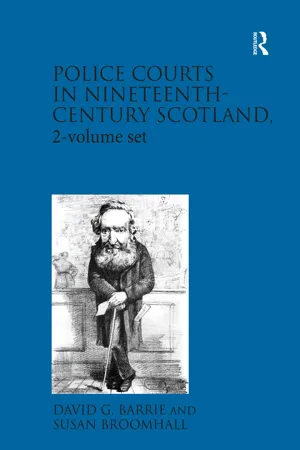
- David G. Barrie, Susan Broomhall(Authors)
- 2022(Publication Date)
- Routledge(Publisher)
In some respects their responsibilities are even heavier than those of the higher courts, for it is usually the lay magistrate who has to act as arbiter of the fate of the first offender, whose initial appearance in a criminal court so often marks the parting of the ways between a career of crime and a restoration of citizenship. In every criminal court without distinction there is need for unremitting efforts to combine that wise humanity and firm discrimination which will ensure that none leaves the court embittered by a just sense of grievance, and that no proved offender departs with a diminished respect for the laws he has violated or for 100 Police Courts in Nineteenth-Century Scotland, Volume 1 those entrusted with the enforcement of these laws. This is a high ideal. Its full attainment requires a combination of qualities some of which are incapable of forced cultivation. 11 Humility and discretion, for Cooper, lay at the heart of magisterial authority. The role of local justices was not simply to administer the law, it was also to ensure respect for law, justice and, by definition, the position and status of magistrates – a responsibility that could only be entrusted to a certain type of man whose qualifications for office rested more on his character and standing in the community than formal legal training. Such qualities were especially important in summary courts, where magistrates were responsible for deciding guilt or innocence without the aid of a jury and the level of punishment. Magisterial authority – what it consisted of, who should wield it, and who should supervise those who enacted it – was a key focus of debates in the early years of the Scottish police courts. In early nineteenth-century Edinburgh, much of the discourse on the police court structure centred on whether judges should come from a legal background or be drawn from the wider community. eBook - PDF
- Faulkner, David, Dickinson, Sally, Faulkner, David, Dickinson, Sally(Authors)
- 2012(Publication Date)
- Waterside Press(Publisher)
I can say that I found the presence of two non-legally qualified magistrates almost invariably helpful, even on occasion a healthy corrective to my, seemingly excessive, liberal attitudes to criminal justice. The one postscript for the magisterial experience I have described fortifies my plea for some development towards a mixed tribunal. At the end of the 30 day hearing I indicated to our justices’ clerk (a man of huge experience and skill in managing a magistracy containing one or two mavericks and eccentrics) that we would be delivering a reasoned judgment, at which he metaphorically threw up his hands in horror, attesting a warning that that would be a recipe for disaster, because the accused (if found guilty) would appeal to the Central Criminal Court (strictly a rehearing before a circuit judge and two magistrates from the London magistracy). I politely pointed out that if we were wrong in our reasoned judgment, we jolly well ought to be appealed. In fact there was no appeal; the two stockbrokers were later struck off the list at the Stock Exchange. The reaction of the justices’ clerk was typical of the view at the time, that mag-istrates should decide cases and not open their mouths, just like the mother whale advising her young that it is only when you begin to spout that you get harpooned. The day of the unarticulated verdict of a magistrates’ court has long since passed, although I expect that ‘ticking of boxes’ does not suf-fice to meet the need for giving reasons. It may just be possible to advance reform as an alternative to trial by jury. We should recall that Sir Robin Auld in his Review of the Criminal Courts in 2001 2 recommended that defendants should be allowed to waive jury trial if they so wished. The alternative form of the mixed composition of a criminal court could become that alternative. The Magistracy — A Professional Court? 41 Endnotes 1. eBook - PDF
The Secrets of an Aborted Decolonisation
The Declassified British Secret Files on the Southern Cameroons
- Carlson Anyangwe(Author)
- 2010(Publication Date)
- Langaa RPCIG(Publisher)
103 Chapter Four: Legislation Establishing Courts of Justice 21. For the avoidance of doubts it is hereby declared that sections 19 and 20 confer power on a magistrate of any grade to deal summarily with any offence other than a capital offence subject to the following conditions – (a) if the offence is one within the terms of paragraph (c) of subsection (1) of section 19, the magistrate shall without fail before any evidence is taken inform the person charged of his right to trial in the High Court and if such person wishes to exercise his right of consent to trial by the magistrate he shall do so at the latest before being called upon to make his defence; (b) if the person charged shall be convicted, the magistrate in imposing sentence shall not award a punishment in excess of the criminal jurisdiction as to fine and imprisonment prescribed in respect of the grade to which he has been appointed. 22. Where an offence is committed or any cause or matter arises over which a magistrate has jurisdiction, in any ship, boat or canoe, such offence may be prosecuted or such cause or matter heard and determined either by the magistrate exercising jurisdiction over the place where the ship, boat or canoe may be at the time when the offence was committed or the cause or matter arose, or by the magistrate exercising jurisdiction over the place at which the ship, boat or canoe may call after the commission of the offence or arising of the cause of matter. 23. (1) The Governor-General may, on the recommendation of the Chief Justice, by writing under his hand authorize an increased jurisdiction in civil and criminal matters, or in both, to be exercised by any magistrate o such extent as the Chief Justice may on such recommendation specify. Such authority may at any time be revoked by the Governor-General in writing under his hand.
- Nicola Padfield, Jonathan Bild(Authors)
- 2015(Publication Date)
- Routledge(Publisher)
Criminal justice practitioners, while appreciative of the quality of service given by lay magistrates, have greater confidence in professional judges (stipendiaries). Furthermore governmental pressure to make the criminal courts more efficient, and to reduce the time that cases take to complete, will also tend to favour the greater efficiency of stipendiary magistrates. However, this has to be balanced against the potential increase in cost to the Prison Service.The nature and balance of contributions made by lay and stipendiary magistrates could be altered to better satisfy these wider considerations, but should not prejudice the integrity and support of a system founded on strong traditions. Not only is the office of Justice of the Peace ancient and in an important tradition of voluntary public service, it is also a direct manifestation of government policy which encourages active citizens in an active community. In no other jurisdiction does the criminal court system depend so heavily on such voluntary unpaid effort. At no stage during the study was it suggested that in most respects the magistrates’ courts do not work well or fail to command general confidence. It is our view, therefore, that eliminating or greatly diminishing the role of lay magistrates would not be widely understood or supported.
(2011) Ministry of Justice Research Series 9/11 (at page 1)[6:5] Ipsos MORI/Ministry of Justice, The strengths and skills of the Judiciary in the Magistrates’ CourtsSummary
Study objectives and methodology
This report presents the findings from a Ministry of Justice (MoJ) commissioned research study, aimed at examining the strengths and skills of the judiciary in the magistrates’ courts for criminal cases.The research was designed to inform operational and policy decisions on the deployment of the judiciary within the magistrates’ courts in England and Wales. Specifically the research objectives were to understand:
Index pages curate the most relevant extracts from our library of academic textbooks. They’ve been created using an in-house natural language model (NLM), each adding context and meaning to key research topics.

