Literature

Aubade
An aubade is a poem or song that is typically about lovers separating at dawn. It often features a melancholic tone and expresses the sadness of parting. The word "aubade" comes from the French word "aube," which means "dawn."
Written by Perlego with AI-assistance
Related key terms
1 of 5
3 Key excerpts on "Aubade"
 eBook - PDF
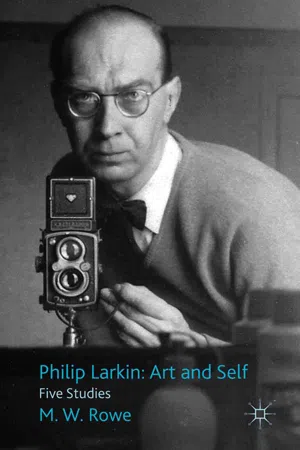
Philip Larkin: Art and Self
Five Studies
- M. Rowe(Author)
- 2011(Publication Date)
- Palgrave Macmillan(Publisher)
7 These musical Aubades are invariably small-scale, fresh, joyful pieces that carry no taint of loss or departure. ‘Aubade’ became an internationally popular title for pieces of music – particularly for wind instruments – in the early to middle twentieth century, and Larkin, who knew more about classical music than he often pretended, could well have come across a few examples. 8 IV Having clarified Larkin’s intention, we can see that the ironies Larkin finds in ‘Aubade’ are less multivalent than those in ‘Vers de Société’, but the word’s larger stock of historical associations makes them richer. Had he chosen to entitle the poem ‘Morning Song’ (like Sylvia Plath) or ‘Dawn Song’ there would be no Gallic gloss to roughen. It would also sever our link with the troubadours. With them comes the hint of the warm south and Provençal mirth; nobility and refinement; courtly love ‘Aubade’: Death and the Thought of Death 173 and the devotion to an exalted woman; chivalry and the celebration of heroes and crusades; the clarity and gravity of the pre-Raphaelite world; a life of wandering and artistic freedom; a life devoted to the refining of music and lyric; a young, richly costumed, amorous performer; a life set amongst castles, winding staircases, woods, the glint of dark wine in goblets, rich tapestries, feasts, and most speaking looks. In fact, it is quite likely that no troubadour ever sang a joyful dawn song outside his lover’s window. The alba is not joyful or sung from outside, and troubadours tended to leave performance to jongleurs. But the myth is firmly rooted in our imaginations, and continues to be nourished by children’s history books and pre-war costume dramas. This is the mental landscape in which a poem’s title is intended to resonate; not in that of esoteric, hard-won, historical facts. Larkin systematically subverts all these associations. eBook - PDF
Personae and Poiesis
The Poet and the Poem in Medieval Love Lyric
- Próspero Saíz(Author)
- 2011(Publication Date)
- De Gruyter Mouton(Publisher)
As in Släfest du, the poem opens with a natural setting but the detail is not as poetically honed. The description is general but it is specified somewhat by the place name of Betune and it is time-bound by the naming of mairdi. But the important thing is that the woman - an actor in the poem - is also the (participating) narrator - a device common to the pastourelle where the knight serves the same function. Time's onslaught on love is less important to this aube, but in keeping with the convention the lovers, reluctant to part, renew their affectionate embraces by kissing (stanza two). Though they have spent the night in love-making (juwant), there is not now time to do more than kiss. The woman closes on a note of regret at the passing of night: their renewed embraces represent a futile attempt to stave off time and bring back the night. Yet in tone this poem is quite spirited and gay in contrast to most albas. Indeed, it suggests more the joys of love than its sorrows, for the lovers have sported all alone throughout the night in a wood. While this implies secrecy, no direct reference to the dangers of their meeting is made, which tones down both the pathos and the drama of the genre. The poem in essence represents a narrated event that took place on a given Tuesday and does not exploit the poetic possi-bilities of the event or of the form. 45 Ibid., p. 370. THE ALBA, AUBE AND TAGELIEf 53 The Old French poem that best exemplifies the dramatic nature of the genre is also the longest, the best known, and the most puzzling. The Gälte de la Tor has received detailed treatment elsewhere. 46 Because of this and the impossibly corrupt state of the text, it will not be cited here or commented upon at length. How-ever, a few remarks of interest to the study are in order. eBook - PDF
- Ursula R. Franklin(Author)
- 2019(Publication Date)
- University of Toronto Press(Publisher)
Thes e introduced us to some of the dominant mo-tifs of all the Aubades , suc h as the emergenc e of a still impersonal self -'on n'est pas encoré la personne qu'o n est ' - at dawn, that self's freedom fro m thos e specifi c personal traits which will later fix and imprison it in a particular person an d day. We have seen this motif grow into a major them e of these poems; i t participates in Valéry's myth of the 'Moi pur,' predominant throughout his poetry. Another characteristic motif encountered here was the exultation-anguish ten-sión and th e theme of lucid sadness, o r sad lucidity, which reflects the essential light-darkness polarity of the moment -'l e jour commence par une lumiére plus obscure que toute nuit.' Finally, the prose poe m 'Laure' introduced an important actor of the matutinal drama, the soul, anima, with which the morning-moi i s united 'dans une sphér e unique au monde' at the privileged golden momen t of Taurore.' In the ' A B c' poem s we encountere d thre e fragments, each of which constitutes a self-contained whole , while their underlying unity makes up the integrity of the sequence's tripartite configuration. 'A/ in which the awakening mind finds its still sleeping body at dawn, was the spirit's Aubade, its passionate lov e song to the form whic h gave it life. The conscious mind and mal e spirit, animus, here was an ángel of light wooing the stil l unconscious body , his mysterious fe-male 'other half.' 6 In 'B ' mind and body , united , greeted th e new day, not without a nostalgia, however, fo r the origin, for a return t o the source and 'l a douceur de n'étre pas.' 7 And as in 'c' the newly-risen self too k possession of the ne w world , it was a self compose d o f an 126 Th e Rhetoric of Valéry's Prose Aubades inner tensión o f opposing forces , an 'enfan t aux cheveux gris' whose soul 'se sent femm e endormie, ange fai t de lumiére/ a self reflectin g the hour surrounding it, that moment which is both night and day.
Index pages curate the most relevant extracts from our library of academic textbooks. They’ve been created using an in-house natural language model (NLM), each adding context and meaning to key research topics.

