Literature

Jacques Derrida
Jacques Derrida was a French philosopher known for developing the concept of deconstruction, which challenges traditional notions of language, meaning, and truth. His work has had a significant impact on literary theory, particularly in questioning the binary oppositions and hierarchies within texts. Derrida's ideas have influenced the way literature is analyzed and understood, emphasizing the complexities and ambiguities of language and interpretation.
Written by Perlego with AI-assistance
Related key terms
1 of 5
11 Key excerpts on "Jacques Derrida"
 eBook - ePub
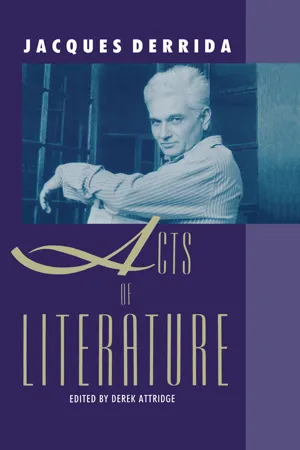
- Jacques Derrida, Derek Attridge(Authors)
- 2017(Publication Date)
- Routledge(Publisher)
together the literature/philosophy couple, to gain a sense of their co-implication— which is also the double bind in which both are caught—as well as their distinctiveness. One way of doing this is to separate out, as a strategic move, Derrida’s writings on literary texts, and to ask what it is about these texts that interests him, and what in his own response to them can throw light on the question “What is literature?”—which, as we’ve seen, is inseparable from the question “What is philosophy?”, and is implicated in any consideration of culture, politics, ethics, or history. Derrida’s writing on literature is not necessarily more “literary” in style than his writing on philosophy or art criticism or ethics; and the essays in this collection take advantage of a variety of tools, “philosophical” as well as “literary,” in pursuing and staging a number of interconnected issues arising out of the peculiar status of literature, and bearing close links with the issues addressed in Derrida’s readings of philosophy.❧ I have already stressed that “philosophical” deconstruction can work only through particular acts of reading (Derrida’s reading of a text, my reading of Derrida, my reading of that text in the light of Derrida’s reading, my reading of other texts…), that there is no abstractable or applicable argument, concept, or method which could be laid out independently of such readings.19 (This, of course, is precisely the deconstructive quarrel with philosophy, which is based on the principle of abstraction away from particular acts of language, and responses to language, toward transcendent meaning, truth, or instrumentality). Much of the difficulty of Derrida’s work stems from this insistence, since our inclination in any strenuous mental activity is to extract the meaning, the theme, the repeatable program. While Derrida demands that we do not economize on this effort—and there is much in his writing that is systematic and programmable—he also finds ways of thwarting it by placing in its way reminders of the idiomatic, the irreducibly singular, as a necessary aspect of any act of writing.There is one linguistic practice in which we habitually celebrate the unique, instead of finding it a hindrance, in which we usually have little objection to the impossibility of abstracting a detachable meaning or moral, in which we welcome being obliged to read the text again (in a repetition which is always different) in order to apprehend its power or its value: the practice we call literature. This, at least, is the claim frequently made about the distinctiveness of literature, but we’ve already had occasion to consider the ease with which the tradition of literary commentary passes to the assertion of generalities, the abstraction of meanings, the uncovering of origins, and many other typically philosophical activities. Against this transcendentalizing and universalizing tendency, Derrida tries to do justice to the literary text as radically situated eBook - PDF
- Anthony Elliott, Bryan S Turner, Anthony Elliott, Bryan S Turner(Authors)
- 2001(Publication Date)
- SAGE Publications Ltd(Publisher)
On the contrary, it is one of his prime fascinations, along with all the tricks of language, logic, and meta-physics that interfere with the expression of that intention, distort it and deviate it, and sometimes cause writers to say pre-cisely the opposite of what they (thought they) intended. Derrida's early work is, then, devoted primarily to a reconsideration of phenom-enology. This is closely followed by a cri-tique of structuralism, especially through Le Âvi-Strauss, and of structural linguistics through Saussure. Other linguistic threads are followed with (and sometimes against) Jakobson, Benveniste, Ricoeur, Austin, and Searle. Derrida's fascination with language is probably at its most evi-dent, and perhaps its most playful, in the essays of the 1970s devoted to literary wri-ters who are themselves ludic rather than logical: Genet, Sollers, Artaud, Joyce, and poet-wordsmiths such as Mallarme Â, Baudelaire, or Ponge. The latest phase of Derrida's development is his concern with psychoanalysis, ethics, and politics, fore-grounded since the 1980s, but in fact already apparent in his earliest essays of the 1960s, such as those on Freud, Bataille, and Levinas. This is the aspect of Derrida's thought which is of most immediate relevance to social theory, though his studies of phenomenology, structuralism, language, and literature are all part of the deconstructive enter-prise, and have an essential contribution to make in the theoretical domain, in par-ticular in their problematization of iden-tity, expression, intention, and meaning. SOCIAL THEORY AND CONTRIBUTIONS Derrida is clearly a philosopher rather than a social theorist, but his philosophy, like any major epistemological shift, has 152 Profiles in Contemporary Social Theory eBook - PDF
- Paul H. Fry(Author)
- 2012(Publication Date)
- Yale University Press(Publisher)
123 chapter 10 Deconstruction I Jacques Derrida Reading: Derrida, Jacques. “Structure, Sign, and Play in the Discourse of the Human Sciences” and “Différance.” In The Critical Tradition , pp. 915–925, 932–939. In this lecture we confront one of the most formidable and influential figures in our reading. In the years preceding and since his recent death (2004), Jacques Derrida has enjoyed a second vogue on the strength of hav-ing turned to ethical and political issues. He never repudiated his earlier thinking or his notoriously involuted style, but he adapted these signatures to the interests of progressive humanists. Together with the Italian philoso-pher Giorgio Agamben in particular, late Derrida is associated with what’s called “the ethical turn” in theoretical approaches to literature and other matters that is very much of the current moment. Hence owing to his latest books, Derrida’s reputation, endangered when deconstruction came under more or less theoretical attack during the late 1980s within the academy (no longer just in the broadsides of the public press), is very high again today. The materials that we are reading for this lecture date back much earlier, however, and belong to an earlier sphere of influence. The essay “Structure, Sign and Play in the Language of the Human Sciences” was delivered during a conference about “the sciences of man” at Johns Hopkins University in 1966. The event was intended as a kind of 124 Text and Structure coronation of Claude Lévi-Strauss, whose work, understood as a “science,” had burst upon the American scene only a few years earlier. Lévi-Strauss was there. He gave a talk, he was in the audience; but Derrida’s talk was widely viewed, not least by Lévi-Strauss, to be a dethroning rather than a coronation. Lévi-Strauss, who died in 2009 at the age of 101, expressed great bitterness in his old age about the displacement of his own work by what happened subsequently. eBook - PDF
- James KA Smith(Author)
- 2005(Publication Date)
- Continuum(Publisher)
Above all — as every reader can establish for himself (and for this purpose any page will do 15 ) - his work employs a written style that defies comprehension' (Points, 420). 'When the effort is made to penetrate it,' they continue, 'it becomes clear, to us at least, that, where coherent assertions are being made at all, these are either false or trivial' (Points, 420). The same sorts of charges were repeated, after the vote was decided in Derrida's favour, from within Cambridge. 16 In a post-affair docu-ment, Brian Hebblethwaite amped up the rhetoric: 'One has only to read a little of Derrida's writing to become aware that one is dealing with a thoroughly decadent strand in modern philosophy.' 17 Then his vitriolic rhetoric gets on a roll: 'Derrida's work is particularly degenerate 5 6 Jacques Derrida: Live Theory in its contempt for argumentative rigour and clarity of expression, and in its predilection for barbarous neologisms and idiotic word-play in the interests of relentless deconstruction ' (Points, 109). He then moves beyond mere questions of a barbarous style to what he sees as the content and effects of deconstruction, viz., 'Derrida's deliberate attempt to undermine all stable meaning and reference, and to deconstruct all identifiable authorial intention' (Points, 109); 'he deliberately sets himself to destroy the conditions of sensible discussion' (Points, 109); and his work 'is pernicious just because it attacks the very basic values of phil-osophy as such and of the university as such, 18 namely, disinterested search for truth, commitment to rational enquiry, respect for great minds, their insights and their power to illuminate reality' (Points, 110). Derrida is, quite simply one of 'the enemies of reason, truth, and objectivity' (Points, 111). 19 What a monster. This kind of rhetoric repeated the criticisms of Derrida that had already been aired in the States by Alan Bloom, John Searle and others. eBook - PDF
Reconsidering Difference
Nancy, Derrida, Levinas, Deleuze
- Todd May(Author)
- 1997(Publication Date)
- Penn State University Press(Publisher)
For whatever reason, if the passage from deconstruction to the next 78 Reconsidering Difference philosophical fashion occurs without more of a critical grappling with Der- rida's thought, we will all be worse off for it, and for several reasons. First, the scope and power of Derrida's rereading of the classical philo- sophical canon are rarely matched. Regarding its scope, Derrida has claimed that what he has called into question, logocentrism, has controlled not only "the concept of writing" but also "the history of (the only) metaphysics" and "the concept of science or the scientificity of science." ' Regarding its power, many reflective people have been drawn to this rereading, and it would be a shame merely to go on to the next thing without trying to dis- cover what is worth preserving in such an influential philosophical ap- proach. Second-and this is both the opposite and the complement of the first reason-the effect of Derrida's work will not be erased without (forgive me) a trace. His influence, however concealed, will continue to be felt not only in philosophy but in literature, architecture, the social sciences, and elsewhere. Whether such effects operate for good or ill depends on an as- sessment of the adequacy, in whole or in part, of his philosophical ap- proach. We need such assessment, then, not only to do justice to him but in addition to do justice to the fields his work has affected. Finally, closer to the specific concerns of this book, Derrida has been a leading member, along with Foucault, Deleuze, and Lyotard, of the contem- porary French approach that focuses upon the often neglected role of differ- ence in philosophical thought. If difference does play such an important role in our thinking-or ought to-we would do well to understand that role; and such an understanding cannot afford to bypass Derrida's proposals.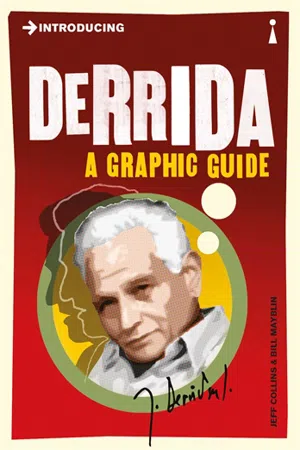 eBook - ePub
Introducing Derrida
A Graphic Guide
- Jeff Collins, Bill Mayblin(Authors)
- 2014(Publication Date)
- Icon Books(Publisher)
THERE’S NO ASSURED ESSENCE OF “LITERATURE” OR “PHILOSOPHY”. THEY’RE UNSTABLE CATEGORIES WITH NO GUARANTEES. IF THEY SEEM SECURE AND NATURAL, IT’S BECAUSE THEY’RE GOVERNED BY A POWERFUL CONSENSUS, PREMISED ON FOUNDATIONAL THINKING.Their boundaries can never be entirely certain. Texts have traits , characteristics which they share with other texts. And a literary text can share some of its traits with philosophical, legal or political texts, etc.Derrida exploits this. If the categories and boundaries are disturbed, the hierarchy too might begin to lose its grip.Contamination
So Derrida opens literature and philosophy to a mutual CONTAMINATION. It’s a deconstructive strategy. Certain characteristics of philosophy and literature might remain, but they won’t be allowed an assured, overarching mastery of what is written and how it is read.WHAT INTERESTS ME IS NOT STRICTLY CALLED EITHER PHILOSOPHY OR LITERATURE. I DREAM OF A WRITING THAT WOULD BE NEITHER, WHILE STILL KEEPING – I’VE NO DESIRE TO ABANDON THIS – THE MEMORY OF LITERATURE AND PHILOSOPHY.What can philosophy gain from its own contamination? Studying literature can reveal something about philosophy’s limits of interpretation . That’s Derrida’s main interest.He’s pursued it in two ways. He’s written about literary texts, though not producing standard literary criticism. But also, he’s borrowed devices and strategies from literary writing, and put them to use in his destabilization of metaphysics.Writing at the Limits
Searching out texts that have “made the limits of our language tremble”, Derrida has turned to avant-garde literature, to the modernist or postmodern writings of Mallarmé, Kafka, Joyce, Ponge, Blanchot and others.In 1974 he wrote an essay, “Mallarmé”, for the series Tableau de la littérature française . It’s one of Derrida’s many engagements with texts by Stéphane Mallarmé (1842–98), poet and prose writer, modernist and Symbolist.Mallarmé’s writing has usually been seen as a poetic exploitation of semantic richness – the potential of language for multiple meanings, references and allusions. Derrida reads it instead as a decomposition of linguistic elements eBook - PDF
- Peter V. Zima(Author)
- 2002(Publication Date)
- Continuum(Publisher)
In this dialogical context, Deconstruction appears neither as philosophical D E C O N S T R U C T I O N A N D C R I T I C A L T H E O R Y 3 0 irrationalism nor as fashionable obscurantism, but as a theoretical approach that often subverts the prejudices and received ideas of rationalist ideologies which are firmly rooted in everyday consciousness. The comments on Derrida’s literary analyses will show why each rationalist or Hegelian attempt to turn an ambivalent text into a conceptual structure is doomed to fail. Moreover, they will outline the limits which each Deconstructionist interpretation will reach sooner or later: limits that coincide with the phonetic, semantic and syntactic structures of texts – no matter how these are defined. In this respect the critique of Derrida’s strategy of interpretation will be related to the problems of Chapter 1: the question of the conceptual definability of art and literature. Before this crucial semiotic and aesthetic problem is approached, however, it is necessary to return to Derrida’s critique of the metaphysical tradition in order to explain to which extent such a critique expresses radical doubts concerning the metaphysical and onto-theological conception of language. 1 P A R O L E A N D E ´ C R I T U R E : C R I T I Q U E O F M E T A P H Y S I C S , C R I T I Q U E O F H E G E L By the end of the previous chapter a basic difference between Heidegger and Derrida emerged. Despite his claim that ‘[w]hat I have attempted to do would not have been possible without the opening of Heidegger’s questions’, 3 Derrida points out the meta-physical residues in the work of the Freiburg philosopher. At the same time, he continues Heidegger’s (self-)critique of metaphysics when he explains that, despite the relatedness of Deconstruction and Heidegger’s ontology, he is ‘attempt[ing] to locate in Heideg-ger’s text . . . the signs of a belonging to metaphysics, or what he calls onto-theology’. eBook - PDF
Literary Criticism in the 21st Century
Theory Renaissance
- Vincent B. Leitch(Author)
- 2014(Publication Date)
- Bloomsbury Academic(Publisher)
Derrida argues as a self-conscious French Algerian against many of Nora’s generalizations and for a future postcolonial multicultural society in Algeria. This carefully articulated position-taking remained private, and Derrida did not speak out on Algeria until subsequent troubles occurred in the 1990s. This information gives credence to the contentious idea of a late versus an early Derrida. It’s worth noting, though the biographer misses this point, that Derrida was one of the few prominent French male theorists of his cohort publicly to support at various moments feminism, anti-racism, immigrant rights, and other new social movements. The author bypasses the Anglo-sphere cultural wars of the 1980s, the time of the Thatcher–Reagan regimes and the vociferous conservative condemnations of French theory and deconstruction, which in 1987 had fastened on the de Man affair. Such attacks pressured Derrida to go public and to do so in major media. Not incidentally, this is the moment when the mainstream media were increasingly adopting tabloid-style sensationalism in the context of both the speeded-up news cycle and the proliferation of outlets. The fin-de-siècle transformation of leading academic scholars and theorists like Derrida into public intellectuals and celebrities was often initially a matter of fighting back. SECOND LIVES OF Jacques Derrida 109 Derrida’s long relationship with French educational institutions remained vexed throughout his life. The biography provides poignant cases beyond the early expulsion and the subsequent uneven school attendance during adolescence. After he left Algeria for the first time at age nineteen and entered Paris’s Louis-le-Grand Lycée in preparation for ENS entrance examinations, Derrida failed twice and ended up spending three years at this famous preparatory institution before finally succeeding. eBook - PDF
Radical Indecision
Barthes, Blanchot, Derrida, and the Future of Criticism
- Leslie Hill(Author)
- 2010(Publication Date)
- University of Notre Dame Press(Publisher)
For what was also implicit in Derrida’s citational mime-play was that each interpretative or other frame which philosophy or literary criticism might endeavour to draw around a text in order to position it as an object of reading and put it in its alleged proper context, and decide upon its meaning or meanings—which still today is how the task of reading is most commonly understood—was always already pre-ceded by the possibility of another frame, be it in the form of an ap- Jacques Derrida 259 parent absence of frame. Each and every frame was therefore necessarily partial and incomplete, which both enabled and required the interven-tion of yet another frame, while also making it superfluous and inade-quate in its turn, without it ever being possible to set a term to this irresistible movement of addition or subtraction. But there was nothing negative about this dispersion of each and every text beyond itself. For it was an indispensable condition of possibility of reading—albeit one that could not do other than spell the end of reading understood as the positioning of the text as a clearly circumscribed object, interpretable only within its own given, so-called proper (historical, formal, bio-graphical, or other) horizon of intentional meanings. Moreover, if no text could be deemed to be fully present to itself or entirely identical with itself (and it is hard to see how literary criticism or any other form of commentary might otherwise be possible), it followed that every text was indelibly marked by an irreducible, unavowable silence: an inter-ruption, erasure, or withdrawal. The mastery to which philosophy or lit-erary criticism aspired was simply impossible; for there was in every text an unmeasurable measure of secrecy, a secret whose fate was to remain unspeakable, and of which it might not even be possible to decide whether it was a secret at all. eBook - PDF
- Stephen Linstead(Author)
- 2003(Publication Date)
- SAGE Publications Ltd(Publisher)
Jacques Derrida 55 Notes 1 For example, Derrida writes that ‘the facile, demagogic, grave error of confusing my work (or even “deconstruction” in general) with postmodernism is indicative … of a massive failure to read and analyze’ (1999b: 263–4). 2 For more on Derrida’s background, and also on the problem of biography, see Bennington and Derrida (1991/1993). 3 The translation of these sections, and particularly of the word Destruktion as ‘destruction’ has contributed to some of the most serious misunderstandings of both Heidegger and now Derrida. Here I follow David Farrell Krell who in his retranslation of the Introduction to Heidegger’s Being and Time translates Destruktion as ‘destructuring’. Krell explains this choice: ‘Heidegger’s word Destruktion does not mean “destruction” in the usual sense – which the German word Zerstörung expresses. The word destructuring should serve to keep the negative connotations at a distance and to bring out the neutral, ultimately constructive sense of the original’ (in Heidegger, 1977: 63n). 4 Boje outlines a ‘seven-step deconstruction process’: 1. Define the dualities – who or what is at opposite ends in the story? 2. Reinterpret – what is the alternative interpretation to the story? 3. Rebel voices – deny the authority of the one voice. Who is not being represented or is under-represented? 4. Other side of the story – what is the silent or under-represented story? 5. Deny the plot – what is the plot? Turn it around. 6. Find the exception – what is the exception that breaks the rule? 7. What is between the lines – what is not said? What is the writing on the wall? (Boje, 1998: 462; see also 2001: 21) 5 If we were to consider the deconstructive method outlined by Calás, Boje and Martin in deconstructive fashion, we might recover a recognition of the way that some of these dangers (at some level) come back to haunt their simple outlines of method. eBook - PDF
- Suzanne Guerlac, Pheng Cheah, Suzanne Guerlac, Pheng Cheah(Authors)
- 2009(Publication Date)
- Duke University Press Books(Publisher)
≤π As we shall see in more detail further on, Derrida’s late writings specifically perform this ‘‘contamination’’ or interaction between politics and the ultrapolitical, the conditioned and the unconditioned. Furthermore, deconstruction can itself be considered an event and an activity insofar as it brings about a confrontation between philosophemes and categories of knowledge and decisive mutations in the world, causing an interruption of the former by the latter in order to force a mutation in thought so that it can be adequate to the task of thinking these important shifts, instead of being outstripped and rendered irrelevant or e√ete by them. 8 pheng cheah and suzanne guerlac Only in this way can thought live on instead of being imprisoned within a past present. Deconstruction intervenes by tracking the points of instability within political institutions and systems articulated around presence with the aim of intensifying these instabilities in the interests of emancipatory transformation. In Philosophy in the Time of Terror , Derrida characterizes the philosopher as someone who, ‘‘in the future, . . . [would] demand account-ability from those in charge of public discourse, those responsible for the language and institutions of international law. A ‘philosopher’ . . . would be someone who analyzes and then draws practical and e√ective consequences from the relationship between our philosophical heritage and the structure of the still dominant juridico-political system that is so clearly undergoing mutation. A ‘philosopher’ would be one who seeks a new criteriology to distinguish between ‘comprehending’ and ‘justifying.’ ’’ ≤∫ And the task is urgent. Concerning the political violence of the present day Derrida has written, ‘‘If intellectuals, writers, scholars, professors, artists . . . do not . . . stand up together against such violence, their abdication will be at once irresponsible and suicidal.
Index pages curate the most relevant extracts from our library of academic textbooks. They’ve been created using an in-house natural language model (NLM), each adding context and meaning to key research topics.

