Literature

Middle English Period
The Middle English Period refers to the era in English literature from around 1100 to 1500. It is characterized by the evolution of the English language from Old English to the early modern form. Notable works from this period include Geoffrey Chaucer's "The Canterbury Tales" and Sir Gawain and the Green Knight.
Written by Perlego with AI-assistance
Related key terms
1 of 5

11 Key excerpts on "Middle English Period"
 eBook - PDF
- Alexander Bergs, Laurel J. Brinton, Alexander Bergs, Laurel J. Brinton(Authors)
- 2012(Publication Date)
- De Gruyter Mouton(Publisher)
Ferdinand von Mengden, Berlin (Germany) 3 Periods: Middle English 1 What is Middle English? 2 Issues of evidence 3 Writing and speech 4 Grammar 5 Lexicon 6 Summary 7 References Abstract Middle English is the period in the history of English when variation is most thoroughly recorded in the spoken mode, and the body of surviving material is very large. In this chapter, the extralinguistic reasons for the survival of variation in Middle English are 32 I Periods Alex Bergs and Laurel Brinton 2012, Historical Linguistics of English (HSK 34.1), de Gruyter, 32 – 48 given, focusing on the relationship between linguistic form and socio-cultural function. Middle English has come down to us directly through manuscripts, and indirectly through reconstruction and through the study of residualisms in Present-day English; the reliabil-ity of the evidence for Middle English is assessed. Each level of language in turn is then discussed: writing-and speech-systems (= transmission), grammar and lexicon. New re-sources (especially online) for the study of Middle English are flagged, offering exciting possibilities for future research. The aim of the article is to offer both a characterization of Middle English itself and a sketch of the resources available for its study. 1 What is Middle English? Middle English is the form of English spoken and written roughly between 1100 and 1500 CE . Its beginning roughly corresponds to the Norman Conquest of 1066, while its end roughly corresponds to the first book printed in English (1475) and the arrival of printing in England (1476): these two historical events, though of very different kinds, have implications for the status of the language during the Middle English Period. Up until the Norman Conquest, English (i.e. Old English) had a distinct status as a language of record and for literary expression; it developed a written standardized form, classical Late West Saxon, which was used by scribes outside its area of origin, i.e.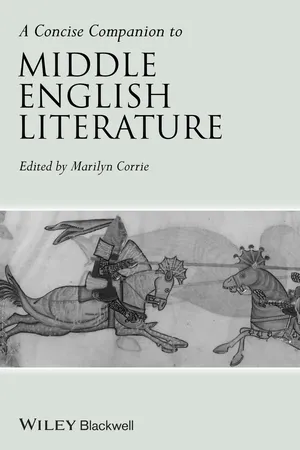 eBook - ePub
- Marilyn Corrie(Author)
- 2013(Publication Date)
- Wiley-Blackwell(Publisher)
It is striking that such reconfigurations actually stage a return to the Tudor view of Middle English. It was suggested at the beginning of this essay that the earliest retrieval of Middle English, in the Tudor period, was confined to literature after 1350, with a corresponding focus on how Chaucer and his contemporaries could be linked to Tudor writers. In the twenty-first century, this configuration is being revived in a way that implies it is not 1066 or 1100 that marks a beginning for Middle English, but the active lifetime of Chaucer. While this might be viewed as a beneficial reconnection of early English literary history with the tradition established in the early modern period, in practice it also lends itself to a fresh split within Middle English. In a way reminiscent of Dryden in 1700, recent scholars could be seen as wanting to lift Chaucer and his contemporaries out of a medieval context in order to piggy-back them on to the more successful Shakespeare.How Middle English literature will be perceived in the future is difficult to predict. On the one hand it is surely the case that there are more people than ever before reading it. But on the other, unless the future involves a broadening of the Middle English texts that are read, the field will divide so that Chaucer can be studied alongside his fellow geniuses Spenser and Shakespeare, while everything else becomes the specialist subject of the very few left to research it.What does Middle English have to recommend it that no other period of literature has? The field is vast, uneven, often infuriating, sometimes tedious – to the great perplexity of generations of readers since 1500. More positively, for the native English speaker, for a relatively small linguistic effort, a huge literature is unlocked. And, at a time when, as I have suggested, the links between late fourteenth-century writing (in particular) and early modern literature are being affirmed, it is worth remembering the attraction of the fundamental difference eBook - ePub
Teaching English Language 16-19
A Comprehensive Guide for Teachers of AS and A Level English Language
- Martin Illingworth, Nick Hall(Authors)
- 2018(Publication Date)
- Routledge(Publisher)
As well as these ‘internal’ features of the texts of Old English, you could discuss with your group how they feel about having become detached from the origins of their language. I would suggest that most merely feel that it is mildly irritating not to be able to read texts in museums. It perhaps makes the past feel even more distant and strange. You might reflect with your class upon the plight of languages which are becoming extinct, subsumed by bigger languages like English. For example, the last speaker of the language Kasabe, spoken in Cameroon, died in November of 1996 before the language had been documented by linguists (there are many languages in the world that do not have a written form). It would surely be more than ‘mildly irritating’ if that speaker were a relative of yours and he took with him all of your family history. Languages are the repositories of history, the gateposts to identity and cultural understanding.Middle English Period 1150–1500AD
The Canterbury Tales , Geoffrey Chaucer. Chaucer is an important writer for linguistic study because of the sheer range of voices portrayed in his choice of characters on their pilgrimage to Canterbury from London. Chaucer chose his characters from all walks of life and they bring with them the multiplicity of accents, dialects, high-brow foreign borrowings and earthy Anglo-Saxon vocabulary.The Lord’s Prayer . It can be useful to contrast your Old English version of The Lord’s Prayer (above) with a Middle English version. This makes a good introduction to the ways in which the language has moved on between the two general time periods. Students will undoubtedly note that this text is much more accessible. So, you explore why they can now, not only identify the text, but fully understand it.Oure fadir that art in heuenys, Halewid be thy name. Thy kingdom come to, Be-thy wille don as in heuene an in erthe. Give to us this day oure breed ouer other substaunse, And furgiue to us oure dettouris, And leede us not into temptacioun, But delyuere us from yuel. Amen.Piers Plowman , William Langland. In a period when the English language had made extensive borrowings from French, Langland’s verse is notably lacking in such borrowings. This text deals with the plight of the working classes of the Midlands area and is written in alliterative verse making use of the voice of the peasant classes. For the linguist, this text is a good reminder that each text must be considered on its own merits rather than general notions of what one might expect to see in a text written in 1390.__________________________________This period is dominated by the invasion of the Norman French in 1066. English became a second-, or indeed third-class language in its own country behind the French of the ruling classes and the language of learning and religion, Latin. Writing in English all but disappears after the Norman Conquest until around 1200. English became an oral language, not thought fitting for serious and important matters.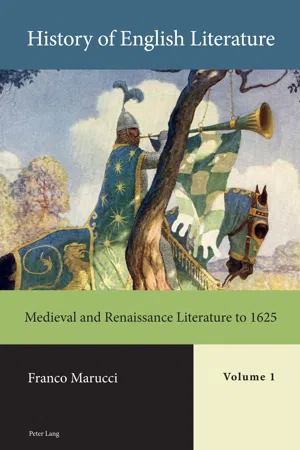 eBook - PDF
History of English Literature, Volume 1 - eBook
Medieval and Renaissance Literature to 1625
- Franco Marucci(Author)
- 2019(Publication Date)
- Peter Lang Group(Publisher)
48 part ii the Middle English Period been definitely abolished as the current tongue in the schools: it was slowly becoming a foreign language, to study and learn, not the common speech. If one looks only at literature, there is basically a void for a good hundred years, and the centuries to be considered are two, not three, the starting point being from 1160 or even as late as 1190. A further, or alternative cut- off point is 1155, which was when the Chronicles ceased to be written in Anglo-Saxon and were known henceforth as the ‘Peterborough’ Chronicles. The intermediate examples are somewhat erratic, like Canute’s poem that tells of the king in a boat in the river who hears the monks singing in Ely Cathedral and stops to listen to them; or St Godric’s ‘Hymn to the Virgin’ (the first with four, the second with eight rhyming lines). At present, historians are debating whether there was a definite break between Old English and Middle English literature or whether there was continuity in the flow of one into the other. Broadly speaking, it is obvious that the two canons are written in two totally different languages, and that the newer one is influenced by French, which lacks rhetorical depth, halo effects and excessive embellishments (Praz’s ‘barbaric jewellery’),3 and is based on the conjunction of euphonic words, producing a less heraldic, pompous, peri- phrastic vernacular than Old English. In the area of prosody, the difference is mainly between the rigid syllabic principles of French or Latin and the English tolerance for extra syllables in metre and rhythm, which, in itself, is an allegory of the English language’s eternally lurking, wayward propen- sity to shake off Latinity and continental, ‘romance’ linguistic elements (or so it may appear). eBook - ePub
- Laurel Brinton, Alexander Bergs, Laurel Brinton, Alexander Bergs(Authors)
- 2017(Publication Date)
- De Gruyter Mouton(Publisher)
The canonical names for stages in the history of English can also create false impressions about the nature of language and of language change, specifically in terms of the teleology they can imply. The term “middle” in Middle English suggests the movement of the language from a beginning, through a middle, to an end, through this transitional period. As Hockett asserts above, all periods can and should be seen as transitions, and Modern English is just one more stage in the language’s history, not in any way an endpoint. If one imagines a horizontal timeline, the middle of any language’s history is also always shifting to the right as the language continues (Lass 2000); if “Middle English” retains that name for several more centuries, it will be much closer to Old English than to the English of that future moment – i.e., it will no longer clearly be in the middle of the language’s history, no matter whether one starts that in the 5th century or the 8th. The other canonical names for periods in the history of English are equally problematic. A period can only be “old” from the perspective of a future moment; as Nicolaisen (1997: 165) points out: “[…] each phase of a language is ‘modern’ to its speakers in its contemporary setting”, which highlights both the problem with “old” and “modern”. At some point, scholars will need to draw a boundary to end Modern English (cf. Curzan 2000), which means that either the new period will become the “modern” period and what we now know as Modern English will need a new name, or the new period will be forced into a label such as “Postmodern English”. To draw such a boundary, however, scholars will need to use criteria different from those Henry Sweet employed over 130 years ago when he first proposed “Modern English” as the third major historical period of English.4Origins of canonical periods in the history of English
Henry Sweet, the renowned phonetician and philologist working in the late 19th century, is generally acknowledged as the creator of the now canonical historical framework of Old, Middle, and Modern English, and most recent scholarship on the topic uses his work as a starting point. However, James A. H. Murray, Sweet’s colleague in London’s philological circles, seems to be equally important in the development of the canonical periodization, as detailed below, offering not only dates for period breaks but also an alternative perspective on the appropriate criteria for setting those boundaries. There were, of course, also other models proposed during the period that did not become canonical. For example, Oliphant (1886) offers a ten-period model in The New English
- Britannica Educational Publishing, J.E. Luebering(Authors)
- 2010(Publication Date)
- Britannica Educational Publishing(Publisher)
CHAPTER 2
THE Middle English PeriodB y the end of the Old English period, English had been established as a literary language with a polish and versatility unequaled among European vernaculars. The Norman Conquest (1066) worked no immediate transformation on either the language or the literature of the English.EARLY MIDDLE ENGLISH POETRY
Older poetry continued to be copied during the last half of the 11th century. Two poems of the early 12th century—“Durham”, which praises that city’s cathedral and its relics, and Instructions for Christians , a didactic piece—show that correct alliterative verse could be composed well after 1066. But even before the conquest, rhyme had begun to supplant, rather than supplement, alliteration in some poems, which continued to use the older four-stress line, although their rhythms varied from the set types used in classical Old English verse. A postconquest example is “The Grave,” which contains several rhyming lines. A poem from The Anglo-Saxon Chronicle on the death of William the Conqueror, lamenting his cruelty and greed, has more rhyme than alliteration.INFLUENCE OF FRENCH POETRYBy the end of the 12th century, English poetry had been so heavily influenced by French models that such a work as the long epic Brut (c . 1200) by Lawamon, a Worcestershire priest, seems archaic for mixing alliterative lines with rhyming couplets while generally eschewing French vocabulary. The Brut draws mainly upon Wace’s Anglo-Norman Roman de Bru t (1155; based in turn upon Geoffrey of Monmouth’s Historia regum Britanniae [History of the Kings of Britain]), but in Lawamon’s hands the Arthurian story takes on a Germanic and heroic flavour largely missing in Wace. The Brut exists in two manuscripts, one written shortly after 1200 and the other some 50 years later. That the later version has been extensively modernized and somewhat abridged suggests the speed with which English language and literary tastes were changing in this period. The Proverbs of Alfred was written somewhat earlier, in the late 12th century. These proverbs deliver conventional wisdom in a mixture of rhymed couplets and alliterative lines, and it is hardly likely that any of the material they contain actually originated with the king whose wisdom they celebrate. The early 13th-century Bestiary mixes alliterative lines, three- and four-stress couplets, and septenary (heptameter) lines, but the logic behind this mix is more obvious than in the Brut and the Proverbs , for the poet was imitating the varied metres of his Latin source. More regular in form than these poems is the anonymous Poema morale eBook - PDF
- Violeta Sotirova(Author)
- 2015(Publication Date)
- Bloomsbury Academic(Publisher)
Recent focus on the multilingual situation of late-medieval Britain has revealed the enrichment of Middle English by large num-bers of words drawn from Anglo-French, rather than the continental variety, a form of French with which the scribes and authors of administrative documents in Middle English were in daily contact. The Bloomsbury Companion to Stylistics 604 Middle English was regionally and socially diverse and, for much of the medieval period, was not a language of record; its spelling systems reveal the wide diversity of its written form. However, although there is not yet any notion of linguistic regional stereotyping, we do find in Chaucer one example (as dis-cussed above) of the use of dialects in literary writing to convey verisimilitude and the disruption of expectations about how people speak. As the period develops, we also see evidence of the use of different levels of language, from the ornate to the vulgar, combined with variations in tone which reveal that writers of Middle English were conscious of the varying demands of text type and genre and were developing these. By the end of the Middle English Period, it is not difficult to discern an acute awareness of the nuances of semantic mean-ing and the appropriateness (and adaptability) of different vocabularies for dif-ferent genres contributing to the elaboration of the functions of Middle English so that it is able to serve as the instrument for the writing of administrative, religious and academic works, and verse both high and low. Notes 1. I have counted tokens, not types, so that some repeated terms are counted twice on the grounds that the poet frequently refers more than once to the same concept, some-times selecting a synonym in place of his original term, and sometimes choosing lexi-cal repetition. 2. More recent editions, such as that of Andrew and Waldron (1987) and Stanbury (2001) do not include etymological information as part of their glosses. eBook - ePub
- Christopher Upward, George Davidson(Authors)
- 2011(Publication Date)
- Wiley-Blackwell(Publisher)
1400) was writing in the second half of the 14th century, the English court was certainly English-speaking, though still French-speaking as well. Of particular importance to the development of a new standard written English in the 15th century is Henry V’s use of English in nearly all his official correspondence between 1417 and his death in 1422 (prior to 1417 he had used French). Henry’s use of English can be said to mark a turning point in establishing English as the national language of England. 13 In 1422, the Brewers Guild states that it is changing over to keeping its records in English; one of the reasons given for this is that the king now writes in English. In literature too, there was a significant change in practice over the period in question. Up to about the middle of the 13th century, most literature produced in England was written in French. It was generally only works of a religious nature, such as the Ancrene Riwle and the Ormulum (see below), that were written in English, though there are exceptions such as Layamon’s Brut dating from around the end of the 12th century and possibly The Owl and the Nightingale (though some now date this to the late 13th century). But from the mid-13th century onwards, more and more literature, in a variety of genres, appears in English, a trend which continues into the next century. The second half of the 14th century sees the appearance of some the most important works of Middle English literature, such as Sir Gawain and the Green Knight (in which, it has been calculated, almost a quarter of the words are of French origin), Langland’s Piers Plowman and of course Chaucer’s Canterbury Tales. The Ormulum The Ormulum, a versified English translation of the Gospels by a 12th-century Augustinian canon whose name was Orm, is of some interest in the history of English spelling because of the unique phonetic spelling system Orm devised for it No longer available |Learn more
The Broadview Anthology of British Literature: Concise Volume A - Third Edition
The Medieval Period - The Renaissance and the Early Seventeenth Century - The Restoration and the Eighteenth Century
- Joseph Black, Leonard Conolly, Kate Flint, Isobel Grundy, Wendy Lee, Don LePan, Roy Liuzza, Jerome J. McGann, Anne Lake Prescott, Barry V. Qualls, Jason Rudy, Claire Waters(Authors)
- 2016(Publication Date)
- Broadview Press(Publisher)
The Middle English passage is nearly identical to the early Modern English of the Douay- Rheims version. To understand something of the dialect diversity in written Middle English, however, one should compare the Wycliffte version to the same passage in two other Middle English texts, the West Midlands Psalter and the Yorkshire version of Richard Rolle, both written around the middle of the fourteenth century: (West Midlands Psalter) Our Lord gouerneþ me, and noþyng shal defailen to me; in þe stede of pasture he sett me þer. He norissed me vp water of fyllyng; he turned my soule fram þe fende. He lad me vp þe bistiges of rigtfulnes for his name. (Richard Rolle Psalter) Lord gouerns me and naþyng sall me want; in sted of pasture þare he me sett. On þe watere of rehetynge forþ he me broght; my saule he turnyd. He led me on þe stretis of rightwisnes; for his name. By the end of the thirteenth century English began to appear once again as a language of official documents and public occasions. In 1337 a lawyer addressed the 38 Broadview Anthology of British Literature Parliament in English for the first time, as a chronicle says, “so that he might be better understood by all”; in 1362 Parliament ordered all lawsuits to be conducted in English. There is some indication that at the beginning of the fourteenth century the nobility had to be taught French—the language still held prestige, but it was by no means the native tongue of those born on English soil. Not surprisingly, it is in the same period, the fourteenth century, that English literary output becomes significant again. But the language that emerged had been strongly altered by two centuries of “underground” existence and the shaping pressure from the dominant French language and literary culture. Among the most striking changes is the emergence of rhyme as a central organizing principle of English verse. eBook - PDF
- Flora Ross Amos(Author)
- 2019(Publication Date)
- Columbia University Press(Publisher)
94. 127-130, * Minor Poems of Lydgate, E. E. T. S., Legend of St. Gyle, 11. 9-10, 27-32. ® Ibid., Legend of St. Margaret, 1. 74. • St. Christiana, 1. 1028. ' Legend of Good Women, 11. 425-6. THE MEDIEVAL PERIOD 9 compiled, translated, only such works as can claim to be called, in the modern sense of the word, translations would be a difficult and unprofitable task. Rather one must accept the situation as it stands and consider the whole mass of such writings as appear, either from the claims of their authors or on the authority of modern scholarship, to be of secondary origin. Translations of this sort are numerous. Chaucer in his own time was reckoned grant translateur. 1 Of the books which Caxton a century later issued from his printing press a large proportion were English versions of Latin or French works. Our concern, indeed, is with the larger and by no means the least valuable part of the literature produced during the Middle English Period. The theory which accompanies this nondescript collec-tion of translations is scattered throughout various works, and is somewhat liable to misinterpretation if taken out of its immediate context. Before proceeding to consider it, however, it is necessary to notice certain phases of the gen-eral literary situation which created peculiar difficulties for the translator or which are likely to be confusing to the present-day reader. As regards the translator, existing circumstances were not encouraging. In the early part of the period he occupied a very lowly place. As compared with Latin, or even with French, the English language, undeveloped and unstandardized, could make its appeal only to the unlearned. It had, in the words of a thirteenth-century translator of Bishop Grosseteste's Castle of Love, no savor before a clerk. 2 Sometimes, it is true, the English writer had the stimulus of patriotism. eBook - PDF
From Old English to Standard English
A Course Book in Language Variations Across Time
- Dennis Freeborn(Author)
- 2017(Publication Date)
- Red Globe Press(Publisher)
5 From Old English to Middle English 5.1 The evidence for linguistic change The ways in which we have identified and described features of the language in the Old English texts in Chapters 1–4 are those that we can systematically apply to any text of English. We look for: ● Changes in spelling conventions, letter forms and the alphabet used. These are our only guide in OE and ME texts to the pronunciation of the language. ● Changes in pronunciation , inferred from the written words. ● Changes in word structure , suffixes (inflections) and prefixes. ● Changes in the grammar and word order. ● Changes in the word-stock or vocabulary – new words appear, old ones are no longer used. We call the language from about 1150 to 1450 Middle English (ME), because from our point of view in time it comes between the periods of Old and Modern English. The evidence for change and development in ME, before the first printing press was set up by William Caxton in 1476, lies in written manuscripts, just as for OE. Every copy of a book, letter, will or charter had to be written out by hand, but only a few of the existing manuscripts in ME are originals, in the hand of their author. Many copies of a popular book like Chaucer’s Canterbury Tales , for example, have survived, though Chaucer’s original manuscripts have been lost. On the other hand, other works are known through a single surviving copy only. As a result of the social and political upheaval caused by the Norman Conquest (see section 5.2, following), the West Saxon standard system of spelling and punctuation was in time no longer used. Writers used spellings that tended to match the pronunciation of their spoken dialect. Scribes often changed the spelling of words they were copying to match their own dialectal pronunciation. After several copies, the writing might contain a mixture of different dialectal forms.
Index pages curate the most relevant extracts from our library of academic textbooks. They’ve been created using an in-house natural language model (NLM), each adding context and meaning to key research topics.

