Literature

Postcolonial Literary Theory
Postcolonial literary theory examines the cultural, social, and political impact of colonialism and imperialism on literature. It focuses on the representation of colonized peoples, the effects of colonization on language and identity, and the ways in which postcolonial writers challenge and subvert dominant narratives. This theoretical framework seeks to decolonize literary studies and highlight marginalized voices.
Written by Perlego with AI-assistance
Related key terms
1 of 5
11 Key excerpts on "Postcolonial Literary Theory"
 eBook - PDF
Mawere: African Cultures, Memory and Space
Living the Past Presence in Zimbabwean Heritage
- Munyaradzi Mawere, R. Mubaya, Munyaradzi Mawere, R. Mubaya(Authors)
- 2014(Publication Date)
- Langaa RPCIG(Publisher)
As Ashcroft, Griffiths, and Tiffin contend, “The idea of Postcolonial Literary Theory emerges 4 from the inability of European theory to deal adequately with the complexities and varied cultural provenance of postcolonial writing” (11). This theoretical deficiency marks the beginning of what Nigerian writer, Wole Soyinka, has characterized as the “process of self-apprehension” (1976: xi). It is this sense of self-interrogation that constitutes each national literature’s mode of expression and its aspiration to be self-sustaining. Postcolonial writers tend to take stock of colonialism’s impact on the post-colony. They strive to produce works that negate colonialism’s philosophical and cultural foci. For example, issues bordering on the impact of assimilationist policies on the psyche of the colonized are recurring themes in novels such as Le vieux n è gre et la m é daille (1956), Mission termin é e (1957), Le pauvre Christ de Bomba (1956) Climbi é (1956), Aventure Ambiguë (1961), Crépuscule des temps anciens (1962) and Things Fall Apart (1958) among others. The ideology of sovereignty is articulated in each of the aforementioned novels as a decolonizing paradigm. This choice enables writers to produce works that point in the direction of a critical appraisal of the impact of colonialism on fictional writing in European languages in the post-colony. The study of postcolonial literatures concerns itself with the question of how these literatures bear the imprint of the material forces of cultures, politics and power, and of how postcolonial writers attempt to replace the imperial language within the cultural world of the colonial periphery. The question of language is central in postcolonial literary theorization. It is the centrality of language choice in postcolonial literatures that has spurred literary critic, Ngugi wa Thiong’o, to pose the following perplexing question: eBook - PDF
- V. Andreotti(Author)
- 2011(Publication Date)
- Palgrave Macmillan(Publisher)
Part 1 Postcolonialisms and Postcolonial Theories Chapter One Contextualizing Postcolonialisms and Postcolonial Theories Postcolonialism and postcolonial theory are contested terms with con- tested origins and associations. They work in the interface between economic and cultural processes, placing emphasis on how cultural/ epistemological assumptions frame relationships and injustices. For an introduction to postcolonialism in a study in education, the inter- disciplinary dimension and transdisciplinary scope of the debates generated in this field demand various levels of translation. Hence, contextualizing postcolonialism and postcolonial theory in the con- text of this book requires a strategy of situating different perspec- tives in relation to other perspectives and debates, and in relation to education. Postcolonialism is defined in different ways from different perspec- tives, and each perspective tends to critique other uses and definitions. In the late 1960s, the term “postcolonial” was used in Commonwealth literature to refer to cultural interactions within colonial societies in literary circles. It has subsequently been widely used to refer to the political, linguistic, and cultural experience of societies in former European colonies, characterizing it as a site of disciplinary and inter- pretative contestation (Ashcroft et al. 1995). Slemon (1995) gives an overview of other uses of the term: [Postcolonialism] has been used as a way of ordering a critique of totalising forms of Western historicism; as a portmanteau term for a retooled notion of “class,” as a subset of both postmodernism and post-structuralism (and conversely, as the condition from which those two structures of cultural logic and cultural critique themselves are seen to emerge); as the name for a condition of nativist longing in post- eBook - PDF
Telling Our Stories
Continuities and Divergences in Black Autobiographies
- A. Alabi(Author)
- 2005(Publication Date)
- Palgrave Macmillan(Publisher)
Chapter 3 Postcolonial Theory and Black Literatures [W]e black Africans have been blandly invited to submit ourselves to a second epoch of colonisation—this time by a universal-humanoid abstraction defined and conducted by individuals whose theories and prescriptions are derived from the apprehension of their world and their history, their social neuroses and their value systems. It is time, clearly, to respond to this new threat, each in his own field. ––Wole Soyinka, Myth, Literature and the African World (x) . . . I should see what in the universalizing discourse could be useful and then go on to see where that discourse meets its limits and its challenge within that field. I think we have to choose again strategically, not universal discourse but essentialist discourse. I think that since as a deconstructivist—see, I just took a label upon myself—I cannot in fact clean my hands and say, “I’m specific.” In fact I must say I am an essentialist from time to time. ––Gayatri Chakravorty Spivak, The Post-Colonial Critic (11) Various Black societies have experienced different forms of colonialism and are in one postcolonial stage or another; hence this chapter discusses the relevance of postcolonial theory to a transnational study of Black literatures, literatures united by the continuities of race and Blackness discussed in chapter 2. The discussion of postcolonial theory foregrounds not just the similarities but the differences in the colonial and postcolonial experiences of various Black societies. The chapter argues that for postcolonial theory to be relevant to Black literatures, it has to pay particular attention to how Black literatures are different regionally, across continental lines, and from the literatures of other former colonies. A very significant percentage of the world population has experienced one form of colonialism or the other. eBook - PDF
The Life of Texts
An Introduction to Literary Studies
- Ann Rigney, Kiene Brillenburg Wurth(Authors)
- 2019(Publication Date)
- Amsterdam University Press(Publisher)
(But as we have seen, even academic observations are embedded in cultural schemata from which we cannot escape.) Precisely such essentialism often pre-vented the Other from speaking back to the power centre that ruled and oppressed her or him, from saying: this is not who I am, or how I should be represented. However, literature sometimes opened a space to rem-edy this injustice. Writers from colonised or formerly colonised countries have – especially in the twentieth century – used this space to rewrite history as the colonists had presented it, to explore and re-imagine their own literary heritage , or to interrogate and recreate Western literary styles and traditions. In this section, we offer an inventory of these strategies of rewriting – literally, to write again; to retake and reshape creatively and critically (hi)stories, memories, or essentialist representations – in the context of postcolonial literature. What is postcolonial literature? Like the older, problematic term ‘Commonwealth literature’ (see text box below), the term ‘postcolonial literature’ raises a number of issues. Can literatures by so many different writers, with so many different backgrounds and literary traditions be collected under a single name? Hardly. Yet, all these literatures have some-thing in common, in that they are all produced in cultures that have been confronted with European imperialism and colonial occupation. This is why we here define postcolonial literature as a literature that can be seen to emerge in the context of a colonial experience and that is produced in the period during and after that experience. During and after since, as we have seen, there has never been an end to colonialism. Thus, the postco-lonial applies to texts ranging from eighteenth- and nineteenth-century anti-slavery narratives to today’s migrant literatures and literatures criti-cally relating to colonialist expansion in the global south. essentialism heritage postcolonial literature eBook - PDF
Tintinnabulation of Literary Theory
Traversing Genres to Contemporary Experience
- Andrew Nyongesa(Author)
- 2018(Publication Date)
- Mwanaka Media and Publishing Pvt Ltd(Publisher)
Post-colonialism and its prominent theorists have contributed to migration literature by identifying a framework of features and principles. Poujafari and Vahidpour (2014) observe that the primary focus of this literature on marginal groups brings it under postcolonial theory. Post-colonialism in its most recent definition is concerned with persons from groups outside the dominant groups and therefore places subaltern groups in a position to subvert the authority of those with hegemonic power (p. 686). Ashcroft (1995) observes that post-colonial theory entails migration, slavery, suppression, resistance, representation and influences to discourses to imperial Europe (p. 2). The theory can be applied to the topic of resistance because African literature is positioned at the margins of dominant, European literature. Taking into account the fact that post-colonial studies turn the world upside down, a study that looks at issues from the view of the despised aptly comes under it (Young, 2003, p. 2). Pertinent concepts of post colonial theory are cultural hybridity and cultural fixity. Hall (1990) comes up with models of cultural identity that define transition of identity of the Caribbean populace. First, he postulates the traditional model that views identity in terms of one shared culture, hiding inside the many. Hall refers to it as artificial for cultural values are imposed on people because they share a history and ancestry. Citing the Caribbean example, Hall asserts that Caribbeans use this model to seek rediscovery of identity in Africa given their African origin (p. 393). He likens this to what Frantz Fanon calls “Passionate research,” (ibid). Hall points out that such identity was crucial in postcolonial struggles but is not relevant in the contemporary, cosmopolitan world. Bhabha expounds on the concept 62 of cultural fixity. He observes that fixity is a barrier to positive change.
- C. Okonkwo(Author)
- 1999(Publication Date)
- Palgrave Macmillan(Publisher)
3 There is a fundamental conflict between these defi- nitions. Whereas the definition of the literatures properly applies to those that foreground colonizer-colonized contradictions, the definition of postcolonial cultures overwrites this distinction and proceeds to reformulate postcoloniality as a universal condition of 'the world as it exists during and after the period of European imperial domination and the effects of this on contemporary lit- eratures'.4 The crucial terms of the definitions are therefore too vague and self-contradictory to be useful. It comes as no surprise that Ashcroft and partners finally assimilate postcolonial discourse into neocolonialist political theory which actually de-emphasizes colonialism by postulating a misleading analogy 'between the power relationship of the colonizer to the colonized and that of men to women, the upper classes to the lower, or men to the land- scape'.5 Crisis and Politics 3 An intriguing aspect of Ashcroft and partners' concept of post- coloniality is that while it includes African, Asian and South Pacific ex-colonies as well as the English-speaking European Diaspora- dominated countries of Australia, Canada (excluding the French- speaking part), New Zealand and the United States of America as postcolonial societies, it insistently excludes all non-English-speaking European Diaspora countries. Suspicion is thus raised that the major concern of this revisionist conceptualization of postcoloniality is not the illumination of the historical phenomenon but the advantageous repositioning of the English-speaking European Diaspora within this history. The inclusion of the United States of America is justified with the spurious argument that '[despite] its current position of power, and the neo-colonising role it has played, ... its relationship with the metropolitan centre as it evolved over the last two centuries has been paradigmatic for post-colonial literatures everywhere'.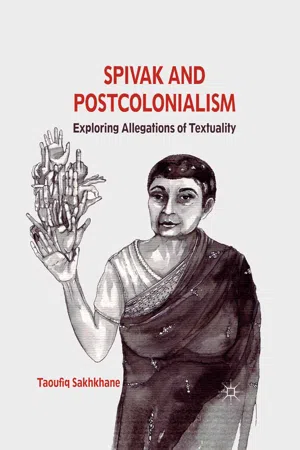 eBook - PDF
Spivak and Postcolonialism
Exploring Allegations of Textuality
- T. Sakhkhane(Author)
- 2012(Publication Date)
- Palgrave Macmillan(Publisher)
4 Postcolonialism: The Critic at Work parents but none daring enough to declare its parenthood. 2 Therefore, by way of granting a somewhat tentative baedecker to its ups and downs, critics tend to consider it, inter alia, as a wholesale practice that projects an abrogation of the heritage of colonialism; as a cri- tique of holistic, totalitarian systems of knowledge that cuts across traditionally dominant Western disciplines; as a new literary sensibil- ity emerging from what is termed ‘Commonwealth literary Studies’; as a subcategory of poststructuralism and postmodernism; as an oppositional form of ‘reading practice’; and, at last but not least, as the name for a socio-cultural condition of migrancy of Third World intellectuals. 3 Such an excessive investiture of postcolonialism, as Bill Aschcroft has pointed out, has made any self-sustained and rigorous dis- cussion of the term as a homogeneously architechtonic totality a matter of conceptual inadequacy and methodological disingenuity and may, at a further remove, incite us to view the concept ‘under erasure’, as the site not of just a single sign but the meeting nexus of a plurality of signs. It has also turned what is supposed to send tremors at its rallying cry in academies into one of its latest rogue by-products. If concepts may, like Adam in the early hours of the morning, to borrow a phrase dear to the heart of Harold Bloom, lay claim to out- and-out originality and matinal novelty, the blatant irony in the case of Postcolonialism is that it falls short of any such presumptuous claims. 4 Being one of the most elusive of terms in an age character- ized by what Mas’ud Zavarzadeh has called a ‘post-al logic’, 5 part of the clue to the concept’s multifacetedness and polyvalency resides in its designation. eBook - PDF
- Julie Mullaney(Author)
- 2010(Publication Date)
- Continuum(Publisher)
LITERARY CONTEXTS 45 Mudrooroo, Us Mob: History, Culture, Struggle – An Introduction to Indigenous Australia (1995) Jackie Huggins, Sister Girl (1998) Aileen Moreton-Robinson (ed.), Sovereign Subjects – Indigenous Sovereignty Matters (2007) Vandana Shiva, Globalization’s New Wars – Seed, Water and Life forms (2005) Arundhati Roy, The Cost of Living (1999) and Power Politics (2002) Barry Barclay, Mana Tuturu: Maori Treasures and International Property Rights (2005) Helen Tiffin and Graham Huggan, Postcolonial Ecocriticism (2009) Gayatri Chakravorty Spivak, Other Asias (2007) Postcolonial literature and the canon, postcolonial canons (some critical works) Robert Fraser, Book History Through Postcolonial Eyes: Rewriting The Script (2008) John Thieme, Postcolonial Contexts – Writing Back to the Canon (2001) Aijaz Ahmad, In Theory: Classes, Nations, Literatures (1999) Gayatri Spivak, In Other Worlds: Essays in Cultural Politics (1987) Graham Huggan, The Postcolonial Exotic-Marketing the Margins (2001) Roy Miki and Smaro Kamboureli, Trans.Can.Lit: Resituating the Study of Canadian Literature (2007) Mary Hammond and Robert Fraser, Books without Borders, Vol. 1: The Cross National Dimension in Print Culture (2008) RESEARCH Compare and contrast different accounts of the term ‘postcolo-nial’ you have found in your reading and research in this subject area? What do they have in common? How do they differ in their definition of the horizons of the term? Look at the syllabus of the module (in postcolonial literatures) you are studying. What questions would you ask about it if you were focusing on it as a ‘canon’? What areas are represented? POSTCOLONIAL LITERATURES IN CONTEXT 46 What not? Discuss the factors that might have shaped selection and organization. Identify three reasons why diasporas are an important site of discussion in postcolonial literatures. Make a list of keywords or terms associated with diasporas and their study. eBook - PDF
- Mark Sanders(Author)
- 2006(Publication Date)
- Continuum(Publisher)
Although not working out the details, A Critique of Postcolonial Reason provides clues, in the form of concrete suggestions, that help its reader to find such links in intuitions about reading and the ethical. One, from the chapter on 'Culture', is the proposal that 'a different standard of literary evaluation, necessarily provisional, can emerge if we work at the (im)possible perspective of the native informant as a reminder of alterity, rather than remain caught in some identity forever' (CPR 351-2). Another, from 'History', in response to United Nations efforts to 'rationalize woman ', concerns 'women outside of the mode of production narrative': 'We pay the price of epistemically fractured transcoding when we explain them as general exemplars of anthropo-logical descriptions. . . . They must exceed the system to come to us, in the mode of the literary' (CPR 245, 245n73). Postcoloniality urges a training of the agent as reader in the literary -where the literary is that which, while it inevitably performs a referential function, is 'singular and unverifiable' (CPR 175) in the way it evokes and invokes an elsewhere and an other, and constantly performs disruption between aesthetico-epistemic and ethico-affective codings of representation. A paradox thus appears to emerge for a reader of A Critique of Postcolonial Reason: in order to read the book, the reader has to stand aside from the reading-position allocated her as declared implied reader; exceed her systemic placing when it risks gelling into yet another identity; and assume, where -unlocatably - she is, the (im)possible task of taking up what has been denied: the writing of an other life-script, which is not necessarily the same as one's own autobiography. The larger project carried forward in A Critique of Postcolonial Reason remains, as I read it, a work in progress, placed in the hands of its readers. eBook - PDF
- Gregory Castle(Author)
- 2009(Publication Date)
- Wiley-Blackwell(Publisher)
The Subaltern Studies Group, a South Asian collective, similarly combats the representations of India and the Indian peoples generated by Orientalist and colonialist dis-courses. One result of this revisionist impulse is the displacement of the postcolonial as the primary category of theoretical reflection. For example, 142 Spivak has recently advocated the development of a “transnational cul-tural studies” that would supplant traditional modes of comparative study and encourage greater sensitivity to native languages and cultures. As for the term postcolonial , she argues that its original use was to desig-nate “the inauguration of neo-colonialism in state contexts. Now it just means behaving as if colonialism didn’t exist.” Moreover, the emphasis in Postcolonial Studies on the nation-state is no longer timely: “we can’t think of post-coloniality in terms only of nation-state colonialism. We have to think of it in different ways. Otherwise, it becomes more and more a study of colonial discourse, of then rather than now. You can no longer whinge on about imperialism. We’re looking at the failure of decolonization” (“Setting” 168). It may be that Fanon’s dialectical fusion of “national consciousness” and “an international dimension” is no longer possible. There appears to be little common ground between well-developed postcolonial states (e.g., Ireland, India, Egypt) and the new transient internationalism of migrants, refugees, exiles, émigrés, and stateless peoples like the Kurds. This problem of transience illustrates from another perspective Bhabha’s “temporality of continuance,” for it is the failure of nationalism and the triumph of neocolonial exploitation that have remained constant in the second half of the twentieth century. This is especially true of the Arab lands, which were carved up by the colonial powers and redistributed without regard for tribal, ethnic, and religious boundaries. eBook - PDF
Postcolonial Studies and the Literary
Theory, Interpretation and the Novel
- E. Sorensen(Author)
- 2010(Publication Date)
- Palgrave Macmillan(Publisher)
By responding to (that is to say, by ‘read- ing otherwise’) the literary – as-permanent-parabasis – Spivak’s version of the postcolonial perspective at the same time involves an excessive and Returning to the Literary 31 transgressive misreading, one that in a sense attempts to mimic (and hence borrow) the catachrestic and parabolic force of the literary. Literature at the threshold Spivak’s deconstructive-postcolonial perspective is, however, also one that to a certain extent defers an actual reading of the literary, ‘literature as such’, while instead using the literary to provide a stage on which she unfolds her own paralogic and catachrestic auto-critique. Trapped within an increasingly homogenised and authoritative discourse of the margin – while seemingly no longer capable of ‘renegotiating the deceptive banality’ of the postcolonial literary text – the contemporary postcolonial perspective simultaneously seems to have lost its identity as the catachrestic recoding of systems of representation; a theoretical field in which the distinctive boundaries and objectives have become blurred, and in which allegedly radical gestures to an uncomfortable degree seem to follow a logic of institutionalised predictability. 8 Although remaining within the general framework of her catachres- tic critique, Spivak’s return to the discipline of Comparative Literature can possibly be seen as an attempt to balance her previous emphasis on strategies of disruption and misreading, with a counter-emphasis on reading closely the value of the literal, the ‘object’ itself: Anyone who believes that a literary education should still be spon- sored by universities must allow that one must learn to read. And to learn to read is to learn to dis-figure the undecidable figure into a responsible literality, again and again.
Index pages curate the most relevant extracts from our library of academic textbooks. They’ve been created using an in-house natural language model (NLM), each adding context and meaning to key research topics.

