Literature

Spenserian Sonnet
The Spenserian sonnet is a 14-line poem with a specific rhyme scheme and structure. It was popularized by the poet Edmund Spenser and is characterized by three quatrains followed by a concluding couplet. The rhyme scheme is ABAB BCBC CDCD EE, and the form allows for the development of a complex argument or narrative within the constraints of the sonnet.
Written by Perlego with AI-assistance
Related key terms
1 of 5
8 Key excerpts on "Spenserian Sonnet"
 eBook - PDF
- Nigel McLoughlin(Author)
- 2017(Publication Date)
- Red Globe Press(Publisher)
Yet because of that the lover of the poem is more real, and more ‘really’ loved as the assertion of the final couplet demonstrates. The Spenserian Sonnet This variety of the sonnet form usually has three quatrains and a couplet, though not an epigrammatic couplet. Usually, it has an interlocking rhyme scheme (as can be seen in the example below). In the classic Spenserian form the rhyme and meter are usually regular, but again, experimentally, many of these constraints may be bent or broken. It does not usually have a volta , and it may be thought of as closer to the Shakespearean form than the Petrarchan, but also as an intermediary form between the two on the evolutionary path of the sonnet. Sonnet 70 (from Amoretti ) Fresh Spring , the her ald of loves migh ty king , A In whose cote arm our rich ly are dis play d B All sorts of flowres the which on earth do spring A In good ly col ours glor iously ar ray d: B Goe to my Love, where she is carelesse layd, B Yet in her winters bowre not well awake: C Tell her the ioyous time wil not be staid B Unlesse she doe him by the forelock take. C Bid her therefore her selfe soone ready make, C To wayt on Love amongst his lovely crew, D Where every one that misseth then her make C Shall be by him amearst with penance dew. D Make haste therefore sweet Love, while it is prime, E For none can call againe the passed time. E Edmund Spenser Varieties of the Sonnet 7 The first thing to note is that, again, although the poem is physically one unit, the rhyme scheme suggests subunits as follows: ABAB, BCBC, CDCD, EE. This demonstrates the interlocking nature of the rhyme scheme, which musically binds each stanza to the one that succeeds it and allows the final couplet a certain musical separation. eBook - PDF
- Michael O'Neill(Author)
- 2010(Publication Date)
- Cambridge University Press(Publisher)
The literary theorist George Gascoigne had indeed complained in 1575 that ‘some thinke that all Poemes (being short) may be called Sonets’. 10 The sonnet proper, or poem in ‘quatorzains’, is a less flexible form, consisting of fourteen lines usually divided into an octave (sub- divided into two quatrains) followed by a sestet. The Italian, or Petrarchan, sonnet form follows the rhyme scheme abba abba in the octave; and, in the sestet, a variety of schemes including cde cde; cdc dcd; or cde dce. This concise, tightly controlled structure was adopted by the early English sonneteers Thomas Wyatt (c.1503–42) and Henry Howard, Earl of Surrey (1516/17–47). 11 Usually separated by a decisive break known as the volta or ‘turn’, the two parts of the sonnet answer or complement each other. The use of alternate rhymes suggests narrative movement while the internal couplets inside each quatrain – and the couplet at lines four and five linking the two quatrains together – have a more static, contemplative effect. As J. W. Lever suggests, ‘the effect is of exposition or narration constantly being impinged upon by lyric stress’. 12 The ‘Shakespearean’ sonnet form – which was in fact pioneered by earlier writers, including Surrey – consists of three quatrains rhyming abab cdcd efef which build upon one another before rounding off with a sententious couplet rhyming gg. The final couplet is a witty aphorism usually expressing paradox rather than simply clinching the preceding quatrains into a straightforward conclusion. The exacting sonnet form required writers to articulate ideas and manipu- late language with uncompromising economy. Himself an accomplished katharine a. craik 156 sonneteer, Daniel praised its formal strictures in his Defence of Ryme (c.1602). The poet works with a conceit by reducing it in girum, and a iust forme, neither too long for the shortest project, nor too short for the longest, being but only imploied for a present passion . eBook - ePub
- Ernst Häublein(Author)
- 2017(Publication Date)
- Routledge(Publisher)
The Eve of St Agnes, we find traces of Byron’s technique, e.g. initial emphasis, faulty rhymes and numerous subdivisions. Like Spenser, Keats stresses the alexandrine’s closure and thus provides the stanzas with firm contours. Nevertheless, his stanzas are not comprehensive units, nor do they exhibit smooth and fluid rhythms. If it were not for the difference in tone and genre and the sensuous richness of sounds, Keats’s Spenserian stanzas would resemble those of Byron. Evaluations of stanzaic technique ultimately depend on aspects of genre and period features. After Keats, Tennyson (‘The Lotos-Eaters’, ll.1–45) was one of the few poets to choose this stanza. In view of the fact that poets tend to avoid excessively long stanzas, the Spenserian stanza has had a remarkable history.Stanzas of ten, eleven or twelve lines hardly occur in English poetry, although some individual forms have become famous, especially those employed by Keats: ‘Ode to a Nightingale’ has a heterometrical ababcdecde stanza which looks like a truncated Italian sonnet; in ‘Ode on Melancholy’ and ‘Ode on a Grecian Urn’ Keats uses a very similar isometrical ten-liner with occasional modifications in the sestet. In ‘Ode to Autumn’ we find an eleven-liner constructed on the same principles. Shelley has a twelve-line stanza in ‘Hymn to Intellectual Beauty’. Most of these longer stanzas, from Elizabethan madrigal stanzas to Shelley’s ‘Autumn: A Dirge’, Arnold’s ‘Thyrsis’ and Swinburne’s ‘Ave atque Vale’, are in some way heterometrical.Classical stanza formsWe should include a few forms that were developed in classical languages. Some of them were adopted by English poets during the Renaissance, when the Areopagus of Sidney, Spenser and Harvey experimented with quantitative metres.The sapphic stanzaEnglish poets knew the sapphic four-liner from Catullus and Horace. It was first employed by the Greek rhapsode Sappho of Lesbos (fl. c. 600 BC ). It consists of three hendecasyllabic (eleven syllables) sapphics and an Adoneus . The classical habit of stanzaic enjambement was often imitated by English poets. Sidney used the stanza in ‘If mine eyes can speake to doo harty errande’ (Old Arcadia 12); he employs rhymes (abab) in ‘O my thoughtes’ sweete foode, my onely owner’ (Certain Sonnets 5). This poem shows that Sidney went beyond the controversy about rhymes, because it combines quantitative and rhyming-accentual principles. In his Defence of Poesie (1593), Sidney attributes ‘musick’, ‘sweetnesse’ and ‘majestie’ to both. Campion was less conciliatory on these matters in Observations in the Art of English Poesie eBook - PDF
Reframing Yeats
Genre, Allusion and History
- Charles I. Armstrong(Author)
- 2013(Publication Date)
- Bloomsbury Academic(Publisher)
Shakespeare, Sonnets and Sonnetic Monstrosities 125 With regard to Shakespeare’s sonnets, the evident structure of thinking is manifest in the poems’ formal architecture. For Vendler, these sonnets exist in basic opposition to the precedent of the earlier Italian, or Petrarchan, sonnet. Whereas the Italian form is dual, through its linking octave and sestet together via a transitional volta , the Shakespearean equivalent is more manifold and unpredictable. Take for instance sonnet number 8, ‘Music to hear, why hear’st thou music sadly?’ Interpreting this poem, Vendler defends the poet’s many variations of a conceit whereby the addressee’s reluctance to fall in love is compared to the concord and discord of music. She utilizes a diagram in order to make an inventory of ‘Shakespeare’s strategies for unifying sonnet-parts into a true concord . . . by unions married .’ 10 Underlying this organized plurality is what she calls an ‘aesthetic principle’: ‘the resolution of many part in one unison’, in the vehicle of the musical metaphor, ‘is of obvious relevance as an aesthetic principle for the Shakespearean sonnet, which, because of its four discrete parts, runs an inherently greater risk of disunity than does the Italian sonnet.’ 11 For readers familiar with the basic architecture and history of the sonnet, Vendler’s distinction between Shakespeare’s aesthetic principle and that of the Italian sonnet may come as something of a surprise: conventional wisdom allows for both of these forms to be seen as either divisible by two or four. Traditionally, the English form has been seen as limited by the temptation to use the closing couplet as a vehicle for aphoristic sententiae , a kind of closure that invites our conceiving of the whole poem as primarily an argumentative vehicle – something which is at odds with the open-ended structures of meaning cultivated in modern poetry. eBook - ePub
The Fetters of Rhyme
Liberty and Poetic Form in Early Modern England
- Rebecca M. Rush(Author)
- 2021(Publication Date)
- Princeton University Press(Publisher)
41The most important resource for interpreting Spenserian poetics is of course his poetry itself, in which he not only offers explicit meditations on the poetic enterprise but provides more general reflections on the benefits of artificial restriction that illuminate his preference for interwoven rhyme. But contemporary defenses of poetry and prosodic manuals like those by Gascoigne, Sidney, Puttenham, and Webbe can also help guide interpretations of Spenser by providing a small sample of the ways that Elizabethan readers interpreted complex rhyme patterns. In his Arte of English Poesie , published in 1589, George Puttenham offers more extensive and detailed analysis of what he calls “proportion poetical” than any other writer of the period. His analysis of rhyme patterns is particularly useful in interpreting Spenser’s corpus since he, like Spenser, displays a decided preference for interwoven stanzas (Arte , K1r). Puttenham defends his preference by arguing that rhymes actually contribute to the solidity of a stanza. In his discussion of the “Situation of the concords,” or the placement of rhymes, Puttenham offers guidance about how to craft a stanza that is “fast and not loose” (Arte , M2v). The secret to the firmly fixed stanza is what Puttenham calls “band,” a term that he draws from the craft of masonry (Arte , M3r).42 We can see “in buildings of stone or bricke,” he notes, that the mason “giueth a band, that is, a length to two breadths, & vpon necessitie diuers other sort of bands to hold in the worke faste and maintaine the perpendicularitie of the wall” (Arte , M3r). In other words, the bricklayer does not just stack one brick directly on top of the other but finds a way of laying them in an alternating pattern so that the wall is more stable and does not fall to the ground. Similarly, the poet’s stanza will “fall asunder” if he does not take care to “close and make band” through the proper placement of like and unlike sounds (Arte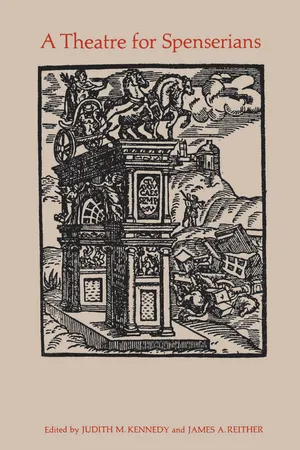 eBook - PDF
A Theatre for Spenserians
Papers of the International Spencer Colloquium Fredericton, New Brunswick October 1969
- Judith Kennedy, James Reither(Authors)
- 2019(Publication Date)
- University of Toronto Press(Publisher)
But the English sonnet form, with its epigrammatic struc-ture, seems to fare best when it is analytic of what is accepted rather than synthetic of new vision. The suspensions, the am-biguities of syntax and of analogy that give scope to The Paerie Queene, are often merely destructive of order in the Amoreiii. In sonnet 8, for example, the postponement of the subject of the sentence, eyes, and the consequent elaboration of the syntax, seems designed to create a network of analogical relationships, between the lady's eyes (set against the traditional fair lady's 139 Amoretti and the English sonnet eyes) and God's light, and also between angelic flights and Cupid's flights, without defining the nature of the relationships too exactly. But Spenser's evasive methods require more space for this than the sonnet allows; if the English sonnet is going to exploit analogies to their full effect they have to be given a crisper definition. Or take sonnet 17- the closest to the Belphoebe stanza quoted above : The glorious portrait of that angel's face, Made to amaze weak men's confused skill, And this world's worthless glory to embase, What pen, what pencil can express her fill? For though he colours could devise at will And eke his learned hand at pleasure guide Lest trembling it his workmanship should spill, Yet many wondrous things there are beside: The sweet eye-glances that like arrows glide, The charming smiles that rob sense from the heart, The lovely pleasance and the lofty pride Cannot expressed be by any art. A greater craftsman's hand thereto doth need, That can express the life of things indeed. This is one of Spenser's best sonnets; and once again it works by confusing the borderline between physical and spiritual. The elements that the painter 'cannot express' -eye-glances, charm-ing smiles, lofty pride, etc. - are not really unphysical; and it is not in fact true that the artist is wholly incapable of expressing these. eBook - ePub
How to Craft a Great Story
Teach Yourself Creating Perfect Plot and Structure
- Chris Sykes(Author)
- 2019(Publication Date)
- Teach Yourself(Publisher)
envoi, in which the end words are repeated again in a prescribed order. Line one of the envoi has the end word of line two of verse one, (‘seas’) in the middle and the word that ends line five of the first verse (‘world’) at the end. Line two has the end word of line four (‘birds’) in the middle and the end word of line three at the end (‘storms’). Line three has the end word of line six (water) in the middle and the end word of line one (‘skin’) at the end. This allows the poem to finish the first and last lines with the same word.Envoi Line 1 2-5 Line 2 4-3 Line 3 6-1 Do not worry, you are not going to be asked to write a sestina (unless you would like to!) This is simply one example of the many different ways writers have designed a form in which to express themselves. You might think it odd; why not just say what you want to say? Why construct such an elaborate artifice and make it so difficult for yourself?Key ideaOften it is exactly the difficulty, the struggle with form and the desire to master it, that gives the writer the pleasure of the challenge and the spur to write. Not only does it help them to write but often it can help a writer to find what it is they want to say. The more controlled the order, the more creative the writer must be to find the word(s) to express what he/she wants to say. The more restricted the form, the more direction the writer can get from the structure. The more direction the writer gets from structure, the more fluidly he can write.The sonnetA sestina is just one of the many intricate forms consciously and deliberately created to give a writer sufficient restriction to test their technical and creative powers and to communicate more deeply and imaginatively than they might otherwise have been able to do if they had written freely and with no formal constraints. The sonnet is another.There are various historical forms of sonnet; the English or Shakespearean, the Miltonic, the Petrarchan, the Spenserian to name but a few. Sonnets traditionally have 14 lines and are written in iambic pentameter.Poetic meter is measured in ‘feet’. Chambers 21st Century Dictionary tells us that ‘iambus or iamb is a metrical foot containing one short or unstressed syllable followed by one long or stressed one’. The word ‘com-pare’, for instance, is pronounced with the stress on the second syllable; com-pare . This is an iamb. Try pronouncing it with the stress on the first syllable, as in com -pare and you are effectively saying the different word ‘compere’ (a compere is someone who hosts a radio or television show or an event where he introduces other performers). Compere needs the stress on the first syllable – as in com -pere. Indeed the word is sometimes spelt with a backwards acute accent over the first ‘e’, compère to ensure the correct stress. This is not an iamb. A unit of two syllables with the accent falling on the first syllable is called a trochee. Trochaic eBook - PDF
- Michael Schoenfeldt(Author)
- 2008(Publication Date)
- Wiley-Blackwell(Publisher)
Two rhyming words are pointedly like and unlike in sound, and they pull apart and together with equal force. Any verse is capable of this kind of analysis. Since what it demonstrates is obvious, there is no need to prolong it. Still, if such analysis is unnecessary in most verse, what it reveals is nonetheless true: verse in general is multiply organized. Shakespeare and the Sonnet Form – Sonnet 15 Although Wordsworth’s “Scorn not the Sonnet” is not a good advertisement for the justice of its plea, the fact that Wordsworth himself wrote sonnets, that he wrote them when nobody else was writing sonnets, that Milton wrote them when almost nobody else was writing sonnets, and that Shakespeare wrote his well after the Elizabethan sonnet vogue had passed suggests that there may be something about the sonnet form that makes it not to be scorned. In an earlier chapter I said that the sonnet form in any of its varieties is simultaneously unifying and divisive. Those contradictory coactions result from its unusually high number of systems of organization. In the limited terms of my thesis that multiplicity of structures is an essence of verse, the sonnet is an espe-cially poetic form. The first line of an English sonnet participates in a metrical pattern (fourteen iambic pentameter lines), a rhyme pattern ( abab ), a trio of quatrains (alike in being quatrains, different in using different rhymes), and an overall pattern contrasting two different kinds of rhyme scheme (three quatrains set against one couplet). I suggest that the concentration of different organizing systems active in the form before any particulars of substance or syntax are added is such as to attract the kind of mind that is particularly happy in the multiple organizations of verse: witness Shakespeare, Milton, and Wordsworth. The different patterns inside the sonnet form pull together and pull apart just as the different patterns do in verse forms less crowded with coherences.
Index pages curate the most relevant extracts from our library of academic textbooks. They’ve been created using an in-house natural language model (NLM), each adding context and meaning to key research topics.

