Mathematics

Derivative Functions
Derivative functions in mathematics represent the rate of change of a function with respect to its variable. They provide information about the slope or gradient of the original function at any given point. By finding the derivative of a function, one can analyze its behavior, identify maximum and minimum points, and solve optimization problems.
Written by Perlego with AI-assistance
Related key terms
1 of 5
11 Key excerpts on "Derivative Functions"
 No longer available |Learn more
- (Author)
- 2014(Publication Date)
- Library Press(Publisher)
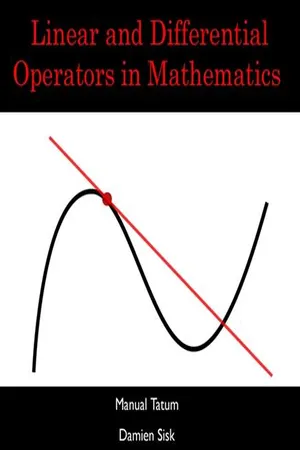
________________________ WORLD TECHNOLOGIES ________________________ Chapter-3 Derivative The graph of a function, drawn in black, and a tangent line to that function, drawn in red. The slope of the tangent line is equal to the derivative of the function at the marked point. In calculus, a branch of mathematics, the derivative is a measure of how a function changes as its input changes. Loosely speaking, a derivative can be thought of as how much one quantity is changing in response to changes in some other quantity; for example, the derivative of the position of a moving object with respect to time is the object's instantaneous velocity. Conversely, the integral of the object's velocity over time is how much the object's position changes from the time when the integral begins to the time when the integral ends. The derivative of a function at a chosen input value describes the best linear approxi-mation of the function near that input value. For a real-valued function of a single real variable, the derivative at a point equals the slope of the tangent line to the graph of the function at that point. In higher dimensions, the derivative of a function at a point is a ________________________ WORLD TECHNOLOGIES ________________________ linear transformation called the linearization. A closely related notion is the differential of a function. The process of finding a derivative is called differentiation . The reverse process is called antidifferentiation . The fundamental theorem of calculus states that antidifferentiation is the same as integration. Differentiation and the derivative At each point, the derivative of is the slope of a line that is tangent to the curve. The line is always tangent to the blue curve; its slope is the derivative. Note derivative is positive where green, negative where red, and zero where black. Differentiation is a method to compute the rate at which a dependent output y changes with respect to the change in the independent input x . No longer available |Learn more
- (Author)
- 2014(Publication Date)
- Learning Press(Publisher)
________________________ WORLD TECHNOLOGIES ________________________ Chapter 3 Derivative The graph of a function, drawn in black, and a tangent line to that function, drawn in red. The slope of the tangent line is equal to the derivative of the function at the marked point. In calculus, a branch of mathematics, the derivative is a measure of how a function changes as its input changes. Loosely speaking, a derivative can be thought of as how much one quantity is changing in response to changes in some other quantity; for example, the derivative of the position of a moving object with respect to time is the object's instantaneous velocity. Conversely, the integral of the object's velocity over time is how much the object's position changes from the time when the integral begins to the time when the integral ends. The derivative of a function at a chosen input value describes the best linear approximation of the function near that input value. For a real-valued function of a single real variable, the derivative at a point equals the slope of the tangent line to the graph of the function at that point. In higher dimensions, the derivative of a function at a point is a ________________________ WORLD TECHNOLOGIES ________________________ linear transformation called the linearization. A closely related notion is the differential of a function. The process of finding a derivative is called differentiation . The reverse process is called antidifferentiation . The fundamental theorem of calculus states that antidifferentiation is the same as integration. Differentiation and the derivative At each point, the derivative of is the slope of a line that is tangent to the curve. The line is always tangent to the blue curve; its slope is the derivative. Note derivative is positive where green, negative where red, and zero where black. Differentiation is a method to compute the rate at which a dependent output y changes with respect to the change in the independent input x . No longer available |Learn more
- (Author)
- 2014(Publication Date)
- White Word Publications(Publisher)
Differentiation and integration constitute the two fundamental operations in single-variable calculus. Differentiation and the derivative At each point, the derivative of is the slope of a line that is tangent to the curve. The line is always tangent to the blue curve; its slope is the derivative. Note derivative is positive where green, negative where red, and zero where black. Differentiation is a method to compute the rate at which a dependent output y changes with respect to the change in the independent input x . This rate of change is called the derivative of y with respect to x . In more precise language, the dependence of y upon x means that y is a function of x . This functional relationship is often denoted y = ƒ ( x ), where ƒ denotes the function. If x and y are real numbers, and if the graph of y is plotted against x , the derivative measures the slope of this graph at each point. The simplest case is when y is a linear function of x , meaning that the graph of y against x is a straight line. In this case, y = ƒ ( x ) = m x + b , for real numbers m and b , and the slope m is given by ________________________ WORLD TECHNOLOGIES ________________________ where the symbol Δ (the uppercase form of the Greek letter Delta) is an abbreviation for change in. This formula is true because y + Δ y = ƒ ( x + Δ x ) = m ( x + Δ x ) + b = m x + b + m Δ x = y + m Δ x . It follows that Δ y = m Δ x . This gives an exact value for the slope of a straight line. If the function ƒ is not linear (i.e. its graph is not a straight line), however, then the change in y divided by the change in x varies: differentiation is a method to find an exact value for this rate of change at any given value of x . Rate of change as a limiting value Figure 1 . The tangent line at ( x , ƒ ( x )) ________________________ WORLD TECHNOLOGIES ________________________ Figure 2. The secant to curve y = ƒ ( x ) determined by points ( x , ƒ ( x )) and ( x + h , ƒ ( x + h )) Figure 3. No longer available |Learn more
- (Author)
- 2014(Publication Date)
- Orange Apple(Publisher)
________________________ WORLD TECHNOLOGIES ________________________ Chapter- 6 Derivative and Integration Derivative The graph of a function, drawn in black, and a tangent line to that function, drawn in red. The slope of the tangent line is equal to the derivative of the function at the marked point. In calculus, a branch of mathematics, the derivative is a measure of how a function changes as its input changes. Loosely speaking, a derivative can be thought of as how much one quantity is changing in response to changes in some other quantity; for example, the derivative of the position of a moving object with respect to time is the object's instantaneous velocity. Conversely, the integral of the object's velocity over time is how much the object's position changes from the time when the integral begins to the time when the integral ends. The derivative of a function at a chosen input value describes the best linear approximation of the function near that input value. For a real-valued function of a single real variable, the derivative at a point equals the slope of the tangent line to the graph of the function at that point. In higher dimensions, the derivative of a function at a point is a ________________________ WORLD TECHNOLOGIES ________________________ linear transformation called the linearization. A closely related notion is the differential of a function. The process of finding a derivative is called differentiation . The reverse process is called antidifferentiation . The fundamental theorem of calculus states that antidifferentiation is the same as integration. Differentiation and the derivative At each point, the derivative of is the slope of a line that is tangent to the curve. The line is always tangent to the blue curve; its slope is the derivative. Note derivative is positive where green, negative where red, and zero where black. No longer available |Learn more
- (Author)
- 2014(Publication Date)
- Library Press(Publisher)
________________________ WORLD TECHNOLOGIES ________________________ Chapter 3 Derivative The graph of a function, drawn in black, and a tangent line to that function, drawn in red. The slope of the tangent line is equal to the derivative of the function at the marked point. In calculus, a branch of mathematics, the derivative is a measure of how a function changes as its input changes. Loosely speaking, a derivative can be thought of as how much one quantity is changing in response to changes in some other quantity; for example, the derivative of the position of a moving object with respect to time is the object's instantaneous velocity. Conversely, the integral of the object's velocity over time is how much the object's position changes from the time when the integral begins to the time when the integral ends. The derivative of a function at a chosen input value describes the best linear approxi-mation of the function near that input value. For a real-valued function of a single real variable, the derivative at a point equals the slope of the tangent line to the graph of the function at that point. In higher dimensions, the derivative of a function at a point is a linear transformation called the linearization. A closely related notion is the differential of a function. ________________________ WORLD TECHNOLOGIES ________________________ The process of finding a derivative is called differentiation . The reverse process is called antidifferentiation . The fundamental theorem of calculus states that antidifferentiation is the same as integration. Differentiation and the derivative At each point, the derivative of is the slope of a line that is tangent to the curve. The line is always tangent to the blue curve; its slope is the derivative. Note derivative is positive where green, negative where red, and zero where black. Differentiation is a method to compute the rate at which a dependent output y changes with respect to the change in the independent input x . eBook - PDF
Calculus
Late Transcendentals
- Howard Anton, Irl C. Bivens, Stephen Davis(Authors)
- 2021(Publication Date)
- Wiley(Publisher)
59 2 One of the crowning achievements of calculus is its ability to capture continuous motion mathematically, allowing that motion to be analyzed instant by instant. THE DERIVATIVE Many real-world phenomena involve changing quantities—the speed of a rocket, the inflation of currency, the number of bacteria in a culture, the shock intensity of an earthquake, the voltage of an electrical signal, and so forth. In this chapter we will develop the concept of a “derivative,” which is the mathematical tool for studying the rate at which one quantity changes relative to another. The study of rates of change is closely related to the geometric concept of a tangent line to a curve, so we will also be discussing the general definition of a tangent line and methods for finding its slope and equation. 2.1 TANGENT LINES AND RATES OF CHANGE In this section we will discuss three ideas: tangent lines to curves, the velocity of an object moving along a line, and the rate at which one variable changes relative to another. Our goal is to show how these seemingly unrelated ideas are, in actuality, closely linked. TANGENT LINES In Example 1 of Section 1.1 we used an informal argument to find the equation of a tangent line to a curve. However, at that stage in the text we did not have a precise definition of a tangent line. Now that limits have been defined precisely we can give a mathematical definition of the tangent line to a curve y = f (x) at a point P(x 0 , f (x 0 )) on the curve. As illustrated in Figure 2.1.1, the slope m PQ of the secant line through P and a second point Q(x, f (x)) on the graph of f is m PQ = f (x) − f (x 0 ) x − x 0 If we let x approach x 0 , then the point Q will move along the curve and approach the point P. Suppose the slope m PQ of the secant line through P and Q approaches a limit as x → x 0 . In that case we can take the value of the limit to be the slope m tan of the tangent line at P. Thus, we make the following definition. Figure 2.1.1 No longer available |Learn more
- (Author)
- 2014(Publication Date)
- Orange Apple(Publisher)
________________________ WORLD TECHNOLOGIES ________________________ Chapter- 6 Derivative and Integral Derivative The graph of a function, drawn in black, and a tangent line to that function, drawn in red. The slope of the tangent line is equal to the derivative of the function at the marked point. In calculus, a branch of mathematics, the derivative is a measure of how a function changes as its input changes. Loosely speaking, a derivative can be thought of as how much one quantity is changing in response to changes in some other quantity; for example, the derivative of the position of a moving object with respect to time is the object's instantaneous velocity. Conversely, the integral of the object's velocity over time is how much the object's position changes from the time when the integral begins to the time when the integral ends. The derivative of a function at a chosen input value describes the best linear approximation of the function near that input value. For a real-valued function of a single real variable, the derivative at a point equals the slope of the tangent line to the graph of the function at that point. In higher dimensions, the derivative of a function at a point is a ________________________ WORLD TECHNOLOGIES ________________________ linear transformation called the linearization. A closely related notion is the differential of a function. The process of finding a derivative is called differentiation . The reverse process is called antidifferentiation . The fundamental theorem of calculus states that antidifferentiation is the same as integration. Differentiation and the derivative At each point, the derivative of is the slope of a line that is tangent to the curve. The line is always tangent to the blue curve; its slope is the derivative. Note derivative is positive where green, negative where red, and zero where black. eBook - PDF
Calculus
Early Transcendental Single Variable
- Howard Anton, Irl C. Bivens, Stephen Davis(Authors)
- 2016(Publication Date)
- Wiley(Publisher)
79 2 One of the crowning achievements of calculus is its ability to capture continuous motion mathematically, allowing that motion to be analyzed instant by instant. THE DERIVATIVE Many real-world phenomena involve changing quantities—the speed of a rocket, the inflation of currency, the number of bacteria in a culture, the shock intensity of an earthquake, the voltage of an electrical signal, and so forth. In this chapter we will develop the concept of a “derivative,” which is the mathematical tool for studying the rate at which one quantity changes relative to another. The study of rates of change is closely related to the geometric concept of a tangent line to a curve, so we will also be discussing the general definition of a tangent line and methods for finding its slope and equation. 2.1 TANGENT LINES AND RATES OF CHANGE In this section we will discuss three ideas: tangent lines to curves, the velocity of an object moving along a line, and the rate at which one variable changes relative to another. Our goal is to show how these seemingly unrelated ideas are, in actuality, closely linked. TANGENT LINES In Example 1 of Section 1.1 we used an informal argument to find the equation of a tangent line to a curve. However, at that stage in the text we did not have a precise definition of a tangent line. Now that limits have been defined precisely we can give a mathematical definition of the tangent line to a curve y = f (x) at a point P(x 0 , f (x 0 )) on the curve. As illustrated in Figure 2.1.1, the slope m PQ of the secant line through P and a second point Q(x, f (x)) on the graph of f is m PQ = f (x) − f (x 0 ) x − x 0 If we let x approach x 0 , then the point Q will move along the curve and approach the point P. Suppose the slope m PQ of the secant line through P and Q approaches a limit as x → x 0 . In that case we can take the value of the limit to be the slope m tan of the tangent line at P. Thus, we make the following definition. Figure 2.1.1 eBook - PDF
Calculus
Single Variable
- Howard Anton, Irl C. Bivens, Stephen Davis(Authors)
- 2022(Publication Date)
- Wiley(Publisher)
58 CHAPTER 2 Henglein and Steets/Getty Images One of the crowning achievements of calculus is its ability to capture continuous motion mathematically, allowing that motion to be analyzed instant by instant. The Derivative Many real-world phenomena involve changing quantities—the speed of a rocket, the inflation of currency, the number of bacteria in a culture, the shock intensity of an earthquake, the voltage of an electrical signal, and so forth. In this chapter we will develop the concept of a “derivative,” which is the mathematical tool for studying the rate at which one quantity changes relative to another. The study of rates of change is closely related to the geometric concept of a tangent line to a curve, so we will also be discussing the general definition of a tangent line and methods for finding its slope and equation. 2.1 Tangent Lines and Rates of Change In this section we will discuss three ideas: tangent lines to curves, the velocity of an object moving along a line, and the rate at which one variable changes relative to another. Our goal is to show how these seemingly unrelated ideas are, in actuality, closely linked. Tangent Lines In Example 1 of Section 1.1 we used an informal argument to find the equation of a tangent line to a curve. However, at that stage in the text we did not have a precise definition of a tangent line. Now that limits have been defined precisely we can give a mathematical definition of the tangent line to a curve y = f (x) at a point P(x 0 , f (x 0 )) on the curve. As illustrated in Figure 2.1.1, the slope m PQ of the secant line through P and a second point Q(x, f (x)) on the graph of f is m PQ = f (x) − f (x 0 ) x − x 0 If we let x approach x 0 , then the point Q will move along the curve and approach the point P. Suppose the slope m PQ of the secant line through P and Q approaches a limit as x →x 0 . In that case we can take the value of the limit to be the slope m tan of the tangent line at P. eBook - PDF
- James Stewart, Daniel K. Clegg, Saleem Watson, , James Stewart, James Stewart, Daniel K. Clegg, Saleem Watson(Authors)
- 2020(Publication Date)
- Cengage Learning EMEA(Publisher)
107 We know that when an object is dropped from a height it falls faster and faster. Galileo discovered that the distance the object has fallen is proportional to the square of the time elapsed. Calculus enables us to calculate the precise speed of the object at any time. In Exercise 2.1.11 you are asked to determine the speed at which a cliff diver plunges into the ocean. Icealex / Shutterstock.com 2 Derivatives IN THIS CHAPTER WE BEGIN our study of differential calculus, which is concerned with how one quantity changes in relation to another quantity. The central concept of differential calculus is the derivative, which is an outgrowth of the velocities and slopes of tangents that we considered in Chapter 1. After learning how to calculate derivatives, we use them to solve problems involving rates of change and the approximation of functions. Copyright 2021 Cengage Learning. All Rights Reserved. May not be copied, scanned, or duplicated, in whole or in part. Due to electronic rights, some third party content may be suppressed from the eBook and/or eChapter(s). Editorial review has deemed that any suppressed content does not materially affect the overall learning experience. Cengage Learning reserves the right to remove additional content at any time if subsequent rights restrictions require it. 108 CHAPTER 2 Derivatives Derivatives and Rates of Change In Chapter 1 we defined limits and learned techniques for computing them. We now revisit the problems of finding tangent lines and velocities from Section 1.4. The special type of limit that occurs in both of these problems is called a derivative and we will see that it can be interpreted as a rate of change in any of the natural or social sciences or engineering. eBook - PDF
A Course of Mathematical Analysis
International Series of Monographs on Pure and Applied Mathematics
- A. F. Bermant, I. N. Sneddon, S. Ulam, M. Stark(Authors)
- 2016(Publication Date)
- Pergamon(Publisher)
On finding y' from the first equation and substituting in the second, we arrive at an equation from which y can be expressed in terms of x and y. To find a higher order derivative of a function given parametrically, we have to differentiate the expression for the previous derivative as a function of the independent variable. Let y = f(t), x = (p(t). DERIVATIVES AND DIFFERENTIALS 191 VVC I l c t V C Further, ,, d W(t)l y dx and since <-£' ά(-Ά)
Index pages curate the most relevant extracts from our library of academic textbooks. They’ve been created using an in-house natural language model (NLM), each adding context and meaning to key research topics.

