Mathematics

Symmetry
Symmetry refers to a balanced and harmonious arrangement of parts or elements. In mathematics, symmetry is the concept of an object or a function remaining unchanged when subjected to a specific operation, such as reflection, rotation, or translation. It plays a fundamental role in various mathematical disciplines, including geometry, group theory, and algebra.
Written by Perlego with AI-assistance
Related key terms
1 of 5

9 Key excerpts on "Symmetry"
 eBook - PDF
Objectivity, Invariance, and Convention
Symmetry in Physical Science
- Talal A. Debs, Michael L. G. Redhead, Michael L.G. Redhead(Authors)
- 2009(Publication Date)
- Harvard University Press(Publisher)
In its simplest form, however, this relationship may be captured in the observation that structures used in scientific repre-sentation, like W, O, and M, often have nontrivial symmetries. Before dis-33 cussing the significance of these symmetries for scientific representation, a word about Symmetry in general is in order. Symmetry has long seemed a fundamental feature of human experience. The term has been used to refer to such issues as proportion and form in art and architecture, which have interested philosophers from antiquity to the present. This general sense of Symmetry is relevant to an understand-ing of the sciences, as evidenced by the significant role of elegance and form within physics. In addition, the solutions of numerous significant problems within the physical sciences have rested on Symmetry arguments of one form or another. Among these arguments are those that make use of the term “Symmetry” in a more specific sense. Within the history of modern physics and mathematics, the notion of Symmetry has been for-malized precisely within group theory. In this sense, the word “Symmetry” takes on the meaning of invariance under a group of structure-preserving transformations. A Symmetry, or automorphism, of W, O, or M is a trans-formation that preserves all of its structural relations. Formally speaking, a transformation acts on a structure and maps each element of that structure into the elements of another structure. This may take place in a number of ways (including injections, bijections, or surjections); in one of its simplest forms, “point transformations,” Felix Klein explains that these maps involve a one-to-one correspondence be-tween elements that is effectively “a generalization of the simple notion of a function.” 1 A transformation may be encoded by specifying which ele-ment of one structure is to be associated with which element of the other, and the direction in which change (from the first structure to the second) is meant to take place. eBook - PDF
Symmetry And Complexity: The Spirit And Beauty Of Nonlinear Science
The Spirit and Beauty of Nonlinear Science
- Klaus Mainzer(Author)
- 2005(Publication Date)
- World Scientific(Publisher)
Chapter 2 Symmetry and Complexity in Mathematics In the modern era the study of mathematical symmetries has led to an algebraic theory that has found application in almost all branches of mathematics and has become fundamental for a coherent theory of nature. This is group theory, which has come into being since the end of the 18th century in the theory of equations, number theory, and geometry, although initial attempts made in earlier centuries were known at that time. Thus, the ancient interest in regular fig-ures and bodies led to a systematic study of so-called discrete groups in the plane and in space, which became fundamental, in the natu-ral sciences, for spectroscopy and crystallography and which found application in elementary particle physics in the exact definition of a coherent theory of natural forces. But it is not only the character-istics of various mathematical theories and natural phenomena that fulfill the axioms of these groups. Artistic decorations and musical tone patterns can also be examined from the coherent point of view of this mathematical structure. It marks a reemergence of the old Pythagorean idea of a coherent Symmetry structure in mathematics, art and nature, this time algebraically generalized and considerably more comprehensive than what was definable on the basis of the An-tique theory of proportions. The concept of transformation group became central to geometry. The various geometric theories that had arisen in the 19th century can be characterized by those trans-formation groups that leave the laws of the specific theory unchanged (“invariant”). That also produced the mathematical prerequisites for determining natural laws by Symmetry groups. 63 64 Symmetry and Complexity 2.1 Symmetry and Group Theory Figures or bodies were called “symmetrical” in Antiquity when they possessed common measures or proportions. Thus the Platonic bod-ies can be rotated and turned at will without changing their regu-larity.
- William H. Batchelder, Hans Colonius, Ehtibar N. Dzhafarov(Authors)
- 2018(Publication Date)
- Cambridge University Press(Publisher)
388 J . - C . FA L M AG N E et al. 9.4 Meaningfulness in Geometry “Symmetry” is both an important theoretical concept and a powerful multi-faceted scientific tool. Nineteenth-century mathematicians and physicists discovered that the understanding of a mathematical or scientific situation in terms of its symmetries often provided profound insight into the underlying geo- metric situation. This led to the development of Symmetry methods for doing mathematical inference and characterization. In 1872, the mathematician Felix Klein developed a prominent program in geometry for this (Klein, 1872). Klein’s program was based on geometrical symmetries and was designed to unify the qual- itative and quantitative approaches to geometry that existed at the time. Its core ideas are very close to those of the representational theory of measurement. The main difference is that its focus was on a complicated area of mathematics – geom- etry – whereas the representational theory focus is on science. For example, lurking in the background of the representational theory are concerns, e.g., empiricism and error, that are not relevant for geometry. In mathematics, three approaches to geometry have evolved. The first is a syn- thetic approach. It was developed by ancient geometers, and is the content of Euclid’s famous third-century BC treatise. This axiomatic and deductive approach of Euclid is today called “plane Euclidean geometry.” Variants of the approach were also systematically applied to other geometries by nineteenth-century geome- ters. These became known as “synthetic approaches to geometries,” because they were based on formalized methods having intuitive geometric content and sig- nificance. Their formalized methods have evolved into what today is called “the axiomatic method,” which has been applied to many non-geometric domains. eBook - PDF
- Roger G. Newton(Author)
- 2021(Publication Date)
- Princeton University Press(Publisher)
That a Symmetry of the underlying equations does not necessarily lead to the same 1 Gerald Holton, Einstein, History, and Other Passions (Reading, Mass.: Addison-Wesley, 1996), pp. 97ff. 106 Symmetry IN PHYSICS Symmetry in their solutions results in ugly ellipses—a sponta-neously broken Symmetry, as we would call it now. Of course, we don't have to ascribe the choice of rotationally symmetric laws of gravity and of motion to esthetic preferences, and I don't claim that such were Newton's motivations; the most plausible explanation of this choice is certainly simplicity. In the absence of a good reason to introduce a preferred direction, ro-tational invariance is surely the simplest choice, and simplicity is a powerful criterion for physical theories. The important point is that symmetries, for whatever reason they are introduced, now are expected to express themselves not in the world as we di-rectly experience it but in the underlying laws and theories, and in these they have been playing an increasingly central role in physics. THE CASE OF PARITY What, then, do we mean by Symmetry? As I have already implied above, a Symmetry means the same as an invariance under a certain operation. The simplest example of a Symmetry, and one that, for a long time, all fundamental theories had been expected to incor-porate, is invariance under reflection. An inversion of the direction of an odd number of coordinate axes cannot be accomplished by a rotation, as the inversion of an even number of axes can. Thus, in three dimensions, a reflection on a plane, which changes the sign of one direction, perpendicular to the plane, is fundamentally dif-ferent from a rotation: the mirror image of your right hand is a left hand, and they cannot be rotated into one another. eBook - PDF
College Geometry
Using the Geometer's Sketchpad
- Barbara E. Reynolds, William E. Fenton(Authors)
- 2012(Publication Date)
- Wiley(Publisher)
You may use diagrams, symbols, or words to do so. 2. Some terminology: A figure is a set of points in the plane. Typically a figure is a familiar object such as a square or a triangle, but any collection of points will do. A Symmetry of a particular figure S is an isometry f for which f (S) = S. This means that the image of the figure lies on top of the original figure. It does not mean that each point is in the same place; the points can shift while the overall figure looks the same, as you saw in Activity 1. List the symmetries for each of the figures in Figure 10.1. How are your two lists similar and how are they different? 3. Each of the symmetries you listed for the second figure in Activity 2 is an isometry, and thus each has an inverse isometry. Are these inverses also symmetries for the second figure? Explain why or why not. 230 Symmetry IN THE PLANE CHAPTER 10 FIGURE 10.1 Figures for Activity 2 4. Here are the capital letters of the English alphabet, in a sans serif font. Sort these letters into disjoint sets so that every element in the same set has the same symmetries. A, B, C, D, E, F, G, H, I, J, K, L, M, N, O, P, Q, R, S, T, U, V, W, X, Y, Z 5. Figure 10.2 shows an equilateral triangle. For this activity, you may find it helpful to cut out a paper triangle, label its vertices as in Figure 10.2, and use it to perform the isometries. Be careful when you label the back side of the triangle! 1 2 3 FIGURE 10.2 An Equilateral Triangle The triangle in Figure 10.2 has six symmetries: R 0 a rotation through 0 ◦ R 120 a rotation through 120 ◦ R 240 a rotation through 240 ◦ V a reflection across a vertical line through the uppermost vertex L a reflection across a diagonal line through the lower left vertex R a reflection across a diagonal line through the lower right vertex. Do the following: a. Sketch the triangle, showing the lines of reflection and the center of rotation. b. These symmetries can be combined by composition. For instance, V ◦ R 120 = L. eBook - PDF
- Dave Benson(Author)
- 2006(Publication Date)
- Cambridge University Press(Publisher)
9 Symmetry in music First, let me explain that I’m cursed; I’m a poet whose time gets reversed. Reversed gets time Whose poet a I’m; Cursed I’m that explain me let, first. 9.1 Symmetries Music contains many examples of Symmetry. In this chapter, we investigate the symmetries that appear in music, and the mathematical language of group theory for describing Symmetry. We begin with some examples. Translational Symmetry looks like Figure 9.1. In group theoretic language, which we explain in the next few sections, the symmetries form an infinite cyclic group. In music, this would just be represented by repetition of some rhythm, melody, or other pattern. Figure 9.2 shows the beginning of the right hand of Beethoven’s Moonlight Sonata, Op. 27 No. 2. Of course, any actual piece of music only has finite length, so it cannot really have true translational Symmetry. Indeed, in music, approximate Symmetry is much more common than perfect Symmetry. The musical notion of a sequence is a good example of this. A sequence consists of a pattern that is repeated with a shift; but the shift is usually not exact. The intervals are not the same, but rather they are modified to fit the harmony. For example, the sequence shown in Figure 9.3 comes from J. S. Bach’s Toccata and Fugue in D, BWV 565, for organ. Although the general motion is downwards, the numbers of semitones between the notes in the triplets is constantly varying in order to give the appropriate harmonic structure. Reflectional Symmetry appears in music in the form of inversion of a fig- ure or phrase. For example, the bar from B´ ela Bart´ ok’s Fifth String Quartet 312 9.1 Symmetries 313 . . . . . . Figure 9.1 Translational Symmetry. Figure 9.2 Opening of Beethoven’s Moonlight Sonata. Figure 9.3 Part of Bach’s Toccata and Fugue in D. Figure 9.4 Bar from Bart´ ok’s Fifth String Quartet. With kind permission of Bossey & Hawkes. shown in Figure 9.4 displays a reflectional Symmetry whose horizontal axis is the note B . eBook - PDF
- Barbara E. Reynolds, William E. Fenton(Authors)
- 2021(Publication Date)
- Wiley(Publisher)
This 180 ∘ rotation is one way in which the square is self-congruent. There are two other rotations as well as four reflections that show self-congruence. Thus, a square is self-congruent in eight ways. This demonstrates that a square is a very symmetric figure. DEFINITION 10.1 A Symmetry of a figure S is an isometry f for which f(S) = S. If S is the domain of an isometry, the notation f(S) = S means that the range f(S) is exactly the same set of points as the domain. Individual points do not have to be fixed, but the overall set will be. The figures in Activity 2 share some symmetries: the identity (of course), a rotation of 120 ∘ , and a rotation of 240 ∘ . The second figure has three additional symmetries, reflections across certain lines. Thus, the second figure with its straight segments has more Symmetry than the first figure with its curved segments. The regular polygons are very symmetric figures. (See Figure 10.5.) Each reg- ular polygon has rotations and reflections as its symmetries. How many symme- tries of each type are there for a regular n-gon? A circle is an extremely symmetric figure. Which rotations are symmetries for the circle? Which reflections? FIGURE 10.5 Some Regular Polygons Equilateral triangle Square Pentagon Hexagon Heptagon DISCUSSION 229 GROUPS OF SYMMETRIES In Chapter 8 we saw that the set of isometries on the plane, together with the operation of composition, forms a mathematical structure called a group. This requires that four properties must be satisfied by the set and its operation: closure, associativity, identity, and inverse. DEFINITION 10.2 A group is a set G together with a binary operation ⚬ such that • For any two elements x, y of G, x ⚬ y is in G (the closure property). • For any elements x, y, z of G, x ⚬ (y ⚬ z) = (x ⚬ y) ⚬ z (the associative property). • There is an element i of G so that i ⚬ x = x ⚬ i = x (the identity property). eBook - PDF
- Ronald N. Umble, Zhigang Han(Authors)
- 2014(Publication Date)
- Chapman and Hall/CRC(Publisher)
Definition 214 A Symmetry of a plane figure F is an isometry that fixes F. A plane figure with non-trivial rotational Symmetry has point Symmetry and the center of rotation is called a point of Symmetry. A plane figure with reflection Symmetry has line Symmetry and the axis of reflection is called a line of Symmetry. A plane figure with bilateral Symmetry has a unique line of Symmetry. Theorem 215 Given a plane figure F, the set Sym ( F ) of all symmetries of F is a group, called the Symmetry group of F. Proof. Note that Sym ( F ) 6 = ∅ since ι ∈ Sym ( F ). Since Sym ( F ) is a subset of the group I of all isometries, it suffices to verify the axioms of Theorem 208. Closure : Given α, β ∈ Sym ( F ) , we have α ( F ) = F and β ( F ) = F. Since the composition of isometries is an isometry, by Exercise 3.1.2, and ( α ◦ β ) ( F ) = α ( β ( F )) = α ( F ) = F . Therefore α ◦ β ∈ Sym ( F ) . Existence of inverses : If α ∈ Sym ( F ), then α ( F ) = F and α -1 ∈ I by Exer-cise 3.1.5. But α -1 ( F ) = α -1 ( α ( F )) = ( α -1 ◦ α ) ( F ) = ι ( F ) = F so that α -1 ∈ Sym ( F ) . 138 Transformational Plane Geometry Example 216 (The Dihedral Group D 3 ) Let T denote an equilateral tri-angle positioned with its centroid at the origin and a vertex on the y -axis as in Figure 7.1. There are exactly six symmetries of T , namely, the identity ι, two non-trivial rotations ρ 120 and ρ 240 about the origin, and three reflections σ l , σ m , and σ n , where l : √ 3 X -3 Y = 0 , m : X = 0 , and n : √ 3 X + 3 Y = 0. 3 + 3 X Y + = 0 3 -3 = X Y -= 0 l m n X = 0 Figure 7.1. Lines of Symmetry l, m, and n ; the origin is a point of Symmetry. The Cayley table (multiplication table) for the various compositions of these symmetries appears in Table 7.1. By Theorem 215 these six symmetries form a group, which we denote by D 3 . The symbol D 3 stands for the “ Dihedral Group of Order 6 .” Thus Sym ( T ) = D 3 .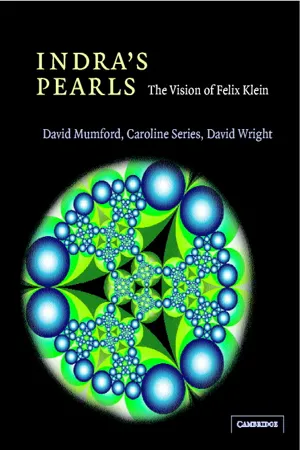 eBook - PDF
Indra's Pearls
The Vision of Felix Klein
- David Mumford, Caroline Series, David Wright(Authors)
- 2002(Publication Date)
- Cambridge University Press(Publisher)
This book, whose publication was a major mathematical event, at last contained a systematic development of all Galois’ insights along with a systematic account of group theory up to that time. In that same year, two young men who had only recently completed their doctoral studies journeyed to Paris to work with Jordan. These were Felix Klein and Sophus Lie. Their different ideas about how to integrate the ideas of a group with those of geometry and calculus were to have a profound and lasting influence on all subsequent mathematics. fit together without overlaps and cover everything, we say they tile or tessellate the plane. Until you get used to it, the formalistic language used to explain a group looks rather abstract and obscure. In fact the idea was used for many years before it was condensed in this abbreviated way. The power The language of Symmetry 21 of the group concept rests in the fact that it condenses all the myriad ways in which you might wish to combine symmetries into two simple rules. The algebra of Symmetry This section is not all that exciting – and can be skipped over until needed – but there is a certain algebra involved in composing trans- formations which will be indispensable later on. We learnt in the last section that the inverse of a transformation T is simply the rule which undoes the effect of the rule defining T : if T moves a point P to a point Q, then T −1 moves Q back to P . We can express this neatly in terms of composition by the equation T −1 T (P ) = P . This brings us to a special transformation, the identity transformation I . This is the rule which doesn’t move any point at all, in symbols, I (P ) = P . It may sound like a silly transformation to study, but it must be there for completeness, in just the same way as it was very hard to do arithmetic before the marvellous invention of the number 0. The equation T −1 T (P ) = P can be expressed in another way by saying T −1 T = I.
Index pages curate the most relevant extracts from our library of academic textbooks. They’ve been created using an in-house natural language model (NLM), each adding context and meaning to key research topics.

