Physics

Kinetic Energy of a Particle
The kinetic energy of a particle is the energy it possesses due to its motion. It is directly proportional to the mass of the particle and the square of its velocity. This form of energy is a scalar quantity and is always positive, with its value increasing as the particle's speed increases.
Written by Perlego with AI-assistance
Related key terms
1 of 5

10 Key excerpts on "Kinetic Energy of a Particle"
 eBook - PDF
- Richard C. Hill, Kirstie Plantenberg(Authors)
- 2013(Publication Date)
- SDC Publications(Publisher)
7.2.2) KINETIC ENERGY Kinetic energy is the energy due to an object’s motion. If a body has mass and is moving, then it has kinetic energy. The body's motion can be used to perform work. If a body is at rest, then it has no kinetic energy. The mathematical definition of kinetic energy is given by Equation 7.2-1. Kinetic energy: 2 1 2 T mv (7.2-1) T = Kinetic Energy of a Particle m = particle's mass v = particle's speed Kinetic energy is the energy possessed by a body due to its motion. There are a few things that we can surmise by looking at Equation 7.2-1. First, this equation is not a vector equation, therefore, kinetic energy is a scalar. It has no direction. Second, kinetic energy depends on both mass and speed. Consider two identical balls. One ball is red and the other blue. The red ball is rolling with twice the speed of the blue one. Which one has the higher kinetic energy? The red one is moving faster, therefore, it has more energy. Now let’s look at the case where the balls are moving with the same speed, but now the red ball has twice the mass as the blue ball. Which ball has the higher kinetic energy in this case? The red ball has more mass and, therefore, has more energy (i.e. a greater capacity to do work) even though both balls are moving at the same speed. Note that kinetic energy is always positive. Mathematically, this is due to the fact that mass cannot be negative and that the speed, in Equation 7.2-1, is squared. More intuitively, a moving body can always perform work regardless of the direction of its velocity. It is also interesting to note that the Kinetic Energy of a Particle captures a particle’s current state and not the particle’s history. A particle's Units of Kinetic Energy SI units: Newton–meter [N-m] Joule [J = 1 N-m] erg [erg = 1 x 10 -7 J] US customary units: foot–pound [ft-lb = 1.3558 J] kilocalorie [kcal = 4187 J] British thermal unit [Btu = 778.16 ft-lb = 1055 J] No longer available |Learn more
- (Author)
- 2014(Publication Date)
- Learning Press(Publisher)
This minimum kinetic energy contributes to the system's invariant mass, which is independent of the reference frame. According to classical mechanics (ie ignoring relativistic effects) the kinetic energy of a non-rotating object of mass m traveling at a speed v is mv 2 /2. This will be a good approximation provided v is much less than the speed of light. History and etymology The adjective kinetic has its roots in the Greek word κίνησις (kinesis) meaning motion , which is the same root as in the word cinema, referring to motion pictures. The principle in classical mechanics that E ∝ mv² was first developed by Gottfried Leibniz and Johann Bernoulli, who described kinetic energy as the living force , vis viva . Willem 's Gravesande of the Netherlands provided experimental evidence of this relation-ship. By dropping weights from different heights into a block of clay, 's Gravesande determined that their penetration depth was proportional to the square of their impact speed. Émilie du Châtelet recognized the implications of the experiment and published an explanation. The terms kinetic energy and work in their present scientific meanings date back to the mid-19th century. Early understandings of these ideas can be attributed to Gaspard-Gustave Coriolis, who in 1829 published the paper titled Du Calcul de l'Effet des Machines outlining the mathematics of kinetic energy. William Thomson, later Lord Kelvin, is given the credit for coining the term kinetic energy c. 1849 - 1851. ________________________ WORLD TECHNOLOGIES ________________________ Introduction There are various forms of energy: chemical energy, heat, electromagnetic radiation, gravitational energy, electric energy, elastic energy, nuclear energy, rest energy. These can be categorized in two main classes: potential energy and kinetic energy. Kinetic energy can be best understood by examples that demonstrate how it is tran-sformed to and from other forms of energy. No longer available |Learn more
- (Author)
- 2014(Publication Date)
- Library Press(Publisher)
This minimum kinetic energy contributes to the system's invariant mass, which is independent of the reference frame. According to classical mechanics (ie ignoring relativistic effects) the kinetic energy of a non-rotating object of mass m traveling at a speed v is mv 2 /2. This will be a good approximation provided v is much less than the speed of light. History and etymology The adjective kinetic has its roots in the Greek word κίνησις (kinesis) meaning motion , which is the same root as in the word cinema, referring to motion pictures. The principle in classical mechanics that E ∝ mv² was first developed by Gottfried Leibniz and Johann Bernoulli, who described kinetic energy as the living force , vis viva . Willem 's Gravesande of the Netherlands provided experimental evidence of this relationship. By dropping weights from different heights into a block of clay, 's Gravesande determined that their penetration depth was proportional to the square of their impact speed. Émilie du Châtelet recognized the implications of the experiment and published an explanation. The terms kinetic energy and work in their present scientific meanings date back to the mid-19th century. Early understandings of these ideas can be attributed to Gaspard-Gustave Coriolis, who in 1829 published the paper titled Du Calcul de l'Effet des Machines outlining the mathematics of kinetic energy. William Thomson, later Lord Kelvin, is given the credit for coining the t erm kinetic energy c. 1849 - 1851. ________________________ WORLD TECHNOLOGIES ________________________ Introduction There are various forms of energy: chemical energy, heat, electromagnetic radiation, gravitational energy, electric energy, elastic energy, nuclear energy, rest energy. These can be categorized in two main classes: potential energy and kinetic energy. Kinetic energy can be best understood by examples that demonstrate how it is transformed to and from other forms of energy. eBook - PDF
- Stephen Lee(Author)
- 2014(Publication Date)
- CRC Press(Publisher)
● The kinetic energy of a moving object 1 2 mass ( speed ) 2 . Potential energy is the energy which a body possesses because of its position. It may be thought of as stored energy which can be converted into kinetic or other forms of energy. You will meet this again on page 208. The energy of an object is usually changed when it is acted on by a force. When a force is applied to an object which moves in the direction of its line of action, the force is said to do work. For a constant force this is defined as follows. ● The work done by a constant force force distance moved in the direction of the force . The following examples illustrate how to use these ideas. A brick, initially at rest, is raised by a force averaging 40 N to a height 5 m above the ground where it is left stationary. How much work is done by the force? S OLUTION The work done by the force raising the brick is 40 5 200 J. Figure 9.1 Examples 9.2 and 9.3 show how the work done by a force can be related to the change in kinetic energy of an object. A train travelling on level ground is subject to a resisting force (from the brakes and air resistance) of 250 kN for a distance of 5 km. How much kinetic energy does the train lose? 5 m 40 N 202 AN INTRODUCTION TO MATHEMATICS FOR ENGINEERS : MECHANICS E XAMPLE 9.1 E XAMPLE 9.2 S OLUTION The forward force is 250 000 N. The work done by it is 250 000 5000 1 250 000 000 J. Hence 1 250 000 000 J of kinetic energy are gained by the train, in other words 1 250 000 000 J of kinetic energy are lost and the train slows down. This energy is converted to other forms such as heat and perhaps a little sound. A car of mass m kg is travelling at u ms 1 when the driver applies a constant driving force of F N. The ground is level and the road is straight and air resistance can be ignored. The speed of the car increases to v ms 1 in a period of t s over a distance of s m. eBook - PDF
Applied Mathematics
Made Simple
- Patrick Murphy(Author)
- 2014(Publication Date)
- Butterworth-Heinemann(Publisher)
We can therefore summarize these last two results by what is called the principle of the conservation of energy: for any body moving under the force of gravity alone the sum of the potential and kinetic energies is constant. An equation such as $mv 2 + mgy = mu 2 above is called the energy equation for the body in motion. Since energy is defined as the capacity for doing work, any form of pent-up or sealed-in energy may be used to perform work; the potential energy due to the height and weight of a body is just one of many ways in which energy may be stored. For example, a watch spring when fully wound has a store of energy or potential energy which is used up in turning the hands to register the time. The old grandfather clocks have large masses suspended by cords which gradually unwind so that the work done by the weight as it descends is used to turn the hands of the clock. When the weight has descended to the bottom of the clock we wind it back up again to replace its potential energy. A piece of elastic also has potential energy when it is held in a stretched state. Thus a catapult releases the energy of the stretched elastic and in so doing imparts a velocity to a stone, i.e. the potential energy of the elastic is converted into kinetic energy for the stone. There are other forms of energy such as heat, chemical, and electrical energy. One very familiar example is the chemical action in a battery which can be converted to electrical energy to start the engine of a car. Considering the principle of the conservation of energy in the widest sense, we suggest that although energy can be converted from one form to another it can never be destroyed. This means that the sum of all the different energies in a system remains constant. To illustrate this point consider the energy stored in a gallon of petrol.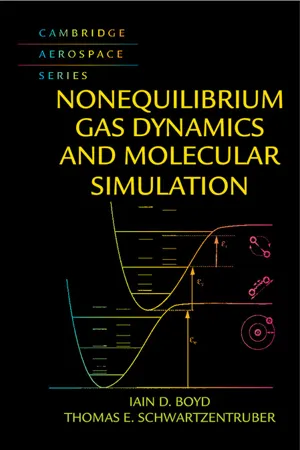
- Iain D. Boyd, Thomas E. Schwartzentruber(Authors)
- 2017(Publication Date)
- Cambridge University Press(Publisher)
We then employ these concepts later in the chapter to analyze a number of different gas flow situations. 3 4 Kinetic Theory Molecular Macroscopic no gradients ρ, p, T Figure 1.1 Macroscopic and molecular views of a gas at rest. 1.2.1 Particle Model The particle is the fundamental unit in kinetic theory and we will use this term generically to refer to atoms and molecules. Each particle has the following properties: Mass (typically around 10 −26 to 10 −25 kg) Size (typically a few 10 −10 m) Position, velocity, and internal energy The mass of a particle is simply the sum of the masses of its constituent atoms. Position is the center of mass location of the constituent atoms and velocity is the center-of-mass velocity of those atoms. For molecules, atomic motion relative to the center of mass (i.e., rotation and vibration) contributes to the internal energy of the particle. The sources of internal energy that a particle of a particular chemical species can possess will be treated in detail using quantum mechanics in Chapter 2. In our introductory treatment of kinetic theory, we will ignore the internal energy for now. In addition, to fix ideas, let us focus on a simple gas, i.e., one in which all particles are of the same species. Particle mass is a well-defined quantity, size is not so clear. An atom con- sists of a nucleus, composed of neutrons and protons, surrounded by orbit- ing electrons, so how large is it? This is an important question, as parti- cle size determines the nature of intermolecular collisions. In real collisions, particles interact through the field that is formed as a result of the electro- static Coulomb forces that act between the elementary charges, the protons and electrons, of the interacting bodies. Figure 1.2 shows an example of the potential energy acting between two argon atoms as a function of their dis- tance of separation.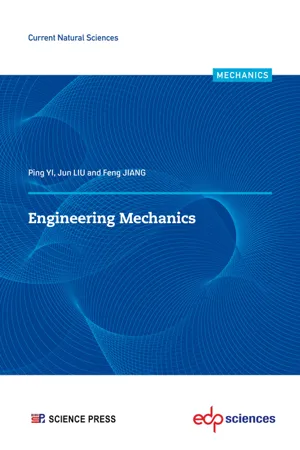 eBook - PDF
- Ping YI, Jun LIU, Feng JIANG(Authors)
- 2022(Publication Date)
- EDP Sciences(Publisher)
Chapter 9 Kinetics: Work and Energy Objectives Calculate the work done by a force or a couple. Understand the concepts of power and efficiency of a mechanical system. Calculate the Kinetic Energy of a Particle, a system of particles, a rigid body or a system of rigid bodies undergoing planar motion. Derive and apply the principle of work and energy to solve kinetic problems that involve force, displacement and velocity. Understand the concept of conservative force and calculate the gravitational and elastic potential energy of a mechanical system. Solve kinetic problems using conservation of energy. Chapter 8 relates force and acceleration through Newton’s second law, i.e., the equation of motion F = ma. Once F is given, we can solve for the acceleration a from this equation; then from kinematics, the velocity and position of the particle at any time can be obtained from integration of a. However, using the equation of motion together with kinematics allows us to derive the principle of work and energy, which directly relates force, displacement and velocity and make the determination of the acceleration unnecessary. We will discuss the principle of work and energy in this chapter. The concepts of conservative force and potential energy and the principle of conservation of mechanical energy will also be examined. 9.1 Work and Power 9.1.1 Work In mechanics, work has a very specific definition that involves force and displace- ment. Force F does work on a particle when the particle acted upon by the force undergoes a displacement in the direction of the force. For example, constant force DOI: 10.1051/978-2-7598-2901-9.c009 © Science Press, EDP Sciences, 2022 F is exerted on a particle that moves along a straight line and has a displacement s, figure 9.1. Then its work equals the magnitude of the force times the component of displacement in the direction of the force, i.e., W ¼ Fs cos h. eBook - PDF
- Ruth W. Chabay, Bruce A. Sherwood(Authors)
- 2015(Publication Date)
- Wiley(Publisher)
REST ENERGY E rest = mc 2 The “rest energy” is the energy of a particle at rest. Even more strikingly, Einstein realized that this means that the mass of an object at rest is its energy content divided by a constant: m = E rest /c 2 . For example, a hot object, with more internal energy, has very slightly more mass than a cold object. In a real sense, mass and energy are the same thing, although for historical reasons we use different units for them: mass in kilograms, energy in joules, with a constant factor of c 2 difference. Note another difference between energy and momentum: A particle at rest has zero momentum but it has nonzero energy, its rest energy. Kinetic Energy QUESTION If a particle is moving with speed v, is its energy greater than mc 2 ? If v > 0, √ 1 - (v/c) 2 is less than 1, so γ = 1/ √ 1 - (v/c) 2 is greater than 1, and the particle energy γ mc 2 increases with increasing speed. As a consequence of its motion, the particle has additional, “kinetic” energy K: KINETIC ENERGY K OF A PARTICLE K = γ mc 2 - mc 2 The kinetic energy K of a particle is the energy a moving particle has in addition to its rest energy. It is often useful to turn this equation around: E particle = mc 2 + K E particle Rest energy = mc 2 E particle = mc 2 + K mc 2 K Figure 6.2 Particle energy is equal to rest energy plus kinetic energy K. This particle has high speed, and its kinetic energy is large compared to its rest energy. If a particle is at rest, its particle energy is just its rest energy mc 2 . If the particle moves, it has not only its rest energy mc 2 but also an additional amount of energy, which we call the kinetic (motional) energy K (Figure 6.2). EXAMPLE Energy of a Fast-Moving Proton A proton in a particle accelerator has a speed of 2.91 × 10 8 m/s. eBook - PDF
Meriam's Engineering Mechanics
Dynamics
- L. G. Kraige, J. N. Bolton(Authors)
- 2020(Publication Date)
- Wiley(Publisher)
Kinetic energy T is a scalar quantity with the units of N ∙ m or joules (J) in SI units and ft-lb in U.S. customary units. Kinetic energy is always positive, regardless of the direction of the velocity. Equation 3 ∕ 13 may be restated as U 1-2 = T 2 − T 1 = Δ T (3 ∕ 15) which is the work-energy equation for a particle. The equation states that the total work done by all forces acting on a particle as it moves from point 1 to point 2 equals the corresponding change in kinetic energy of the particle. Although T is always positive, the change ∆ T may be positive, negative, or zero. When written in this concise form, Eq. 3 ∕ 15 tells us that the work always results in a change of kinetic energy. Alternatively, the work-energy relation may be expressed as the initial kinetic energy T 1 plus the work done U 1-2 equals the final kinetic energy T 2 , or T 1 + U 1-2 = T 2 (3 ∕ 15 a ) When written in this form, the terms correspond to the natural sequence of events. Clearly, the two forms 3 ∕ 15 and 3 ∕ 15 a are equivalent. Advantages of the Work-Energy Method We now see from Eq. 3 ∕ 15 that a major advantage of the method of work and en-ergy is that it avoids the necessity of computing the acceleration and leads directly to the velocity changes as functions of the forces which do work. Further, the work-energy equation involves only those forces which do work and thus give rise to changes in the magnitudes of the velocities. We consider now a system of two particles joined together by a connection which is frictionless and incapable of any deformation. The forces in the connection are equal and opposite, and their points of application necessarily have identical displacement components in the direction of the forces. Therefore, the net work done by these internal forces is zero during any movement of the system. eBook - PDF
- R. Douglas Gregory(Author)
- 2006(Publication Date)
- Cambridge University Press(Publisher)
Since the two particles form an isolated system, their total linear momentum is con- served, that is, ∗ This means ‘at rest in the laboratory reference frame’. 10.6 Collision theory 257 m 1 u = m 1 u 1 + m 2 u 2 (10.12) This linear relation between the vectors u, u 1 and u 2 implies that these three velocities must lie in the same plane so that scattering processes are two-dimensional. Generally, collisions are not energy preserving. The energy principle for the colli- sion has the form 1 2 m 1 u 2 + Q = 1 2 m 1 u 2 1 + 1 2 m 2 u 2 2 , where u = |u|, u 1 = |u 1 |, u 2 = |u 2 |, and Q is the energy gained in the collision. In ‘real’ collisions between large bodies, energy is usually lost in the form of heat, so that Q is negative. However, in nuclear collisions in which the particles change their identities, it is perfectly possible for energy to be gained. Example 10.4 Making Kraptons A little known particle physicist has proposed the existence of a new particle, with charge +2 and mass 2, which he has named the Krapton. He has calculated that this can be produced by the collision of two protons in the reaction ∗ p + + p + + 10 MeV → K ++ Having failed to obtain funding to verify his theory, he has built his own equipment with which he accelerates protons to an energy of 16 MeV and uses them to bombard a stationary target of hydrogen. Could he succeed in making a Krapton? Solution Suppose a proton with kinetic energy E collides with proton at rest. Then this sys- tem has initial linear momentum (2mE ) 1/2 , where m is the mass of a proton. This linear momentum is preserved by the collision so that, if a Krapton of mass 2m were produced, it would have linear momentum (2mE ) 1/2 and therefore kinetic energy E /2. Hence, only 8 MeV of the initial energy is available for Krapton building and, according to the physicist’s own calculation, this is not enough.
Index pages curate the most relevant extracts from our library of academic textbooks. They’ve been created using an in-house natural language model (NLM), each adding context and meaning to key research topics.

