Physics

Lorentz Transformations
Lorentz transformations are a set of equations that describe how measurements of space and time change for observers in different inertial reference frames, particularly when considering objects moving at relativistic speeds. They are a fundamental component of Einstein's theory of special relativity and are used to reconcile the differences in measurements made by observers in relative motion.
Written by Perlego with AI-assistance
Related key terms
1 of 5
12 Key excerpts on "Lorentz Transformations"
 eBook - PDF
- Frederic V. Hartemann(Author)
- 2001(Publication Date)
- CRC Press(Publisher)
25 2 The Lorentz Transformation 2.1 Introduction There are many different conceptual contexts within which one can introduce special relativity: historical, philosophical, mathematical, group theoretical, or physical, to name a few. Each approach has its own specific merits, and it is difficult to define an optimized, streamlined description of the field. Therefore, in this chapter, we will endeavor to give a broad view of the subject by first following the excellent, classic presentations of Pauli and Barut. The unusual approach taken by Schwinger and co-authors will also be reviewed, as it gives new insight on the deep connection between special relativity and electrodynamics. Finally, here and in Chapter 4, a number of important extensions of special relativity will be injected in the discussion to further broaden our overview of the foundations of electrodynamics. These include descriptions of spinors, dual tensors, and some mathematical tools also useful in general relativity. The main physical fact underlying the theory of special relativity is the invariance of the speed of light under a change of inertial reference frame; this fact, which is theoretically borne out of Maxwell’s equations, was first experimentally verified with precision by the well-known Michelson-Morley experiment. The reference frames used in special relativity are defined so that free particles, in the absence of external fields, move with constant velocities in such inertial or “Galilean,” to use Einstein’s terminology, refer-ence frames. eBook - PDF
- Norman Gray(Author)
- 2022(Publication Date)
- Cambridge University Press(Publisher)
5 The Lorentz Transformation In Section 3.2 we saw how observers could make measurements of lengths and times in frames which are in relative motion, and reasonably disagree about the results – the phenomena of length contraction and time dilation. In Section 3.3, we were able to put numbers to this and derive a quantitative relation, Eq. (3.3), between the duration of a ‘tick’ of the light clock as measured in two frames. We want to do better than this, and find a way to relate the coordinates of any event, as measured in any pair of frames in relative motion. That relation – a transformation from one coordinate system to another – is the Lorentz transformation (LT). The derivation in Section 5.1 has a lot in common with the account given in Rindler (2006). Most of the work of this chapter is in Section 5.1. The rest is, to a greater or lesser extent, commentary on that, with several sections being marked with dangerous bends, and thus omissible. Aims: you should: 5.1. understand the derivation of the Lorentz transformation, and recognise its significance. 5.1 The Derivation of the Lorentz Transformation Consider two frames in standard configuration, and imagine an event such as a flashbulb going off; observers in each of the two frames will be able to measure the coordinates of this event. Those observers will of course produce different numbers for those coordinates – they will disagree about the precise time and location of the event – with those in frame producing coordinates (, , , ), and those in ′ producing ( ′ , ′ , ′ , ′ ). It is our task 72 5.1 The Derivation of the Lorentz Transformation 73 now to calculate the relationship between those two sets of numbers. First of all, we can note that ′ = and ′ = , since this is just a re- statement of the lack of a perpendicular length contraction, as discussed in Section 3.3. eBook - PDF
- Per-olov Lowdin(Author)
- 1998(Publication Date)
- World Scientific(Publisher)
I. On the Origin of the Lorentz Transformations and the Special Theory of Relativity A brief review of the history of the establishment of the Lorentz Transformations and the special theory of relativity is given. The properties of privileged systems in uniform motion with respect to each other are then studied under the assumptions that space and time are homogeneous, that space is isotropic and symmetric with respect to velocities, and that the superposition of two positive velocities will again be a positive velocity, but without any reference to the phenomenon of light or electromagnetic phenomena. It is shown that the space and time coordinates of two systems are connected by linear relations, which have exactly the same form as the Lorentz Transformations but contain a parameter a, which has the character of a limit velocity and is a fundamental structure constant of space-time. Phenomena moving with limit velocity in one privileged system are going to move with limit velocity in all privileged systems, and it is then natural to assume that light moves with limit velocity. After introducing the concepts of a Minkowski space, the laws of dynamics are studied in greater detail and the relation E-mc is derived without any reference to radiation or electromagnetic phenomena in general. The results are going to be used to study the behavior of classical waves in privileged systems as a preparation for the introduction of wave mechanics. 1 2 Some Comments on the Foundations of Physics 1. Brief Historical Introduction During the last hundred years, the discussion about the concepts of space and time and their interrelation has been very intense in physics, and the literature is enormous. After the establishment of Maxwell's equations in 1873 and the introduction of the concept of the ether, the question of the motion of the earth with respect to the ether became of fundamental importance. eBook - PDF
- Matts Roos(Author)
- 2015(Publication Date)
- Wiley(Publisher)
2 Special Relativity The foundations of modern cosmology were laid during the second and third decade of the twentieth century: on the theoretical side by Einstein’s theory of general relativ- ity, which represented a deep revision of current concepts; and on the observational side by Hubble’s discovery of the cosmic expansion, which ruled out a static Uni- verse and set the primary requirement on theory. Space and time are not invariants under Lorentz Transformations, their values being different to observers in different inertial frames. Nonrelativistic physics uses these quantities as completely adequate approximations, but in relativistic frame-independent physics we must find invariants to replace them. This chapter begins, in Section 2.1, with Einstein’s theory of special relativity, which gives us such invariants. In Section 2.2 we generalize the metrics in linear spaces to metrics in curved spaces, in particular the Robertson–Walker metric in a four-dimensional manifold. This gives us tools to define invariant distance measures in Section 2.3, which are the key to Hub- ble’s parameter. To conclude we discuss briefly tests of special relativity in Section 2.4. 2.1 Lorentz Transformations In Einstein’s theory of special relativity one studies how signals are exchanged between inertial frames in linear motion with respect to each other with constant velocity. Einstein made two postulates about such frames: (i) the results of measurements in different frames must be identical; (ii) light travels by a constant speed, , in vacuo, in all frames. The first postulate requires that physics be expressed in frame-independent invariants. The latter is actually a statement about the measurement of time in different frames, as we shall see shortly. Introduction to Cosmology, Fourth Edition. Matts Roos © 2015 John Wiley & Sons, Ltd. Published 2015 by John Wiley & Sons, Ltd. eBook - PDF
Modern General Relativity
Black Holes, Gravitational Waves, and Cosmology
- Mike Guidry(Author)
- 2019(Publication Date)
- Cambridge University Press(Publisher)
Therefore, the derivatives appearing in the general definitions of Table 3.1 for tensors are constants and the transformation of a coordinate vector x μ may be expressed as x μ = μ ν x ν , where the matrix μ ν does not depend on the spacetime coordinates. Hence, for flat spacetime the tensor transformation laws simplify to 73 4.3 Lorentz Transformations ϕ = ϕ Scalar A μ = μ ν A ν Vector A μ = ν μ A ν Dual vector (4.12) T μν = μ γ ν δ T γ δ Contravariant rank-2 tensor T μν = γ μ δ ν T γ δ Covariant rank-2 tensor T μ ν = μ γ δ ν T γ δ Mixed rank-2 tensor and so on. In addition, for flat spacetime it is possible to choose a coordinate system for which non-tensorial terms like the second term of Eq. (3.50) can be transformed away so covariant derivatives are equivalent to partial derivatives in Minkowski space. In the transformation laws (4.12) the μ ν are elements of Lorentz Transformations that we will now discuss in more detail. 4.3 Lorentz Transformations Inertial frames enjoy a privileged role in Newtonian mechanics. Newton’s first law is unchanged in special relativity and inertial frames can be constructed in the same way as for Newtonian mechanics. What is different about the inertial frames of special relativity is that because of the requirements imposed by the constant speed of light and principle of relativity postulates, the transformations between inertial frames are no longer the Galilean transformations of Newtonian mechanics but rather the Lorentz Transformations. Hence, the inertial frames of special relativity are often termed Lorentz frames. Rotations are an important class of transformations in euclidean space because they change the direction but preserve the length of an arbitrary 3-vector. It is desirable to generalize this idea to investigate abstract rotations in the 4-dimensional Minkowski space that change the direction but preserve the length of 4-vectors. eBook - PDF
Fundamentals of Physics
Mechanics, Relativity, and Thermodynamics
- R. Shankar(Author)
- 2014(Publication Date)
- Yale University Press(Publisher)
chapter 12 Special Relativity I: The Lorentz Transformation Although the general public associates the theory of relativity with Ein-stein’s monumental work of 1905, it is actually a lot older, going back to Galileo and Newton. According to the relativity principle, two observers in uniform relative motion will deduce the same laws of physics. That view of relativity has remained unchanged even after Einstein. However, in the Galilean version, the laws considered were those of mechanics, which was pretty much everything in those days. In the nineteenth century, it began to look as if the laws of electromagnetism and light did not respect the rel-ativity principle. Einstein then rescued the principle, but he threw many cherished Newtonian ideas of space and time under the bus in the bargain. His 1905 work is referred to as the special theory of relativity, in contrast to his general theory, which came out in 1915. It was a theory of gravi-tation, and it is universally considered one of the greatest feats of human imagination and invention. We will limit ourselves to special relativity, once again working with the minimum number of spatial dimensions, which happens to be just one. Time, which was once viewed as an absolute parameter, will turn out to be an additional dimension, in a sense to be made precise later. 194 Special Relativity I: The Lorentz Transformation 195 12.1 Galilean and Newtonian relativity The standard pedagogical technique for explaining relativity is in terms of some high-speed trains. Imagine two such (infinite) trains parked in parallel tracks in the station, along the x -axis. You board one train and see the other at rest. All the blinds are now closed; you are not to look outside yet. You settle down and explore the world around you. You pour yourself a drink, you play pool, you juggle some tennis balls, you play with your mass-spring system, and so on, and you develop a certain awareness and understanding of the mechanical world. eBook - PDF
- Nivaldo A. Lemos(Author)
- 2018(Publication Date)
- Cambridge University Press(Publisher)
6 Relativistic Mechanics A wise man proportions his belief to the evidence. David Hume, An Enquiry Concerning Human Understanding When a particle moves with a speed close to the speed of light in vacuum, Newtonian mechanics disagrees with experiment and must be reformulated in the light of special relativity. We assume as already known the physical foundations of the special theory of relativity (Bergmann, 1976; Rindler, 1982) as well as the Lorentz transformation and its most immediate consequences. 1 Our attention will be focused on the development of a powerful formalism to express the laws of physics in a form manifestly valid in all inertial reference frames followed by its application to single particle dynamics and its embedding in the framework of analytical mechanics. 6.1 Lorentz Transformations Let K be an inertial reference frame and K another inertial reference frame which moves with the constant velocity v relative to K, as in Fig. 6.1 (the axes of K are parallel to those of K). In order to avoid unnecessary complications, let us suppose that the origins O and O coincide at the instants t = t = 0 and that the relative velocity v is parallel to the x-axis of K, a restriction that will be relaxed further on. Then the coordinates (x, y, z, t) and (x , y , z , t ) ascribed to the same event by observers fixed in the respective reference frames are related as follows: x = x − vt 1 − v 2 /c 2 , (6.1a) y = y , (6.1b) z = z , (6.1c) t = t − vx/c 2 1 − v 2 /c 2 . (6.1d) Equations (6.1) constitute a Lorentz transformation and were derived by Einstein in 1905 on the basis of the fundamental postulate of the constancy of the speed of light in 1 The main original works can be found in Lorentz, Einstein, Minkowski and Weyl (1952). 183 184 Relativistic Mechanics x ´ y ´ z ´ z x y K v K ´ Fig. 6.1 Lorentz transformation. vacuum. 2 Formally, the non-relativistic limit of the Lorentz transformation is obtained by letting c → ∞. eBook - PDF
- Donald Dunn(Author)
- 2012(Publication Date)
- Academic Press(Publisher)
In two or more space dimensions this would 20 2. THE LORENTZ TRANSFORMATION OF TIME AND SPACE Fig. 2.1-3. A four quadrant Minkowski diagram of the Lorentz transformation. The light cone (triangle) divides space-time into past, future, and elsewhere. be a cone, and it is usually referred to as the light cone. The present is the origin and all possible pasts meet here and pass through to the possible futures. The concept of causality is preserved in the Lorentz transformation, just as in the Galilean transformation. Events taking place in the past can be thought of as determining or causing the present which is unique and which is represented by the origin in Fig. 2.1-3. There are many possible futures but only one present. Note that the diagram corresponding to Fig. 2.1-3 for the Galilean transformation would have the light cone as horizontal lines, corresponding to an infinite velocity of light. Under the Galilean transformation there is no elsewhere region, i.e., events occurring through-out all space can affect the present, as long as they occur at earlier times than the present. Under the Lorentz transformation only events occurring within the light cone can be said to have caused the present. Events taking place elsewhere can only affect events in the future. Let us now consider two events (x±, y l9 z l9 1 2) and ( x 2, y 2, z2, t2). The “interval” between these two events in Newtonian mechanics we would 2.1 TRANSFORMATION OF COORDINATES 21 think of as having a space part equal to [ ( * 1 -* 2)2+ ( yi -y 2)2 + (* 1 -* 2)2]1/2 and a time part equal to (t1 — i2)· We have seen that in a Galilean trans-formation these intervals transform independently as invariants, i.e., (*! — x 2) 2 + ( Ji — y 2) 2 + (Zi — Z 2)2 = (*,' — x 2' ) 2 + (yi — y2f + (zi' -z 2') 2 (2.1.15) and (fi -h) = (ti -*.') (2.1.16) In special relativity it is the combined space-time interval [(Xi — x 2f + ( — y 2f + (zx — z2)2 — c2(i! — /2)2] that is invariant. eBook - PDF
- Bernard Schutz(Author)
- 2009(Publication Date)
- Cambridge University Press(Publisher)
1 Special relativity 1.1 Fundamental principles of special relativity (SR) theory The way in which special relativity is taught at an elementary undergraduate level – the level at which the reader is assumed competent – is usually close in spirit to the way it was first understood by physicists. This is an algebraic approach, based on the Lorentz transfor-mation (§ 1.7 below). At this basic level, we learn how to use the Lorentz transformation to convert between one observer’s measurements and another’s, to verify and understand such remarkable phenomena as time dilation and Lorentz contraction, and to make elementary calculations of the conversion of mass into energy. This purely algebraic point of view began to change, to widen, less than four years after Einstein proposed the theory. 1 Minkowski pointed out that it is very helpful to regard ( t , x , y , z ) as simply four coordinates in a four-dimensional space which we now call space-time. This was the beginning of the geometrical point of view, which led directly to general relativity in 1914–16. It is this geometrical point of view on special relativity which we must study before all else. As we shall see, special relativity can be deduced from two fundamental postulates: (1) Principle of relativity (Galileo): No experiment can measure the absolute velocity of an observer; the results of any experiment performed by an observer do not depend on his speed relative to other observers who are not involved in the experiment. (2) Universality of the speed of light (Einstein): The speed of light relative to any unac-celerated observer is c = 3 × 10 8 m s − 1 , regardless of the motion of the light’s source relative to the observer. Let us be quite clear about this postulate’s meaning: two differ-ent unaccelerated observers measuring the speed of the same photon will each find it to be moving at 3 × 10 8 m s − 1 relative to themselves, regardless of their state of motion relative to each other. eBook - PDF
100 Years Of Gravity And Accelerated Frames: The Deepest Insights Of Einstein And Yang-mills
The Deepest Insights of Einstein and Yang-Mills
- Jong-ping Hsu, Dana S Fine(Authors)
- 2005(Publication Date)
- World Scientific(Publisher)
- SCHOUTEN and HAANTJES (j) ha've shown that the Lorentz equation of motion of charged particles is covariant under 217 PHYSICAL CONSEQUENCES 01.' A CO-ORDINATE TRANSFORXATION ETC. 666 conformal transformations, providing the rest mass is not invariant but trans- forms appropriately. The charge of the particle and the velocity of light are invariant. The proper mas8 must transform in the following way (3.16) The quantity m dt is invariant under conformal transformations : (3.17) mcddtc = mddt. For the transformation (2.11), (2.12) by virtue of (2.19), (2.20), in the plane I / s = y = o , (3.18) rrb = 1 - gz' + (g"la)(dZ - fa) In the region of space-time for which gd >> (g2/4)(x'e-t'2), (3.19) mc w m ( l + g d ) . Equation (3.17) suggests how the point of view of general relativity differs from that of conformal transformations. For general relati~ty, the Lorentz equation would be kept invariant, as would (3.17), by keeping each factor m and d t individually invariant ; conformal relativity varies both. The value of the transformed mass (3.18) is origin-dependent; this corresponds to the analogous situation in general relatiGty which has an origin-dependent metric tensor, g L V ( d ) = l ' ( d ) - 2 q p , , . The origin-dependence is not particularly surprising, and occurs quite often in metrics commonly considered in general relativity. Equation (3.19) which is an appropriate approximation for certain regions of space-time suggests an interpretation in classical terms. mc is the total energy of the particle which contains contributions due to the rest mass, m, and to the gravikational potential, mgd. The full eq. (3.18) apparently adds a correction due to velocity and its effects to the total energy. The origin-de- pendence of (3.19) can now be thought of as corresponding to the arbitrary addition of a constant to the gravitational potential; the mass difference be- tween two points will according to (3.19) be origin-independent. eBook - PDF
- John Mcgervey(Author)
- 2012(Publication Date)
- Academic Press(Publisher)
(17a). It is left as an exercise for the reader to solve Eqs. (17a) for J C 3 andx 4 as functions of J C ' 3 and J C , 4 in order to demonstrate this. Converting to the real coordinates t and ί', we have x 3 ' = (x 3 - vt)y t' = (t - vx 3 /c 2 )y (17b) where we have introduced the symbol γ to represent (1 -β 2 ) 1 f 2 . Fig. 10. Graphical illustration of relativity of simultaneity. 2.3 THE LORENTZ TRANSFORMATION 45 Lorentz Contraction and Time Dilation. We can represent the Lorentz transformation graphically, as long as we remember that α is an imaginary angle. We plot the J C 3 J C 4 plane, representing an event as a point in this plane. The x' 3 and J C 4 axes are rotated through the angle α relative to the J C 3 and x 4 axes, respectively (see Fig. 10). The coordinates of an event are different in the two systems; for example, events Q and R are simultaneous in S, but in S', the event Q occurs earlier. (Its x 4 coordinate is smaller.) The graph contains all of the information in Eqs. (17), as long as we remember that α is an imaginary angle; it is very convenient to use the graph to determine distances and time intervals between events as seen in the two coordinate systems. The Lorentz contraction can be seen directly from such a graph (Fig. 11). Suppose a rod of length l 0 is at rest in system S', with one end at x' 3 = 0 and (a) (b ) Fig. 11. Lorentz contraction (a) of a rod at rest in system S and (b) of a rod at rest in system S. the other end at x 3 = l 0 . As time passes, x increases; the ends of the rod trace out two lines parallel to the J C 4 axis. Now suppose an observer in S measures the length of the rod as it passes by him with velocity v. He does this by measuring the distance between the respective positions occupied by the two ends of the rod at the same time, that is, when they have the same x 4 coordinate.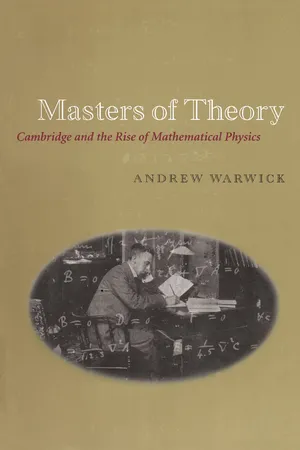 eBook - PDF
Masters of Theory
Cambridge and the Rise of Mathematical Physics
- Andrew Warwick(Author)
- 2011(Publication Date)
- University of Chicago Press(Publisher)
For Cunningham, therefore, the term “principle of relativity” was merely a shorthand statement of the fact that the Lorentz Transformations provided a powerful mathematical tool for dealing with certain problems in the electrodynamics of moving bodies. Cunningham’s position on the status of the Lorentz Transformations was thus more akin to Larmor’s position than to Einstein’s. For example, Cun-ningham noted that the “transformations in question” had been given by Einstein but added that they were, “in substance,” the same as those given by Larmor in Aether and Matter (1907a, 547). Larmor and Cunningham nev-ertheless differed crucially over the precise physical status of the transforma-tions: Cunningham was prepared to accept that the exact mathematical cor-relation between the electromagnetic variables of different systems implied by the transformations was a physical fact (so that motion through the ether could never be detected), whereas Larmor insisted on restricting the trans-formations to the limit of experimental accuracy. But despite this important difference with Larmor, Cunningham remained a long way from adopting Einstein’s interpretation of the principle of relativity, and did not even rec-ognize Einstein’s second postulate (the principle of the constancy of the ve-locity of light). This last point is clarified by Cunningham’s comments during a brief dispute that followed the publication of his reply to Abraham. Towards the end of this reply, Cunningham had remarked, in passing, that the principle of relativity that he (Cunningham) had employed was, in essence, identical to a similar principle that had been stated elsewhere by Alfred Bucherer. 33 Cunningham (1907a, 544) claimed further that the employment of any such principle was bound to lead to the Lorentz Transformations (which Bucherer had not used), because it was necessary to explain how the velocity of light could be the same for all observers in relative states of motion.
Index pages curate the most relevant extracts from our library of academic textbooks. They’ve been created using an in-house natural language model (NLM), each adding context and meaning to key research topics.

